HCPCS Code H0047: Alcohol and drug abuse services (NOS) billing guide
HCPCS Code H0047: Definition and official descriptor HCPCS Code H0047 is the HCP...

Last Updated: Oct 15, 2026
B3012 is the CCSD code for mastectomy and immediate reconstruction of breast using expandable prosthesis - unilateral. It covers one operative episode in which the surgeon removes the breast and inserts a tissue expander under the same anaesthetic.
The code sits in CCSD Chapter 7 (Breast) and carries a Major Plus complexity band. It does not extend to delayed reconstruction, to sentinel lymph node biopsy, or to the stage-two exchange of the expander for a permanent implant. Each of those carries its own code and its own pre-authorisation.
Let Pabau's smart automation suggest the right codes, reduce claim denials, and keep your practice compliant—effortlessly.
Automate repetitive tasks and focus on what matters most—your patients.
Reduce coding errors and ensure compliance with the latest regulations.
Clean claims, fewer denials, and faster reimbursements.
Powerful insights and reporting to help your practice thrive.
HIPAA compliant SOC 2 certified GDPR-compliant Trusted by 4,000+ clinics worldwide

B3012 covers mastectomy combined with immediate insertion of an expandable prosthesis in one operative episode, not delayed reconstruction.
Sentinel lymph node biopsy, axillary clearance, and the stage-two implant exchange are each separately billable and not bundled into B3012.
All major UK PMI insurers require pre-authorisation before funding B3012, and reconstruction added intraoperatively without pre-auth is the leading cause of claim queries.
B3012 sits in CCSD Chapter 7 (Breast) and carries a Major Plus complexity band, which is what insurers price the episode against.
Pabau’s claims management software helps UK private practices submit CCSD-coded invoices, track authorisation status, and attach supporting documentation via Healthcode.
CCSD code B3012 is defined by the Clinical Coding and Schedule Development Group as “mastectomy and immediate reconstruction of breast using expandable prosthesis.” The code captures a single operative episode. In it the surgeon performs the mastectomy and inserts the expandable prosthesis, or tissue expander, without the patient leaving theatre.
The key qualifying criterion is timing: The reconstruction must begin in the same anaesthetic sitting as the mastectomy. If the two procedures are separated by any interval, a different code pathway applies. This single-episode rule is what distinguishes B3012 from billing a mastectomy and a reconstruction as two independent claims.
B3012 applies to therapeutic mastectomy (for breast cancer or other malignancy) and to prophylactic (risk-reducing) mastectomy for patients with, for example, confirmed BRCA gene variants. The code descriptor does not restrict use to one indication. Insurer coverage for prophylactic cases requires additional clinical evidence and often carries separate pre-authorisation criteria.
Immediate breast reconstruction after mastectomy using an expandable prosthesis typically follows this operative sequence, all within a single anaesthetic episode.
Oncoplastic reconstruction (where breast reshaping accompanies partial excision rather than full mastectomy) uses a different CCSD code and is not captured by B3012. Similarly, delayed reconstruction, where the patient returns for a separate operative episode weeks or months after the mastectomy, follows a distinct code pathway.
Patient eligibility for immediate reconstruction is determined by the multidisciplinary team (MDT), not the billing code itself. Immediate reconstruction is contraindicated in some cases, including patients who require post-operative radiotherapy to the chest wall, or those with significant comorbidity affecting wound healing. The B3012 billing code carries no clinical eligibility criteria – those remain the responsibility of the operating team.
Understanding the bundling scope of B3012 prevents both under-coding (leaving separately billable work unbilled) and over-coding (claiming for items already captured by the code).
The most frequent unbundling error in UK private practice billing is submitting B3011 alongside a separate reconstruction code. B3012 is the correct single code in that situation. B3011 and B3012 are mutually exclusive for the same breast in the same episode. Check the CCSD Technical Guide for current unbundling guidance and any schedule updates.
B3012 sits within CCSD Chapter 7 (Breast). The table below covers the codes most commonly billed alongside or confused with B3012, along with their billing relationship. Verify current code numbers and descriptors against the live Bupa code search before submitting claims, as codes are updated annually.
The wider Bupa CCSD codes reference sets out how the Chapter 7 breast codes map to Bupa’s published fee schedule. Check it for the benefit maximum attached to a Major Plus procedure before quoting a self-pay patient.
Not every reconstruction uses a prosthesis. Where the surgeon rebuilds the breast with the patient’s own lower abdominal tissue, the episode is billed under CCSD code B2985. That free TRAM code also sits in Chapter 7 and covers delayed reconstruction.
Immediate breast reconstruction after mastectomy means reconstruction begins in the same operative episode as the mastectomy. Delayed reconstruction means the patient returns for a separate anaesthetic at a later date – weeks, months, or even years after the original mastectomy.
B3012 applies exclusively to immediate reconstruction. If a patient undergoes mastectomy coded as B3011 and later returns for reconstruction, that second episode uses a different CCSD code. Delayed reconstruction carries its own pre-authorisation requirement. Using B3012 for a delayed reconstruction is a coding error and will commonly be queried by insurers who can cross-reference the original mastectomy claim date.
Where the delayed episode inserts a fixed, non-expandable implant, it is billed under CCSD code B3015. That code applies whether the implant goes in at mastectomy or months later. A subcutaneous mastectomy that preserves the skin envelope and places a permanent implant in the same episode is billed under CCSD code B2700.
Where the delayed episode adds a latissimus dorsi flap alongside a prosthesis, it is billed under CCSD code B2913. Where the reconstruction instead uses transferred fat, the delayed episode is coded B3017.
One grey area arises when reconstruction was planned as immediate but converted to delayed intraoperatively. Unanticipated positive margins requiring extended resection are the usual cause. In that scenario, the mastectomy is correctly coded as B3011 for that episode, with the reconstruction episode coded separately when it occurs. Document the intraoperative decision clearly in the operative note.
The operative note is the medico-legal record that must support the B3012 claim. It must be accurate, contemporaneous, and contain specific elements. A templated note that does not describe the procedure performed satisfies neither the insurer nor the medico-legal record.
A B3012-supporting operative note should confirm all of the following:
Missing device details and no written confirmation of same-episode reconstruction are the two omissions UK PMI insurers cite most often when querying B3012 claims. Store operative notes and supporting evidence inside your practice management system, so they can be attached to a Healthcode submission without delay.
Audit your last 10 B3012 operative notes against the documentation checklist above before submitting claims. Identify which elements are most frequently missing from your templates and revise them. Incomplete documentation is far easier to fix prospectively than to resolve after a claim has been queried or downgraded.
Pre-authorisation is mandatory for B3012 across all major UK private medical insurers. Without a valid authorisation reference number, the claim will be rejected regardless of clinical documentation quality. Obtaining pre-auth before surgery is not optional.
The following table summarizes the pre-authorisation approach for the three largest UK PMI payers. Requirements change periodically, so always verify against each insurer’s current provider portal before submitting.
A specific scenario that generates claim queries: Pre-authorisation was obtained for mastectomy only (B3011), but the surgeon decided intraoperatively to proceed with immediate reconstruction. In this situation, the insurer authorised a different procedure to the one billed. Contact the insurer immediately after surgery to request an amendment to the authorisation reference before submitting the B3012 claim. Submitting B3012 against a B3011 authorisation is the single most common reason B3012 claims are rejected outright rather than simply queried.
Coverage for B3012 is always subject to individual policy terms and pre-authorisation approval. No insurer guarantees funding for this procedure, whatever the clinical indication. Practices running surgical billing across several consultants get the best result when pre-authorisation is checked at the point of booking. Leaving it to the day of surgery is where the reference number goes missing.
B3012 claims are queried or rejected for a small set of recurring reasons. Each one is avoidable with the right processes in place.
Practices submitting B3012 claims benefit from tracking denial patterns across their breast surgery caseload. Pabau is a practice management platform built for UK private practices. Its claims management software logs rejection reasons, manages resubmissions, and shows which documentation element keeps going missing.

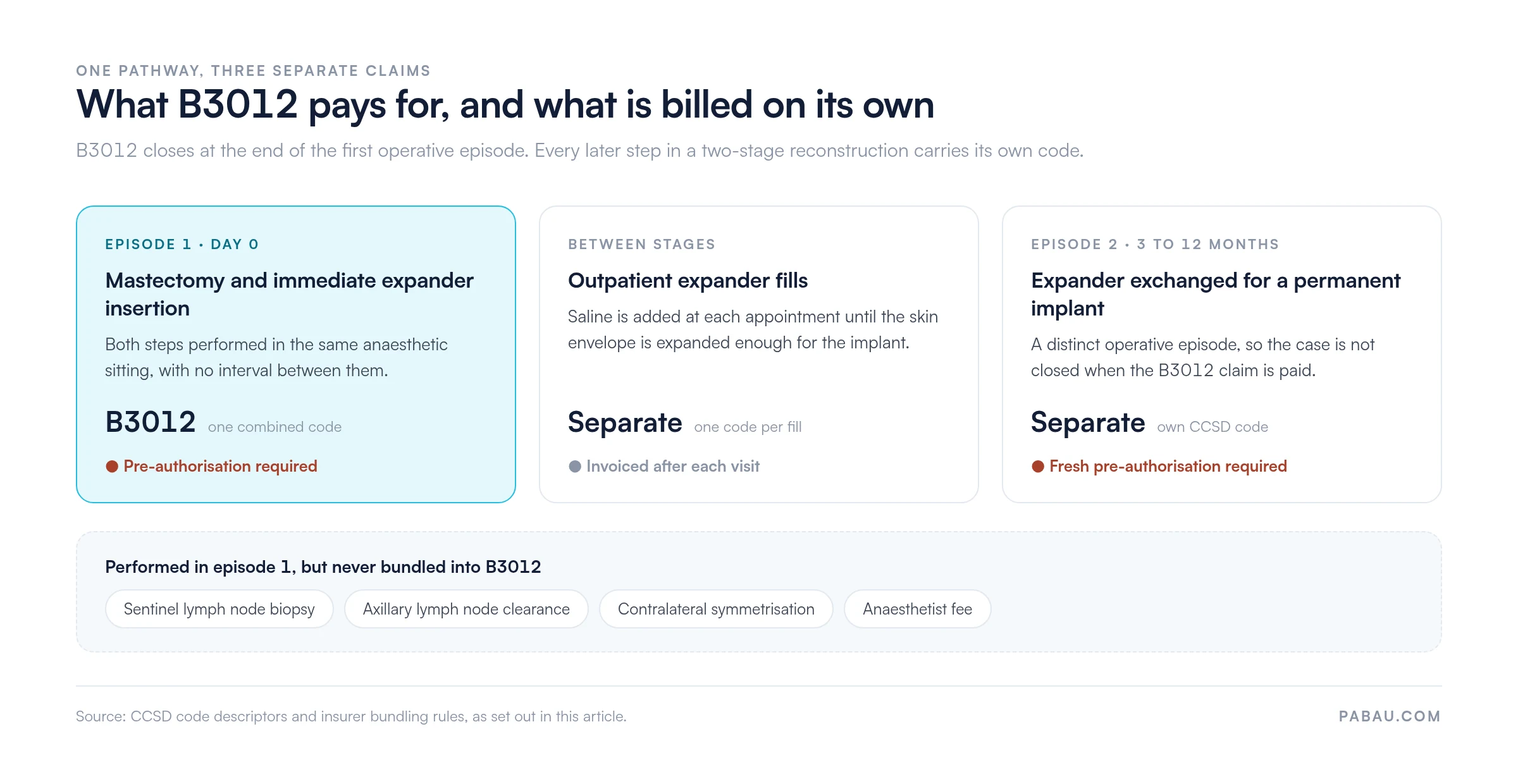
B3012 covers stage one of a two-stage breast reconstruction: the mastectomy and immediate expander insertion. Stage two, the exchange of the tissue expander for a permanent silicone implant, is a distinct operative episode and must be billed separately.
Stage two typically occurs three to twelve months after stage one. By then a series of outpatient fill appointments has expanded the skin envelope enough for a permanent implant. The exchange procedure uses a different CCSD code (verify the current code number against the live CCSD schedule before billing, as codes are updated periodically). That code requires its own pre-authorisation from the relevant PMI insurer.
When B3012 is submitted and paid, the case is not closed. A separate billing episode for stage two follows, so the practice should track patients through the reconstruction pathway until the exchange is billed. A missed stage-two claim is revenue the practice has already earned in theatre.
Outpatient expander fills between stage one and stage two are each separately billable under their own CCSD code. These are not captured by B3012 and should appear on separate invoices submitted after each fill appointment. The pathway below shows which episode carries which claim.
Healthcode is the primary electronic invoicing route for B3012 claims to UK private medical insurers. Most major UK PMIs, including Bupa, AXA Health, Vitality, and Aviva, accept and process CCSD-coded claims through the Healthcode portal. Check the Healix fee schedule for payer-specific CCSD unbundling rules that apply to breast surgery codes.
A standard B3012 claim submission via Healthcode requires the following elements:
A B3012 claim also carries a diagnosis code, and that is where its medical necessity is argued. Coders working across both systems can check the breast carcinoma entries in the ICD-10-CM codes reference before the invoice goes out. Keeping operative notes and consent records retrievable inside the practice system shortens the response when an insurer asks for supporting evidence.
Run a quarterly review of all B3012 claims submitted in the period. Compare pre-auth reference present vs absent, code submitted vs planned, and denial rate by denial reason. Three months of data is usually enough to identify your practice’s top two recurring errors and fix them at the documentation or booking stage.
B3012 claims involve highly sensitive patient data: Cancer diagnoses, genetic risk status (BRCA), operative reports, and implant records. UK private practices handling this information are subject to the UK GDPR and must manage billing records accordingly.
Operative notes and billing records supporting B3012 claims should be retained for at least eight years for adult patients, under standard NHS medical records guidance. Individual insurer contracts may specify longer periods, so review your retention policy against current ICO guidance before you set a deletion date.
When submitting claims electronically through Healthcode, ensure that only the minimum necessary patient data is included in claim attachments. Device serial numbers, operative reports, and pathology results should be available on request rather than routinely attached unless the insurer specifically requires them.
In most UK private surgical practices the B3012 story is spread across three places. The authorisation reference sits in an email thread, the operative note sits in a document folder, and the invoice sits in the billing system. When an insurer queries the claim, someone rebuilds the episode by hand.
Pabau holds the booking, the authorisation reference, the operative note, and the invoice against one patient record. The billing team can see before surgery whether the authorisation on file names B3012 or B3011. That single check removes the most expensive error in this code.
Because the reconstruction pathway runs across months, the same record carries the fill appointments and the stage-two exchange. A practice can therefore see which patients still owe a stage-two claim, instead of finding out when the surgeon mentions it.

Pabau helps UK private practices organize CCSD-coded claims, track pre-authorisation status, store operative documentation, and submit invoices via Healthcode, without switching between disconnected systems.

B3012 is a well-behaved code with one demanding requirement. The claim has to match an authorisation that names B3012. The operative note has to say in writing that the expander went in during the same sitting. Practices that settle both at the booking stage rarely see this code queried.
The trade-off worth remembering is that a paid B3012 claim looks like a finished case and is not one. The fills and the stage-two exchange are still owed, and nobody chases them unless the practice is tracking the pathway rather than the invoice.
Book a demo to see how Pabau keeps CCSD authorisations, operative notes, and multi-stage claims on one patient record.

Need a broader view of CCSD codes used by UK private insurers? Bupa CCSD codes covers the Chapter 7 breast surgery codes and how Bupa applies them.
Coding the delayed version of this procedure? CPT code 19342 sets out how a delayed breast prosthesis insertion is documented and billed.
Reconstructing with the patient’s own tissue instead? CPT code 19367 covers TRAM flap breast reconstruction and what a payer expects on the claim.
CCSD code B3012 covers mastectomy and immediate reconstruction of the breast using an expandable prosthesis performed in a single operative episode. The code captures both the mastectomy and the tissue expander insertion together. It does not extend to sentinel lymph node biopsy, axillary clearance, contralateral symmetrisation, or the stage-two expander-to-implant exchange. Each of those requires a separate CCSD code.
Immediate reconstruction (B3012) occurs in the same anaesthetic episode as the mastectomy. Delayed reconstruction occurs in a separate operative episode, often weeks or months later, and is coded under a different CCSD code. Using B3012 for a delayed reconstruction is a coding error – insurers can cross-reference the original mastectomy claim date and will query the timing.
Yes. B3012 is a combined code that captures both the mastectomy and the immediate insertion of the tissue expander in one operative sitting. You do not need to submit separate codes for each component when both are performed in the same episode.
All major UK PMIs require pre-authorisation before funding B3012. Typical submission requirements include the procedure code (B3012), the patient’s diagnosis, a consultant letter or MDT letter, and the referring specialist’s details. For prophylactic mastectomy, insurers commonly require additional evidence such as confirmed BRCA status or a genetics MDT letter. Coverage is always subject to individual policy terms.
Sentinel lymph node biopsy is not bundled into B3012. It has its own CCSD code within CCSD Chapter 7 (Breast). It is submitted as an additive procedure on the same claim when performed in the same episode. Verify the current SLNB code number against the live CCSD schedule, as codes are updated annually.
The most common rejection reasons are missing pre-authorisation, or pre-auth obtained for B3011 rather than B3012. An operative note that does not explicitly confirm same-session reconstruction is next. After that come B3011 submitted instead of B3012, a laterality mismatch between claim and operative note, and absent device documentation. Device documentation means the manufacturer, the model, and the serial number.
B3012 is a CCSD code used exclusively in UK private healthcare billing. The NHS uses Healthcare Resource Group (HRG) codes for commissioning and reimbursement. CCSD codes have no role in NHS invoicing and should not be used on NHS claims.
No. B3011 (mastectomy without reconstruction) and B3012 (mastectomy with immediate reconstruction) are mutually exclusive for the same breast in the same operative episode. Submitting both on one claim is an unbundling error. Use B3012 when immediate reconstruction was performed; use B3011 only when no reconstruction occurred in that episode.