CPT Code 26356: Flexor tendon zone 2 primary repair
CPT Code 26356: Official descriptor and procedure overview CPT Code 26356 report...

Last Updated: Nov 13, 2026
B2710 is the CCSD code for radical mastectomy including block dissection. UK private medical insurers use it to bill removal of the breast, both pectoral muscles and the axillary lymph nodes in one operation. It sits in Chapter 7, Breast, under sub-chapter 7.2.0 Mastectomy (excluding Implant/Reconstruction).
The CCSD site marks B2710 as “Pre 2025,” so treat it as a historic code. Check the current CCSD schedule and the patient’s insurer before you bill it. CCSD sets no fees, so each insurer decides what it pays.
Let Pabau's smart automation suggest the right codes, reduce claim denials, and keep your practice compliant—effortlessly.
Automate repetitive tasks and focus on what matters most—your patients.
Reduce coding errors and ensure compliance with the latest regulations.
Clean claims, fewer denials, and faster reimbursements.
Powerful insights and reporting to help your practice thrive.
HIPAA compliant SOC 2 certified GDPR-compliant Trusted by 4,000+ clinics worldwide

CCSD code B2710 covers radical mastectomy including block dissection: en bloc removal of the breast, both pectoral muscles and the axillary lymph nodes.
The CCSD site marks B2710 as “Pre 2025,” so check the current CCSD schedule and the insurer’s code list before you bill it.
Block dissection is bundled in B2710 and is never billed on its own line alongside it.
A modified radical mastectomy keeps pectoralis major, so it takes B2742, B2743 or B2744, not B2710.
UK private medical insurers such as Bupa usually need a pre-authorization number before surgery, and the operation note must support every part of the descriptor.
Pabau keeps the authorization, operation note and invoice on one patient record, ready to send to insurers through Healthcode.
CCSD Code B2710 is the UK private insurer code for radical mastectomy including block dissection. The CCSD Schedule, which needs a CCSD login to search, lists the code as “Radical mastectomy (including block dissection)”. The surgeon removes the breast, pectoralis major, pectoralis minor and the axillary lymph node contents as one specimen. The word “including” in the descriptor means the axillary dissection is bundled, not billed on its own line.
The Clinical Coding and Schedule Development Group maintains that schedule for UK private medical insurers. It places B2710 in sub-chapter 7.2.0, Mastectomy (excluding Implant/Reconstruction), and marks the code “Pre 2025” on the CCSD site. CCSD sets no fees, and each insurer decides which codes it adopts and what it pays.
Treat B2710 as a historic code. Radical mastectomy is now rare, and an insurer may not accept a Pre 2025 code for a current date of service. Confirm the code in force with the CCSD schedule and the patient’s insurer before you raise an invoice.
The radical mastectomy described by B2710 is the Halsted procedure in its classical form. It differs from the modified radical mastectomy (Patey or Auchincloss technique) in one key respect. The Halsted radical removes the pectoral muscles, while a modified radical preserves pectoralis major. That anatomical difference decides which CCSD code applies.
The radical mastectomy covered by CCSD Code B2710 follows the Halsted technique. The surgeon removes the breast, the overlying skin (except the flaps needed for closure), both pectoral muscles and all three levels of axillary nodes. These come away as a single en bloc specimen, and neither pectoral muscle is preserved.
Billing staff need these steps because the operation note must record each component. A note that describes breast removal and axillary clearance but not pectoral muscle resection does not support B2710. It may support a modified radical mastectomy code instead, and an insurer’s claims auditor will query or recode it.
Radical mastectomy under B2710 is indicated in far fewer cases than modified radical mastectomy, which is now the standard operation. Coders must confirm that the clinical notes record an appropriate indication, since insurers may ask for medical necessity evidence on audit.
When the operation note describes tumor fixation to the pectoralis or direct muscle invasion, B2710 is appropriate. When the pectoralis is intact and preserved, the coder should choose a modified radical mastectomy code instead. The axillary surgery then decides between B2742, B2743 and B2744, as the chart below shows.
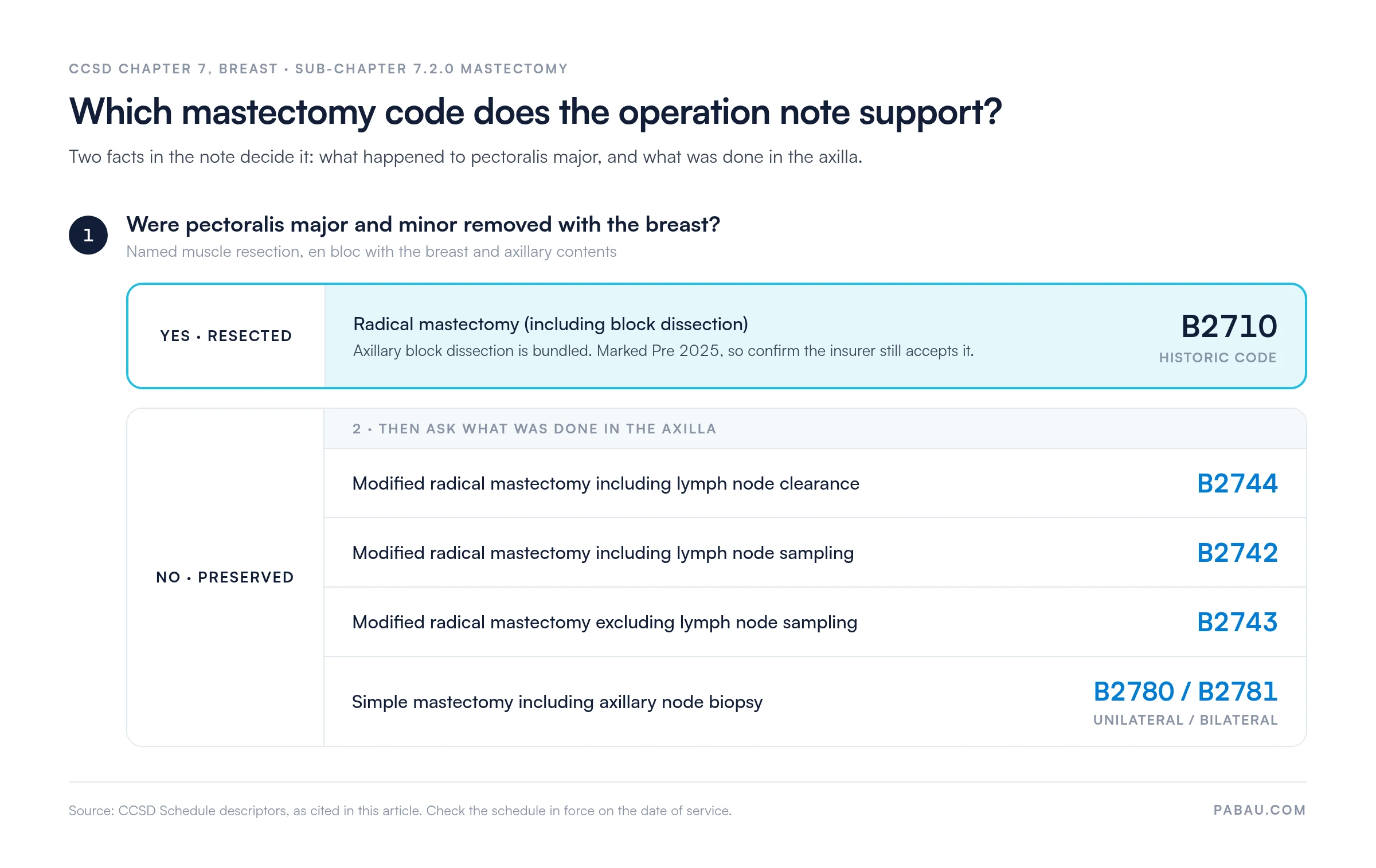
Choosing the wrong mastectomy code is a common CCSD coding error in breast surgery. The key difference between B2710 and the modified radical codes is pectoral muscle resection. Without that check, B2710 may be billed for a smaller operation. That is miscoding, and it invites an overpayment audit.
Important: CCSD adds, retires and revises codes in each publication cycle. Check every code against the CCSD schedule in force on the date of service, and against the patient’s insurer, before you submit a claim. Our CCSD code reference covers the neighboring breast surgery codes as well.
A radical mastectomy episode rarely produces B2710 alone. The diagnosis and the services below usually appear on the surgeon’s invoice or on separate invoices, subject to the insurer’s benefit and bundling rules.
Every B2710 invoice needs a diagnosis from WHO ICD-10 category C50, malignant neoplasm of breast. WHO ICD-10, which UK insurers use, has no laterality codes for C50. Record the side in the operation note and on the invoice instead. Use the most specific C50 subcategory the pathology and clinical notes support, as listed in the WHO ICD-10 browser.
These services often sit alongside B2710 in the same episode. Each is billed only when the clinical record documents it. Check CCSD combination rules and the insurer’s bundling policy before you submit.
UK private medical insurers usually need pre-authorization before major cancer surgery. The patient or the practice contacts the insurer, quotes the CCSD code and receives an authorization number. An invoice without that number is a common reason for rejection, and an authorization does not guarantee payment.
Requirements vary by insurer, because Bupa, AXA Health, Aviva and Vitality each set their own criteria. Our Bupa CCSD codes guide shows how one large insurer works with the schedule. Because B2710 is marked Pre 2025, ask the insurer to confirm the code it will accept. The documents below are typically requested.
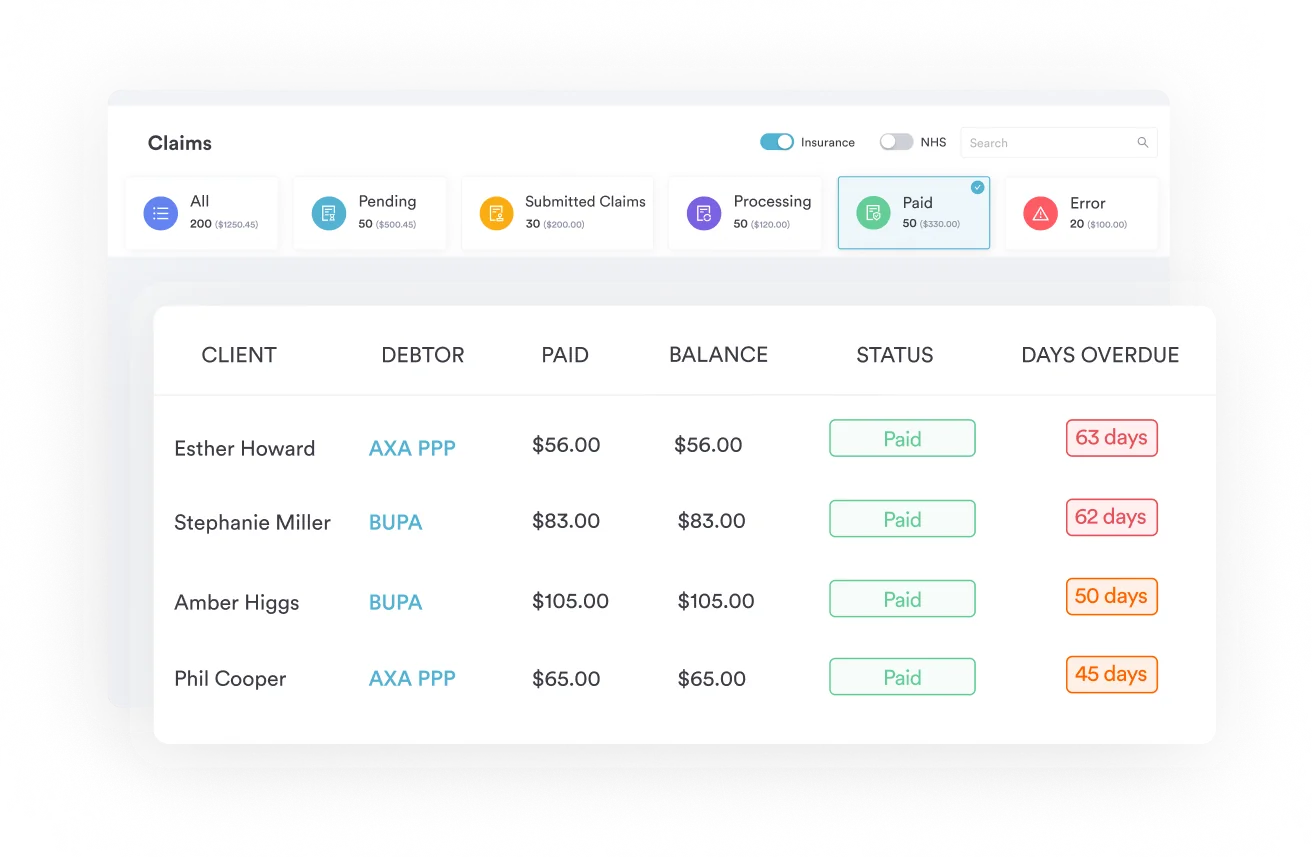
Request authorization as early as possible, and always before the patient is admitted. Claims management software tracks authorization status and keeps the supporting documents on the patient record. That makes it far less likely a case reaches theater without an authorization number.
Request pre-authorization for B2710 well before the planned surgery date. Send the TNM staging report and the surgeon’s letter with the first request. Insurers often query incomplete requests rather than approve them, and a query on the day of surgery can leave the patient facing a shortfall.
The operation note is the billing team’s main source for CCSD Code B2710. A claim without documentation that supports the descriptor may be queried, recoded or rejected on audit. The note must clearly show all three components: breast removal, pectoral muscle resection and axillary block dissection.
When you review the operation note before coding, check for each element below. A missing element leaves the claim open to an audit query.
Before you code any mastectomy claim, confirm three things from the operation note. Which breast was removed? Were pectoralis major and minor resected or preserved? Was block dissection done in the same operation? Those answers decide whether B2710 or an adjacent code applies.
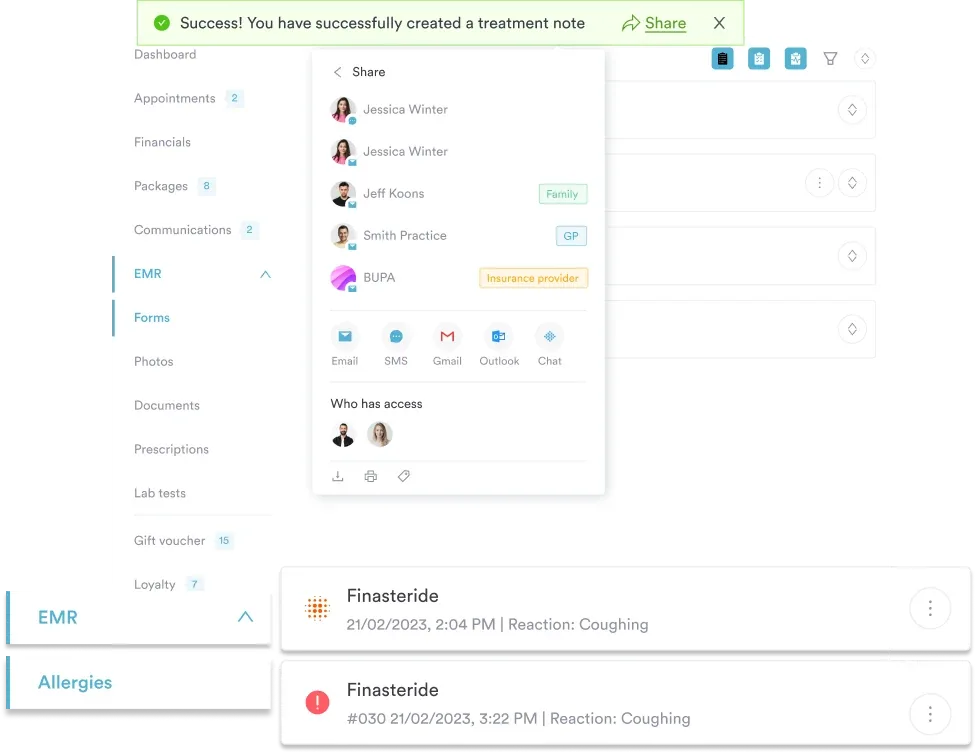
Pabau, the practice management platform we build, keeps operation notes on the patient record beside the invoice. Coders can then check them before a claim goes out. Consent and pre-operative forms completed in Pabau sit on the same record, ready at the time of coding.
Bilateral radical mastectomy is uncommon, but it can occur with synchronous bilateral cancer and muscle invasion on both sides. The CCSD schedule treats laterality differently for different operations. Simple mastectomy, for example, has separate unilateral and bilateral codes, B2780 and B2781. Check the current schedule and the insurer’s rules before you bill a bilateral radical procedure.
Surgical assistant fees follow insurer policy. Some insurers pay a separate assistant fee when the operation note names the assistant, and others do not. Confirm the insurer’s rules before you bill one.
Rejected CCSD Code B2710 claims follow predictable patterns, and pre-submission checks prevent most of them. The table lists the most frequent causes and the fix for each.
When an insurer rejects a CCSD Code B2710 claim, the fix depends on the reason. Work through these steps before you escalate to a formal appeal.
Billing a radical mastectomy involves several moving parts: pre-authorization, the operation note, companion invoices and rejection follow-up. These often sit with different team members on different timelines. Many UK practices still chase them across email, paper files and insurer portals.
Pabau brings these steps onto one patient record. Practices record the authorization number on the case, and Pabau warns when one is missing. The operation note and histology report stay on the patient record beside the invoice. Practices can then send insurer invoices electronically through Healthcode, the UK private healthcare billing service.
The outcome is fewer claims sent without supporting documents, and faster answers when an insurer queries a historic code like B2710.

Pabau helps surgical billing teams track pre-authorization, attach operative documentation and submit cleaner insurer claims for complex codes like B2710. See how it fits your practice.

CCSD Code B2710 belongs to a procedure UK surgeons now rarely perform, and the CCSD site marks it Pre 2025. The first step on any B2710 claim is to confirm that the insurer still accepts the code for the date of service.
After that, the claim rests on the operation note. It must show pectoral muscle resection, because that alone separates B2710 from the modified radical codes. Block dissection is bundled, so it never appears as its own line, and the invoice must state the side.
Practices that keep authorization, operation note and invoice together send cleaner claims and answer insurer queries faster. Book a demo to see how Pabau keeps B2710 authorizations, operation notes and invoices together for your practice.

Need a broader CCSD coding reference for UK insurer billing? Bupa CCSD codes guide explains how the CCSD schedule works across UK private insurer billing.
Billing a mastectomy that preserved pectoralis major? CCSD code B2743 covers modified radical mastectomy excluding lymph node sampling.
Reconstructing the breast in the same operation? CCSD code B3012 covers mastectomy with immediate breast reconstruction.
Billing a subcutaneous mastectomy with an implant? CCSD code B2700 sets out the descriptor and the documentation insurers expect.
CCSD Code B2710 covers radical mastectomy including block dissection. That is en bloc removal of the breast, pectoralis major and minor, and the axillary lymph nodes in one operation. The CCSD site marks B2710 as “Pre 2025,” so check the current CCSD schedule and the insurer’s code list before you bill it.
Yes. The B2710 descriptor states “including block dissection,” so the axillary lymph node dissection is bundled within the code. Billing the axillary dissection separately alongside B2710 is unbundling, and UK private medical insurers reject it.
The key difference is pectoral muscle preservation. B2710 (radical mastectomy) removes both pectoral muscles along with the breast and axillary nodes. A modified radical mastectomy preserves pectoralis major and takes B2742, B2743 or B2744 instead. Confirm from the operation note whether the pectoralis was resected or preserved before you choose.
UK private medical insurers such as Bupa usually require pre-authorization before major cancer surgery like radical mastectomy. An invoice without a valid authorization number is a common cause of rejection. Authorization does not guarantee payment, and each insurer sets its own rules, so confirm them with the patient’s insurer.
The operation note must record total breast removal and named resection of pectoralis major and minor. It must also give the levels and node count of the axillary dissection, confirm en bloc removal and state the side.
B2710 is paired with a WHO ICD-10 code from category C50, malignant neoplasm of breast. Choose the subcategory that matches the tumor’s location, such as C50.4 for the upper-outer quadrant. WHO ICD-10 has no laterality codes for C50, so record the side in the operation note and on the invoice.
No. Anesthesia is not bundled within B2710, but the anesthetist invoices the insurer separately for their own fee. The surgeon’s invoice covers B2710 and any separately billable services the surgeon performed.