HCPCS Code J0461: Atropine sulfate injection billing guide
HCPCS Code J0461: official descriptor and drug identity HCPCS Code J0461 is the ...

Last Updated: Oct 7, 2026
B2743 is the CCSD code for modified radical mastectomy excluding lymph node sampling. It covers removal of the whole breast and overlying skin with the pectoralis major preserved, when no axillary lymph node procedure is performed.
B2743 sits in Chapter 7 Breast, sub-chapter 7.2.0 Mastectomy. CCSD uses one code per procedure, so lymph node sampling during the same operation is coded B2742 and full clearance is coded B2744.
Let Pabau's smart automation suggest the right codes, reduce claim denials, and keep your practice compliant—effortlessly.
Automate repetitive tasks and focus on what matters most—your patients.
Reduce coding errors and ensure compliance with the latest regulations.
Clean claims, fewer denials, and faster reimbursements.
Powerful insights and reporting to help your practice thrive.
HIPAA compliant SOC 2 certified GDPR-compliant Trusted by 4,000+ clinics worldwide

CCSD code B2743 covers a modified radical mastectomy with no lymph node procedure. Sampling and clearance have their own single codes, B2742 and B2744.
The procedure preserves the pectoralis major muscle, which distinguishes it from the older Halsted radical mastectomy, coded B2710.
Most UK private medical insurers require pre-authorization before a modified radical mastectomy, and a missing authorization number is a common cause of claim denial.
Pabau’s private healthcare billing software helps surgical practices manage CCSD claim submission, pre-auth tracking, and operative documentation in one place.
CCSD code B2743 is the procedure code for modified radical mastectomy excluding lymph node sampling, as defined by the CCSD Group. The Clinical Coding and Schedule Development Group maintains the procedure code schedule used across UK private healthcare.
B2743 sits in Chapter 7 Breast, sub-chapter 7.2.0 Mastectomy, of the CCSD code schedule. It applies when a surgeon removes the entire breast, including the overlying skin and nipple-areola complex, while preserving the pectoralis major muscle. No axillary lymph node procedure is performed in the same operative episode.
The “excluding lymph node sampling” qualifier defines B2743 and separates it from B2742 and B2744, the codes for more extensive procedures. Coders must confirm in the operative note that no sentinel node biopsy, axillary sampling, or axillary clearance took place before assigning B2743. If any of them did, the code changes or needs a combination check, as the sections below explain.
For Bupa-specific fee values and code guidance, see the Bupa CCSD billing guide on Pabau. It covers how Bupa structures its breast surgery schedule and what documentation it requires at the point of claim.
A modified radical mastectomy (MRM) coded as B2743 removes the breast tissue and the overlying skin, and it preserves the pectoralis major muscle. Axillary node procedures are coded separately from B2743, because performing one changes the code. Muscle preservation is what distinguishes the MRM from the classic Halsted radical mastectomy. The Halsted procedure removed the pectoralis major and is no longer standard of care for operable breast cancer.
Under B2743, the operative steps typically include the following:
Sentinel node biopsy and axillary lymph node clearance are not part of this operative sequence under B2743. If either is performed in the same sitting, the coding changes. Skin-sparing and nipple-sparing mastectomies carry their own code, B2760, in CCSD-based insurer schedules. Check the current schedule and the insurer’s guidance before using B2743 for either variant.
The lymph node boundary in CCSD code B2743 is explicit. Any procedure that samples, biopsies, or clears axillary lymph nodes falls outside this code, and three procedures commonly sit at that boundary.
The boundary matters because the axillary work changes the code. Sampling turns the episode into B2742, and a full clearance turns it into B2744. Submitting B2743 after node work under-codes the episode and can trigger a claim query or denial. The diagram below shows how each answer in the operative note leads to a code.
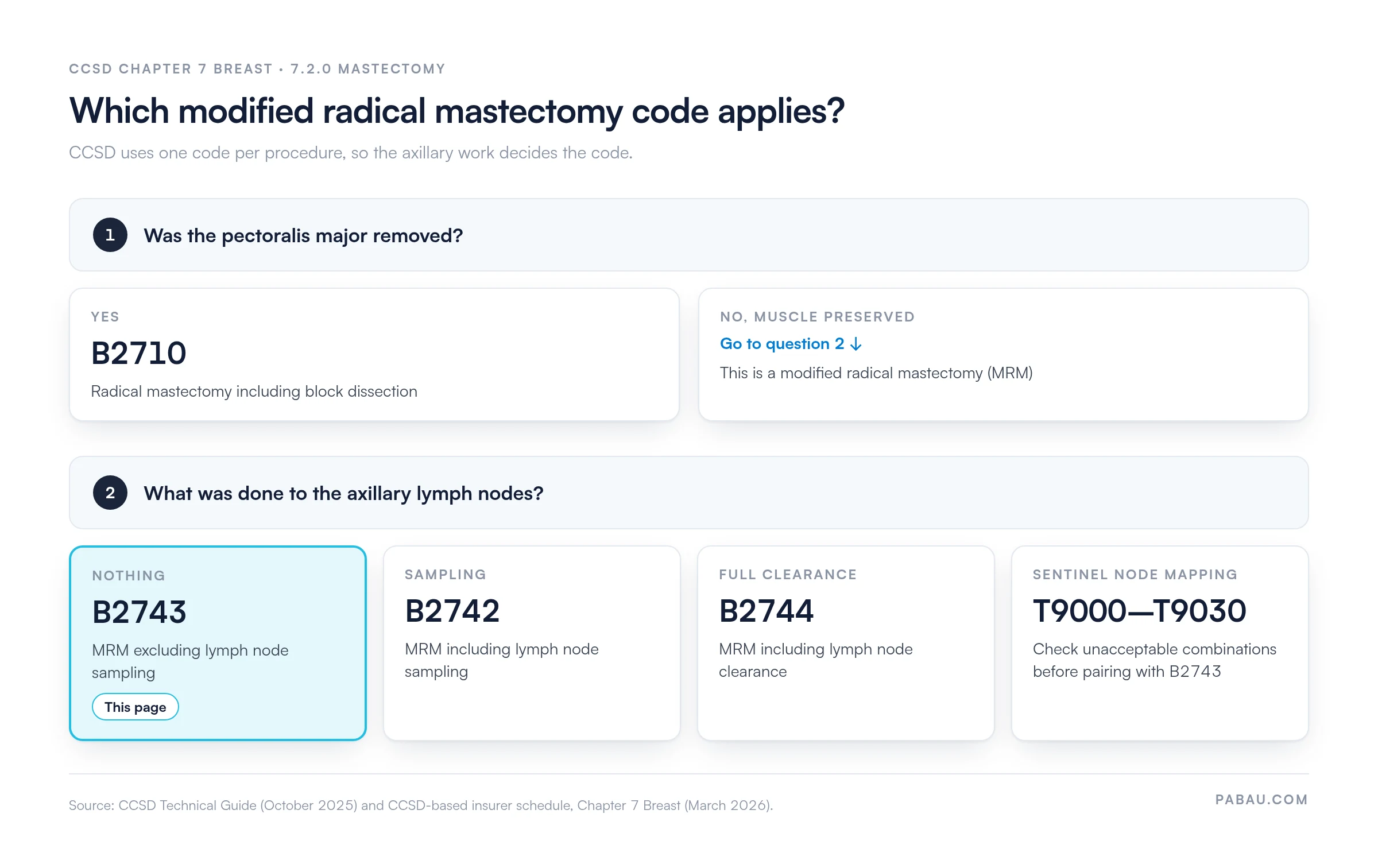
B2743 sits within a family of CCSD mastectomy codes. Selecting the right one depends on the extent of the resection and on what happened in the axilla. The table below sets out the decision criteria for the codes most commonly confused with B2743.
Two neighboring codes cover different operations altogether. B2752 is the code for a subcutaneous mastectomy, and B3012 covers mastectomy with immediate breast reconstruction. Neither should be billed as B2743.
Always verify against the current CCSD schedule and the individual insurer’s code schedule, as fee levels and code availability vary by payer. The schedule is updated periodically, so a descriptor or bundling rule from a prior year may have changed.
Check each insurer’s own published schedule before submitting a B2743 claim. Bupa, AXA Health, Aviva, and Vitality each maintain their own fee tables for breast surgery codes. Fees for B2742, B2743, and B2744 can differ between payers, even when all of them accept the same CCSD code.
The CCSD Technical Guide sets out a single code principle. One code should describe the whole procedure, including the steps routinely performed with it. So when the axillary nodes are sampled or cleared during a modified radical mastectomy, the code usually changes rather than a second code being added.
Practical steps for B2743 and related submissions:
Bilateral mastectomy, with both breasts treated in the same session, is a separate scenario. Billing rules for simultaneous bilateral procedures vary by insurer. Some apply a percentage reduction on the second procedure, and others require a separate claim per side. Verify with the individual PMI before submitting a bilateral B2743 claim.
A payable CCSD code B2743 claim depends on operative documentation that shows the procedure performed matches the code descriptor. Missing or inadequate documentation is a frequent reason a modified radical mastectomy claim fails adjudication. Claims management software that links operative notes, consent records, and claim submissions keeps clinical and admin teams working from the same record.

The operative note should contain the following to support a B2743 claim:
A histopathology report is not required at the point of claim submission, but insurers often request it during a post-payment audit. Store operative documentation digitally, timestamped and retrievable for at least eight years after the last treatment, in line with UK adult medical records retention guidance.
Most UK PMIs require pre-authorization before a modified radical mastectomy. Submitting a B2743 claim without a valid pre-authorization number is a common cause of claim denial, whatever the quality of the operative documentation. Practice software that tracks pre-auth status against each patient episode can alert the team before the procedure date.
The pre-authorization process typically follows these steps:
Vitality Health also publishes a procedure-level fee finder for healthcare providers. Use it as part of pre-submission checks for Vitality-insured patients.
Denial patterns for CCSD code B2743 are consistent across PMIs. Most can be prevented at the point of claim preparation rather than resolved on appeal.
On appeals, if a B2743 claim is denied for an operative note deficiency, request the specific information the insurer says is missing before resubmitting. A blanket resubmission that ignores the insurer’s stated reason rarely succeeds and can reset the adjudication timeline.
Build a B2743 pre-submission checklist for your billing team. Confirm the pre-auth reference, the operative note elements listed above, the procedure date against theater records, and the lymph node status. Then review the insurer’s unbundling rules. Running the checklist before every submission catches the denial triggers in the table above before the claim goes out.
A surgical billing team often chases one B2743 claim across three places. The pre-authorization sits in an email, the operative note in the clinical system, and the claim in the insurer portal. Each handoff is a chance for the wrong code or a missing authorization number to slip through.
Pabau, the practice management platform we build for private practices, keeps those steps on one patient record. Pre-authorization numbers sit against the episode, and structured operative note templates prompt for lymph node status. Claims then go to insurers through Healthcode from that same record.
The result is a claim that matches the operative note before it leaves the practice, so your team spends less time answering queries and resubmitting.

Pabau connects pre-authorization tracking, operative documentation, and CCSD claim submission in one platform built for UK private practices. Book a demo to see how it works.

B2743 is the right code for one operation only, a modified radical mastectomy with the pectoralis major preserved and no axillary work. Once the nodes are sampled or cleared, the claim belongs on B2742 or B2744.
So read the operative note’s lymph node statement before you choose the code. If it records sentinel node mapping, check the CCSD unacceptable combinations before you add anything to B2743.
The trade-off is a few extra minutes per claim at submission, against the time a query or appeal takes to resolve. Book a demo to see how Pabau links pre-authorization, operative notes, and CCSD claims for breast surgery billing.

Working with Bupa CCSD codes regularly? Pabau’s Bupa CCSD billing guide covers the full Bupa procedure code schedule and what documentation Bupa requires at the point of claim.
Billing a mastectomy that preserves the skin envelope? CCSD code B2752 explains how subcutaneous mastectomy is coded and documented.
Reconstructing in the same operation? CCSD code B3012 covers mastectomy with immediate breast reconstruction.
Using a latissimus dorsi flap? CCSD code B2913 walks through latissimus dorsi breast reconstruction with implant.
Coding the diagnostic biopsy first? CCSD code B2880 covers excision biopsy of a breast lesion after localization.
CCSD code B2743 covers modified radical mastectomy excluding lymph node sampling. That means removal of the entire breast with the pectoralis major preserved, and no axillary lymph node procedure in the same episode. If nodes are sampled or cleared, B2742 or B2744 applies instead.
Sentinel node biopsy, axillary lymph node sampling, and axillary lymph node clearance all fall outside B2743. CCSD lists the sampling and clearance versions as their own single codes, B2742 and B2744. Sentinel node codes need a check against the schedule’s unacceptable combinations before they are added.
Only after a combination check. Sentinel node codes T9000 to T9030 sit in the CCSD breast chapter, and the schedule lists unacceptable combinations for B2743. Check that list and the insurer’s own rules before pairing them, and make sure the operative note describes each procedure separately.
Yes, in most cases. Most UK PMIs require pre-authorization before a modified radical mastectomy. Bupa, AXA Health, Aviva, and Vitality each publish their own pre-auth criteria. Submitting a B2743 claim without a valid authorization reference is a common cause of claim denial.
The operative note must confirm the clinical indication, describe the mastectomy technique including pectoralis major preservation, and state whether any lymph node procedure was performed. It should also record laterality, specimen details, and surgeon identification. Leaving out the lymph node status statement often triggers an adjudication query.
B2743 describes a modified radical mastectomy where the pectoralis major is preserved and no lymph node procedure is included. A simple mastectomy is coded B2780 and may include an axillary node biopsy. It is used in different clinical contexts, such as prophylactic surgery or in situ disease, so the two codes are not interchangeable.