

CPT Code 30801: Superficial turbinate ablation billing guide
CPT Code 30801: Official descriptor and procedure overview The American Medical ...

Last Updated: Nov 27, 2026
T8520 is the CCSD code for block dissection of axillary lymph nodes (axillary clearance levels 1 to 3). The surgeon removes the nodes from all three levels of the armpit, most often to treat breast cancer that has spread there.
It sits in the lymphatic system section of chapter 9 of the CCSD schedule. Sentinel node biopsy and axillary node sampling take different codes, and a level I-II dissection does not meet the T8520 descriptor.
Let Pabau's smart automation suggest the right codes, reduce claim denials, and keep your practice compliant—effortlessly.
Automate repetitive tasks and focus on what matters most—your patients.
Reduce coding errors and ensure compliance with the latest regulations.
Clean claims, fewer denials, and faster reimbursements.
Powerful insights and reporting to help your practice thrive.
HIPAA compliant SOC 2 certified GDPR-compliant Trusted by 4,000+ clinics worldwide

CCSD code T8520 covers block dissection of axillary lymph nodes at all three levels (I, II and III), not partial dissections.
The operative note must explicitly state which levels were cleared, the lymph node count, and laterality to support a T8520 claim.
UK private insurers including Bupa, AXA Health, Aviva, and Vitality typically require pre-authorisation before performing axillary clearance.
Check CCSD T8520 principles and the insurer’s guidance before billing a sentinel node code (T9000, T9020, T9021 or T9030) with T8520.
CCSD lists B2710 and B2744 as unacceptable combinations with T8520, because both mastectomy codes already include the nodal clearance.
CCSD code T8520 is the CCSD surgical code for “block dissection of axillary lymph nodes (axillary clearance levels 1 to 3).” Insurer schedules carry the same wording, as AXA Health’s schedule of procedures shows for T8520. The code covers complete removal of the axillary lymph nodes from all three anatomical levels in a single operative episode.
The schedule itself is maintained by the Clinical Coding and Schedule Development Group, which sets the procedure codes used across UK private medical insurance (PMI). You can check the current descriptor and fee banding against the CCSD surgical code schedule that major UK insurers use.
T8520 applies to therapeutic and staging axillary clearance. It does not cover sentinel lymph node biopsy or axillary node sampling, which have their own CCSD codes. A level I-II dissection does not meet the T8520 descriptor either, so check the CCSD schedule or the insurer’s guidance for the correct code.
The axillary lymph nodes are grouped into three anatomical levels defined by their position relative to the pectoralis minor muscle. Coders need this anatomy because T8520 is only billable when the dissection covers all three levels. A note documenting only level I-II clearance does not support T8520, however extensive the operation was.
Standard terminology in operative notes refers to level III as the “apical” nodes. If the surgeon’s note says “apical clearance confirmed” alongside levels I and II, that satisfies the documentation requirement. If the note is silent on level III, the claim should not be submitted as T8520.
Axillary lymph node dissection is performed when breast cancer staging or treatment calls for removal of the regional nodes. The most common indications are a positive sentinel lymph node biopsy and clinically palpable axillary nodes at presentation. Inflammatory breast cancer is another, because upfront nodal clearance is part of its treatment plan.
The procedure typically follows this sequence in private practice:
Drain placement codes may be billed alongside T8520 depending on insurer policy. Confirm with the specific payer before adding drain codes to the claim.
Several CCSD codes cover lymph node procedures in the axilla, and the CCSD code library lists each one. Using the wrong code, or combining incompatible codes, is the fastest route to a denial or an audit query.
Sampling a few axillary nodes without a full clearance is T8620, not T8520. Block dissection at another node basin takes its own code, such as T8550 for the inguinal nodes.
The harder decision comes when a sentinel node biopsy and the clearance happen in the same operative episode. Check CCSD T8520 principles and the insurer’s guidance before billing a sentinel node code with T8520. When the biopsy was a separate, earlier encounter, each admission carries its own code.
Several companion codes are legitimately billed with T8520, provided the operative note confirms each procedure was performed and insurer unbundling rules permit the combination.
Two checks settle most T8520 claims: which axillary code matches the operative note, and whether the breast code beside it already includes the nodes. The chart below puts both decisions side by side.
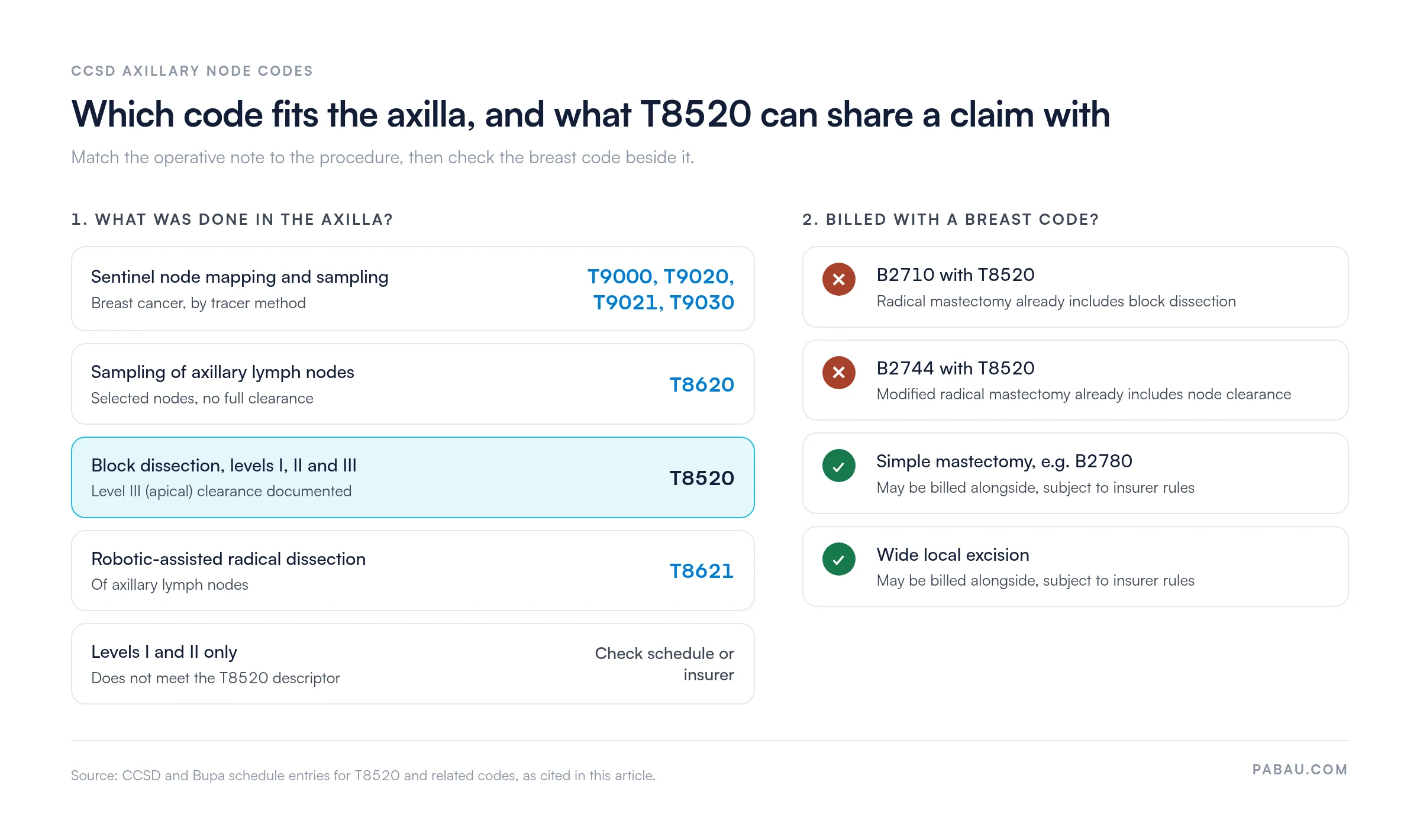
Bilateral axillary clearance is rare but does occur. The CCSD technical guide sets out how the bilateral rules apply. Check it before submitting, as insurer interpretation of bilateral coding for T8520 varies.
A T8520 claim lives or dies by the operative note. UK private insurers scrutinise surgical claims closely, and an incomplete note is treated the same as no note at all. A structured operative note template standardises what gets captured before the note reaches the billing team.
The operative note for T8520 must contain all of the following:
The histopathology request is a secondary documentation anchor. It should reference the CCSD procedure code or at minimum list the levels and orientation of the specimen. A report returning nodes from the “right axilla” without naming levels gives the insurer grounds to query or reduce the claim.
Before submitting any T8520 claim, compare the operative note against a checklist: levels confirmed, node count present, laterality stated, indication documented, drain recorded. Claims returned for missing information delay payment by weeks. They can also trigger a broader documentation audit of the surgical team.
UK private insurers generally require pre-authorisation before axillary clearance is performed. The process varies by insurer, but the core requirement is consistent. Submit a clinical summary before the procedure date and obtain a written authorisation number. For surgeons moving from NHS work into private practice, this pre-authorisation step is one of the first operational differences.
One scenario comes up often. The insurer authorises a sentinel node code (T9000, T9020, T9021 or T9030) before surgery, but the intraoperative result shows positive nodes. The surgeon then proceeds to full axillary clearance (T8520) in the same session.
In that case, obtain retrospective authorisation for T8520 as soon as possible after surgery, ideally before submitting the claim. Document the intraoperative finding and the clinical rationale in both the operative note and the authorisation request. Insurers generally consider retrospective authorisation for an intraoperative escalation when the evidence is clear, but confirm the policy with each one.
CCSD code T8520 claims are denied more often than most surgical codes because the documentation standard is exacting. These are the denial patterns billing teams see most consistently:
When a T8520 claim is denied, request the specific denial reason in writing from the insurer before resubmitting. A vague “insufficient documentation” response should trigger a formal appeal with the full operative note and histopathology report attached.
CCSD unbundling rules for T8520 centre on three scenarios that catch billing teams repeatedly.
Scenario 1: Same-day sentinel node biopsy and axillary clearance. When a sentinel node biopsy and the clearance (T8520) happen in one operative session, do not assume both codes are payable. Check CCSD T8520 principles and the insurer’s guidance before billing a sentinel node code (T9000, T9020, T9021 or T9030) with T8520.
Scenario 2: Prior sentinel node biopsy at a separate encounter. The biopsy was performed and billed at an earlier admission, and the patient returns for completion axillary clearance. T8520 is then billable as the primary code for the second admission, because the encounters are distinct.
Scenario 3: Anaesthetic and assistant fees. CCSD anaesthetic codes are not bundled into T8520, so the anaesthetist bills separately. First assistant fees follow the standard CCSD assistant billing rules, which vary by insurer. The Healix fee schedule shows how companion codes are handled for surgical procedures, including axillary clearance. It is a useful reference when other insurer guidance is unclear.
Build a simple internal coding check for breast surgery claims. Was a sentinel node biopsy performed in the same session as the clearance? Then confirm the CCSD T8520 principles and the insurer’s rules before adding the sentinel node code. Was the biopsy a separate, earlier encounter? Then T8520 stands alone for this admission.
A consistent submission process shortens the time between procedure and payment. It also catches the most common T8520 errors before they reach the insurer.
Most breast surgery teams assemble a T8520 claim from three places: the operative note, the authorisation email and the insurer portal. Each handover is a chance for the level III wording or the authorisation number to drop out.
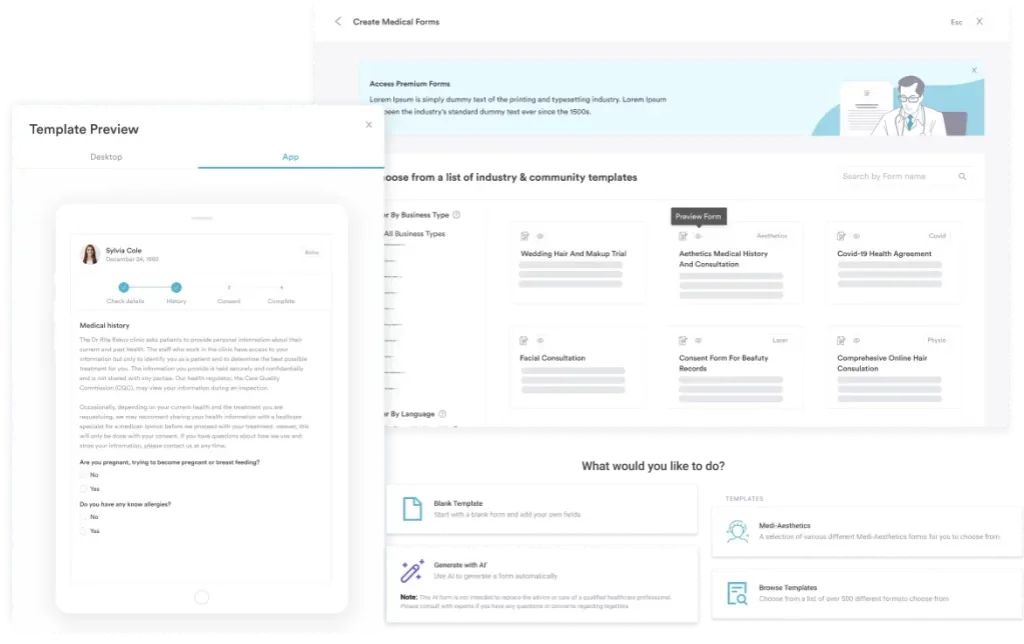
Pabau keeps those pieces on one patient record. Its digital forms structure the operative note around the fields insurers query. Its claims management software submits insurer claims through Healthcode and tracks each one to payment.
Your billing staff can see which T8520 claims are queried, which are part-paid and which are settled. Remittances from Bupa and AXA are matched against each invoice, so a short payment is spotted the week it arrives.
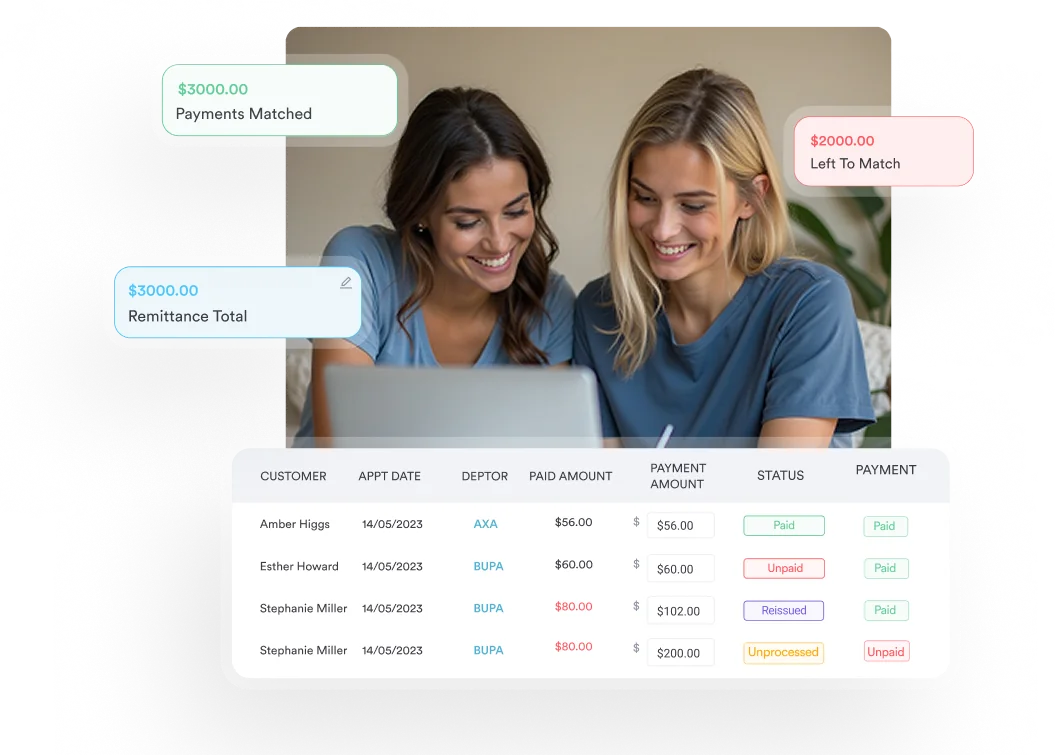

Pabau keeps the operative note, the authorisation number and the Healthcode claim on one patient record. Your billing team can follow each axillary clearance claim from submission to payment.

T8520 pays when the operative note proves a level III clearance and the claim keeps the nodal work in one place. Fix the note template first. A surgeon who writes “levels I, II and III cleared” every time removes the most common denial before billing starts.
Then treat the companion codes as a deliberate choice. B2710 and B2744 already include the nodes, and a same-session sentinel node code needs the insurer’s rules checked first. That check takes minutes, while an unbundled claim can hold up payment for weeks.
Book a demo to see how Pabau links the operative note, the authorisation and the Healthcode claim for every axillary clearance.

Need a reference for other CCSD surgical codes? Bupa CCSD codes guide covers the schedule structure, fee banding, and common billing rules used across UK private healthcare.
Only sampled a few axillary nodes? CCSD code T8620 explains when node sampling, rather than a full clearance, is the right code.
Clearing the groin nodes instead? CCSD code T8550 covers block dissection of the inguinal lymph nodes and its documentation.
Billing a radical mastectomy? CCSD code B2710 shows why a radical mastectomy already includes the block dissection.
Looking to streamline how your team handles surgical invoicing? Pabau claims management software helps private practices track submitted claims, manage denials, and generate CCSD-coded invoices.
CCSD code T8520 covers block dissection of axillary lymph nodes (axillary clearance levels 1 to 3). That means surgical removal of lymph nodes from all three anatomical levels of the axilla in a single operative episode. It does not cover partial dissections limited to levels I and II, sentinel lymph node biopsy, or simple node sampling.
T8520 is used when the surgeon performs a full three-level axillary clearance. If only sentinel node mapping and sampling was planned and performed, bill a sentinel node code (T9000, T9020, T9021 or T9030) instead. Sometimes the sentinel result prompts clearance in the same session. Then check CCSD T8520 principles and the insurer’s guidance before billing a sentinel node code with T8520.
Levels I-II clearance removes nodes lateral to and behind pectoralis minor, leaving the apical (level III) nodes intact. Levels I-III clearance, which T8520 covers, also removes the apical nodes medial to pectoralis minor. Only a documented level I-III dissection supports a T8520 claim. A level I-II dissection does not meet the T8520 descriptor, so check the CCSD schedule or the insurer’s guidance for the correct code.
Yes, most major UK private medical insurers, including Bupa, AXA Health, Aviva and Vitality Health, typically require pre-authorisation before axillary clearance. The authorisation must be for T8520 specifically. An authorisation obtained for a sentinel lymph node biopsy does not automatically extend to axillary clearance if the procedure escalates intraoperatively.




