CPT Code 27425: Lateral retinacular release billing guide
CPT Code 27425: Official descriptor and procedure overview CPT code 27425 is def...

Last Updated: Nov 16, 2026
B2742 is the CCSD code for modified radical mastectomy including lymph node sampling. It covers removal of the whole breast with the pectoralis major preserved, plus sampling of the axillary lymph nodes in the same operation.
B2742 sits in Chapter 7 Breast, sub-chapter 7.2.0 Mastectomy. CCSD uses one code per procedure. A modified radical mastectomy with full axillary clearance is coded B2744, and one with no lymph node procedure is B2743.
Let Pabau's smart automation suggest the right codes, reduce claim denials, and keep your practice compliant—effortlessly.
Automate repetitive tasks and focus on what matters most—your patients.
Reduce coding errors and ensure compliance with the latest regulations.
Clean claims, fewer denials, and faster reimbursements.
Powerful insights and reporting to help your practice thrive.
HIPAA compliant SOC 2 certified GDPR-compliant Trusted by 4,000+ clinics worldwide

CCSD code B2742 covers modified radical mastectomy with axillary lymph node sampling and the pectoralis major preserved.
The same operation is coded B2743 when no lymph node procedure is done, and B2744 when the axilla is fully cleared.
The operative note must record breast tissue removal, lymph node sampling with the number of nodes sampled, and pectoralis major preservation.
Bupa, AXA Health and the other major UK private insurers require pre-authorization before elective breast cancer surgery, and claims without it are usually refused.
Pabau, our practice management software, raises CCSD claims through Healthcode and tracks each one until the insurer pays.
CCSD code B2742 describes modified radical mastectomy including lymph node sampling. It is listed in the CCSD Schedule, the standard procedure code set for UK private healthcare. The surgeon removes all breast tissue, samples the axillary lymph nodes and preserves the pectoralis major muscle.
B2742 belongs to CCSD Chapter 7 Breast, sub-chapter 7.2.0 Mastectomy, alongside the other mastectomy codes in our CCSD code library. The Clinical Coding and Schedule Development (CCSD) group maintains the schedule for UK private insurers. Its descriptor is authoritative, so a B2742 claim must reflect a mastectomy that included axillary lymph node sampling.
The axillary step is what separates B2742 from its neighbors. With no lymph node procedure, the correct code is B2743. With a full axillary clearance, the correct code is B2744.
A modified radical mastectomy removes the whole breast while leaving the pectoralis major intact. The Patey modification, the dominant form of the operation today, reaches the axilla without excising the pectoralis major. That muscle-preserving approach separates it from the older Halsted radical mastectomy, which removed the pectoral muscles and is coded B2710.
From a coding perspective, these are the operative steps that decide the code:
If the operative note records no axillary procedure, the claim cannot carry B2742, and B2743 applies instead. If the note records a full axillary clearance rather than sampling, the procedure is billed as B2744.
Knowing what B2742 bundles prevents both under-coding and over-coding. Under-coding misses separately billable elements, while over-coding unbundles components the code already includes. The table below shows what the code covers and what may be billed on top, subject to each insurer’s rules.
The breast chapter holds several mastectomy codes that coders regularly confuse, and picking the wrong one is a common error in breast oncology billing. Two clinical questions decide it. Was the entire breast removed, and what was done to the axillary lymph nodes? The diagram below maps the three modified radical mastectomy codes to the axillary procedure in the operative note.
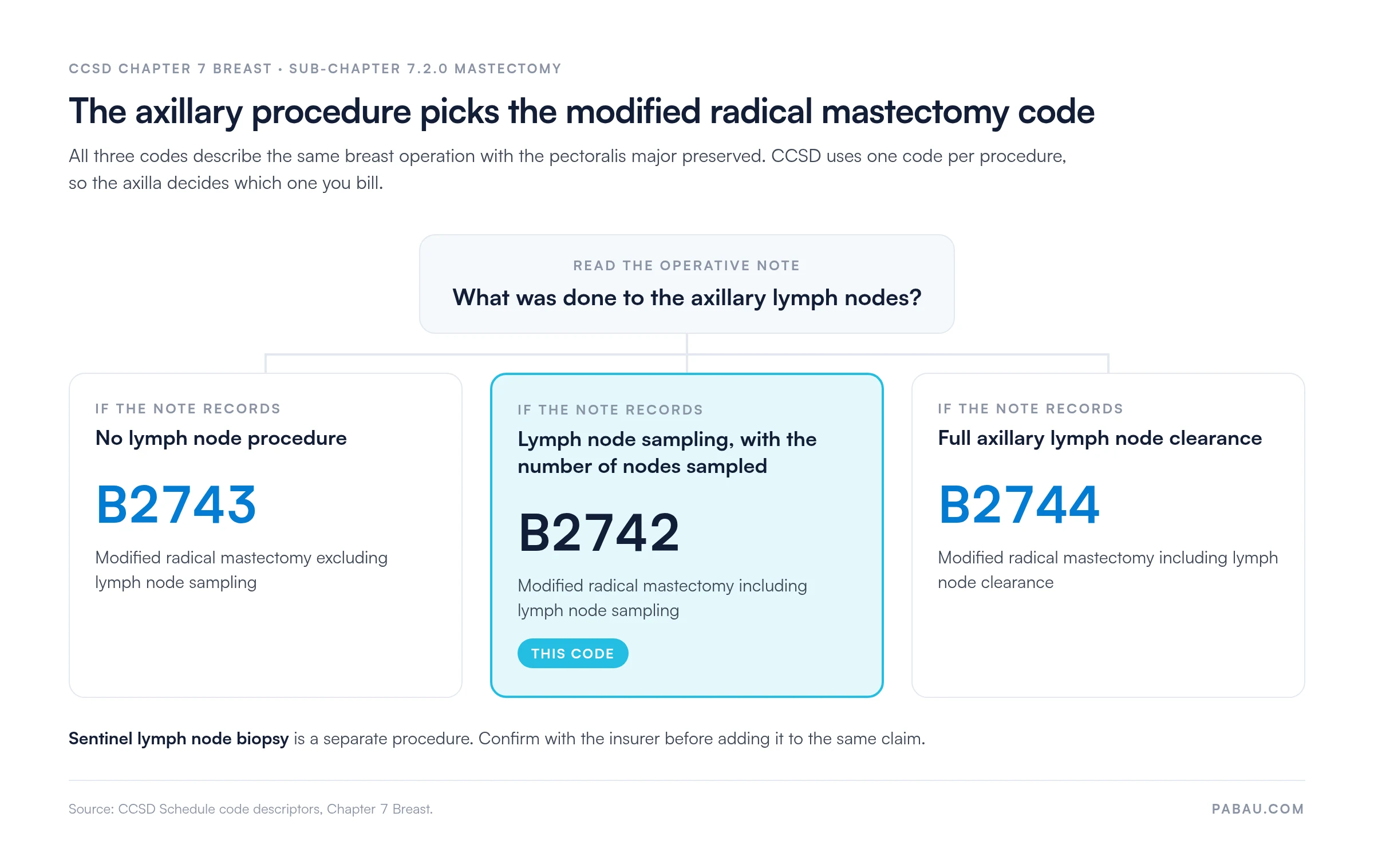
B2743 covers modified radical mastectomy with no lymph node procedure. B2742 adds axillary lymph node sampling to the same breast removal, and B2744 adds a full axillary clearance. All three involve complete excision of the breast, so the axillary documentation in the operative note is the only distinguishing factor.
Sentinel lymph node biopsy (SLNB) can be billed separately alongside B2742 only where the insurer’s policy allows it. SLNB is clinically distinct from axillary lymph node sampling, because it identifies the first draining node with a tracer technique. It may therefore carry its own CCSD code.
CCSD coding convention alone does not settle the question, so verify with the insurer before submitting both codes on the same claim. Billing SLNB with B2742 without that confirmation is a bundling risk that frequently triggers adjudication queries.
An incomplete operative note is the most preventable reason a B2742 claim fails. The operative documentation must contain every element below for a UK insurer to process and pay the claim without a query.
Modified radical mastectomy is an elective oncology procedure, and all major UK private insurers require pre-authorization before surgery. A B2742 claim for surgery done without prior authorization is usually refused outright rather than paid at a reduced rate. Check the insurer’s current policy before the patient is listed, because oncology pre-authorization requirements can change at policy renewal.
Healthcode is the main electronic claims clearinghouse for UK private healthcare. Most major insurers, including Bupa, AXA Health and Aviva, accept claims through the Healthcode portal. The steps below follow a B2742 submission through claims software for practices connected to Healthcode.
Denials on mastectomy claims follow predictable patterns. Checking for them before submission, rather than after a rejection letter, keeps breast surgery billing out of a cycle of rework.
Most of these denials trace back to two documents, the operative note and the pre-authorization record. Both belong in the check you run before every submission.
Before submitting any B2742 claim, run a five-point check. Confirm (1) the pre-authorization number is recorded and (2) the operative note documents the lymph node sampling and node count. Then check that (3) the ICD-10 code matches the pre-authorization record and (4) any additional codes are confirmed as separately billable with the insurer. Finally, (5) submit within the insurer’s submission window. Catching these at the desk takes minutes, while correcting them after a denial takes weeks.
Immediate breast reconstruction, performed in the same operative episode as the modified radical mastectomy, is not bundled into B2742. Reconstruction is a distinct surgical service with its own CCSD code, and it may be billed in the same claim, subject to insurer rules. Delayed reconstruction at a separate admission is billed independently under its own episode.
Key considerations when billing reconstruction alongside B2742:
Bilateral modified radical mastectomy is less common than unilateral surgery. It occurs mainly in patients with bilateral synchronous breast cancer, or in those who choose contralateral risk-reducing mastectomy in the same episode. Before you submit, check the CCSD code principles and each insurer’s policy for bilateral submission. Each side’s operative note should show its own axillary procedure, because the two sides may not take the same code.
The two approaches practices typically adopt are:
Contact the insurer’s provider support team before submitting a bilateral claim. Confirm the preferred submission format, the reimbursement for the second side and whether each side needs its own pre-authorization number. Record that confirmation in the patient’s billing record.
Oncology claims attract scrutiny during insurer audits, and B2742 describes a major breast cancer operation. Each insurer audits against its own schedule, and our Bupa CCSD codes guide explains how Bupa structures its codes and submission requirements. Practices that keep one operative note standard across every breast surgery episode are far better placed when an audit arrives.
Three compliance steps protect breast surgery practices:
Without a connected system, staff copy the code from the operative note into a separate billing tool. They chase the pre-authorization number by email and track Healthcode responses in a spreadsheet. Each hand-off is a chance to bill B2742 when the note supports B2743 or B2744.
Pabau keeps those steps in one patient record. Structured operative note templates prompt the surgeon for the axillary procedure and node count. The claim is then raised against the patient’s insurer through Healthcode with the pre-authorization number attached, and follow-up tasks flag any claim still pending.
The result is fewer coding queries from insurers, and pended claims get chased before they age into write-offs.

Pabau supports UK private practices with structured operative notes, Healthcode claim submission and claim tracking. See how it fits your breast surgery practice.

Billing B2742 correctly comes down to the axilla. If the operative note shows lymph node sampling with a node count, B2742 is the code. If it shows no node procedure, the code is B2743, and a full clearance makes it B2744.
Build that distinction into your operative note template, and confirm pre-authorization before the patient is listed. Those two habits remove the most common reasons a B2742 claim comes back. Book a demo to see how Pabau links operative notes, pre-authorization and Healthcode claims for UK breast surgery practices.

Coding the same operation without node sampling? CCSD code B2743 covers modified radical mastectomy when no axillary lymph node procedure is performed.
Looking for the full CCSD code list? CCSD codes library collects the breast chapter and every other CCSD code we cover for UK private billing.
Need a full Bupa CCSD code reference? Bupa CCSD codes guide covers Bupa’s private healthcare code structure, fee schedule context and submission requirements for UK consultants.
Billing an older radical mastectomy record? CCSD code B2710 explains the historic code for radical mastectomy including block dissection.
Want to reduce claim rejection rates across your practice? Pabau’s claims management software tracks submission status, flags pended claims and connects to Healthcode for UK private practices.
CCSD code B2742 is the UK private healthcare code for modified radical mastectomy including lymph node sampling. It covers complete breast tissue removal with axillary lymph node sampling and preservation of the pectoralis major muscle. It sits in CCSD Chapter 7 Breast, sub-chapter 7.2.0 Mastectomy, and a full axillary clearance is billed as B2744 instead.
The three codes cover the same modified radical mastectomy and differ only in the axillary procedure. B2743 applies when no lymph node procedure is done, B2742 when axillary nodes are sampled, and B2744 when the axilla is fully cleared. Code from what the operative note records.
All major UK private insurers, including Bupa, AXA Health, Aviva, Vitality and Healix, require pre-authorization for elective oncology surgery such as modified radical mastectomy. Submit the clinical indication, staging details and surgeon credentials to the insurer before the patient is listed for surgery.
Sentinel lymph node biopsy may be billed separately alongside B2742 only where the insurer’s bundling policy allows it. It is clinically distinct from axillary lymph node sampling and may carry its own CCSD code. Verify with the insurer before submitting both codes on the same claim.
The leading reasons are missing or expired pre-authorization and an operative note that does not document the lymph node sampling. Wrong code selection comes next, such as B2742 billed when no nodes were sampled or the axilla was fully cleared. A diagnosis code that does not match the pre-authorization record is the fourth.
Check the CCSD code principles and each insurer’s policy for bilateral submission before you bill B2742 for both sides. Code each side for the procedure its operative note records, since the axillary step may differ between sides. Confirm the submission format, the reimbursement for the second side and whether each side needs its own pre-authorization.