CCSD code V2680: Revision anterior lumbar decompression with fusion
What CCSD code V2680 covers: Revision anterior decompression with fusion and ins...

Last Updated: Nov 26, 2026
T8620 is the CCSD code for sampling of axillary lymph nodes. The surgeon removes a selection of nodes from the armpit so a pathologist can check them for cancer spread.
The code sits in sub-chapter 9.8.0 Lymphatic System of the CCSD schedule used by UK private medical insurers, under CCSD reference FI.089. Sentinel node mapping for breast cancer and full axillary clearance have their own codes.
Let Pabau's smart automation suggest the right codes, reduce claim denials, and keep your practice compliant—effortlessly.
Automate repetitive tasks and focus on what matters most—your patients.
Reduce coding errors and ensure compliance with the latest regulations.
Clean claims, fewer denials, and faster reimbursements.
Powerful insights and reporting to help your practice thrive.
HIPAA compliant SOC 2 certified GDPR-compliant Trusted by 4,000+ clinics worldwide

CCSD code T8620 covers sampling of axillary lymph nodes, under CCSD reference FI.089 in sub-chapter 9.8.0 Lymphatic System.
Sentinel node mapping for breast cancer has its own codes, T9000 and T9020, so a mapped procedure is not billed as T8620.
A full axillary clearance is T8520, and a diagnostic excision biopsy of a lymph node is T8700.
Some mastectomy codes already include the axillary nodes, such as B2742, so T8620 is not added on top of them.
Get the insurer’s pre-authorization before the operation, then submit electronically via Healthcode or direct to the insurer.
CCSD code T8620 is the UK private-sector code for sampling of axillary lymph nodes, the nodes in the armpit. Insurer schedules such as National Friendly’s CCSD-based schedule of fees list it in the Minor band.
Sampling removes a selection of axillary nodes so a pathologist can check them for cancer spread. It stages the axilla without clearing it. Sentinel node mapping with blue dye or an isotope for breast cancer has separate codes.
The CCSD record for T8620 was created in June 2013. Its narrative used to read “Biopsy/sampling of axillary lymph nodes”, and the word biopsy has since been dropped.
The CCSD Group publishes the codes, but each insurer sets its own band and fee. National Friendly’s October 2025 schedule lists a £197 procedure fee for T8620. Check the paying insurer’s current schedule before you invoice. For the other codes in the schedule, browse our CCSD code library.
CCSD files T8620 in the lymphatic sub-chapter alongside several other axillary codes. The right one depends on how the nodes were found and how many were removed.
The band matters for income. On National Friendly’s schedule, a dual-technique sentinel node procedure coded as T8620 claims £197 instead of £548. Plain sampling coded as T9020 claims a band the note can’t support, and the insurer may query it.
NICE guideline NG101 recommends sentinel lymph node biopsy to stage the axilla in invasive breast cancer with a normal ultrasound. It advises using isotope and blue dye together. Where a surgeon follows that advice, the note usually supports T9020 rather than T8620.
A diagnostic node biopsy and internal mammary sampling have their own guides. See CCSD code T8700 and CCSD code T8640 for those claims.
Axillary sampling is often done in the same session as breast surgery. The CCSD technical guide says one code should usually describe a procedure from start to finish, including steps routinely performed with it.
Several mastectomy narratives already name the axillary work, so T8620 is not added to them:
If the nodes were sampled during a modified radical mastectomy, B2742 describes both in one code. B2743 is the version without sampling. Our guide to CCSD code B2742 covers that claim.
The technical guide confirms that unacceptable combinations are listed against these radical mastectomy codes. For other pairings, such as a wide local excision with sampling, each insurer has its own rules on two codes. Ask the insurer before you bill both.
Taken together, those rules give five checks to run on the operation note, in order, before T8620 goes on the claim.
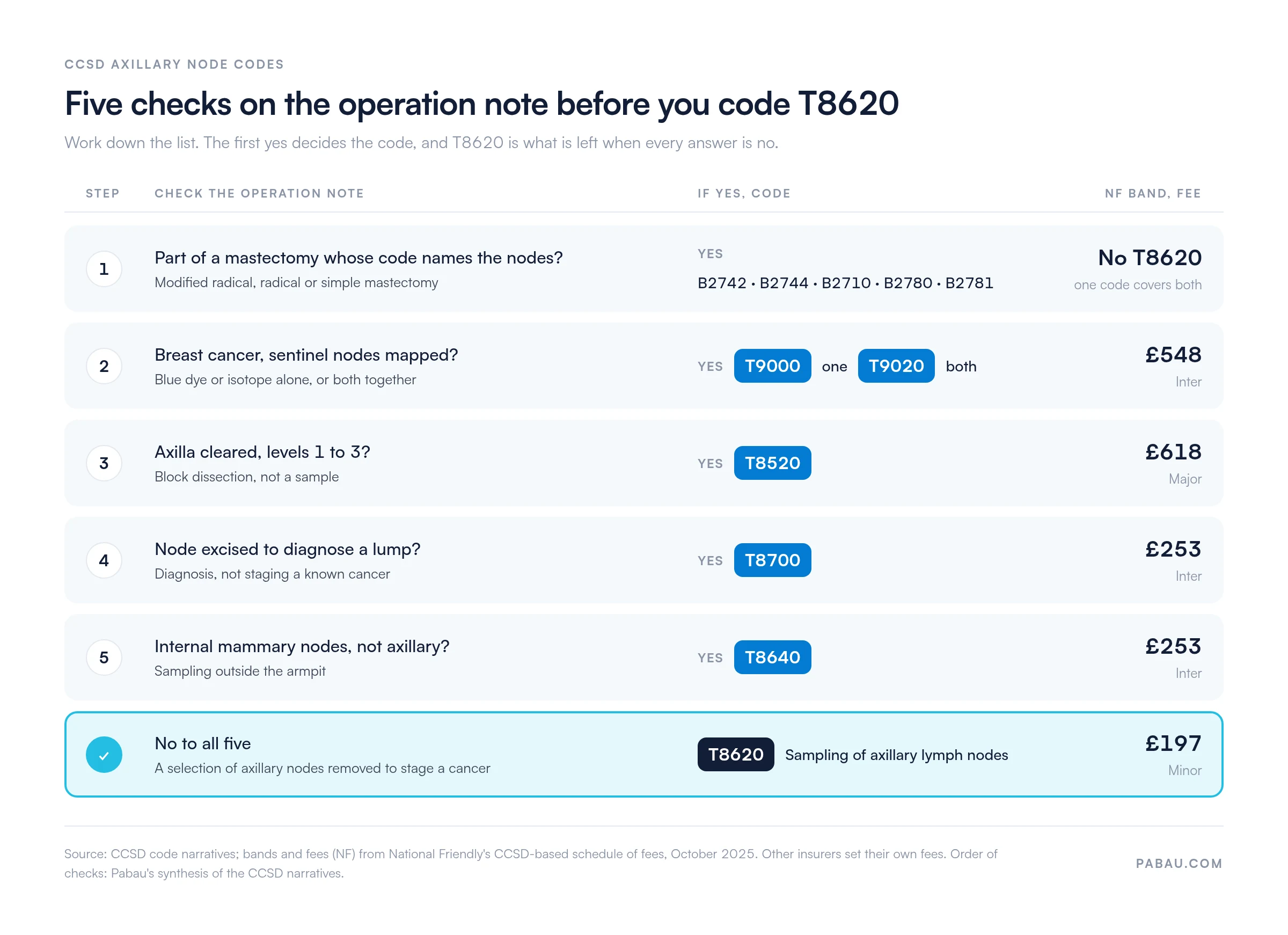
Before you code T8620, ask two questions of the operation note. Did the surgeon use blue dye or an isotope? Was the nodal work part of a mastectomy whose code already includes it? Either answer changes the code.
Insurers want to know the condition behind the operation before they authorize it. Record the diagnosis in the same terms in the referral, the pre-authorization request and the operation note. These WHO ICD-10 codes cover the usual reasons for axillary sampling.
When nodal disease is already confirmed, list C77.3 alongside the primary cancer code. That pairing tells the insurer why the axilla is being operated on.
A T8620 claim is only as strong as the operation note behind it. If the note just says “axillary nodes removed”, the coder can’t tell sampling from clearance or mapping.
The work starts before the operation. UK insurers such as Bupa, AXA Health, Aviva and Vitality generally ask for planned surgery to be approved in advance. The patient’s policy decides what is covered.
The anesthetist usually bills separately for the same operation. Check whether the insurer wants both claims to carry the same authorization reference.
Each of these slips gives the insurer a reason to query a T8620 claim, and each one has a fix.
If a claim is still refused, check the insurer’s current provider manual for its appeal process. Only commit to a deadline you have confirmed there.
In many breast surgery practices, the authorization lives in an email and the operation note sits in another system. Then someone keys the claim in by hand. Each handoff risks a lost reference or the wrong code.
Pabau, a practice management platform, keeps those steps on the patient record. Its paperless claims management sends claims electronically through Healthcode and to Bupa. The authorization code, dates and sessions sit on the patient’s case, with a warning when one is missing.
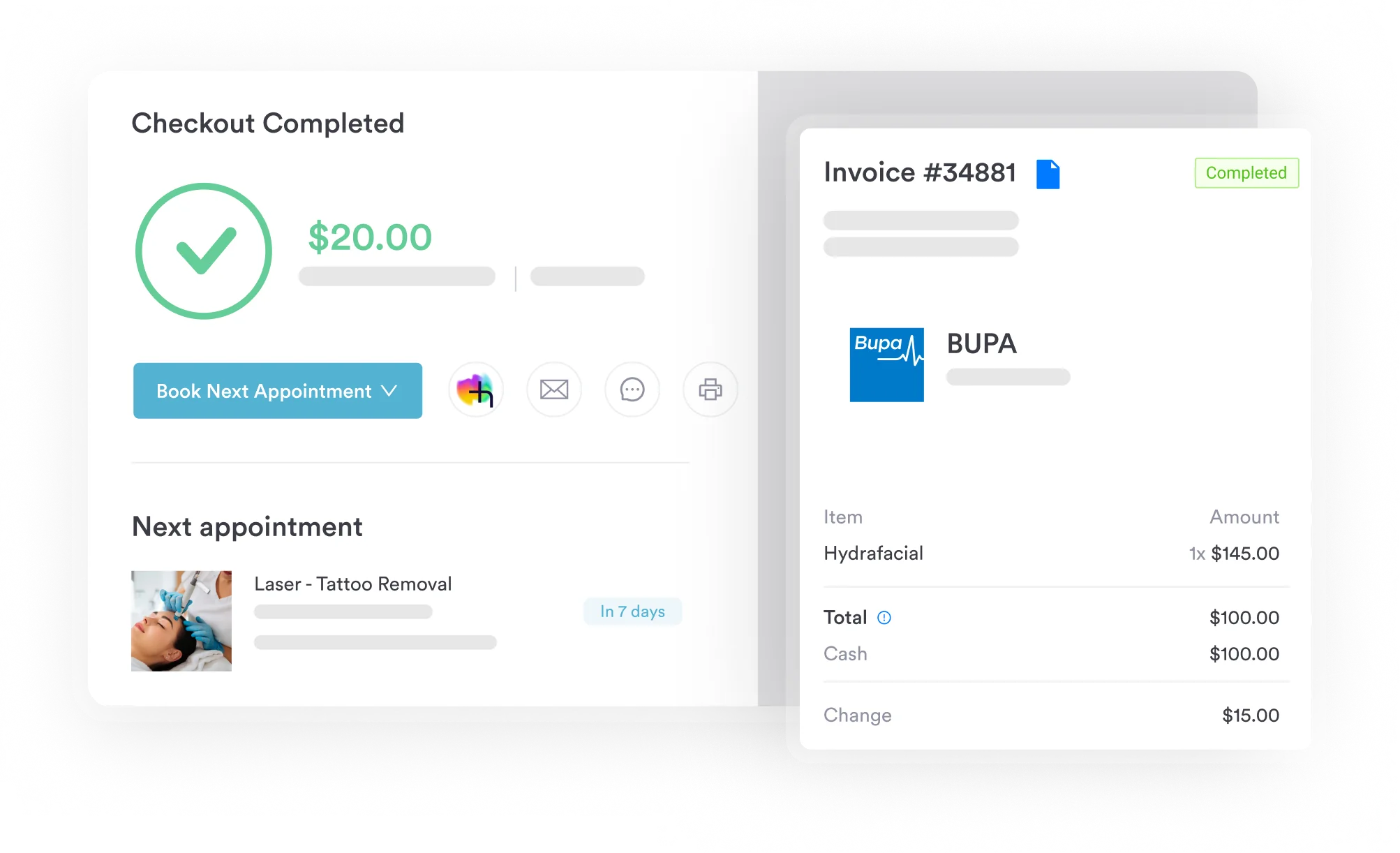
The result is fewer claims queried for a missing reference or a mismatched code. Your team spends less time on rework and more on patients.

Pabau keeps the operation note, the authorization code and the claim on one patient record. Claims go electronically through Healthcode and to Bupa, so you can track each one without phoning the insurer.

T8620 describes one operation, a sample of the axillary nodes taken without sentinel node mapping. Most errors come from its neighbors. A mapped breast procedure belongs under T9000 or T9020, a clearance is T8520, and some mastectomy codes already include the nodes. In the groin, a block dissection of the inguinal nodes is coded T8550.
Build a note template that records the side, the technique and any other surgery in the session. Then check the paying insurer’s current schedule before you invoice. Book a demo to see how Pabau tracks authorizations and sends your Healthcode claims from one patient record.

Looking for another CCSD procedure code? CCSD codes lists the procedure codes Pabau covers, chapter by chapter.
Need a full Bupa CCSD billing reference? Bupa CCSD codes covers Bupa’s procedure list and how its claims work.
Removing a node to diagnose a lump? CCSD code T8700 covers excision biopsy of a lymph node for diagnosis.
Sampling the nodes during a mastectomy? CCSD code B2742 explains the modified radical mastectomy code that includes lymph node sampling.
CCSD code T8620 covers sampling of axillary lymph nodes. The surgeon removes a selection of armpit nodes so a pathologist can check them for cancer spread, without clearing the axilla.
T8620 sits in chapter 9.0.0 Vascular System, sub-chapter 9.8.0 Lymphatic System. Its CCSD reference is FI.089, and it is a procedural code.
Not for breast cancer. Sentinel node mapping and sampling with blue dye or a radioactive probe is T9000, and with both is T9020. Other sentinel node biopsies use T8780, unless a more specific code is listed.
T8620 is a sample of axillary nodes, taken to stage a cancer. T8520 is a block dissection of the axillary nodes, levels 1 to 3, also called axillary clearance.
Not when the mastectomy code already includes the nodes, as B2742, B2744, B2710 and B2780 do. For other breast operations, ask the insurer whether it accepts two codes.
Each insurer sets its own fee. National Friendly’s October 2025 schedule lists T8620 in the Minor band at £197. Check the paying insurer’s current schedule before you invoice.
Get pre-authorization before the operation, then submit electronically via Healthcode or direct to the insurer. Include the authorization reference, and keep the operation note ready in case the insurer asks for it.