

CPT Code 30801: Superficial turbinate ablation billing guide
CPT Code 30801: Official descriptor and procedure overview The American Medical ...

Last Updated: Nov 27, 2026
A0200 is the CCSD code for excision of lesion of tissue of brain. CCSD stands for Clinical Coding and Schedule Development, the group that maintains the procedure schedule used by UK private medical insurers. The code covers open removal of a lesion from brain tissue, usually through a craniotomy.
Biopsy, AVM excision, abscess excision and meningeal lesions each take their own code. Bupa, AXA Health, Aviva and Vitality commonly require pre-authorization before surgery. Claims pair A0200 with a WHO ICD-10 diagnosis code, such as C71.1 or C79.3.
Let Pabau's smart automation suggest the right codes, reduce claim denials, and keep your practice compliant—effortlessly.
Automate repetitive tasks and focus on what matters most—your patients.
Reduce coding errors and ensure compliance with the latest regulations.
Clean claims, fewer denials, and faster reimbursements.
Powerful insights and reporting to help your practice thrive.
HIPAA compliant SOC 2 certified GDPR-compliant Trusted by 4,000+ clinics worldwide

CCSD code A0200 covers open excision of a brain tissue lesion, billed to UK insurers such as Bupa, AXA Health, Aviva and Vitality.
Brain biopsy, AVM excision, abscess excision and meningeal lesions each have their own CCSD code, so check the lesion before choosing A0200.
CCSD lists stereotactic biopsy (A0310) and awake craniotomy with ablation (A0280) as unacceptable combinations with A0200.
Pair A0200 with a WHO ICD-10 diagnosis code, such as C71.1 or C79.3, and confirm insurer pre-authorization before surgery.
CCSD code A0200 is the UK private-insurer procedure code for excision of lesion of tissue of brain.
UK insurer The Exeter lists A0200 under that exact descriptor in its CCSD-based fee schedule, with a maximum surgeon and anesthetist benefit.
It applies when a neurosurgeon removes a lesion from the brain itself through an open approach, usually a craniotomy. The resected tissue then goes for histopathology.
CCSD stands for Clinical Coding and Schedule Development, the group that maintains the procedure schedule used across UK private healthcare. Insurers such as Bupa, AXA Health, Aviva and Vitality use the schedule to authorize, price and settle consultant invoices.
A0200 sits in Chapter 2, Brain, cranium and other intracranial organs, alongside its neighbors in our CCSD code library. For how insurers apply the schedule, see our guide to Bupa CCSD codes.
Excision of a lesion of brain tissue is an open neurosurgical procedure performed under general anesthesia. Knowing the operative steps helps billers confirm that A0200 is the right code, not a neighboring one.
The key test for code selection is open excision of brain tissue. A biopsy that only samples the lesion is billed as A0310 when stereotactic, or as A0400 through a burr hole. Radiosurgery is not an excision at all. The operative note must state the approach, the extent of resection and that the lesion was excised.
A0200 is indicated when a neurosurgeon excises a space-occupying lesion within the brain tissue. The common indications are listed below.
Some intracranial lesions look similar on a referral letter but take a different code. Arteriovenous malformations go to CCSD code A0260, and brain abscess excision goes to CCSD code A0180. A meningioma arises from the meninges rather than brain tissue, so CCSD code A3810 is the code to check. An AVM blocked from the inside through a catheter under imaging, rather than excised, is billed as XR390 instead.
Billing A0200 to a UK private medical insurer follows a set sequence. Most rejections trace back to a step that was skipped or done out of order.
UK private insurers expect a WHO ICD-10 diagnosis code alongside each CCSD procedure code. For A0200, the diagnosis must describe the brain lesion being excised. The table lists the most common pairings.
Use the most specific code the record supports. If histology is still pending, code the working diagnosis and update the claim when the report arrives. A diagnosis that does not describe a brain lesion invites a query or rejection. The WHO ICD-10 browser holds the authoritative code titles.
Chapter 2 of the CCSD schedule holds several codes that are easy to confuse with A0200. The CCSD schedule itself is login-gated, so confirm each entry against the current schedule before billing.
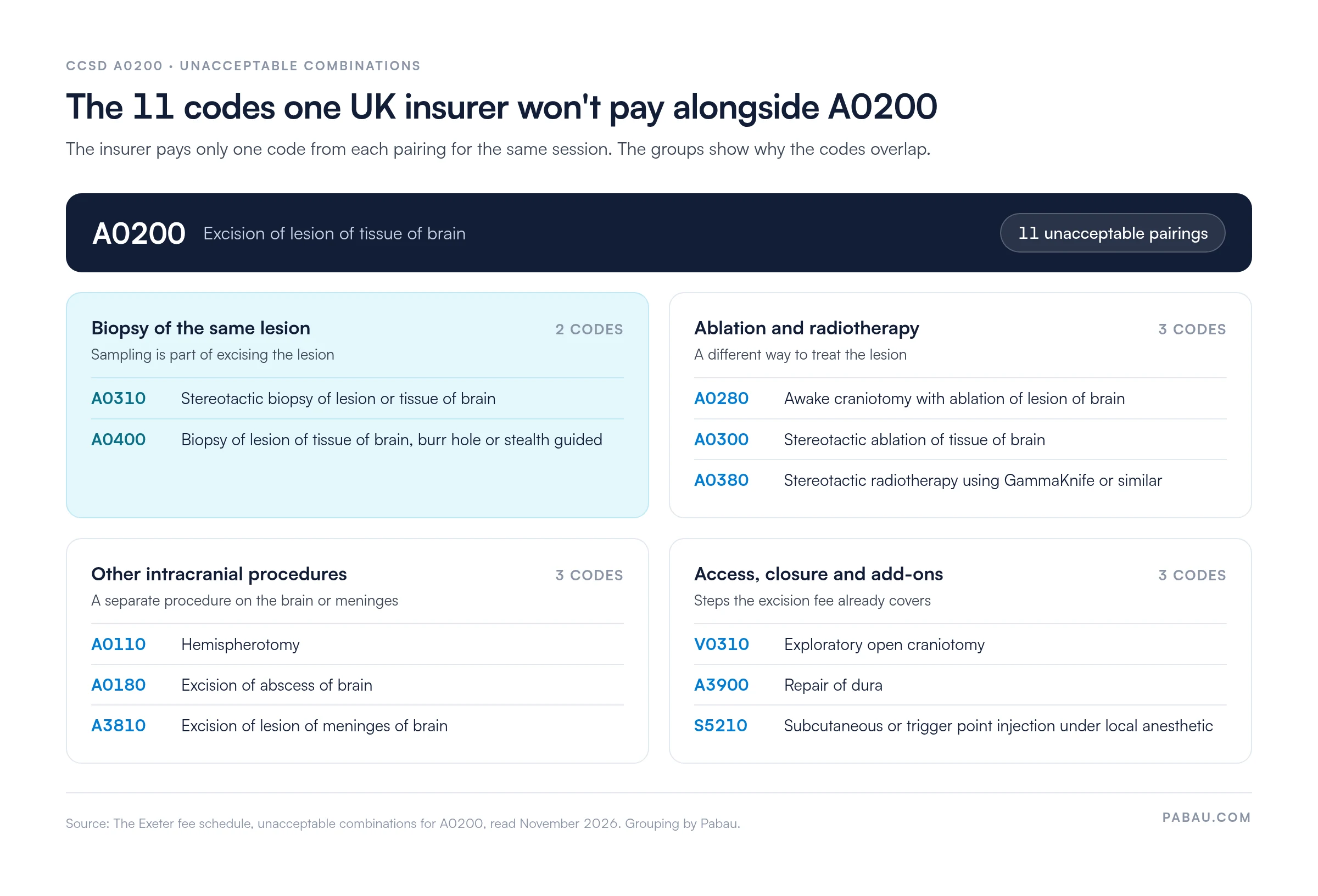
CCSD publishes unacceptable combinations: pairs of codes that should not both appear on one invoice for the same session. The usual reason is overlap, where one code already includes the work the other describes.
For A0200, stereotactic biopsy (A0310) and awake craniotomy with ablation (A0280) appear as unacceptable combinations. A biopsy taken before the same lesion is excised is part of the excision, not a second procedure. The same logic applies to access, because the craniotomy used to reach the lesion is covered by the excision code.
CCSD describes its coding principles as guidance, and each insurer decides which combinations it applies. Check the A0200 entry in the current schedule and the patient’s insurer rules before you add a second code.
An insurer’s own list can run far longer than the two pairings above. The Exeter’s fee schedule names 11 codes it won’t pay alongside A0200, grouped below by why they overlap. Brain biopsy, abscess excision and meningeal lesion excision all appear on it. A case that combines them needs the insurer’s agreement before surgery.
Insurers can ask for clinical records to support an A0200 claim during or after settlement. Having the full record ready before you invoice cuts delays and protects against later clawbacks.
Keep records in line with your practice’s retention policy and each insurer’s audit terms. Insurers can query an A0200 claim long after it was paid.
Brain lesion excision is major surgery, and UK private medical insurers commonly require pre-authorization before it goes ahead. The exact rules depend on the insurer and the patient’s policy.
Confirm pre-authorization against the patient’s own policy, not the insurer in general. Two policies from the same insurer can carry different cover, excesses and consultant-choice rules for the same CCSD code.
A pre-authorization request usually includes the following. Some insurers ask for more on complex neurosurgical cases.
After emergency surgery, contact the insurer as soon as possible and send the clinical notes explaining the urgency. Elective surgery without authorization risks a reduced payment or none, and the patient may face the bill.
Rejections on A0200 follow predictable patterns across UK insurers. Each one can be caught and fixed on the invoice before it goes out.
A0200 covers the surgeon’s fee for the excision. The anesthetist sends a separate invoice, usually quoting the same CCSD procedure code. Hospital, imaging and pathology charges are billed separately by the providers concerned.
Surgical assistant fees, revision surgery and fees above the insurer’s benefit limit vary by insurer. Confirm with the insurer before surgery so the patient knows about any shortfall.
A0200 applies to open excision of brain tissue. The approach recorded in the operative note decides the code, not the pre-operative plan.
A single A0200 case involves an authorization number, a CCSD code, an ICD-10 diagnosis and a long clinical record. Many neurosurgical practices still keep those in separate spreadsheets, inboxes and insurer portals.
In Pabau, a practice management platform, the authorization code sits on the patient’s case, with a warning if it is missing before you bill. Invoices to UK insurers such as Bupa go out through Healthcode, with the codes and authorization number attached. Pabau’s claims management software then shows where each claim stands.
The result is fewer rejected A0200 claims and less time chasing insurers for payment.
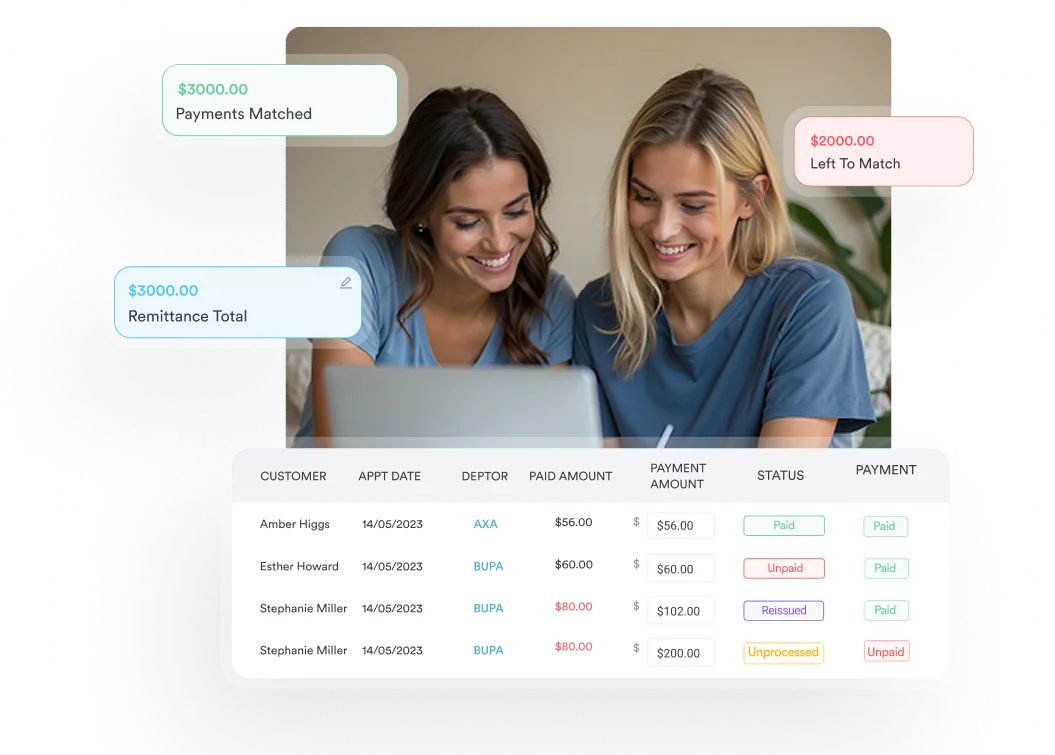

Pabau tracks pre-authorization on each case, warns you when it is missing, and sends insurer invoices through Healthcode. See how it works for neurosurgical and specialist practices.

A0200 rewards precision. The code covers open excision of brain tissue only, so AVMs, abscesses, meningeal lesions and biopsies each need their own code. Pair it with a WHO ICD-10 diagnosis, secure pre-authorization and keep an operative note that says “excision”.
Get those three right before surgery, and an A0200 claim has far fewer reasons to come back. Book a demo to see how Pabau keeps authorization and insurer billing on one record.

Need the wider insurer picture? Bupa CCSD codes explains how UK insurers apply the CCSD schedule.
Billing a biopsy instead? CCSD code A0400 covers biopsy of a brain lesion via a burr hole or stealth guidance.
Excising a brain AVM? CCSD code A0260 covers open AVM resection.
Removing a brain abscess? CCSD code A0180 covers open abscess excision.
Lesion on the meninges? CCSD code A3810 covers excision of a meningeal lesion such as a meningioma.
CCSD code A0200 covers excision of lesion of tissue of brain in the UK private insurance schedule. It applies when a neurosurgeon removes a lesion from brain tissue through an open approach, usually a craniotomy. It does not cover biopsy alone, radiosurgery, AVM excision or abscess excision.
A0200 covers removal of the lesion. A biopsy code covers taking a tissue sample for diagnosis only. Stereotactic biopsy is A0310, and burr-hole or stealth-guided biopsy is A0400. CCSD lists A0310 as an unacceptable combination with A0200.
UK insurers use WHO ICD-10. Common pairings are C71.0 to C71.9 for a primary malignant tumor and C79.3 for a metastasis. Others are D33.0 to D33.2 for a benign tumor and D18.0 for a cavernoma. Use the most specific code the record supports.
UK private medical insurers commonly require pre-authorization for brain surgery, including A0200. The rules depend on the insurer and the patient’s policy. Confirm authorization before the surgery date and quote the number on the invoice.
CCSD lists stereotactic biopsy (A0310) and awake craniotomy with ablation (A0280) as unacceptable combinations with A0200. Each insurer decides which combinations it applies, so check its rules and the current schedule before adding a second code.
Common reasons are missing pre-authorization and a wrong or ICD-10-CM diagnosis code. Others are an operative note that does not record excision, an unacceptable code combination and a late invoice. Using A0200 for an AVM, abscess or meningioma also triggers rejection.
The anesthetist sends a separate invoice to the insurer, usually quoting the same CCSD procedure code. The anesthetic record supports that invoice. The surgeon’s A0200 fee and the anesthetist’s fee are paid separately.




