

CCSD code G5100: Bypass of duodenum billing guide
CCSD code G5100 bills a bypass that leaves the duodenum in place CCSD code G5100...

Last Updated: Oct 16, 2026
A0400 is the CCSD code for biopsy of lesion of tissue of brain (including via a burr hole or stealth guided). It covers taking tissue samples from a brain lesion for histopathology, whether the neurosurgeon reaches it through a burr hole or with neuronavigation.
UK private medical insurers such as Bupa, AXA Health and Aviva use A0400 for biopsy only. Anesthesia and pathology are billed separately. If the surgeon goes on to remove the tumor in the same sitting, a craniotomy code applies instead.
Let Pabau's smart automation suggest the right codes, reduce claim denials, and keep your practice compliant—effortlessly.
Automate repetitive tasks and focus on what matters most—your patients.
Reduce coding errors and ensure compliance with the latest regulations.
Clean claims, fewer denials, and faster reimbursements.
Powerful insights and reporting to help your practice thrive.
HIPAA compliant SOC 2 certified GDPR-compliant Trusted by 4,000+ clinics worldwide

CCSD code A0400 covers a brain lesion biopsy by burr hole or stealth guidance, billed as one procedure code.
Both approaches fall under A0400, so a separate navigation code is billable only where your insurer agreement explicitly allows it.
Anesthesia and histopathology are always billed separately, and most major UK insurers require pre-authorization before the procedure.
The CCSD Group sets no fees, so each insurer’s own published schedule is the benchmark for what A0400 pays.
Practice management software like Pabau helps UK private practices track CCSD-coded claims, flag missing documentation, and cut denial rates across insurers.
CCSD code A0400 is the procedure code for biopsy of lesion of tissue of brain (including via a burr hole or stealth guided). UK private healthcare uses it for billing and insurer reimbursement.
CCSD stands for Clinical Coding and Schedule Development, the group that maintains the CCSD schedule. Bupa, AXA Health, Aviva, Vitality Health, and other major UK private medical insurers accept it as their standard procedure coding system.
The parenthetical in the official descriptor confirms that two techniques share this code: the traditional burr-hole approach and neuronavigation-guided (stealth) biopsy.
A coder doesn’t pick a different A-series code based on surgical technique alone. A0400 is correct whenever the procedure’s objective is tissue biopsy rather than resection or drainage. Neighboring neurosurgery codes sit alongside it in the CCSD code directory.
Deep brain stimulation is one of those neighboring codes. A0980 covers stereotactic implantation of electrodes into a deep brain target, so its objective is treatment rather than tissue sampling.
A brain biopsy under A0400 is a neurosurgical procedure performed under general anesthesia. The neurosurgeon identifies the target lesion on pre-operative MRI, then uses either a burr hole or a neuronavigation system to reach the tissue safely. The core clinical steps are the same regardless of approach.
Because the procedure objective decides the code, the operative note has to say plainly whether the surgeon took a biopsy or went on to resect. That one line settles the CCSD code before billing starts.
Both named approaches in the A0400 descriptor produce tissue samples for histopathological diagnosis. They differ in the technology used to reach the lesion, while the clinical objective stays the same.
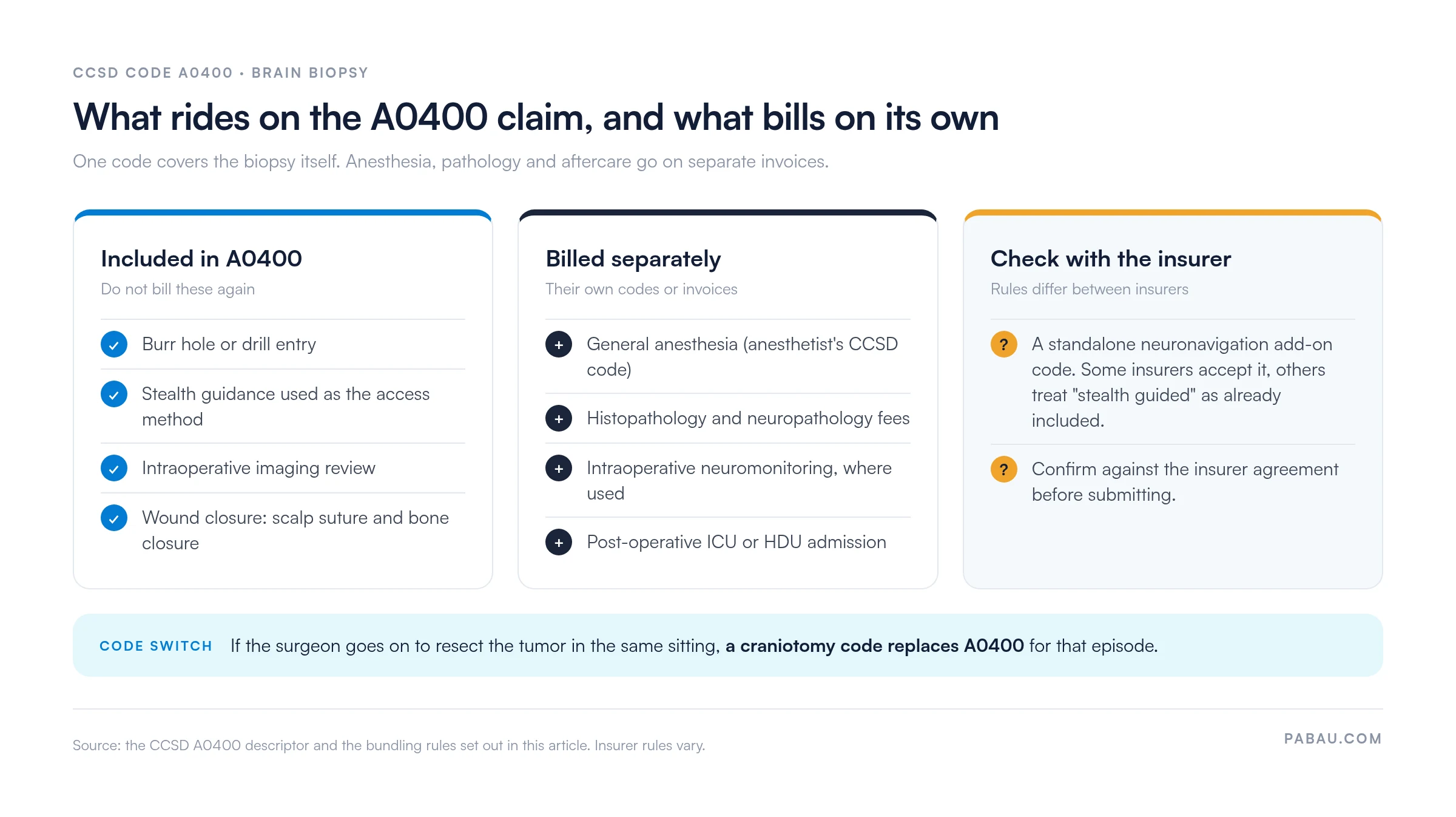
The key coding rule: when the neuronavigation system was used, the operative report should say so. Some insurers reject a separately billed navigation code because the A0400 descriptor already implies it. Always check your specific insurer’s fee schedule before billing a navigation add-on.
Brain biopsy is indicated when a space-occupying lesion visible on imaging needs histological confirmation before treatment decisions can be made. Common indications include primary brain tumors, cerebral metastases, suspected demyelinating disease, infectious lesions, and unexplained space-occupying lesions. The ICD-10 diagnosis codes below are the ones most often paired with A0400 on a claim.
The primary diagnosis code drives medical necessity for the claim. If a lesion on imaging is uncharacterized, use the most specific lesion descriptor available rather than a non-specific G93 code. That lowers the risk of a medical necessity rejection.
The most common coding error for brain biopsy is selecting a craniotomy code when the procedure objective was tissue sampling, not resection. The operative report and the CCSD code submitted must both make that distinction clear. Knowing where the Bupa CCSD procedure codes draw each A-series boundary helps billing staff choose correctly.
Sometimes a biopsy reveals resectable tumor and the surgeon proceeds to resection in the same sitting. The applicable craniotomy code then replaces A0400 for that episode. Check the exact adjacent code numbers in the CCSD Technical Guide for the current schedule year. Code numbers within the A-series are revised periodically.
The same objective test runs through biopsy codes in other chapters. Where a surgeon opens a salivary gland to sample a lesion and leaves the gland in place, CCSD code F4810 applies.
Abscess cases divide by objective too. Where the surgeon opens the skull to remove the abscess capsule rather than drain it, A0180 is the code that fits.
Endoscopic ventricular procedures carry their own bundling rule. Where a therapeutic neuroendoscopy of the ventricle also samples a lesion, the examination and biopsy are included in A1700. They are not billed separately as A0400.
Check the operative note before coding. If the note records tissue removal for histopathology with no further resection, A0400 is correct. If the surgeon debulked or removed a tumor mass, a craniotomy code applies instead. A one-paragraph operative note that doesn’t state the procedure objective is the biggest single cause of coding errors on brain biopsy claims.
Knowing what is bundled within A0400 prevents both underbilling (missing separately billable items) and overbilling (adding components the insurer treats as included). The split below shows which charges ride on the A0400 claim and which go on their own invoices.
UK private insurers expect a consistent set of clinical documents before settling a brain biopsy claim. After missing pre-authorization, missing or inadequate documentation is the second most common reason A0400 claims are rejected. Consultants coming from the NHS often underestimate how document-heavy private insurer billing is compared with NHS activity-based funding.
Most major UK private medical insurers classify intracranial biopsy as a complex neurosurgical procedure that needs explicit pre-authorization before surgery, not just notification afterwards. Billing teams should build a pre-authorization checklist for neurosurgical admissions to avoid retrospective denials.
Always check current pre-authorization requirements directly with each insurer. Individual insurer policies on neurosurgery authorization change periodically, and what Bupa required in 2023 may differ from its current process. Your insurer portal or account manager is the best source of current guidance.
Some A0400 denials are specific to brain biopsy, while others are generic billing errors that happen to land on a neurosurgical claim. Most fall into five categories.
Practices billing for several neurosurgical consultants across several insurers can cut preventable rejections with claims software for consultants. It tracks CCSD-coded claims by insurer, flags outstanding authorizations, and records each denial reason.

No CCSD reference fee exists for A0400. The CCSD Group maintains the procedure codes and descriptors, but it does not set or discuss fees. Each insurer sets and publishes its own fee for the code independently.
Insurers also grade each code by complexity. Freedom Health Insurance’s CCSD-based schedule, for example, lists A0400 as a Complex brain procedure. What a neurosurgeon is paid then depends on that insurer’s schedule rate, or on a higher fee agreed directly with it.
Healix’s fee schedule and Aviva’s practitioner fee schedule both publish their fees by CCSD code online, which gives you a useful benchmark. Avoid stating a specific pound figure in a pre-authorization request. If the billed amount differs from the insurer’s schedule rate, the claim can be held until the consultant justifies it in writing.
To check current fees with other insurers, use the Bupa code search tool and the equivalent portals for AXA Health and Vitality Health.
Many private neurosurgery billing teams still track A0400 claims across spreadsheets, insurer portals and email. A missing operative note or an expired authorization number then turns up only when the insurer rejects the claim.
Practice management software like Pabau keeps the pre-authorization reference, operative report and histopathology letter together on the patient record. Each claim then moves through clear statuses, from pending to paid, for every insurer you bill.
The outcome is fewer preventable rejections on complex procedures. Your billing team spends its time submitting claims instead of chasing paperwork across three systems.

Pabau’s claims management software tracks CCSD-coded claims by insurer, flags missing documentation, and records denial reasons. Your team spends less time chasing A0400 claims and more time on new ones.

An A0400 claim is won or lost before the invoice goes out. The operative note should state the biopsy objective, and the pre-authorization should match the code. Add a specific diagnosis code and the insurer has little left to query.
Navigation is the trade-off to remember. Billing it separately can recover a fee from some insurers, but it invites a dispute from the rest. Check the agreement first, every time.
Fees are the other moving part. With no CCSD reference rate, each insurer’s own schedule is the only benchmark worth using. Book a demo to see how Pabau tracks CCSD claims and authorizations across all your insurers in one place.

Need guidance on UK private practice billing compliance? Medical billing compliance in private practice covers the documentation and audit requirements that UK insurers check when reviewing neurosurgical claims.
Managing denial workflows across multiple insurers? Denial management in healthcare sets out a structured approach to tracking, appealing, and preventing claim rejections.
New to insurer billing in private practice? What is medical billing walks through how a claim moves from the procedure to payment.
CCSD code A0400 covers biopsy of lesion of tissue of brain, performed via a burr hole or a stealth-guided (neuronavigation) approach. It is a single CCSD code used in UK private healthcare, whichever of the two named techniques the neurosurgeon uses.
Yes, stealth-guided (neuronavigation) biopsy is explicitly included in the A0400 descriptor. Whether a separate navigation add-on can also be billed varies by insurer. Most treat guidance as included, but some agreements permit a separately billed navigation item. Check your insurer’s fee schedule before adding one to the claim.
A0400 is a biopsy-only code: the objective is tissue sampling for histopathological diagnosis, with no resection or debulking. Craniotomy codes (such as A0402 and A0450 in illustrative terms) apply when the neurosurgeon performs tumor excision, debulking, or abscess drainage. If the surgeon biopsies and then resects the tumor in the same sitting, the craniotomy code replaces A0400.
UK private insurers typically require a pre-operative MRI report and an MDT or consultant decision to biopsy. They also need an operative report confirming the approach and tissue obtained. The claim should include a histopathology report, a post-operative letter to the referrer, and the pre-authorization reference number. The operative report must state whether stealth guidance was used.
Yes. Anesthesia is always billed separately under a CCSD anesthesia code, as it is for every CCSD surgical procedure code. Intraoperative neuromonitoring (IONM) is also billed separately when performed. Neither is included within A0400.
The most frequent reasons are missing or expired pre-authorization and an operative note that doesn’t confirm tissue was obtained. Others include a non-specific ICD-10 diagnosis code, unbundling of components the insurer treats as included, and a neurosurgeon who isn’t on the insurer’s recognized list. Addressing all five before submission sharply reduces denials.
Each insurer sets its own fee for A0400, and the CCSD Group does not set or publish one. Insurer schedules such as Freedom Health Insurance’s grade A0400 as a Complex procedure. Check the published schedule of the insurer you are billing, or your negotiated rate, for the current figure.



