CPT code 93503: Swan-Ganz catheter billing and modifiers
CPT code 93503: Official descriptor and procedure overview In the AMA CPT code s...

Last Updated: Oct 23, 2026
A0260 is the CCSD code for excision of an arteriovenous malformation from vessels of the brain. It covers open resection of a brain AVM by a neurosurgeon through a craniotomy.
Embolisation and radiosurgery are billed under other CCSD codes. CCSD lists craniotomy, dural repair and endovascular AVM codes as unacceptable combinations with A0260. UK private medical insurers commonly require pre-authorisation before surgery.
Let Pabau's smart automation suggest the right codes, reduce claim denials, and keep your practice compliant—effortlessly.
Automate repetitive tasks and focus on what matters most—your patients.
Reduce coding errors and ensure compliance with the latest regulations.
Clean claims, fewer denials, and faster reimbursements.
Powerful insights and reporting to help your practice thrive.
HIPAA compliant SOC 2 certified GDPR-compliant Trusted by 4,000+ clinics worldwide

CCSD code A0260 covers open surgical excision of a brain arteriovenous malformation (AVM). Embolisation and radiosurgery are billed under other CCSD codes.
Q28.2 (arteriovenous malformation of cerebral vessels) is the usual ICD-10 pairing. I67.1 is a nonruptured cerebral aneurysm code, not an AVM code.
CCSD lists craniotomy, dural repair, aneurysm and endovascular AVM codes as unacceptable combinations with A0260, so they stay off the A0260 claim.
UK private medical insurers commonly require pre-authorisation for A0260. Check the patient’s policy with the insurer before theatre is booked.
Pabau, the practice software we build, sends CCSD invoices through Healthcode and tracks their status, using the codes your team records.
CCSD code A0260 is the UK private-insurer code for excision of an arteriovenous malformation from vessels of the brain. It covers open resection of an intracranial AVM by a neurosurgeon through a craniotomy. Under general anaesthesia, the surgeon isolates, devascularises and removes the abnormal vascular nidus from the brain.
The code covers the excision itself. CCSD lists exploratory open craniotomy (V0310) and repair of dura (A3900) as unacceptable combinations with A0260. The craniotomy and dural closure used to reach the lesion are therefore not billed as separate lines. Neighbouring brain and cranium procedures each have their own entry among our private practice CCSD codes.
Understanding the procedure helps coders check that what the surgeon did matches what A0260 describes. It also prevents miscoding when the surgeon used an adjunct or another treatment instead.
An arteriovenous malformation is an abnormal tangle of blood vessels connecting arteries and veins without an intervening capillary bed. In the brain, this creates a high-pressure shunt that can rupture (causing intracerebral haemorrhage), trigger seizures, or progressively impair neurological function. Surgical excision removes the nidus, eliminating the risk of future haemorrhage from that lesion.
Surgeons usually follow this operative sequence when they bill A0260:
Spetzler-Martin grading (I-V) guides surgical selection. Lower-grade AVMs (I-III) carry acceptable surgical risk, while higher-grade lesions (IV-V) teams often manage with other strategies. The grade in the operative notes shows why the team chose open excision over radiosurgery or observation.
Neurosurgeons choose open excision over radiosurgery or conservative management based on clinical and anatomical factors. A clearly documented indication supports the A0260 claim and the pre-authorisation request.
A0260 does not apply when radiosurgery (Gamma Knife, CyberKnife) or endovascular embolisation alone is the chosen treatment. Different CCSD entries cover those procedures. Coding A0260 when the surgeon only performed radiosurgery is a material coding error, and the insurer is likely to decline the claim. The panel below maps each treatment route to its code and its ICD-10 pairing.
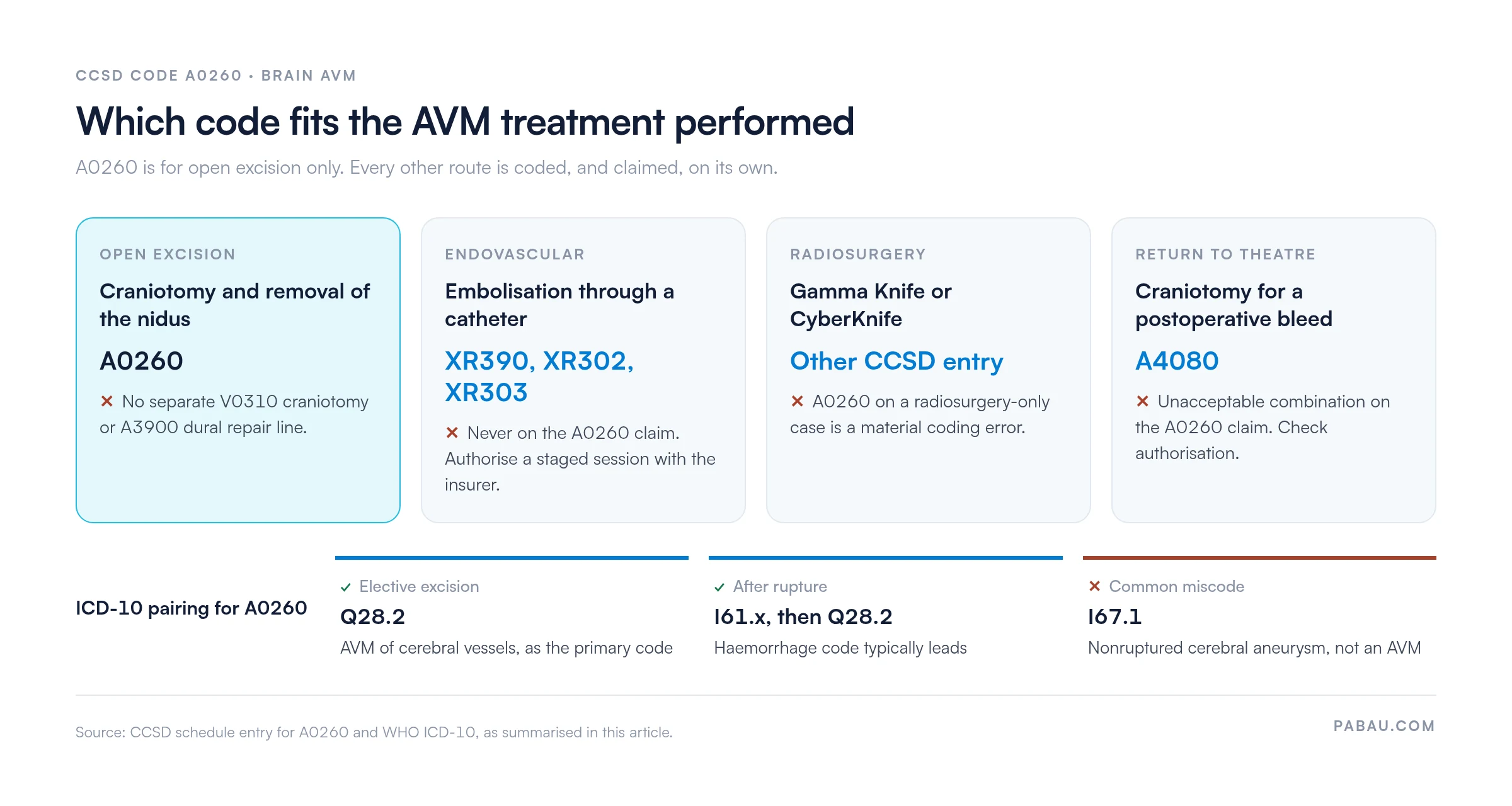
Every A0260 claim needs a paired ICD-10 diagnosis code. The treating clinician selects the most clinically accurate code. The billing team confirms that the code is present, correctly formatted and consistent with the operative notes.
The codes that matter for A0260, per the WHO ICD-10 browser, are:
Insurers may decline claims where the diagnosis code does not match the procedure. Q28.2 is the usual primary code for elective A0260 excision. After a haemorrhage, the I61 code typically leads, with Q28.2 as secondary. Confirm sequencing with the insurer’s coding guidance, as rules vary.
I67.1 is a common miscode on AVM claims. In WHO ICD-10 it describes a nonruptured cerebral aneurysm, so pairing it with A0260 tells the insurer the diagnosis and the procedure disagree.
Teams can treat AVMs by surgery, embolisation, radiosurgery or a combination, and each approach has its own CCSD code. The CCSD schedule lists nine codes as unacceptable combinations with A0260. They should not appear alongside it on the claim for the same procedure. The Bupa CCSD codes guide explains how CCSD codes work and how to look them up.
Surgeons often perform endovascular embolisation before open AVM excision to reduce intraoperative blood loss. CCSD lists XR390, XR302 and XR303 as unacceptable combinations with A0260, so they cannot share the A0260 claim.
When embolisation takes place in an earlier session, confirm with the insurer at pre-authorisation how to authorise and claim each stage. Record each stage with its own date and operative note, so the insurer can see two separate episodes. A later return to theatre for a postoperative bleed is its own episode too, coded as A4080.
UK private medical insurers, such as Bupa, AXA Health, Aviva and Vitality, commonly require pre-authorisation before a planned A0260 procedure. Policies differ by insurer and by the patient’s cover, so check the policy before booking theatre. Without authorisation, the insurer may decline the claim.
The pre-authorisation process for A0260 generally follows these steps:
Keep each authorisation number on the patient record next to the theatre booking, so the invoice can carry it. Our medical billing compliance guide covers the documentation and process standards that reduce claim risk.
UK private insurers may request clinical records to validate an A0260 claim, especially given its high value. Have complete documentation ready before you submit the invoice, and keep it for insurer audit.
Intraoperative neuromonitoring (IONM), including motor evoked potentials (MEPs) and somatosensory evoked potentials (SSEPs), is common during AVM excision and protects eloquent cortex. Whether IONM can be claimed separately depends on the CCSD schedule and the insurer’s policy.
Check both before adding an IONM line. Where the insurer accepts it separately, the neurophysiologist providing the service invoices under their own registration. The operating neurosurgeon does not bill IONM under A0260.
CCSD has no CPT-style modifiers. The schedule does not add modifier suffixes to A0260 for assistant surgeons, co-surgeons, bilateral work or out-of-hours surgery.
The code narrative and the chapter business rules of the CCSD schedule set the scope of a procedure. Assistant surgeon fees and emergency arrangements follow each insurer’s own rules, so check the insurer’s guidance before invoicing them.
Most declined A0260 claims trace back to a small set of avoidable problems. The patterns below are the common ones, each with a corrective action to take before resubmission. Claims management software that keeps codes and authorisation numbers on the patient record makes each check quicker.
Before submitting any A0260 claim, run a three-point check. First, the authorisation number is on the invoice and matches the approved procedure code. Second, the ICD-10 code matches the one in the pre-authorisation request. Third, no code listed as an unacceptable combination with A0260 sits on the same claim.
Neurosurgical billing teams often hold the authorisation letter, the operative note and the invoice in separate places. When one reference goes missing, the claim stalls while someone chases it.
In Pabau, the codes, authorisation number and clinical notes your team records sit on the patient’s record. Its claims management sends the invoice to the insurer through Healthcode and shows each claim’s status, so a declined claim surfaces quickly.
Pabau does not choose codes or obtain authorisations. Your neurosurgeon and billing team make those decisions, and Pabau carries their work through to a submitted, tracked claim.

Pabau sends CCSD invoices to UK private insurers through Healthcode and tracks their status. Codes, authorisation numbers and operative notes stay on one patient record, so billing staff spend less time chasing missing details.

CCSD code A0260 has a narrow scope. It covers open excision of a brain AVM, and a handful of rules decide whether the insurer pays the claim.
Pair it with Q28.2 rather than I67.1, and keep craniotomy, dural repair and endovascular codes off the claim. Then make sure the authorisation number and a detailed operative note travel with the invoice.
Those checks take minutes before submission, while a declined high-value claim can take weeks to reverse. Book a demo to see how Pabau keeps CCSD codes, authorisation numbers and claim follow-up on one patient record.

Billing Bupa patients for neurosurgery? Bupa CCSD codes and fee schedule guide walks through how CCSD procedure codes are structured and submitted to Bupa.
Returning to theatre after a craniotomy bleed? CCSD code A4080 covers craniotomy for post-operative haemorrhage, one of the codes never billed alongside A0260.
Operating on a cranial nerve instead? CCSD code A3200 explains decompression of a cranial nerve through a craniotomy.
Concerned about private practice billing compliance? Medical billing compliance guidance covers the documentation and process standards that reduce claim risk across specialties.
CCSD code A0260 covers the surgical excision of an arteriovenous malformation from vessels of the brain. That means open resection of an intracranial AVM via craniotomy by a neurosurgeon. It applies when the AVM is physically removed, not when it is treated by embolisation or radiosurgery alone.
Q28.2 (arteriovenous malformation of cerebral vessels) is the usual ICD-10 code paired with A0260. Where AVM rupture with intracerebral haemorrhage is the presenting episode, an I61 code often leads, with Q28.2 as secondary. I67.1 is not an AVM code, since it describes a nonruptured cerebral aneurysm.
Whether intraoperative neuromonitoring (IONM) can be claimed separately from A0260 depends on the CCSD schedule and the insurer’s policy. Check both before adding IONM as a separate line. Where it is accepted, the neurophysiologist invoices under their own registration.
No. CCSD has no CPT-style modifiers for assistant surgeons, co-surgeons, bilateral work or out-of-hours surgery. The scope sits in the code narrative and the chapter business rules, and each insurer sets its own rules for assistant fees.