CCSD code XR320: Nasolacrimal duct stenting billing guide
CCSD code XR320 is the UK private insurance code for dilatation or stenting of t...

Last Updated: Nov 24, 2026
CCSD code XR390 is the UK private healthcare code for embolization of an arteriovenous malformation (AVM) of the brain or a major organ. An AVM is a tangle of arteries and veins that skips the normal capillary bed, so it can bleed.
The code belongs to the interventional radiology chapter, which the CCSD technical guide lists as chapter 17. Plain films sit elsewhere, in the diagnostic schedule’s radiology chapter.
That matters because “XR” reads like X-ray. A claim coded on that reading describes a procedure the patient never had. Get the scope, the procedure note and the authorization right for each session, and most insurer queries never start.

CCSD code XR390 covers embolization of an arteriovenous malformation of the brain or a major organ, an interventional radiology procedure.
The XR prefix does not mean a plain film X-ray, so never use XR390 for a chest X-ray or other routine imaging.
The procedure note should name the AVM’s site, the vessels treated, the embolic agent and the imaging that guided it.
AVM treatment is often staged, so check whether each embolization session needs its own authorization.
Confirm the descriptor, fees and code combinations in the CCSD schedule, which needs a login.
XR390 covers blocking an AVM from the inside. The operator steers a catheter into the vessels feeding the malformation under imaging. Then they inject an embolic agent to cut off its blood supply.
The descriptor above comes from a public listing of the schedule. The full entry, with its notes, sits behind the CCSD login, so check it there before you bill. The same goes for which organs count as “major”. The embolization section also holds other AVM codes, so match the site in the note to the right one.
A CCSD prefix doesn’t always tell you the imaging modality, and XR390 proves it. In the technical guide, interventional radiology codes start with X. Plain film examinations sit in the diagnostic schedule, where radiology codes start with IM.
The diagram shows which schedule each kind of record belongs to.
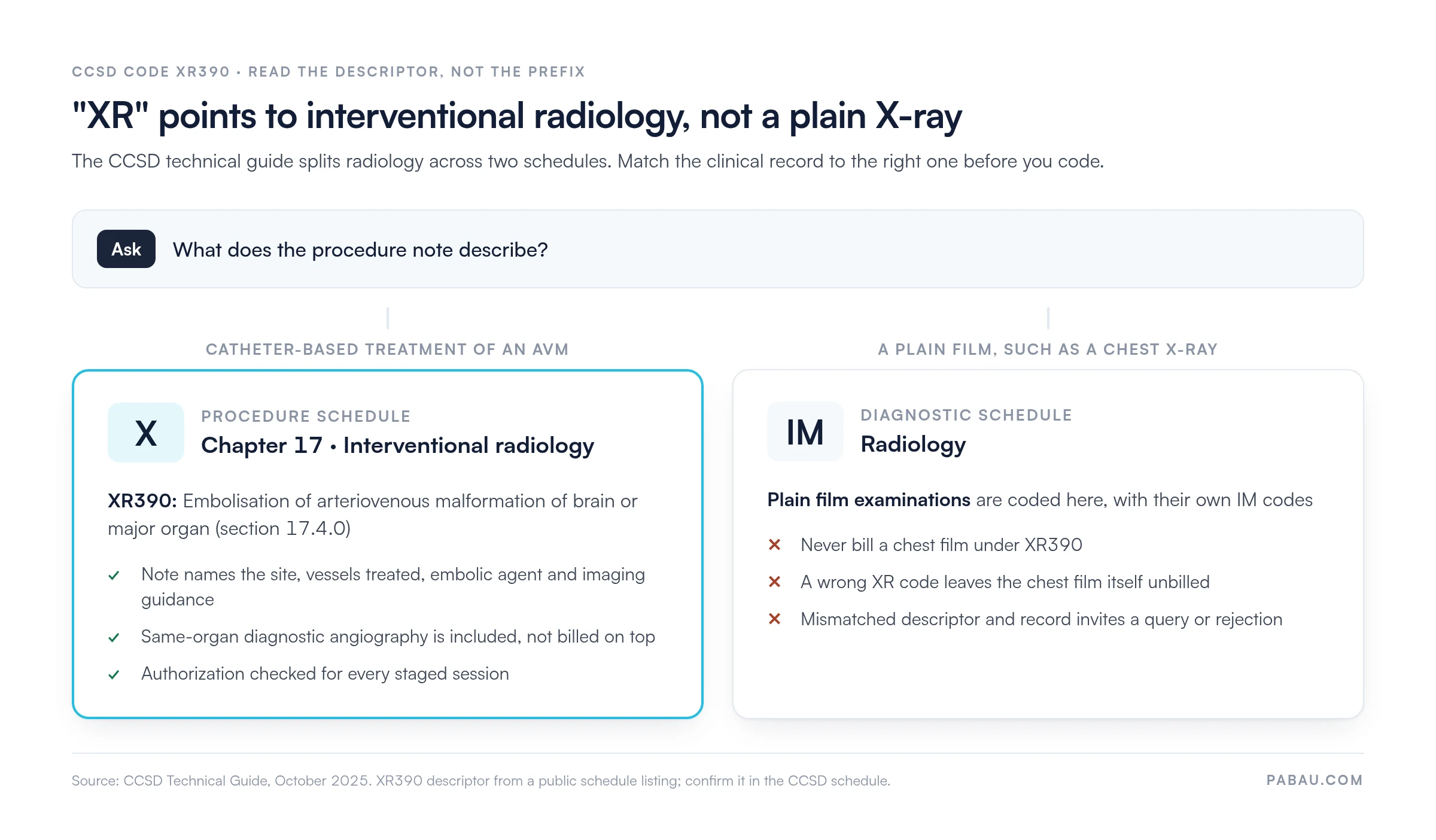
So a busy billing team that sees “XR” and attaches the code to a chest film has made two errors. The claim describes a complex vascular procedure, and the chest film itself goes unbilled. Expect a query or a rejection when the descriptor and the clinical record don’t match.
A claim paid under the wrong code is no safer, either. It can resurface in a later audit. Always look up a code by its descriptor, never by its prefix alone. Our CCSD codes library helps you check neighboring entries before you commit to one.
Knowing the clinical sequence helps you read the procedure note. Details vary by site and center, but a brain AVM case at a unit such as UCLH follows this shape.
For billing, one point matters most. Embolization may be the whole treatment, or it may come before surgery or gamma knife radiosurgery. Large AVMs can also need more than one session, and each stage creates its own claim.
Take an illustrative case. A privately insured patient has a brain AVM, found on a scan after a seizure. The neurovascular team recommends embolization before radiosurgery.
First, the medical secretary calls the insurer with the planned code, the diagnosis and the consultant’s details. The insurer issues an authorization reference, which goes straight onto the patient record.
On the day, the interventional neuroradiologist treats the AVM through the femoral artery. The note names the AVM’s location, the feeders treated, the embolic agent and how much of the AVM was closed off.
Next, the consultant’s invoice goes out with XR390, the authorization reference and the diagnosis. The hospital bills its own charges, such as the bed and the angiography suite, separately.
Three months later, the team plans a second session. This time, the secretary asks the insurer for fresh authorization rather than reusing the first reference. That one call heads off the most common staged-treatment rejection.
The descriptor names a lesion, a site and a technique. Your notes should prove each part of it.
AVM care rarely fits one booking, so authorization works differently case by case. Use this table as a prompt for the call to the insurer.
Insurer rules change, so check each policy at booking. Last year’s answer for a similar patient is no guarantee.
Most UK private claims travel electronically. Our Bupa CCSD codes guide shows how one major insurer handles them. The order below keeps an XR390 claim complete at each handoff.
Most rejections trace back to missing data, not a clinical dispute. Work through the steps in order.
We don’t quote a fee or complexity band for XR390 here. The schedule values sit behind a login, and insurers set their own rates on top. Check these sources instead.
In many private practices, the authorization reference sits in an email and the procedure note in the hospital system. The invoice then gets built somewhere else again. With staged AVM treatment, that happens once per session.
Pabau, a practice management platform, keeps the insurer details, authorization references and clinical notes on one patient record. Its claims management software checks that the required claim fields are complete before a claim can be sent.
Claims then go to insurers through Healthcode, and your team tracks their status in the same system. When a query comes back, the answer is already on the record.
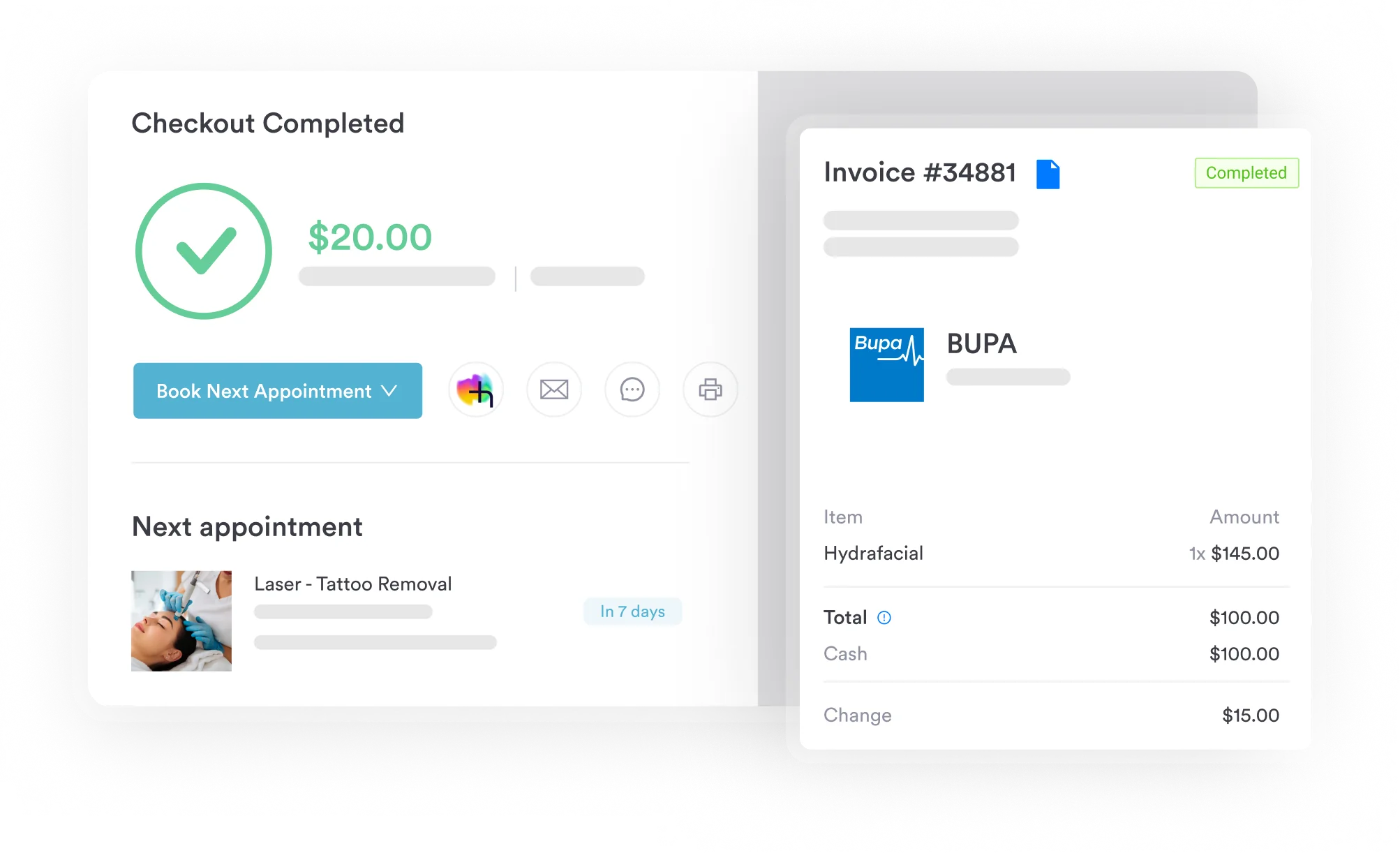

Pabau keeps authorization references, clinical notes and insurer details on one patient record and sends CCSD invoices through Healthcode. Your team tracks each session’s claim in the same place.

XR390 is an interventional code for a serious vascular procedure, and a clean claim starts with reading it that way. Code from the descriptor rather than the prefix, and the most damaging error disappears.
After that, the work is record-keeping across stages. Ask the operator to name the site, the vessels and the agent in every note. Then confirm authorization for each session before the invoice goes out.
Book a demo to see how Pabau keeps authorization, notes and Healthcode claims on one patient record.

Billing another interventional radiology code? CCSD code XR410 covers thrombolysis or aspiration of thrombus, another XR code that isn’t a plain X-ray.
Need a full reference for Bupa procedure codes? Bupa CCSD codes covers how Bupa uses the CCSD schedule, with billing rules and submission guidance.
Looking for Bupa fee schedule context? Bupa procedure codes fee schedule explains how Bupa sets rates for CCSD-coded claims.
Want fewer claim queries across the practice? Claims management software shows how Pabau tracks CCSD invoices from submission to payment.
Yes. The main embolic agent is a glue-like liquid, but small metal coils or permanent balloons are occasionally used too. Name whichever was used in the procedure note.
At least four to five days at a specialist unit such as UCLH’s National Hospital for Neurology and Neurosurgery. The procedure itself usually takes one to three hours.
For a brain AVM, usually an interventional neuroradiologist, working in an angiography suite. The treatment plan is normally agreed with a neurovascular team that includes neurosurgeons.
CCSD stands for the Clinical Coding and Schedule Development Group. It maintains the CCSD schedule, the standard set of procedure and diagnostic test codes used across UK private healthcare.
It depends on the policy. An AVM known before the policy started may fall under a pre-existing condition exclusion. Check the policy wording and get authorization before treatment.