

HCPCS code E0198: Water pressure pad billing guide
HCPCS code E0198 is a water pad for a standard mattress HCPCS code E0198 is the ...

Last Updated: Oct 13, 2026
A0180 is the CCSD code for excision of abscess of brain. CCSD stands for Clinical Coding and Schedule Development, the group that maintains the procedure schedule used by UK private medical insurers. The code covers open removal of a brain abscess capsule through a craniotomy, not aspiration or burr hole drainage.
A0180 sits in Chapter 2 of the CCSD schedule, section 2.1 Brain. Bupa, AXA Health, Aviva, and Vitality price and adjudicate the code against their own published fee schedules. Claims normally pair it with ICD-10 diagnosis code G06.0, intracranial abscess and granuloma.
Let Pabau's smart automation suggest the right codes, reduce claim denials, and keep your practice compliant—effortlessly.
Automate repetitive tasks and focus on what matters most—your patients.
Reduce coding errors and ensure compliance with the latest regulations.
Clean claims, fewer denials, and faster reimbursements.
Powerful insights and reporting to help your practice thrive.
HIPAA compliant SOC 2 certified GDPR-compliant Trusted by 4,000+ clinics worldwide

CCSD code A0180 covers open surgical excision of a brain abscess capsule, not aspiration or stereotactic drainage.
ICD-10 code G06.0 (intracranial abscess and granuloma) is the standard diagnosis code paired with A0180 claims.
The ICD-10 G06 block holds only three sub-codes, so there is no unspecified option to fall back on.
UK insurers require pre-authorisation before an elective A0180 procedure, and emergency cases need retrospective authorisation with imaging support.
Practice management software like Pabau lets billing staff attach pre-auth numbers, link ICD-10 codes, and submit claims electronically.
CCSD code A0180 is the procedure code for excision of abscess of brain in the UK private medical insurance schedule. CCSD stands for Clinical Coding and Schedule Development, the group that maintains that schedule at ccsd.org.uk. The code represents an open neurosurgical operation in which the surgeon removes the abscess capsule and infected material through a craniotomy. That distinguishes it from minimally invasive drainage or aspiration procedures. A0180 sits in Chapter 2 of the CCSD schedule, section 2.1 Brain. Billing staff use it when invoicing UK insurers for this specific operative intervention.
Other intracranial procedures share that Chapter 2 Brain section. Deep brain stimulation, for example, is billed under CCSD code A0980.
Acoustic neuroma excision falls in that same section. Removal of a tumour under 2.5 cm by a single surgeon is billed under A2952. Where the tumour exceeds 2.5 cm or compresses the brainstem, A2953 applies.
The code descriptor is precise. The word “excision” signals open surgical removal, not aspiration. Billers who treat A0180 as interchangeable with drainage codes see consistent rejection. Bupa, AXA Health, Aviva, and Vitality all price A0180 claims off the CCSD schedule, so that one distinction decides whether the invoice is paid.
The scope of A0180 is deliberately narrow. Knowing what falls inside and outside the code prevents the most common billing errors.
The practical test for A0180 eligibility is whether the operative report documents capsule excision through open craniotomy access. If the note describes aspiration, needle drainage, or image-guided burr hole aspiration only, A0180 is the wrong code. The CCSD code index lists the drainage and aspiration entries that apply instead.
Medical billers do not need to perform the surgery, but they do need to recognise it in operative notes. Here is the typical sequence for a procedure coded under A0180:
The operative report’s explicit documentation of capsule excision at step four is the single most important element auditors look for when reviewing an A0180 claim.
Every A0180 claim must carry a valid ICD-10 diagnosis code. According to the WHO ICD-10 browser, the G06 block covers intracranial and intraspinal abscess and granuloma. The block holds only three sub-codes, so there is no unspecified entry to fall back on. Choosing between them matters, because insurers validate the procedure-diagnosis combination before approving payment.
G06.0 is the workhorse code for A0180 claims. Because G06 carries no unspecified sub-code, there is no catch-all to hedge with. A coder who is unsure of the site has to go back to the imaging report and settle it.
A0180 does not stand alone on a claim. Several companion codes typically appear on the same invoice. Getting that code set right matters as much as selecting A0180 itself, because a missing theatre or anaesthesia line leaves fees unrecovered.
Before submitting an A0180 claim, reconcile every code on the invoice against the current CCSD schedule. That confirms companion billing is permitted for the schedule year. CCSD codes and companion-billing rules are updated annually. Billing a craniotomy access code that a schedule revision has bundled into A0180 is a common source of duplicate-billing denials.
The highest-risk coding error for brain abscess claims is a mismatch between access and code. Billers pick a drainage or aspiration code for an open excision, or the reverse. Use the table below as a quick-reference differentiator.
The operative report is the deciding document. When it states “aspiration of abscess” or “burr hole drainage,” A0180 does not apply. When it states “excision of abscess capsule” or “marsupialisation via craniotomy,” A0180 is the correct choice.
Anatomical site drives a second code choice. Where the operative note places the abscess in the meninges rather than the brain parenchyma, A3810 applies. Its descriptor is excision of lesion of meninges of brain.
UK private medical insurers require prior authorisation before an elective A0180 procedure is performed. Bupa, AXA Health, Aviva, and Vitality each issue an authorisation number against a named consultant and procedure code. Emergency cases are handled retrospectively, and even then the documentation requirements are strict.
Coverage rules and authorisation timeframes vary by insurer and by policy. Bupa, AXA Health, Aviva, and Vitality each publish their own recognition criteria and benefit limits for neurosurgery. Always verify the specific insurer’s requirements before submitting.
The operative report is the primary audit document for A0180 claims. Insurers and their clinical auditors compare the claim against the operative note to confirm that what was billed matches what was done. Six elements decide how that comparison goes.
For a high-value neurosurgery claim like A0180, an incomplete operative report is the fastest route to denial or recoupment after audit. Chasing an addendum months later, once the consultant has moved on to other cases, rarely goes well.
A0180 denials follow predictable patterns, and each one traces back to a step in the claim where a document was missing. The six steps below map where each requirement sits. Every denial has a corresponding fix and a prevention step.
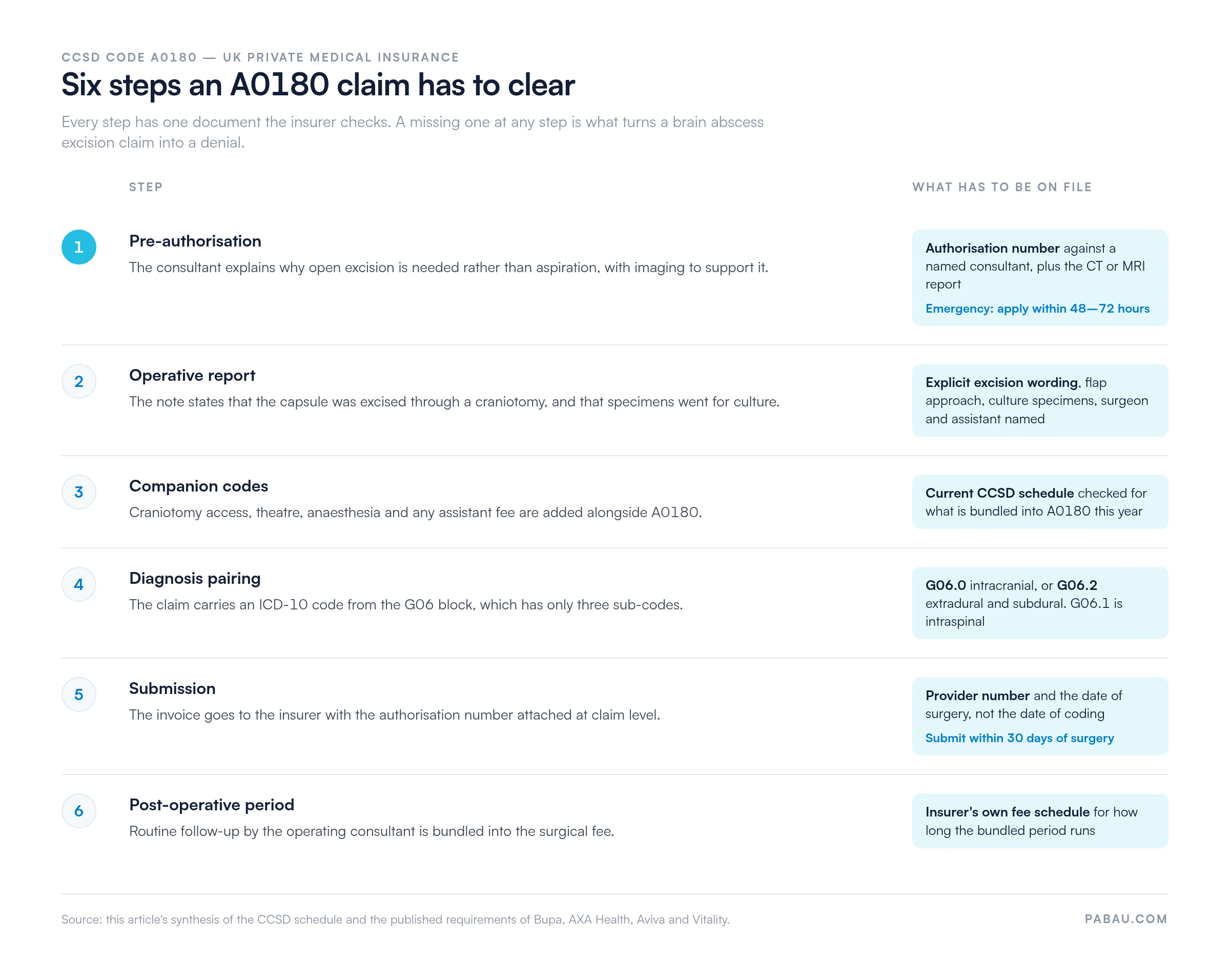
When an A0180 claim is denied for an ICD-10 mismatch, cross-reference the operative report against the ICD-10 G06 block before resubmitting. Check whether G06.0 (intracranial), G06.2 (extradural or subdural), or a secondary code for the underlying cause of infection applies. Use the WHO ICD-10 tabular list to verify code specificity rather than relying on memory.
UK insurers bundle a defined period of routine post-operative care into the surgical fee for A0180. Follow-up consultations by the operating consultant during that bundled period are not separately billable to the insurer.
Consultations that fall outside the bundled period may be billed separately using the applicable consultation code. The same holds for a new or distinct clinical problem arising after the index procedure. The exact duration of the bundled period varies by insurer and by schedule year. Confirm the current rule against the insurer’s own published fee schedule before billing post-operative visits.
Practices billing several neurosurgery procedures a month benefit from software that flags post-operative consultations against the index procedure date. That removes the risk of invoicing inside the bundled period. Re-reading the Bupa fee schedule at the start of each schedule year keeps those rules current.
Submitting an A0180 claim electronically to a UK insurer requires several elements to be linked correctly in the practice management system. Most UK practices route those invoices through Healthcode, the clearing house the major insurers use, so an incomplete record fails before it reaches adjudication.
Practice management software like Pabau gives neurosurgery billing staff claim templates that carry A0180 alongside its standard companion codes. Staff attach the authorisation number at invoice level and link the ICD-10 code before the claim is sent.
Our medical claims management tools keep the authorisation, the operative note and the invoice on one patient record. When an insurer queries an A0180 claim, the evidence is already together rather than spread across three systems. Book a demo to see how that workflow handles neurosurgery billing.

Pabau links the authorisation number, the ICD-10 diagnosis and the companion codes to the same patient record, so a neurosurgery invoice leaves the practice complete. Billing staff stop rebuilding claims after a rejection.

A0180 is a high-value claim that turns on one line in the operative report. Where the note records excision of the capsule through a craniotomy, the code holds. Where it records aspiration or drainage, no amount of appeal correspondence rescues it. The moment to settle that wording is before the consultant signs the note, not after the rejection arrives.
Practices that get A0180 right treat the authorisation number and the operative note as part of the claim, not as paperwork that trails behind it. Book a demo to see how Pabau holds both against the invoice before it reaches the insurer.

Need the wider CCSD procedure code set? Bupa CCSD codes explains how the schedule is structured and how insurers price against it.
Unsure how far ahead authorisation has to be arranged? The prior authorization process walks through each step, from clinical justification to the number on the claim.
Want fewer claims coming back at all? What makes a clean claim sets out the checks that keep an invoice moving through adjudication first time.
Comparing billing systems for a UK practice? Best medical billing software in the UK reviews the platforms that handle insurer submission.
CCSD code A0180 covers open surgical excision of an intracranial abscess, performed via craniotomy. The abscess capsule is removed from the surrounding brain tissue. It does not cover minimally invasive aspiration, stereotactic drainage, or burr hole drainage procedures, which use separate CCSD codes.
Excision (A0180) requires a craniotomy and physical removal of the abscess capsule through open surgery. Drainage or aspiration procedures use minimally invasive access – a needle, burr hole, or stereotactic frame – without capsule removal, and are assigned separate CCSD codes. Billing A0180 for a drainage-only procedure is the most common claim error for brain abscess surgery.
G06.0 (intracranial abscess and granuloma) is the standard ICD-10 code paired with A0180. G06.2 may apply for extradural or subdural abscess cases where open excision was performed. G06.1 covers intraspinal abscess, a different anatomical site, so it should not be used with A0180. The G06 block carries no unspecified sub-code at all.
UK insurers bundle a standard period of routine post-operative care into the surgical fee for A0180. Follow-up by the operating consultant during that period is not separately billable. The exact duration varies by insurer and by schedule year. Confirm the current rule against the insurer’s published fee schedule before billing post-operative consultations.
Rejections cluster around six causes. The first is using a drainage code instead of A0180, or the reverse. The second is submitting without a valid authorisation number. The third is an ICD-10 mismatch, such as G06.1 instead of G06.0. Claims also fail where the operative report does not explicitly document capsule excision. Duplicate billing of bundled companion codes and missing the insurer’s claim window account for the rest.
Craniotomy access is typically billed separately alongside A0180, as the access procedure and the excision are distinct surgical steps. However, companion-billing rules are updated annually in the CCSD schedule, and some revisions have bundled access codes into the primary procedure fee. Verify against the current CCSD schedule year before including a separate craniotomy code on the claim.



