

CCSD code G5100: Bypass of duodenum billing guide
CCSD code G5100 bills a bypass that leaves the duodenum in place CCSD code G5100...

Last Updated: Oct 16, 2026
A3810 is the CCSD code for excision of a lesion of the meninges of the brain. It covers removal of a lesion arising from or attached to the dura mater, arachnoid mater, or pia mater at cranial level. Meningiomas, meningeal cysts, and meningeal abscesses are the usual indications.
The craniotomy used to reach the lesion is part of A3810 and is never billed separately. UK private insurers, including Bupa and AXA Health, require pre-authorization before the procedure. The operative note must name the meningeal layer, the laterality, and the extent of resection.
Let Pabau's smart automation suggest the right codes, reduce claim denials, and keep your practice compliant—effortlessly.
Automate repetitive tasks and focus on what matters most—your patients.
Reduce coding errors and ensure compliance with the latest regulations.
Clean claims, fewer denials, and faster reimbursements.
Powerful insights and reporting to help your practice thrive.
HIPAA compliant SOC 2 certified GDPR-compliant Trusted by 4,000+ clinics worldwide

CCSD code A3810 is the UK private billing code for excision of a lesion of the brain’s meninges.
Bupa, AXA Health, and other major UK insurers require pre-authorization before an A3810 procedure goes ahead.
The operative note must state the meningeal layer, the approach, the laterality, and the lesion type.
Without that detail, insurers down-code the claim to a decompression code or refuse it outright.
Practice management software like Pabau validates mandatory claim fields before an A3810 submission leaves the practice.
CCSD code A3810 is the Clinical Coding and Schedule Development Group’s procedure code for excision of a lesion of the meninges of the brain. A3810 applies when a neurosurgeon removes a discrete lesion arising from or adherent to one of those layers at the cranial level.
The meninges are the three protective membranes around the brain and spinal cord. They are the dura mater on the outside, the arachnoid mater in the middle, and the pia mater innermost.
The code sits in the CCSD neurosurgery section, and major UK private medical insurers accept it. Bupa and AXA Health both publish CCSD-aligned procedure schedules for specialist billing.
You can check the current descriptor against Bupa’s code search portal or against the Bupa CCSD code list. A3810 does not cover a brain tumor excision or a decompressive craniotomy, because the lesion must involve meningeal tissue.
Removing a meningeal lesion requires a craniotomy approach in most cases. The neurosurgeon raises a bone flap to reach the intracranial compartment, then opens the dura.
The lesion is identified at its meningeal attachment and resected as completely as oncological and anatomical safety allows. The dura is then closed and the bone flap replaced or secured.
The procedure divides into five operative stages that billing teams should recognize when checking the operative note.
The whole surgical episode maps to A3810. If the lesion extends into the brain parenchyma and substantial intraparenchymal resection is also performed, a different or additional CCSD code may apply. The operative note has to make that distinction explicit.
A3810 is appropriate for a meningeal lesion whose size, location, or growth makes surgical excision the recommended management. The diagnoses that reach a UK private neurosurgical list most often are these:
An abscess inside the brain tissue itself, rather than in the meningeal layers, is excised under CCSD code A0180. Both codes pair with G06.0, so the operative note has to name the layer that was opened.
Insurers expect the diagnosis code submitted with A3810 to match the lesion type confirmed on histopathology or imaging. Filing D32.0 for a lesion reported as WHO grade II is a mismatch, and it triggers a query or a denial.
Where pathology is still pending, use the most specific suspected lesion code in the ICD-10-CM code set and say so in the claim narrative.
The most frequent error in meningeal lesion billing is reaching for A3810 when another CCSD neurosurgery code fits the procedure better. The reverse happens just as often, when a brain excision code is applied to a procedure confined to the meningeal layers. The table below maps the adjacent codes that matter on an intracranial neurosurgical list.
A lesion arising from a cranial nerve inside the skull, rather than from the meninges, is excised under A2900. Trigeminal and facial nerve schwannomas are the usual indications for that code.
Where a neuroendoscope is used to biopsy or fenestrate an intraventricular lesion, the correct code is A1700 rather than A3810. That code also bundles the ventricular examination performed in the same session.
Drainage of the subarachnoid space without excision of a lesion falls to A2210 instead. Opening the arachnoid to release cerebrospinal fluid or blood does not meet the A3810 descriptor.
Always verify adjacent code descriptors against the current CCSD schedule, because code numbers and descriptors are updated over time. Unbundling rules apply as well. The craniotomy access is included within A3810 and must not be billed separately.
The operative note is the primary document insurers use to audit an A3810 claim. A note that does not map onto the code descriptor will draw a query, a down-coding request, or a refusal. The checklist below reflects what Bupa, AXA Health, and most UK private insurers ask for on a meningeal excision claim.
Supporting documents help as well. Attach the pre-operative MRI or CT report, plus any multidisciplinary team outcome that recorded the decision to operate. Insurers often ask for both as supplementary evidence.
Pre-authorization is standard for A3810 across every major UK private medical insurer. Meningeal lesion excision is costly and clinically complex, so insurers want approval on file before the procedure goes ahead.
Submitting an A3810 claim with no pre-authorization reference is the most common reason a claim comes back unprocessed.
Requirements, timescales, and accepted evidence vary by policy year and plan type. Check current insurer guidance rather than last year’s process. Approval does not guarantee payment either, because the claim still has to satisfy the documentation and coding rules.
A structured submission workflow cuts re-work and shortens the wait for payment on meningeal excision claims. The six checkpoints below are where UK private insurers actually test the claim, and each one has its own failure mode.
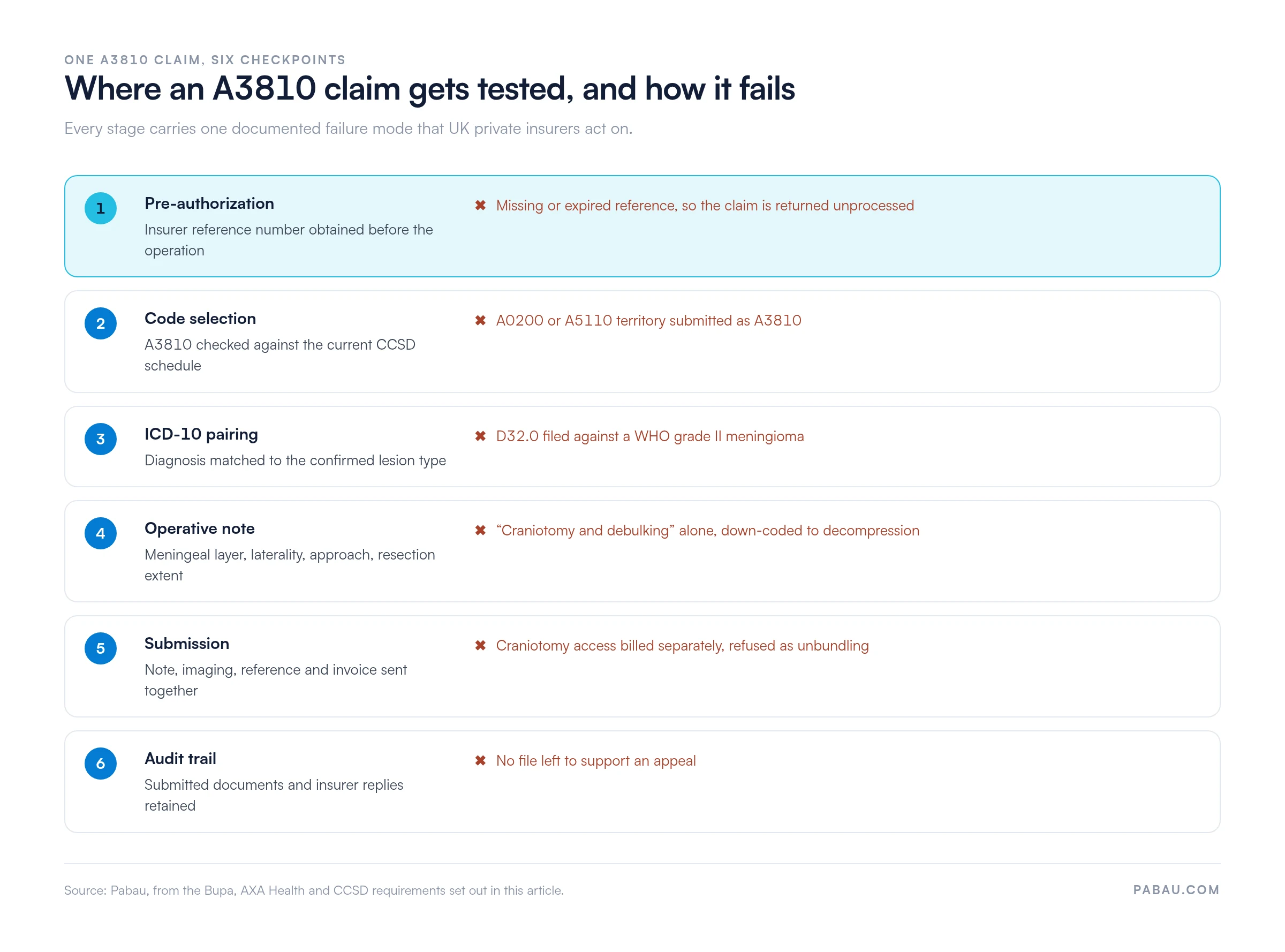
Denial rates for neurosurgical claims run higher than for most elective specialties, because the documentation bar is high and the sums are large. Six patterns account for most A3810 refusals.
Request a copy of each insurer’s written denial reason before drafting an appeal. Bupa and AXA Health are required to provide the specific reason for any claim refusal. An appeal that addresses the stated reason directly, with supporting documentation, succeeds far more often than a general resubmission.
Meningeal lesion excision involves an anesthetic team, and often a surgical assistant. Both fees can be billed alongside A3810 under most UK private insurer frameworks. Co-billing is one of the most misunderstood parts of CCSD neurosurgery billing, and getting it wrong triggers bundling denials.
The anesthetist submits a separate claim, using the CCSD anesthetic code that matches the duration and ASA classification. Cranial meningeal lesion excision is a major intracranial procedure, so these codes are time-based and often sit at ASA III or IV.
Under standard CCSD rules that claim is independent of A3810 and is not bundled into the surgeon’s fee. Neither party includes the other’s professional fee on their own claim.
An assistant surgeon’s fee may be claimable in addition to A3810, though insurer acceptance varies. Bupa, AXA Health, and most UK private insurers recognize it for complex neurosurgery where a second surgeon is clinically justified.
The assistant needs their own CCSD provider number, their own claim form, and the primary surgeon’s pre-authorization reference. Some insurers also ask the primary surgeon to confirm on the claim that an assistant was required.
Two habits trigger denials here. Billing the assistant’s fee inside the surgeon’s claim is the first, and skipping the check that the policy covers it is the second.
Manual CCSD billing for complex neurosurgery leaves too much to memory. A billing administrator holds the pre-authorization reference in an email, the operative note in a hospital system, and the invoice in a spreadsheet. One missing field is enough to send the claim back.
Practice management software like Pabau closes that off at the point of care. Mandatory field validation stops an A3810 claim from being submitted without an ICD-10 pairing, a pre-authorization reference, or consultant identification.
Operative note templates carry the A3810 fields, so the surgeon records the meningeal layer, the laterality, and the resection extent in theatre. The claim record then keeps every submitted document, insurer reply, and appeal outcome on one searchable timeline.
For a multi-consultant unit, software for billing teams also checks that each consultant’s CCSD provider number and GMC registration are current. That check runs before the claim goes out, not after a rejection lands.

Pabau validates CCSD codes, tracks pre-authorization references, and stores claim documentation in one system, so an A3810 submission leaves the practice complete.

A3810 pays reliably when the paperwork matches the descriptor, and it fails predictably when it does not. Three checks decide the outcome: the pre-authorization reference, the meningeal detail in the operative note, and the ICD-10 pairing.
Get those three right before the patient leaves theatre, and the appeal work never starts. Chase them afterwards and you are reconstructing evidence for an insurer who has already refused you.
Book a demo to see how Pabau validates CCSD codes and tracks pre-authorization references before a claim is submitted.

Billing a spinal intradural lesion instead? CCSD code A5110 covers the code that applies when the lesion sits at spinal rather than cranial level.
Struggling to get insurer approvals on file? Prior authorization process sets out how approval is obtained before a procedure goes ahead.
Appealing more claims than you would like? Denial management in healthcare covers how practices track, appeal, and prevent refused claims.
CCSD code A3810 covers surgical excision of a lesion of the meninges of the brain. Meningiomas, meningeal cysts, arachnoid cysts, and meningeal abscesses removed through a craniotomy all fall under it. The craniotomy access is included within A3810 and is not coded separately.
A3810 is specific to excision of a meningeal lesion. Craniotomy codes in the CCSD schedule cover decompressive procedures where no lesion is excised. A craniotomy performed purely for decompression or hematoma evacuation does not qualify. The operative note must confirm excision from the meningeal layer.
Yes. Bupa requires pre-authorization for neurosurgical procedures, A3810 included. The reference number must be obtained before the procedure and must appear on the claim form. Claims submitted without a valid Bupa reference are returned unprocessed.
The operative note must state that a lesion of the meninges of the brain was excised. It must identify the meningeal layer and the anatomical location, confirm laterality, document the surgical approach, and state the completeness of resection. The claim also carries the ICD-10 code, the pre-authorization reference, and the consultant’s GMC and CCSD provider numbers.
The most common reasons are a missing pre-authorization and an operative note that does not support the A3810 descriptor. Down-coding to a decompression code, an ICD-10 mismatch against the confirmed pathology, and unbundling the craniotomy access account for the rest.
Yes. The anesthetist submits a separate claim under the appropriate CCSD anesthetic code, and it is not bundled into the surgeon’s A3810 fee. A surgical assistant’s fee may also be claimable where the insurer recognizes it for complex neurosurgery. Acceptance varies by policy, and the assistant needs their own CCSD provider number.



