CPT Code 62284: Injection procedure for myelography
CPT Code 62284: official descriptor and procedure overview The American Medical ...

Last Updated: Oct 19, 2026

CCSD code 0309T covers a pre-sacral interbody fusion, an arthrodesis at the lumbar L4–L5 interspace performed through the pre-sacral approach, and it bundles disc space preparation, discectomy, posterior instrumentation, image guidance, and bone graft (when performed) into one code.
Because so much sits inside that one code, the most common 0309T mistake is billing an included step, like the discectomy or the instrumentation, as a separate line. Check the CCSD Schedule’s bundling rules before you itemise anything further.
Spinal fusion is major elective surgery, so pre-authorisation is standard practice with UK private medical insurers. Get it in writing before the operation, not after.
Practice management software can route CCSD-coded claims straight to insurers via a Healthcode integration, cutting the manual re-entry that causes coding errors.
CCSD code 0309T covers a pre-sacral interbody fusion, an arthrodesis at the L4–L5 interspace carried out through the pre-sacral approach. The code takes in the disc space preparation, the discectomy, the posterior instrumentation, any image guidance used, and the bone graft, when performed, all under a single line on the invoice.
Bill any one of those included steps as its own line, and the claim reads as duplicate billing to an insurer’s coding checks, however clean the surgery was. Here is what the code actually covers, how a claim like this should move from theatre to payment, and where 0309T claims get rejected.
0309T is billed for a lumbar interbody fusion, an arthrodesis, at the L4–L5 disc space, using the pre-sacral (sometimes called axial) approach. Rather than reaching the disc through an incision in the back or the abdomen, the surgeon works through a small corridor near the tailbone to get to the L4–L5 interspace from below.
The code is written to bundle the components that go with that fusion: preparing the disc space, removing the disc material (the discectomy), placing posterior instrumentation to hold the segment, the image guidance used to confirm level and placement, and the bone graft that promotes fusion, when a graft is used.
That last point matters more than it looks. A lot of billing mistakes on fusion codes come from treating a bundled code like a menu, adding the instrumentation or the discectomy back in as though they were extras. They are not extras here. They are what 0309T already pays for.
The restriction runs the other way on some CCSD codes. CCSD code A2080 pays for a ventricular puncture only when no other major neurosurgical work is billed in that session.
The Clinical Coding and Schedule Development (CCSD) Group maintains the CCSD Schedule, the shared list of codes that UK private medical insurers, among them Bupa, AXA Health, Aviva, Vitality, and WPA, use to describe procedures like this one on an invoice. The Group writes the code and its narrative. It does not set the price.
Each insurer decides separately whether it recognises 0309T for a given consultant, what it pays for it, and whether the patient’s policy covers a fusion at all. Two consultants billing the same code to the same insurer can end up with different reimbursement, depending on their recognition status and their individual contract.
There is no national tariff to quote, so treat any fee figure you come across as a starting point to verify, not a fact to bill against.
Fusion surgery has more steps than most CCSD-coded procedures, and each one is a place a claim can stall. Here is the journey, start to finish.
Here is a fairly typical, illustrative case. A patient in their late fifties has had six months of physiotherapy and injections for confirmed degenerative disc disease at L4–L5, without lasting relief. MRI confirms the level, and they are booked in with a consultant recognised by their insurer for spinal surgery.
Pre-authorisation is requested two weeks ahead of surgery, referencing the MRI and the failed conservative treatment, and comes back approved with a reference number.
On the day, the consultant performs the pre-sacral interbody fusion at L4–L5: disc space preparation, discectomy, posterior instrumentation, fluoroscopic image guidance, and a bone graft. The operation note records all of it, even though it will all sit under one code on the invoice.
The invoice goes out with 0309T, the matching diagnosis code, the pre-authorisation reference, and correct references for the consultant, the assisting surgeon, and the anaesthetist. A few days later, a query comes back: the insurer’s system has flagged what looks like the instrumentation billed twice.
It was not. It was a formatting slip on the original invoice, and it is resolved the same day by sending across the operation note. That single exchange is the most common friction point on a code like this, and it is exactly why keeping the note ready to hand matters.
Accurate CCSD codes are only half the job — day-to-day practice management decides how quickly insurers pay.
If a claim on a fusion code is ever queried or audited, the paperwork is what defends it. Before you file, make sure the following are in place and agree with each other.
Keep a copy of the operation note attached to the claim before you submit, even if the insurer has not asked for it upfront. It is the fastest way to answer a bundling or level query without a week-long delay waiting on medical records.
Ask what 0309T pays, and the honest answer is that it depends, and for a procedure this size, it depends on more than just the code. The CCSD Group sets the narrative. Each insurer sets its own rate against it, and that rate can move with your recognition status and your individual contract.
Spinal fusion also tends to involve more than one fee. The surgeon’s fee for the procedure itself, an assistant’s fee where a second surgeon or an assisting practitioner is involved, and the anaesthetist’s fee are usually billed and adjudicated separately, alongside any hospital charge for theatre time, implants, and the inpatient stay.
A patient’s policy will also have its own benefit maximum for a procedure of this scale, so even a correctly coded, correctly authorised claim can still leave a shortfall if the total sits above what the policy covers.
None of that is something any article can put a figure on. Check the rate that applies to you directly with the insurer, ideally at the same time you request pre-authorisation, so the patient knows what to expect before the operation rather than after.
Rejections on a code like this are rarely mysterious. Nearly all of them trace back to a handful of avoidable slips, and once you have seen them a few times, you start catching them before the claim leaves the practice.
The single biggest mistake specific to 0309T. Billing the discectomy, the instrumentation, the image guidance, or the graft as separate lines alongside 0309T reads as duplicate billing to an insurer’s coding checks, however necessary each step was clinically. If it is part of the bundle, it does not get its own line.
Pituitary surgery follows the same rule. Under B0410, a nasal endoscopy or a sphenoid sinus exploration belongs to the transsphenoidal approach, so neither is claimed separately.
The imaging, the signed consent, the operation note, and the invoice all need to agree on L4–L5. Even a typo, one document saying L4–L5 and another saying an adjacent level, is an audit flag on spinal cases and can hold up the whole claim while it is queried.
Elective spinal fusion almost always needs pre-authorisation, and it needs to be requested and granted before the operation, not applied for afterwards. Operating first and sorting the paperwork later rarely ends well when the procedure is this significant.
The authorisation also has to name the procedure you actually perform, not the one you planned. Authorisation granted for B2752 does not cover the case once an implant turns it into a different mastectomy code.
Vagotomy claims turn on the same point. An approval written against CCSD code A2720 fails if the operation note describes a truncal vagotomy instead.
The diagnosis on the invoice needs to justify a fusion outright, reflecting the confirmed pathology at the point of treatment, not just the symptom the patient first presented with months earlier.
Fusion surgery frequently involves more than one billing provider: the operating consultant, an assisting surgeon, and the anaesthetist. Each needs their own correct, current insurer reference. This bites hardest in group practices where one administrator bills for several consultants at once.
Run through this before the invoice leaves the building. Every line maps to a rejection reason above.
Recognition is not a one-off box to tick, and for major surgery, insurers tend to look at it closely. Bupa, for example, only pays for a procedure that falls within the consultant’s recognised specialty and is listed in its own Schedule of Procedures. A CCSD-listed procedure that isn’t yet on Bupa’s schedule has to be requested so Bupa can adopt it first.
In practice, getting recognised to bill a procedure like this usually means:
Timelines vary from a couple of weeks to a few months.
Recognition is granted against a specialty, so a consultant on the neurosurgical side bills cranial codes from the same CCSD schedule. A4010 covers evacuating an extradural hematoma.
Manual CCSD billing for a procedure like this has more moving parts than most: the code itself, a matching diagnosis, a pre-authorisation reference, and separate provider references for everyone involved in the case. Typed from memory across several invoices, that is exactly where transposition errors and level mismatches creep in.
Practice management software like Pabau, an all-in-one platform built for clinics and private practices, keeps those pieces attached to the same patient record instead of scattered across notes and spreadsheets.
A CCSD code like 0309T can be looked up and applied at the point of invoicing, the pre-authorisation reference sits against the same appointment.
For a case with this many moving documents, its digital intake and consent forms also help, since the signed consent, the pre-op questionnaire, and the operation note can sit against the same record the invoice is built from, rather than in a separate filing system that has to be cross-checked by hand.
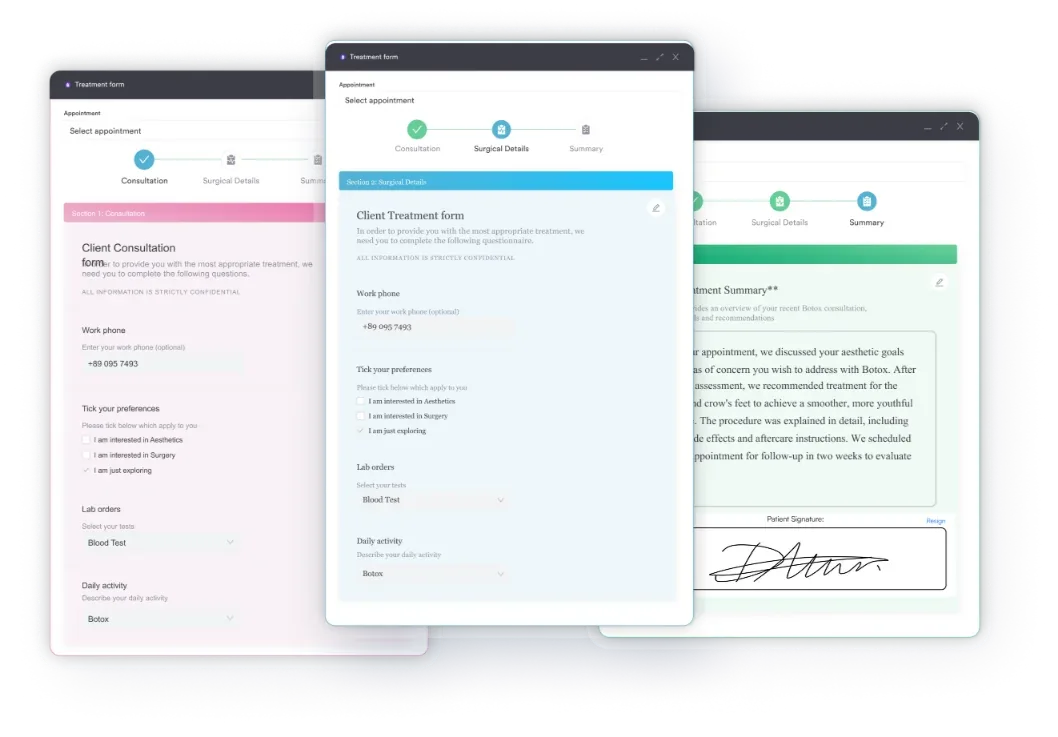

Pabau helps UK private practices apply the right CCSD code at the point of invoicing, keep pre-authorisation and consent against the same record, and submit claims to insurers through Healthcode, so fewer claims come back queried and your team spends less time on billing admin.

CCSD code 0309T is a single code for a bundled procedure: a pre-sacral interbody fusion at L4–L5, complete with the disc preparation, discectomy, instrumentation, image guidance, and graft that go with it. The code itself is straightforward. Getting paid for it depends on the workflow around it, from recognition and pre-authorisation through to a level that matches on every document and a diagnosis that genuinely justifies fusion surgery. Billing compliance programs work when someone reviews a sample regularly, rather than after a payer letter arrives.
Get that workflow right, and 0309T looks after itself. Get the bundling wrong, even by accident, and a clean operation can still come back as a rejected or queried claim.

Billing pressure-reducing equipment instead? powered air mattress billing guide covers the powered pressure-reducing air mattress and the prior authorization it has required since 2019.
Billing a bed code without side rails? hospital bed without side rails guide covers the fixed-height hospital bed supplied without side rails or a mattress.
Billing a hospital bed upgrade instead? total electric hospital bed guide covers the total electric hospital bed Medicare denies as a convenience feature.
CCSD code 0309T is a CCSD Schedule code for a pre-sacral interbody fusion, an arthrodesis at the lumbar L4–L5 interspace, using the pre-sacral approach. It bundles the disc space preparation, discectomy, posterior instrumentation, image guidance, and bone graft, when performed, into one code.
Instead of reaching the L4–L5 disc space through an incision in the back or the abdomen, the surgeon accesses it through a small corridor near the tailbone. It changes the surgical approach, not the billing rules that sit around the code.
No. The discectomy, the posterior instrumentation, the image guidance, and the bone graft, when used, are all part of what 0309T covers. Billing any of them as a separate line alongside 0309T reads as duplicate billing to an insurer and is one of the most common reasons a claim on this code gets queried or clawed back.
Yes, in practice almost always. Spinal fusion is major elective surgery, and UK private medical insurers expect a pre-authorisation number in place before the operation, not applied for afterwards. Get it in writing and put the reference on the invoice.
The major UK private medical insurers, including Bupa, AXA Health, Aviva, Vitality, and WPA, all work from the CCSD Schedule. Whether a specific insurer covers 0309T for a specific patient depends on that patient’s policy and on your recognition status with that insurer, so confirm both before you bill rather than assuming.
There is no fixed national fee. The CCSD Group sets the code and its narrative, not the price, so each insurer applies its own rate, and spinal fusion claims often involve separate surgeon, assistant, and anaesthetist fees on top of any hospital charge. Check the figure that applies to you with the insurer before you set expectations with the patient.
Imaging confirming the L4–L5 level and pathology, a written pre-authorisation reference, signed consent naming the correct level and procedure, an operation note describing what was actually done, a diagnosis code that supports fusion surgery, and correct provider references for everyone billing on the case.
No, not from the CCSD Group itself. The code and its narrative sit inside the live CCSD Schedule, which is a login-gated resource at ccsd.org.uk, so there isn’t a single public PDF of the 0309T entry to download. What you will find are insurer PDFs, since individual insurers publish their own procedure or fee schedules that reference CCSD codes, so check the specific insurer’s published schedule for how they treat 0309T and their maximum benefit.
No. CCSD is the coding schedule for the UK private healthcare sector, maintained for use by private medical insurers, so 0309T is used when billing a private spinal fusion, not NHS-funded care. NHS activity is recorded under its own coding systems, OPCS-4 for procedures, rather than CCSD.