

ICD-10 Code S53.013D: Anterior subluxation of unspecified radial head
ICD-10 Code S53.013D: Quick reference summary Use the table below as your first ...

Last Updated: Nov 6, 2026
Billable Code Specific Code
T32.82 is the billable ICD-10-CM code for corrosions involving 80-89% of body surface with 20-29% third degree corrosion. It is complete at five characters and takes no 7th character.
T32.82 records how much of the body a chemical injury covers, not where the injury sits. Code the T51-T65 chemical and intent first, then any documented site codes, then T32.82 for extent. A thermal burn of the same extent goes to T31.82 instead.
Let Pabau's smart automation suggest the right codes, reduce claim denials, and keep your practice compliant—effortlessly.
Automate repetitive tasks and focus on what matters most—your patients.
Reduce coding errors and ensure compliance with the latest regulations.
Clean claims, fewer denials, and faster reimbursements.
Powerful insights and reporting to help your practice thrive.
HIPAA compliant SOC 2 certified GDPR-compliant Trusted by 4,000+ clinics worldwide

T32.82 is a billable ICD-10-CM code for chemical corrosions covering 80-89% of total body surface area. Thermal burns of the same extent use T31.82.
The fifth character (2) records that 20-29% of the body surface is third-degree corrosion, and the provider must document that figure.
T32.82 is complete at five characters and takes no 7th character. The A, D or S belongs on the chemical code and the site codes.
Code the T51-T65 chemical and intent first, then T32.82 for extent. When the corrosion sites are documented, their T20-T25 codes come before T32.82.
ICD-10 Code T32.82 is a billable ICD-10-CM diagnosis code with the official descriptor “Corrosions involving 80-89% of body surface with 20-29% third degree corrosion.”
It sits in Chapter 19 (Injury, poisoning and certain other consequences of external causes), under category T32.
Category T32 classifies corrosions by the percentage of total body surface area (TBSA) involved, not by anatomical site. T32.82 is complete as written, with five characters and no 7th character extension.
The code hierarchy runs Chapter 19 > T20-T32 (Burns and corrosions) > T32 (Corrosions classified according to extent of body surface involved) > T32.8 (80-89% TBSA) > T32.82. Confirm your code selection against the CDC/NCHS ICD-10-CM web tool for the current fiscal year before submission. Our library of ICD-10-CM codes also lists the neighboring T31 and T32 extent codes.
Category T32 uses two characters after the category to encode two clinical measurements. The fourth character gives the total TBSA range in tens of percentage points. The fifth character gives the share of the body surface that is third-degree corrosion.
Applied to T32.82, “8” means 80-89% total TBSA, and “2” means 20-29% of the body surface is third-degree corrosion. A coder needs both values documented by the treating provider before the code can be assigned.
TBSA estimation in clinical practice uses the Wallace Rule of Nines or the Lund-Browder chart. The Rule of Nines assigns 9% to the head and to each arm, and 18% to each leg. It also assigns 18% each to the front and back of the trunk, and 1% to the perineum.
For pediatric patients, the Lund-Browder chart adjusts for a proportionally larger head. Coders do not calculate TBSA themselves. They code from the percentages the physician or other qualified provider documents.
Confirm both percentages are documented before you assign T32.82. If the note gives the total extent but not the third-degree share, query the provider. T32.80 covers 0-9% third degree, so never use it as a stand-in for an undocumented figure.
T32.82 and T31.82 share the same TBSA structure, 80-89% total and 20-29% third degree, but they code different causes. T31 covers thermal burns from flame, contact heat, radiation, electricity and friction. T32 covers corrosions caused by chemical agents such as acids, alkalis and other caustic substances.
Coding a corrosion as T31, or a thermal burn as T32, is an etiology error. A T32 code without a T51-T65 chemical code invites a payer edit or an audit query. So does a T32 code paired with a fire or hot-substance external cause code. The note must name the causative agent, and the coder should query the provider when it does not.
T32.82 is a complete, valid code at five characters. T32.82A, T32.82D and T32.82S do not exist, so adding an extension to T32.82 creates an invalid code.
The 7th character still matters on a corrosion claim. It sits on the chemical and site codes that travel with T32.82, and it follows the encounter status the provider documents.
On the partner codes, A applies while the patient receives active treatment. D applies to routine healing visits after active treatment ends, and S applies to late effects. A common error is assigning D to a readmission that is still active treatment.
Per the ICD-10-CM Official Guidelines for Chapter 19, A applies throughout active treatment, whether or not it is the first visit. The guidelines published by CMS set out this distinction, so always consult the current fiscal year release.
T32.82 rarely stands alone. The corrosion site codes in T20-T25 (e.g. T21.4-, T21.7-) carry a code-first note for T51-T65. T32 itself has none, only a note that it is primary only when the site is unspecified. Chapter 20 adds external cause codes for context.
The guidelines use T32 as the first-listed corrosion code only when the site is not specified. When the sites are documented, T32 is an additional code for extent data. The guidelines advise an extent code when third-degree involvement reaches 20% or more, and treat burns and corrosions alike.
For inpatient stays, principal diagnosis selection follows UHDDS guidelines. When a complication of the corrosion is the reason for admission, the complication may take the principal position. Coders can check the code hierarchy in the AAPC Codify ICD-10-CM lookup.
Accurate T32.82 coding hinges on explicit provider documentation. Coders cannot calculate, estimate or infer either TBSA value from nursing notes or general descriptions. Both must come from an attending physician, surgeon or other qualified provider.
The record must contain each of these items before T32.82 can be assigned and before you can submit a clean claim:
When documentation is ambiguous, query the provider with a compliant clinical documentation improvement (CDI) query rather than making a coding assumption. AHIMA guidance on query format and clinical indicators supports this practice.
At 80-89% TBSA, T32.82 almost always involves an inpatient acute care admission, often at a designated burn center. That shapes payer requirements across Medicare, Medicaid and commercial plans.
Under Medicare, inpatient burn and corrosion stays group to MS-DRGs 927-935 in MDC 22 (Burns). The grouper weighs the extent codes alongside mechanical ventilation and skin grafting. The coder owns accurate code selection, and the grouper assigns the DRG.
Check the current grouper logic in the CMS MS-DRG classifications and software for the applicable fiscal year.
Emergency burn admissions usually need notification to the plan, while scheduled grafting, transfers and rehabilitation may need prior authorization. Confirm requirements with the specific plan.
Medical necessity documentation should include the TBSA figures, degree, causative agent and the treatment plan. Claims management software that tracks payer-specific rules lowers the risk of an avoidable denial on these high-cost admissions.
T32.82 claims are denied most often for errors that the right documentation and denial management workflows prevent. The table below maps each common denial cause to its corrective action.
Billing software such as Pabau, the practice platform we build, can stop several of these errors before a payer sees them. Pabau’s claim validation checks each claim for missing or invalid details before it is sent through the Claim.MD clearinghouse. Coding errors are then fixed at the front end rather than returned as denials weeks later.
Run a monthly audit of T32 denials grouped by reason code. Missing chemical codes and absent external cause codes are common triggers on corrosion claims. A short review of the CARC codes on those claims shows which error drives your team’s rework.
The T32.8 subcategory holds nine codes, one for each 10-point band of third-degree involvement. Selecting the wrong fifth character is a specificity error. It may not trigger an automated denial, but it creates audit exposure and can skew DRG assignment.
When total TBSA reaches 90% or more, the coder moves to the T32.9 subcategory. T32.90 through T32.99 follow the same two-character logic as T32.8. Like T32.82, none of them takes a 7th character.
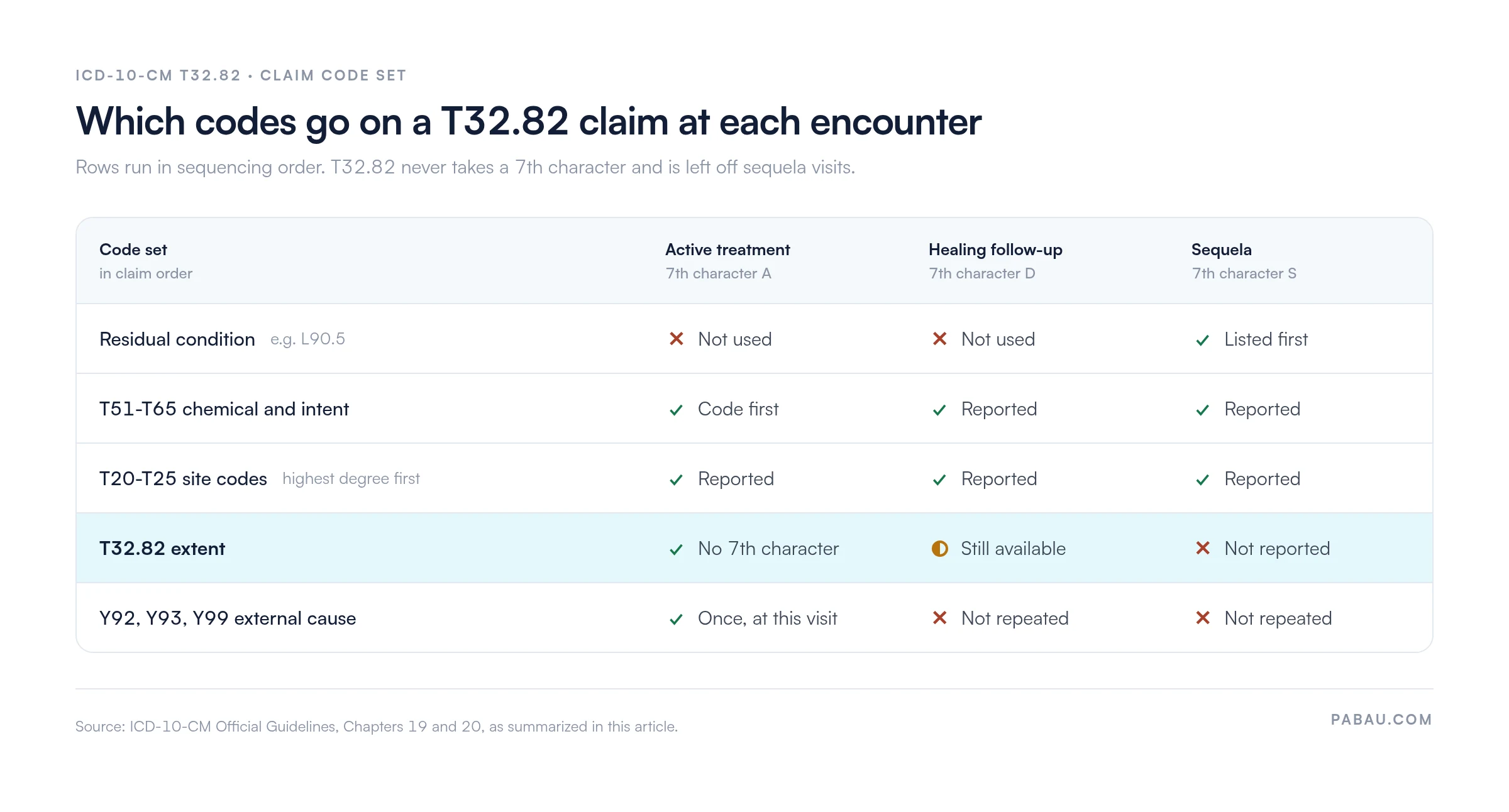
Sequela coding applies when a patient returns for a late effect of the corrosion, such as hypertrophic scarring, scar contracture or rehabilitation. By then the acute corrosion has healed, so the code set changes.
List the residual condition first, such as L90.5 (Scar conditions and fibrosis of skin). Then report the site-specific corrosion code and its T51-T65 chemical code, each with an S in the 7th position. Guideline I.C.19.d.6 says T31 and T32 codes are not used for sequelae, so T32.82 is left off sequela encounters. The matrix below maps each code set across the three encounter stages.
An 80-89% corrosion admission carries a chemical code, several site codes, T32.82, external cause codes and graft procedures. Teams that assemble that claim by hand often find a missing code only when the payer rejects it.
Pabau pre-fills each claim from the invoice, so the codes and charges your team posted at checkout carry straight onto it. Required fields are checked before the claim can be sent.
In the US, claims go out through Claim.MD, with eligibility checks and ERA remittance posting. Your team fixes a missing chemical code before submission instead of in an appeal weeks later.

Pabau pre-fills claims from the invoice, checks required fields before sending, and tracks each claim to payment through Claim.MD.

T32.82 rests on two figures in the provider’s note: 80-89% total extent and a 20-29% third-degree share. When either figure is missing, query the provider before billing.
The code itself is complete at five characters. Claims on it fail because of what surrounds it, such as a missing T51-T65 chemical code or T32.82 listed ahead of known sites. Carrying T32.82 onto a sequela visit is another avoidable error. Build the full code set at the first submission, and a high-cost burn center stay is far less likely to come back.
Pabau checks required claim fields before submission, so a missing chemical or site code is caught before the payer sees it. Book a demo to see how it fits your burn and corrosion billing workflow.

Need a foundation for understanding burn and corrosion billing? Medical billing fundamentals for clinical practices covers the end-to-end billing workflow including how diagnosis codes drive reimbursement.
Struggling with claim rejections on complex injury codes? How the Claim.MD clearinghouse integration works explains how claims travel from the practice to the payer through the clearinghouse.
Want to reduce your team’s denial workload? Medical billing compliance best practices outlines the documentation and coding standards that keep high-acuity claims out of the denial queue.
ICD-10 Code T32.82 is a billable diagnosis code for corrosions (chemical burns) involving 80-89% of total body surface area. Third-degree corrosion covers 20-29% of the body surface. The code classifies the extent of a chemical injury rather than its location. It is complete at five characters, with no 7th character.
Yes. T32.82 is a billable, valid ICD-10-CM code as written, with five characters and no 7th character. When the corrosion sites are documented, it is reported as an additional code after the chemical and site codes.
T31 covers thermal burns from heat sources such as flame, contact heat, electricity, radiation and friction. T32 covers corrosions caused by chemical agents such as acids, alkalis and caustic substances. Both use the same TBSA structure, but a T32 code is paired with a T51-T65 chemical code coded first.
No. T32.82 is complete at five characters, and T32.82A, T32.82D and T32.82S do not exist. The 7th character belongs on the T51-T65 chemical code and the T20-T25 site codes reported with it.
No. Coders cannot calculate or assume clinical values the physician or qualified provider has not documented. Both the total TBSA percentage and the third-degree percentage must appear in the record before T32.82 can be assigned. Send a CDI query when either value is missing.
List the late effect first, such as L90.5 for scarring. Then add the site-specific corrosion code and its T51-T65 chemical code, each with an S in the 7th position. T32.82 is not reported for sequela encounters, because the guidelines exclude T31 and T32 from sequela coding.



