

ICD-10 Code S42.444P: Medial epicondyle fracture, right humerus
ICD-10 Code S42.444P: full descriptor and code validity ICD-10 Code S42.444P car...

Last Updated: Oct 13, 2026
Billable Code Specific Code
T31.82 is the billable ICD-10-CM code for burns involving 80-89% of body surface with 20-29% third degree burns.
The code carries two percentages, and both are measured against the whole body surface. The first says how much skin is burned at any depth. The second says how much of that skin is burned to full thickness. Neither figure is a share of the other, and the record has to state both.
Let Pabau's smart automation suggest the right codes, reduce claim denials, and keep your practice compliant—effortlessly.
Automate repetitive tasks and focus on what matters most—your patients.
Reduce coding errors and ensure compliance with the latest regulations.
Clean claims, fewer denials, and faster reimbursements.
Powerful insights and reporting to help your practice thrive.
HIPAA compliant SOC 2 certified GDPR-compliant Trusted by 4,000+ clinics worldwide

T31.82 is a billable ICD-10-CM code for burns covering 80-89% of body surface, with 20-29% of body surface burned to third degree. It took effect on October 1, 2025, in the FY2026 edition.
The 4th character (8) sets the share of body surface burned at any depth. The final character (2) sets the share burned to third degree.
T31 codes carry no 7th character, so nothing follows that 5th character. The A, D and S extensions belong to the site-specific burn codes in T20-T29.
T31.80 is not an unspecified code. It reports 0% to 9% third degree involvement, so it understates a record that documents 22%.
Practice management software like Pabau validates the full ICD-10 code set before submission, which cuts denials on high-severity burn claims.
Burns at this TBSA threshold are classified as massive burns. They typically require intensive care admission, fluid resuscitation, and specialist burn center management. The 80-89% range represents near-total body involvement, with only small areas of intact skin left.
Three clinical facts drive code selection in this range. First, the TBSA figure covers burns of any depth. Second, the third degree figure is separate, and it is also measured against total body surface. Third, the record has to quantify both numbers before T31.82 holds up on audit.
At 80-89% TBSA, even patients with low third degree percentages face severe mortality risk. The distinction between T31.82 (20-29% third degree) and T31.80 (0% to 9% third degree) affects DRG assignment and case-mix index directly. Accurate documentation therefore carries clinical and financial weight. For broader context on ICD-10-CM injury and condition codes across different diagnostic categories, the underlying classification principles are consistent.
The final character of a T31 code records how much body surface is burned to third degree. In T31.82 that character is the 2, and it stands for 20-29% of body surface. T31 codes take no 7th character at all, so the code is complete at five characters. The A, D and S extensions that coders reach for on other injury codes belong to the site-specific burn codes in T20-T29.
That distinction is where T31 codes go wrong most often. A coder who reads the second figure as a share of the burned area lands on the wrong final character. The figure is a share of the whole body.
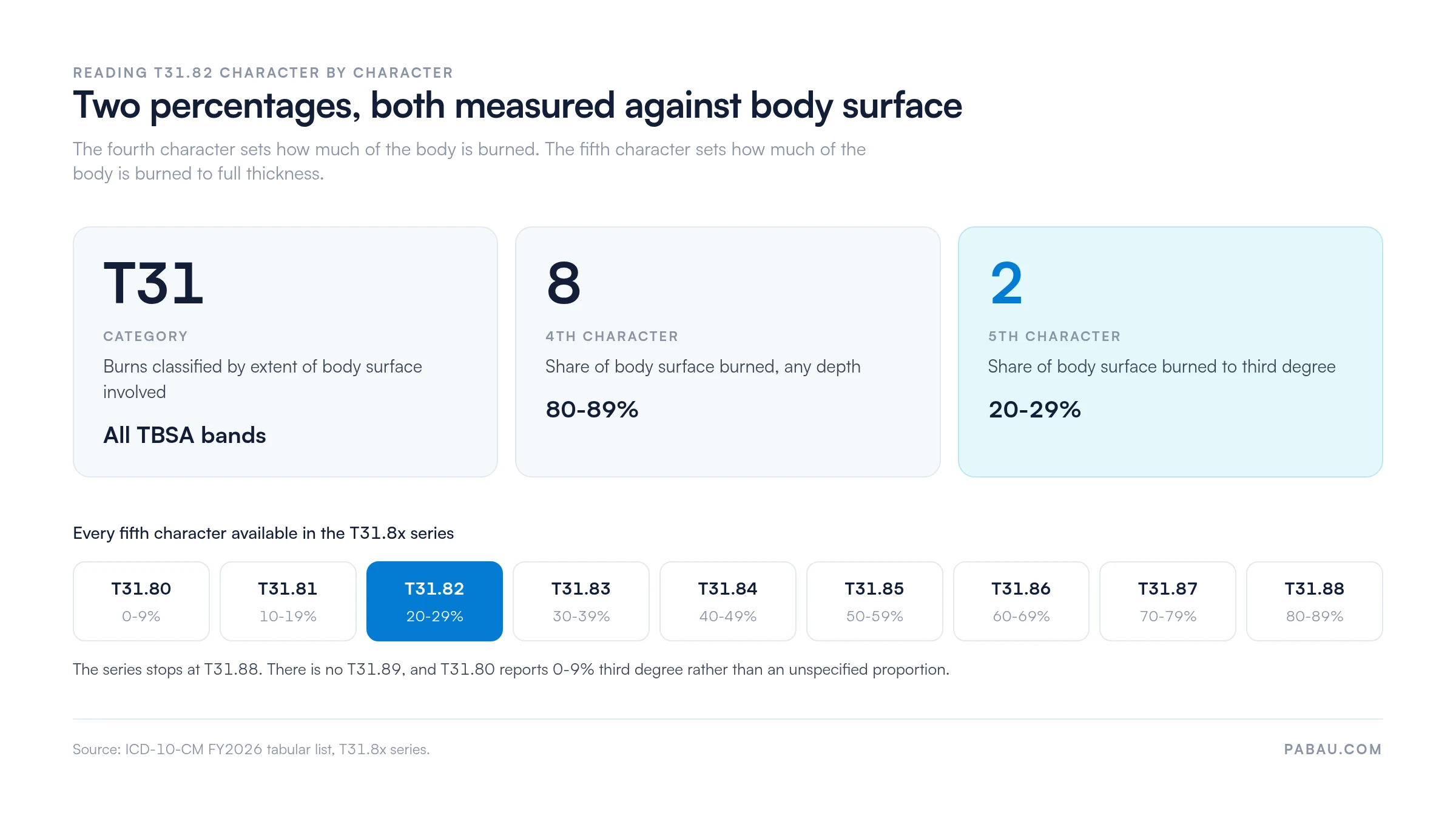
For T31.82, burns cover 80-89% of body surface and 20-29% of body surface is full thickness. Subtract one range from the other and roughly 51% to 69% of body surface is burned to a lesser depth. That remainder may be second degree, first degree, or a mix of both.
The series ends at T31.88. There is no T31.89, so a claim carrying it will reject as an invalid code before a payer ever reviews the record.
T31.80 is not a fallback for missing detail either. It reports 0% to 9% third degree involvement, which is a positive statement about depth rather than an absence of one. Choosing it when the record quantifies 22% understates severity and leaves reimbursement on the table. Sequencing rules work the same way across other high-acuity injury codes (see ICD-10-CM sequencing rules for analogous multi-code scenarios).
The T31 parent category covers burn diagnoses organized by the extent of body surface involved, whatever the burn depth or anatomical site. It runs parallel to the site-specific burn codes in T20-T29. Inpatient settings use it most, because that is where the overall physiological burden has to be captured for DRG assignment.
The full ICD-10-CM hierarchy for T31.82 runs from the S00-T88 block, to T31, to T31.8 (burns involving 80-89%), to T31.82 (with 20-29% third degree). For coders navigating adjacent ICD-10-CM diagnosis code references, the hierarchical structure applies consistently across code categories.
TBSA calculation is the foundation of accurate T31 code selection. Burn care recognizes two methods, and coders should know both, because the method used changes what appears in the record.
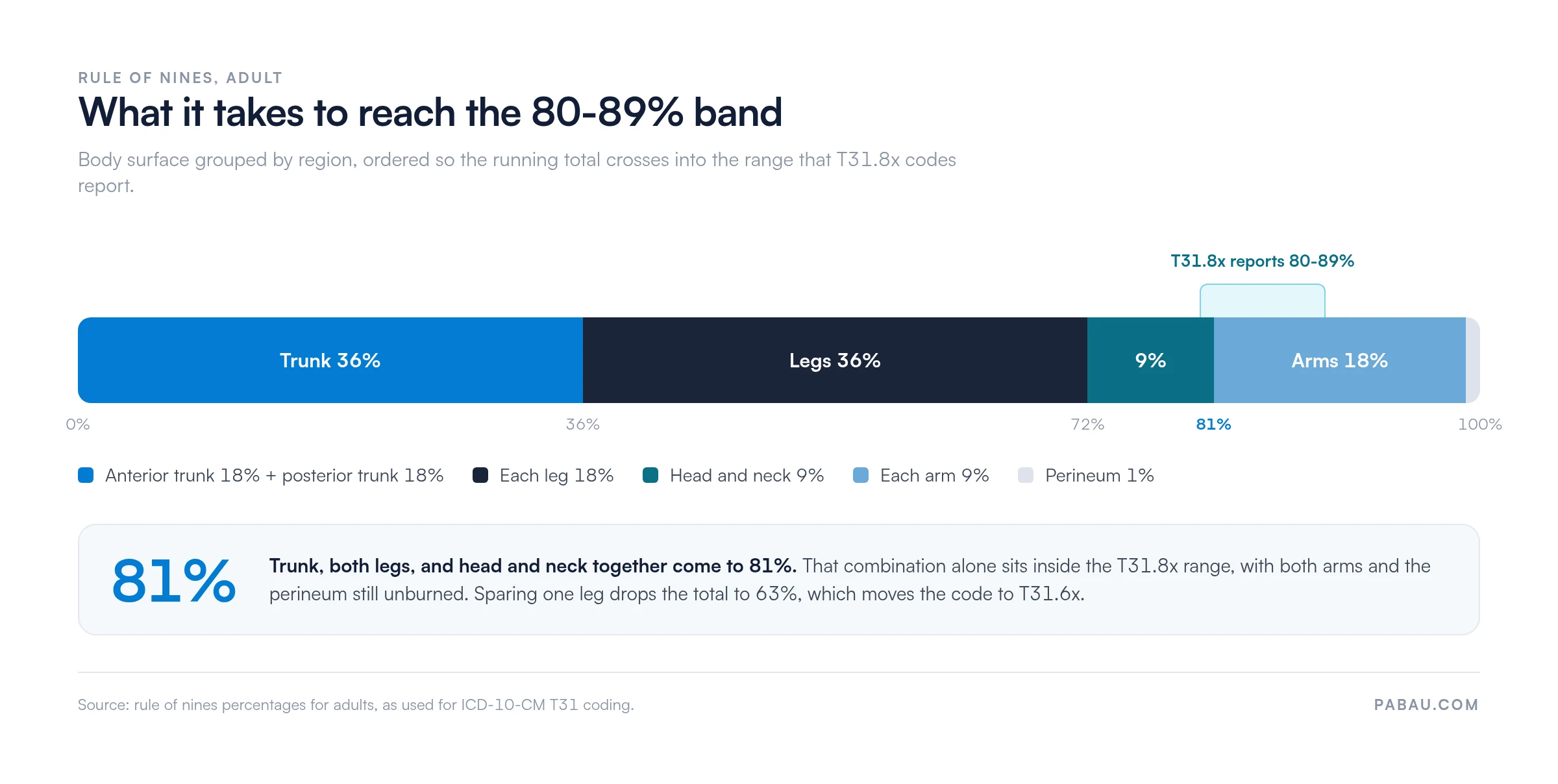
The rule of nines divides the adult body into regions, each representing roughly 9% of total body surface area. It is the most widely used bedside estimation tool, and the ICD-10-CM guidelines name it as the basis for the T31 category.
Those regions add up in a way that matters for code selection. It takes the trunk, both legs, and the head and neck together to reach the 80-89% band that T31.8x reports.
The Lund-Browder chart is more precise, particularly for pediatric patients, whose head and leg proportions differ from adults. When a clinician documents TBSA with the Lund-Browder method, the coder takes that figure as written rather than recalculating it from the rule of nines.
For T31.82, the record must show total burn involvement at 80-89% of body surface and third degree involvement at 20-29% of body surface. Both figures have to be there before the T31 code holds up.
Document TBSA and third degree percentage as two distinct values in the burn assessment note. A phrase like ‘extensive third-degree burns’ does not support ICD-10 code T31.82. The record needs explicit numbers, for example ‘TBSA 82%, third degree 22% of body surface.’
Under ICD-10-CM burn coding guidelines, T31.82 usually works as an additional diagnosis code in inpatient records, alongside site-specific burn codes from T20-T29. Where the extent of the burns drives management, a T31 code may be sequenced as the principal diagnosis. That happens most often when the individual burn sites cannot be fully enumerated.
The ICD-10-CM tabular list carries a “use additional code” instruction with T31.82. It calls for companion external cause codes that identify the source, place, and intent of the burn. Leaving those companion codes off is a leading cause of denials on high-severity burn diagnoses. Understanding claim denial management workflows helps billing teams respond efficiently when these codes are rejected.
External cause coding for T31.82 covers three dimensions: the source of the burn, the place it happened, and the activity at the time. Code all three when the record supports them. Accurate medical billing documentation at this level supports clean claim submission and reduces payer queries.
ICD-10-CM guidelines treat external cause coding as mandatory for inpatient records under most facility policies, though payer requirements vary. Some commercial payers treat these codes as optional on the professional claim and required on the facility claim. Check the individual payer policy before leaving them off a submission.
The electronic claims via Claim.MD integration supports submission across 4,000+ US payers. Built-in ICD-10 code catalogs validate the full code set before the claim leaves the practice.
A T31.82 claim without supporting documentation is the fastest path to a denial or a post-payment audit recovery. The CMS ICD-10 codes page sets the standard: specificity must be supported by the clinical record. For T31.82, that means five documentation elements must be present.
When the third degree figure is missing, query the provider rather than reach for T31.80. That code states that 0% to 9% of body surface is third degree, which is a different clinical picture. An addendum documenting 22% third degree involvement supports T31.82 instead, and the two codes can carry meaningfully different DRG weight.
Building clean claim submission standards into your documentation workflow catches these omissions at the point of care rather than at billing. Practices using electronic remittance advice processing can spot denial patterns tied to incomplete burn documentation across a patient population.
T31.82 and T32.82 carry identical TBSA and third degree qualifiers, so the two look interchangeable in a code lookup. They describe different injury mechanisms, and picking the wrong one misstates both the clinical record and the claim.
The selection rule is simple. If the mechanism is chemical, code T32.82. If it is thermal, electrical, radiation, or friction, code T31.82. The injury history in the emergency department note or transfer documentation settles it. Both codes use the same qualifier system, so the coding mechanics are identical once the mechanism is established.
Operative notes, burn center transfer summaries, and discharge documentation use varied clinical language that maps to T31.82. Coders who meet these terms should read them as pointers to this code when the two percentages match.
None of these phrases triggers T31.82 on its own without explicit numbers. A note reading “massive burns, approximately 80% of body” establishes only the first figure. The coder has to query for the third degree percentage, or confirm it from a documented wound assessment. Refer to the AAPC ICD-10-CM code lookup for cross-referencing synonyms against the official tabular list. Revenue cycle operations that handle high-acuity coding benefit from structured query workflows (see revenue cycle management in burn care for broader documentation frameworks).
When you review burn documentation, look for two separate percentage figures in the same note. If only one appears, it is usually the total TBSA. Query for the third degree percentage before you choose the final character.
A T31.82 claim leaves the practice carrying two documented percentages, a set of external cause codes, and a DRG that depends on both. In most billing teams, someone checks that set by hand against the record before the claim goes out. Anything missed comes back weeks later as a denial, by which time the coder has moved on to other charts.
Practice management software like Pabau keeps the note and the claim in one system. The figures a provider documents are the figures the claim reports. Our claims tools validate the ICD-10 code set before submission and run eligibility checks against the payer. A code that will not pass gets caught while the chart is still open.
Claims then go out through the Claim.MD integration, which reaches more than 4,000 US payers and returns remittance advice into the same record. Your team spends less time rekeying codes between systems, and less time reworking denials that a pre-submission check would have caught.

Pabau’s claims management tools support ICD-10 code validation and real-time eligibility checks, so high-acuity codes like T31.82 reach payers with the full code set attached.

T31.82 asks for two numbers, both measured against body surface, and it gives up nothing without them. Read the final character as a share of the burned area instead of the whole body, and the claim goes out wrong. On this diagnosis, DRG weight moves with depth.
So the query is worth making. A provider addendum that puts the third degree figure in the record costs a few minutes. On a claim that will be audited, it is the difference between T31.80 and T31.82.
Pabau’s claims management software validates ICD-10 code sets before submission and integrates with Claim.MD for eligibility and remittance processing. To see how that shortens the trip from documentation to payment on complex claims, book a demo.

Need to understand ICD-10 sequencing across injury categories? Intraparenchymal hemorrhage ICD-10 codes walks through principal vs. additional diagnosis sequencing in complex injury presentations.
Want a clean claim checklist for high-acuity submissions? Clean claim submission standards covers the documentation and code-set requirements that prevent first-pass denials.
Looking to streamline burn billing with a clearinghouse integration? Electronic claims via Claim.MD explains how Pabau connects to 4,000+ payers for ICD-10 validated submissions.
ICD-10 code T31.82 is a billable ICD-10-CM diagnosis code for burns covering 80-89% of total body surface area. Of that body surface, 20-29% is burned to third degree, meaning full thickness. It captures both the overall extent and the depth severity of a major burn injury.
Yes. T31.82 is a specific, billable ICD-10-CM code valid for HIPAA-covered transactions and claims submission. It became effective October 1, 2025 under the FY2026 ICD-10-CM edition and is not a header or non-billable code.
No. T31 category codes carry no 7th character, so T31.82 is complete at five characters. The A, D and S extensions cover initial encounter, subsequent encounter and sequela. They apply to the site-specific burn codes in T20-T29, not to T31.
T31.82 applies to burns caused by heat, flame, radiation, electricity, or friction covering 80-89% TBSA with 20-29% third degree involvement. T32.82 covers the same TBSA and depth percentages but for chemical corrosions caused by acids, alkalis, or caustic agents. The mechanism of injury is the deciding factor, not the wound appearance or extent.
ICD-10-CM guidelines require external cause codes alongside T31.82. Use source codes from X00-X09 (fire/flame) or X10-X19 (hot objects/liquids), a place of occurrence code from Y92, and an activity code from Y93 when documented. Payer requirements for external cause coding on professional vs. facility claims vary, so verify individual payer policies.
The rule of nines is the standard adult bedside tool. It allocates head/neck 9%, each arm 9%, each trunk surface 18%, each leg 18%, and perineum 1%. The Lund-Browder chart provides greater precision for pediatric patients. Coders must use the clinician’s documented TBSA figure, not independently calculate from wound descriptions.
T31.81 and T31.83 sit immediately either side of T31.82 in the series. T31.81 reports 10-19% third degree burns, and T31.83 reports 30-39%. The parent code T31.8 covers all 80-89% TBSA burns regardless of third degree percentage. T31.80 sits at the bottom of the series and reports 0% to 9% third degree burns, and the series ends at T31.88.




