ICD-10 Code T31.77: Burns involving 70-79% of body surface
ICD-10 code T31.77: Quick reference and code details ICD-10 code T31.77 is the b...

Last Updated: Nov 5, 2026
Billable Code Specific Code
S86.222A is the billable ICD-10-CM code for laceration of muscle(s) and tendon(s) of anterior muscle group at lower leg level, left leg, initial encounter. It applies while the patient receives active treatment for a cut through the tibialis anterior, the long toe extensors, or fibularis tertius.
Assignment turns on three details in the note: a documented laceration, explicit left-side laterality, and active treatment at the visit. Missing laterality or the wrong 7th character can cause claim denials.
Let Pabau's smart automation suggest the right codes, reduce claim denials, and keep your practice compliant—effortlessly.
Automate repetitive tasks and focus on what matters most—your patients.
Reduce coding errors and ensure compliance with the latest regulations.
Clean claims, fewer denials, and faster reimbursements.
Powerful insights and reporting to help your practice thrive.
HIPAA compliant SOC 2 certified GDPR-compliant Trusted by 4,000+ clinics worldwide

S86.222A codes a laceration of the anterior muscle group at the lower leg level on the left side. The right leg takes S86.221A, and an unspecified side takes S86.229A.
The 7th character A marks active treatment, not necessarily the patient’s first visit to any provider.
Category S86 carries a code-also note, so an associated open wound of the lower leg (S81.-) gets its own code on the claim.
Extensor tendon repairs in the anterior compartment take CPT 27664 (primary) or 27665 (secondary), not the flexor codes 27658 and 27659.
Pabau’s claims management software, with Claim.MD for US claims, submits and tracks claims from the diagnosis codes recorded on the patient’s record.
ICD-10 Code S86.222A is the billable code for an initial-encounter laceration of the muscles and tendons in the front compartment of the left lower leg. Per the CDC/NCHS ICD-10-CM web tool, it is valid for the current fiscal year. The table below lists the fields a coder checks before submitting the claim.
S86.222A covers a laceration of the muscle(s) and tendon(s) of the anterior compartment at the lower-leg level, left side, during the active treatment phase. Four muscles make up this compartment: tibialis anterior, extensor hallucis longus, extensor digitorum longus, and fibularis (peroneus) tertius. The code applies when any one or more of these structures sustains a laceration, including at the musculotendinous junction or along the tendon itself.
A laceration is a cut or tear through tissue caused by a sharp or shearing force. It differs from a contusion of the lower leg (S80.1-) and from a strain of the anterior muscle group (S86.21x). Sprains apply to joints and ligaments, not muscles. A record that documents a cut, or an open wound with muscle involvement, maps to a laceration. A muscle tear from overuse maps to a strain.
Accurate anatomical documentation matters because laterality drives code selection. A wound in the same compartment on the right leg is S86.221A. Unspecified laterality forces S86.229A, which many payers downcode or deny. Sports medicine and orthopedic emergency practices see these lacerations regularly, so the side belongs in every note.
The 7th character in S86.222A signals the phase of care, not the visit count. A patient seen for the third time after a laceration repair still takes A if the provider is delivering active treatment at that visit.
The ICD-10-CM Official Guidelines for Coding and Reporting are published by NCHS and CMS. Under them, “initial encounter” covers every visit where the patient receives active treatment for the condition, whichever provider is seen. Switch to D once the injury is in the healing phase and the patient receives only routine care. Wound checks and suture removal after the repair count as aftercare, so they take D.
Understanding the parent hierarchy helps coders verify they are at the right level before appending the 7th character.
S86.222 without the 7th character is not billable. Claims submitted without the extension are rejected at the clearinghouse level before reaching the payer. Every code in category S86 requires a 7th character, and the CMS ICD-10-CM codes page carries the current release.
A frequent coding error is choosing the right injury type but the wrong anatomical level or side. The table below sets S86.222A against five codes that are often confused with it.
The S66 and S76 mix-ups happen because coders search the index using “laceration extensor” or “laceration anterior” without specifying the body region. Always verify the anatomical level first: S66 = wrist/hand, S76 = hip/thigh, S86 = lower leg.
The S86 category carries coding instructions that directly affect claim acceptance.
An Excludes2 note means the condition is not part of category S86. When the patient has both conditions, both codes may be reported.
Vague documentation tends to push a claim down to S86.229A (unspecified laterality) or into a denial. Five elements should be in the medical record before you assign S86.222A. Each one also helps the claim meet clean claim requirements.
If any of these elements is missing, query the provider before coding. Assigning S86.222A without supporting documentation is a compliance risk, not a coding shortcut.
Procedure code selection depends on what the provider did at the encounter, not simply on the diagnosis. The table below covers the CPT codes most frequently submitted alongside S86.222A. Physical therapy practices managing post-repair rehabilitation switch to D at follow-up, with therapy CPT codes for the ongoing services.
CPT 27658 and 27659 describe flexor tendon repair, but the anterior compartment holds extensor tendons. Reporting either one with S86.222A may trigger a CPT/anatomy mismatch edit. Primary extensor repair takes 27664, and secondary repair takes 27665. Check descriptors against the current AMA CPT code set, and confirm complex pairings with a certified coder.
When the cut needs layered closure without tendon repair, the complex repair range starting at CPT 13120 applies. Selective debridement of the open wound starts at CPT 97597.
Run your CPT and ICD-10 pairing through a claims scrubber before submission. Anterior-compartment extensor tendon repairs belong on 27664 (primary) or 27665 (secondary). Reporting the flexor tendon codes 27658 or 27659 instead may trigger a CPT/anatomy mismatch edit. A CPT swap costs less to fix before submission than to appeal after a denial.
S86.222A denials usually trace back to one of six root causes. Identifying which one applies tells you what to fix before resubmission. For the wider process, see our guide on denial management workflows and the reference list of medical billing denial codes.
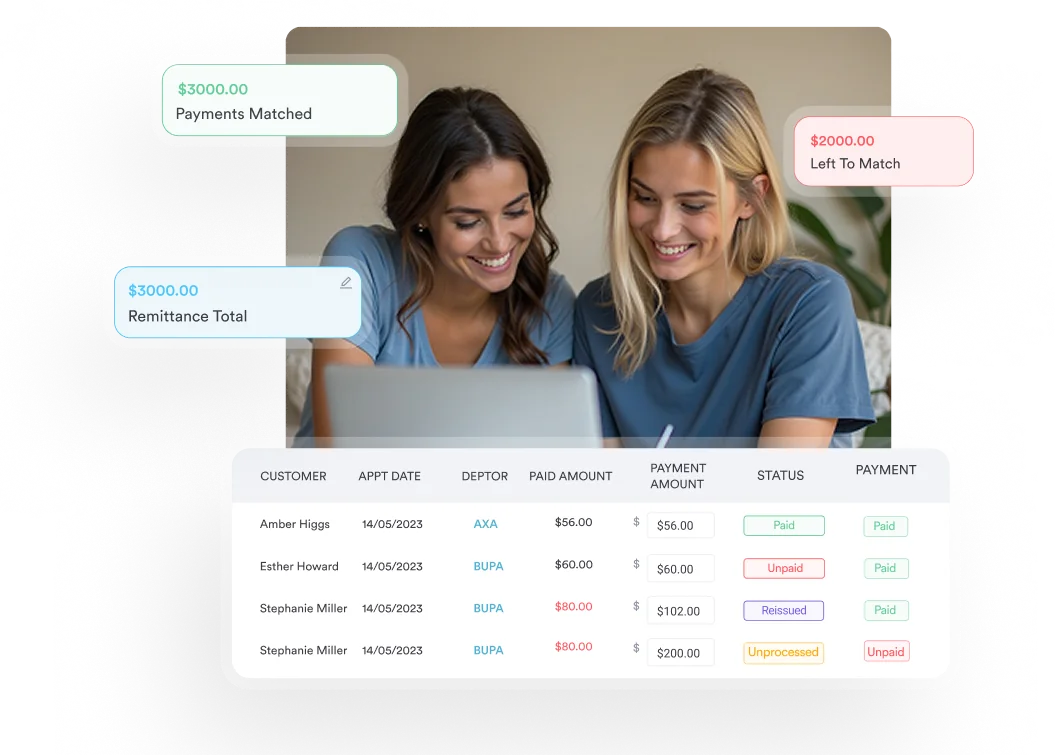
US practices often send S86.222A claims through a clearinghouse such as Claim.MD, which handles submission and status tracking. Check laterality and the 7th character before the claim leaves the practice, because the clearinghouse sends what was coded.
The 7th character must change as care progresses. Reporting A for the whole course of treatment is a frequent error in orthopedic injury billing. The chart below turns the rule into three questions to ask at each visit.
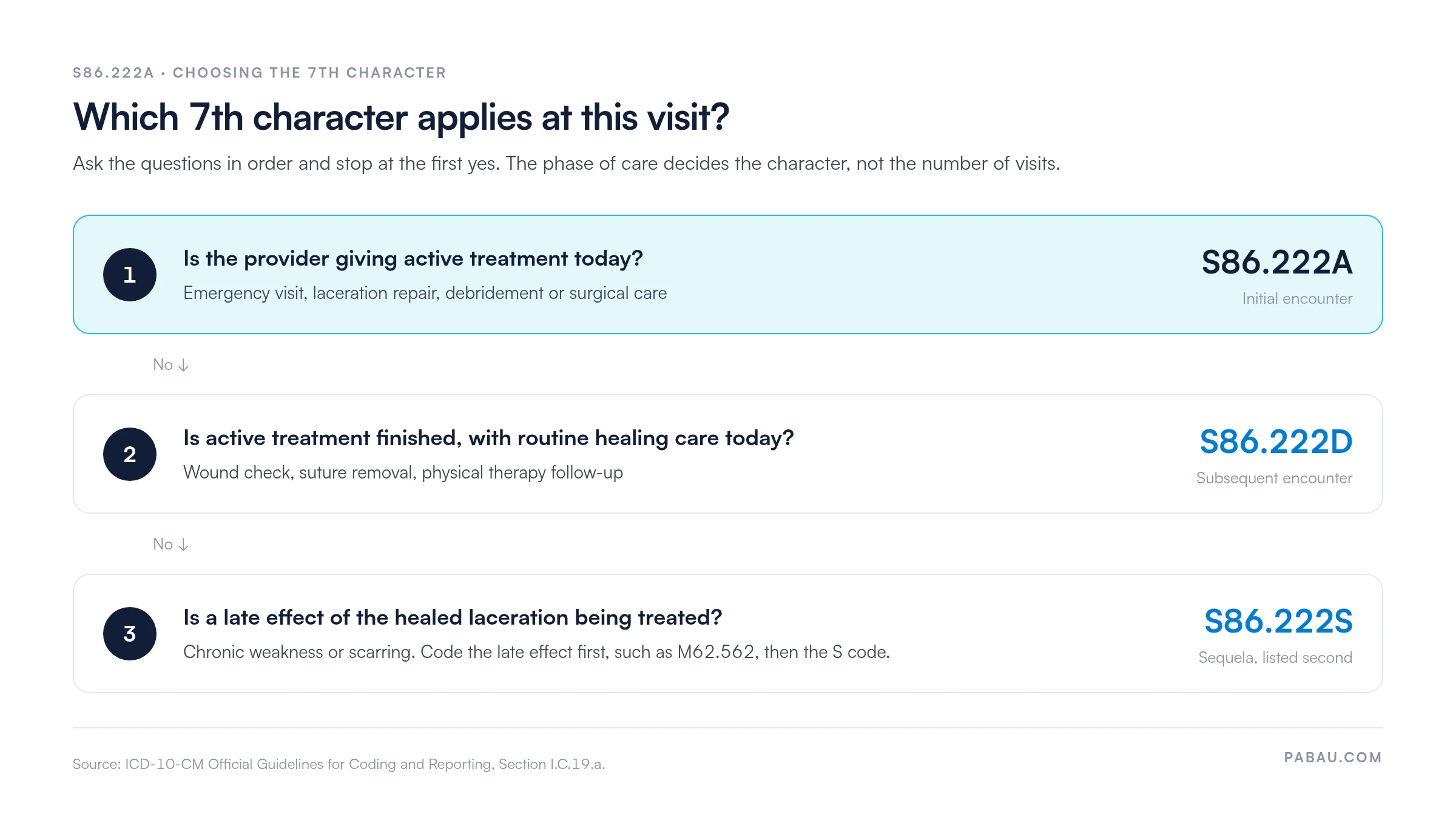
When coding a sequela, sequence the code for the nature of the sequela first, then S86.222S. For example, muscle wasting of the left lower leg (M62.562) goes first, followed by S86.222S, per the ICD-10-CM sequela guidelines.
In many practices, the clinical note lives in one system and the claim is built in another. Each handoff between them is a chance for the wrong side or a stale 7th character to reach the payer. Medical billing for injury codes runs cleanest when both sit in one place.
Pabau, the practice management and EHR platform we build, pairs clinical notes with billing and claim tracking on one patient record. Its claims management software, with Claim.MD for US claims, submits and tracks claims from the diagnosis codes recorded on that record.
Your clinicians and coders still own the documentation checks in this guide. What changes is the handoff, because the codes your team records are the codes that go out. Each claim’s status is then visible on the same record.

Pabau’s claims management software, with Claim.MD for US claims, submits and tracks claims from the diagnosis codes recorded on the patient’s record. Your team sees each S86.222A claim’s status without leaving the record.

S86.222A holds up at the payer when the note settles three questions before the code is picked. Which leg was hurt, what kind of injury is it, and is treatment still active? When an answer is missing, query the provider first. A corrected note takes minutes, while an appeal takes far longer.
From there, the work is keeping the claim in step with the patient. Move to D once the visits become routine healing care, and add the S81 code when an open wound is documented. Keep extensor repairs on 27664 or 27665.
Book a demo to see how Pabau submits and tracks your injury claims from the codes on each patient’s record.

Need to understand denial reason codes on returned claims? Common medical billing denial codes maps the most frequent CARC and RARC codes to their root causes and resolution steps.
Managing the full denial lifecycle across your practice? Denial management workflows covers denial tracking, root-cause analysis, and appeal strategies for billing teams.
Filing an injury claim on a standard form? Medical insurance claim form gives you a ready-made claim form template to download.
ICD-10 Code S86.222A is the billable diagnosis code for an initial-encounter laceration of the anterior muscle group muscles and tendons, left lower leg. It sits in category S86 (injury of muscle, fascia and tendon at lower leg level). It requires documented left-side laterality, and the 7th character A applies during active treatment.
Yes, S86.222A is a billable and valid ICD-10-CM code for the current fiscal year. The parent code S86.222 is not billable without a 7th character, and A, D, or S is required for claim submission. Verify it against the current CMS ICD-10-CM release, because code validity is updated each October.
S86.221A codes a laceration of the anterior muscle group at the lower leg level on the right leg. S86.222A codes the same injury on the left leg. The only difference is laterality. Using the wrong code when the record clearly documents a side is a documentation-accuracy error and a compliance risk.
Switch from A to D when active treatment is complete and the visit is routine healing care. Wound checks, suture removal and physical therapy follow-ups all qualify. Switch to S when treating a late effect of the original laceration, such as chronic weakness or scarring, and list the late-effect code first. Reporting A for the whole treatment course is a compliance error.
Common denials trace to missing laterality in the clinical note, which forces the unspecified S86.229A. Others come from the wrong 7th character (A when D applies) and a missing S81 open wound code under the code-also note. Pairing flexor tendon repair codes 27658 or 27659 with this laceration may trigger a CPT/anatomy mismatch edit. Extensor repairs take 27664 (primary) or 27665 (secondary).