ICD-10 code T43.604S: Psychostimulant poisoning sequela
What does ICD-10 code T43.604S cover? ICD-10 code T43.604S covers the late effec...

Last Updated: Oct 22, 2026
Billable Code Specific Code
S76.221A is the billable ICD-10-CM code for laceration of adductor muscle, fascia and tendon of right thigh, initial encounter. A strain of the same muscle group codes to S76.211A instead.
It belongs to the S76 category, which covers injuries to muscles, fascia and tendons at the hip and thigh level. The code applies during active treatment for a cut through the adductor muscle, fascia or tendon, such as wound exploration or surgical repair. Assignment turns on documented laterality, wound depth and the 7th character.
Let Pabau's smart automation suggest the right codes, reduce claim denials, and keep your practice compliant—effortlessly.
Automate repetitive tasks and focus on what matters most—your patients.
Reduce coding errors and ensure compliance with the latest regulations.
Clean claims, fewer denials, and faster reimbursements.
Powerful insights and reporting to help your practice thrive.
HIPAA compliant SOC 2 certified GDPR-compliant Trusted by 4,000+ clinics worldwide

S76.221A is the billable ICD-10-CM code for a laceration of the right adductor muscle, fascia and tendon during active treatment.
A right adductor strain codes to S76.211A, not S76.221A, so confirm the injury type in the clinical note before you assign either code.
The 7th character ‘A’ signals active treatment. Switch to ‘D’ for routine follow-up or rehabilitation visits, and use ‘S’ only when a sequela is documented.
Report the associated open wound of the thigh (S71.-) alongside S76.221A, as the S76 category instructs.
Missing laterality and the wrong 7th character are the two errors to check for before any S76.221A claim goes out.
ICD-10 Code S76.221A is the billable code for a laceration of the adductor muscle, fascia and tendon of the right thigh, at the initial encounter. It sits in the S76.2 subcategory, which covers adductor injuries of the thigh. The table below captures the reference data coders need before assigning it.
Verify current-year validity against the CDC/NCHS ICD-10-CM web tool before billing, as CMS releases annual updates that can affect code validity.
The descriptor for S76.221A has four distinct components, and clinical documentation must support each one before the code is assigned. Each component maps to one character of the code, as the breakdown below shows.
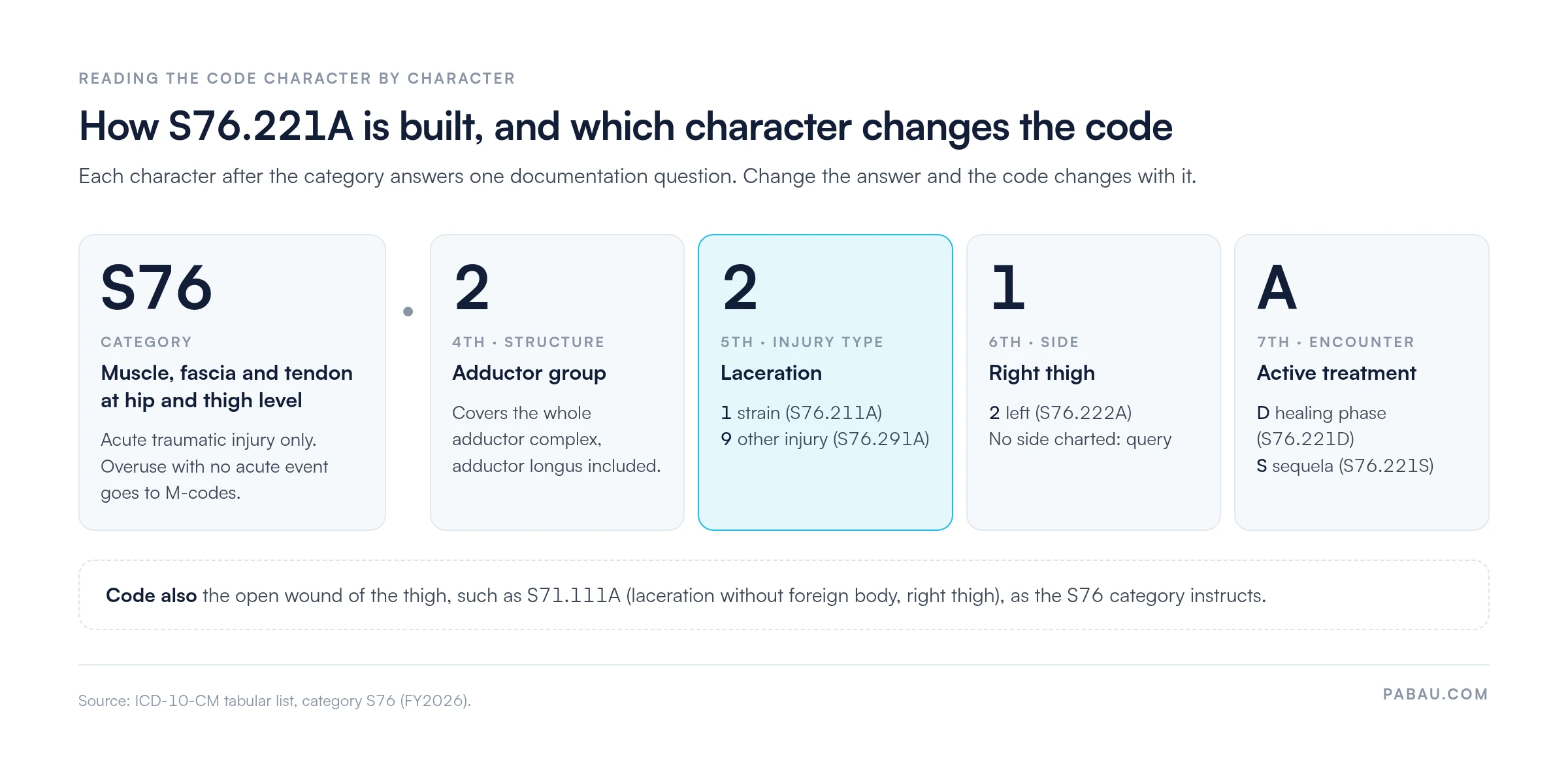
Coders should note that this code covers traumatic injury mechanisms. Overuse or chronic adductor tendinopathy with no acute event typically codes elsewhere in the musculoskeletal chapter (M-codes) rather than S76.221A. The S76 category also instructs you to code any associated open wound of the thigh (S71.-).
Strain vs laceration: A strain is an overstretch or tear of muscle fibers, often from a sudden change of direction, with the skin intact. A laceration is a cut through the tissue. A right adductor strain, often charted as a groin pull, codes to S76.211A instead. ICD-10-CM also has no code specific to the adductor longus, so a named adductor longus injury still codes to the S76.2- adductor group.
The 7th character tells the payer where the patient is in their care. Assigning “A” to a follow-up visit can trigger payer edits and delay payment.
Per the ICD-10-CM Official Guidelines for Coding and Reporting, “initial encounter” does not mean literally the first visit. It means the patient is still in the active treatment phase. A patient who sees three different providers for the same injury during active treatment is coded “A” at each visit. That holds until treatment goals shift to rehabilitation or monitoring.
The two structural errors to guard against on adductor laceration claims are the wrong side and the wrong injury type. The table below maps the S76.22- codes alongside their closest neighbors, so you can rule both out.
Use the AAPC Codify ICD-10-CM lookup or the ICD List browser to cross-check descriptor wording and code hierarchy before finalizing the claim.
Knowing what the S76 category covers, and what its notes send elsewhere, keeps the code on the right injury.
What S76 covers:
What S76 excludes (Excludes2 notes):
Both are Excludes2 notes, so either code can sit alongside S76.221A when the patient has both injuries. Non-traumatic conditions fall outside S76 altogether. Overuse tendinopathy, chronic adductor pain without an acute event and degenerative muscle disorders code to M-codes.
Query the treating provider if the documentation does not clearly establish an acute traumatic mechanism. Coding a chronic overuse injury as S76.221A exposes the practice to medical necessity audit risk.
A claim submitted with S76.221A is only as defensible as the clinical note behind it. Auditors and payer reviewers expect the following elements to be explicitly stated, not inferred.
The ICD-10-CM Official Guidelines, approved by CMS, NCHS, the AHA and AHIMA, bar coders from making clinical assumptions to raise code specificity. When documentation is ambiguous about laterality or injury type, a clinical query to the provider is required before the claim is submitted.
Run a documentation audit on adductor laceration encounters before batch-billing. Filter encounters coded S76.221A in your practice management system. Confirm each note states ‘right’ laterality, a laceration rather than a strain, and the wound mechanism. A missing side is the fastest path to a laterality-related denial.
The ICD-10-CM guidelines encourage external cause codes alongside injury codes, and some payers ask for them. There is no national mandate, so leaving them off rarely causes a denial on its own. Adding them records how the injury happened, which supports medical necessity.
External cause codes are sequenced after the primary injury code (S76.221A). Report the place (Y92), activity (Y93) and status (Y99) codes once, at the initial encounter. The mechanism code can be reported for the full course of treatment, with a 7th character that matches the injury code. Check each payer’s policy, since some commercial and workers’ compensation plans ask for activity and place codes on injury claims.
S76.221A pairs with wound repair codes billed by the treating surgeon or ED provider at the initial encounter, then with rehabilitative codes in physical therapy. Once care moves into the healing phase, those therapy claims carry S76.221D instead. Medical necessity must be established in the clinical note for each CPT code billed.
Confirm CPT-to-ICD-10 crosswalk compatibility with individual payer LCDs before billing. Requirements vary by Medicare Administrative Contractor and by commercial plan. Therapy codes such as CPT 97110 usually pair with S76.221D once care moves to rehabilitation, so confirm the 7th character before the crosswalk check.
Prior authorization requirements for services billed with S76.221A vary significantly by payer, plan, and region. No universal rule applies. The guidance below reflects general patterns, so verify with the specific payer before rendering service.
Completing insurance eligibility verification before each encounter catches benefit limits and authorization requirements early, which prevents retroactive denials.
Claim denials for S76.221A follow a predictable set of documentation and coding failures. Each one comes back with a reason code, and our guide to common denial codes explains how to read and fix them. Fixing the cause before submission is faster than working a denial queue.
Effective denial management in healthcare starts before the claim leaves the practice. Pre-bill coding audits, automated eligibility checks and clearinghouse claim scrubbing catch most of these errors before they reach the payer. For practices that bill electronically, submitting a clean claim the first time saves a resubmission cycle on every claim.
Step-by-step code selection logic helps coders apply S76.221A correctly across the most common clinical presentations. The three scenarios below cover the situations where coders most frequently make errors.
A 24-year-old soccer player falls onto the sharp metal edge of a portable goal frame during a game. Exploration in the emergency department finds a deep right inner-thigh laceration that extends through the fascia into the adductor muscle. The surgeon performs a layered repair and documents “laceration of right adductor muscle and fascia.”
The same patient returns to physical therapy four weeks after the repair for adductor strengthening and gait training. The PT note documents progress and ongoing therapeutic exercise. No new injury or acute intervention is recorded.
A provider documents “laceration, adductor muscle, thigh” with no side specified. The triage note mentions a wound on the right inner thigh, but the clinical note does not confirm the side.
The CMS ICD-10 coding guidelines are clear that coders must not make assumptions about clinical information not stated in the documentation. A clinical query is always the right step when documentation is ambiguous about a code-defining element like laterality.
In many practices, the coder reads the note in one system and keys the claim into another. That handoff is where the side, the injury type or the 7th character slips. A strain charted as a laceration, or an “A” carried into week four, only surfaces when the denial comes back.
Pabau, the practice management platform we build, keeps the clinical note, the diagnosis code and the claim in one patient record. With claims software for coders, the coder checks laterality and encounter stage against the note before the claim goes out. Eligibility checks and electronic submission through a clearinghouse run from the same screen.
The result is fewer claims bouncing back for a wrong side or a stale 7th character. Your team spends less time reworking adductor laceration claims and more time on the next encounter.

Pabau’s claims management software keeps the diagnosis code, the clinical note and the claim in one record. Your team can check side, injury type and encounter stage before a claim goes out.

S76.221A has to be earned from the note. If the chart cannot tell you the side, the wound depth and the stage of care, send a query before you bill. A held claim costs a day, while a denied one costs a resubmission and an appeal.
The bigger shift comes once the encounter moves to rehabilitation. Switching every follow-up claim to S76.221D, and dropping the one-time Y92, Y93 and Y99 codes, keeps the episode consistent from first visit to discharge. Book a demo to see how Pabau keeps the code and the clinical note aligned at every visit.

Need to understand denial patterns before they hit your revenue? Denial management in healthcare explains the most common claim rejection types and how to build a pre-bill audit process that catches them.
Billing physical therapy services and need clean claim guidance? Submitting a clean claim covers the essential elements every PT and sports medicine claim must include to clear payer edits on the first pass.
Want to verify patient benefits before the first appointment? Insurance eligibility verification walks through how real-time eligibility checks prevent retroactive denials and authorization surprises.
Coding the repair of a deep thigh laceration? CPT code 12032 covers intermediate wound repair, including length rules and documentation for layered closures.
ICD-10 Code S76.221A is the billable diagnosis code for a right thigh laceration of the adductor muscle, fascia, and tendon at the initial encounter. It applies while the patient is receiving active treatment for an acute traumatic injury to this muscle group.
The 7th character “A” in S76.221A denotes an initial encounter, meaning the patient is in the active treatment phase. It applies to any visit where the provider is actively managing the injury, not just the very first appointment. It continues until care transitions to healing-phase rehabilitation or monitoring.
S76.221A covers the right thigh and S76.222A covers the left thigh. The digit in the 6th position distinguishes laterality: “1” is right, “2” is left. Clinical documentation must explicitly confirm which side is injured before either code is assigned.
Use S76.221S only when the patient presents with a late effect, or sequela, of the original adductor laceration. Scarring or weakness documented as caused by that injury are typical examples. When sequela coding applies, the sequela condition is coded first with S76.221S sequenced after it. It is not interchangeable with “A” or “D.”
Prior authorization requirements vary by payer and plan. Medicare does not generally require prior auth for initial outpatient physical therapy visits, but commercial insurers frequently require it beyond a visit threshold. Workers’ compensation almost always requires prior authorization. Verify with each specific plan before rendering service.
The most relevant external cause codes for S76.221A start with a mechanism code, such as W26.8XXA for contact with a sharp object. Add an activity code from Y93, such as Y93.66 for soccer, and a place-of-occurrence code from Y92. External cause codes are sequenced after S76.221A. Y92, Y93 and Y99 codes are reported once, at the initial encounter, while the mechanism code can be reported throughout treatment.