

ICD-10 Code S53.013D: Anterior subluxation of unspecified radial head
ICD-10 Code S53.013D: Quick reference summary Use the table below as your first ...

Last Updated: Nov 6, 2026
Billable Code Specific Code
S60.039S is the billable ICD-10-CM code for contusion of unspecified middle finger without damage to nail, sequela. It applies when the bruise itself has healed and the visit treats a residual condition it left behind, such as stiffness or persistent pain.
Assignment turns on two details. The 7th character S applies only once the acute phase has resolved, while D covers routine healing. ICD-10-CM Official Guidelines also require the residual-condition code to be sequenced first, with S60.039S listed after it.
Let Pabau's smart automation suggest the right codes, reduce claim denials, and keep your practice compliant—effortlessly.
Automate repetitive tasks and focus on what matters most—your patients.
Reduce coding errors and ensure compliance with the latest regulations.
Clean claims, fewer denials, and faster reimbursements.
Powerful insights and reporting to help your practice thrive.
HIPAA compliant SOC 2 certified GDPR-compliant Trusted by 4,000+ clinics worldwide

S60.039S is a billable 7-character ICD-10-CM code for a sequela visit after a contusion of an unspecified middle finger with no nail damage.
The 7th character S applies only once the acute injury has fully resolved. Use S60.031S (right) or S60.032S (left) when the record documents the side.
ICD-10-CM Official Guidelines require the residual condition code, such as joint stiffness or a scar, to be sequenced before S60.039S on the claim.
A missing companion residual-condition code is a common denial reason. Reporting D after the injury has fully resolved is another.
ICD-10 code S60.039S is a valid, billable ICD-10-CM diagnosis code for a sequela encounter. It covers a contusion of an unspecified middle finger without damage to the nail. Per the CDC/NCHS ICD-10-CM web tool, it has been billable since the ICD-10-CM transition. It is valid in the current ICD-10-CM release, and coders should verify it annually. The parent code S60.039 (without the 7th character) is non-billable and cannot be submitted on a claim.
The code sits within ICD-10-CM Chapter 19 (Injury, Poisoning and Certain Other Consequences of External Causes, S00-T88). Clinically, it applies once a middle finger bruise with no subungual hematoma or nail bed injury has resolved. The patient returns for a residual condition, such as chronic stiffness, scar tissue, or persistent pain at the site.
Knowing the full hierarchy prevents a common encoder error: Submitting a non-billable parent code on a claim. Each node above S60.039S is non-billable, because a claim needs the full 7-character code. For related injury and sequela codes, browse the ICD-10 diagnostic code library.
S60.039 takes one of three 7th characters. Under the ICD-10-CM Official Guidelines for Coding and Reporting (Section I.C.19.a), the character reports the phase of care, whatever the visit count.
Key distinction: D and S are the most conflated pair. D is used while the original contusion is still on the healing timeline. S is used only once the acute phase is completely resolved and the patient now has a distinct residual condition. If the provider note still references the finger as “healing” or “bruising fading,” D is correct. Once the note documents that the original contusion has resolved and the chief complaint is a late effect (stiffness, scar, chronic pain), S is correct.
Run a simple two-question check before assigning S60.039S: (1) Has the original contusion fully resolved with no active wound care or acute symptom management? (2) Is today’s visit explicitly for a residual condition traced to that old injury? Both must be yes. If either is no, use S60.039D instead.
Nail status has to be documented, because it decides the code family. When a subungual hematoma, nail bed injury, or nail avulsion accompanies the finger contusion, the coder moves to the S60.13- series instead of S60.039S.
If the original encounter note did not explicitly address nail status, coders should query the provider before assigning S60.039S. Payers auditing sequela claims will check for consistency between the original injury record and the sequela encounter record. A mismatch is a common audit trigger.
Several codes share enough descriptor overlap with ICD-10 code S60.039S to be confused with it. The table below lists each one and the documentation element that decides between them.
The AAPC ICD-10-CM lookup tool displays the full S60.03- hierarchy. Use it to confirm the laterality-specific codes before submission.
The decision path below runs those checks in the order a coder meets them, from nail status to the order of codes on the claim.
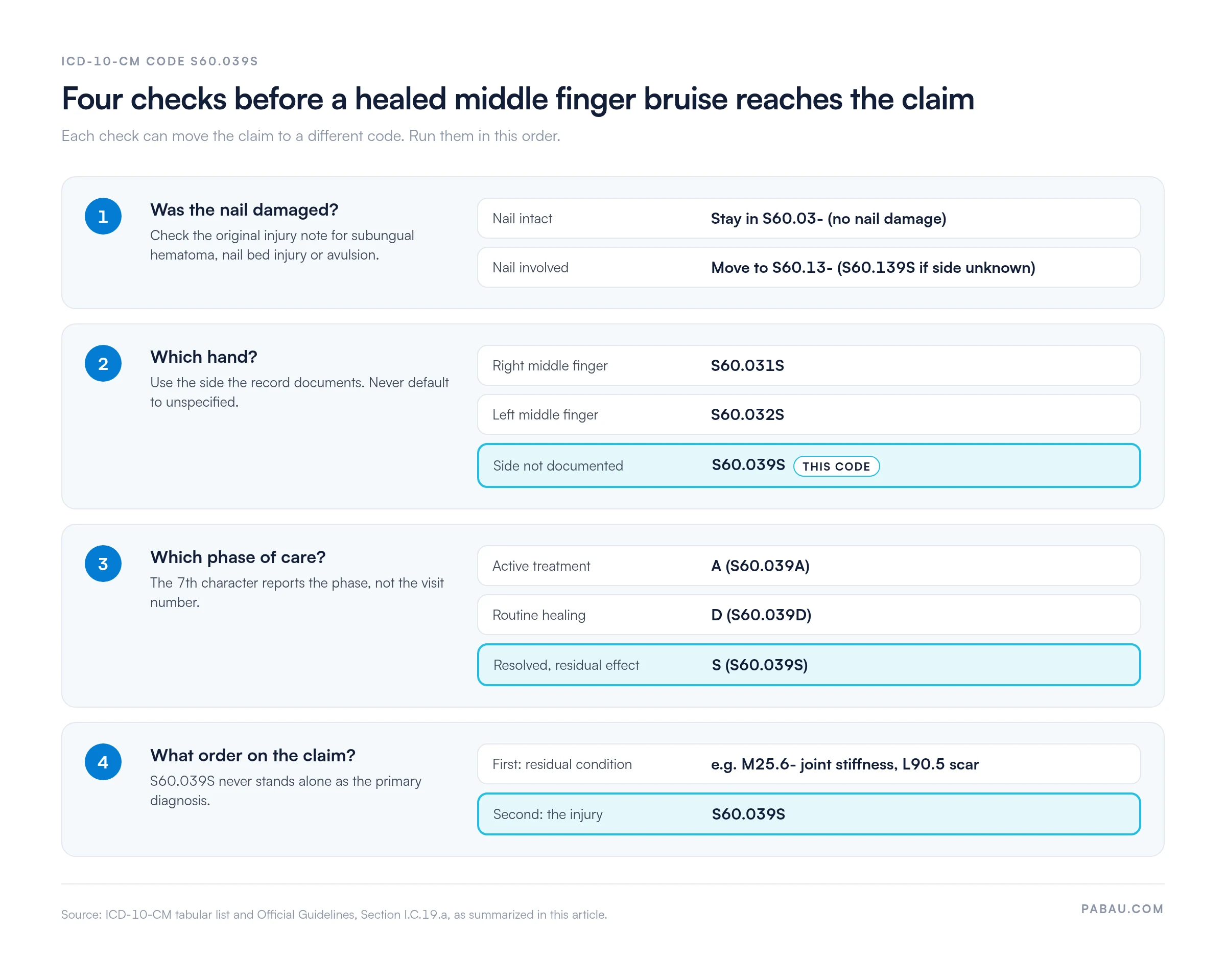
Sequela coding for ICD-10 code S60.039S follows Section I.C.19.a of the ICD-10-CM Official Guidelines, published annually by CMS and NCHS. The rule is explicit: The residual condition code is sequenced first, and the injury code (S60.039S) second.
S60.039S cannot function as a standalone primary diagnosis. The payer needs the residual condition code to understand the clinical justification for the visit. Payers commonly reject a claim carrying S60.039S with no companion residual-condition code at the front-end edit stage.
Payers auditing sequela claims look for a documentation chain that connects the current encounter to the original injury. Without that chain, even a correctly coded claim can be denied on audit or during post-payment review. Prioritize medical billing compliance at the note level before the claim is submitted.
The medical record supporting S60.039S must include all of the following:
For submitting a clean claim with this code, list the residual condition code as the primary diagnosis. S60.039S goes in a secondary position. Any inversion of that sequencing is grounds for denial.
Common denial reasons for ICD-10 code S60.039S:
Audit your S60.039S claims quarterly. Pull every claim with this code and confirm a residual-condition code sits in the primary position. Then check that the encounter note states the original contusion resolved. Those two checks catch most sequencing and documentation denials before the payer sees them.
Pabau, the practice management platform we build, connects to the Claim.MD clearinghouse for US claims. Its pre-submission edits help catch sequencing errors and missing companion codes before the claim reaches the payer. For a broader framework on preventing and appealing these rejections, see our guide to denial management workflows.
Middle finger contusions show up regularly in workers’ compensation claims from manufacturing, construction, and warehouse settings. Sequela coding in an occupational context adds requirements that standard health insurance claims do not impose.
Occupational health practices handle these claims more cleanly when encounter notes feed claim submission directly. The note that documents resolution and the residual condition then travels with the claim to the carrier.
A wrong 7th character, a missing companion code, or an inverted sequence usually starts as a documentation problem. The provider note did not state that the original injury resolved. Or it named the residual condition too vaguely for the coder to pick the companion code.
In Pabau, structured clinical notes feed the billing workflow directly. Pabau’s claims management software lets coders check the documentation chain for a sequela claim before the claim is built. It supports medical billing workflows that flag a missing companion code as a pre-submission edit.
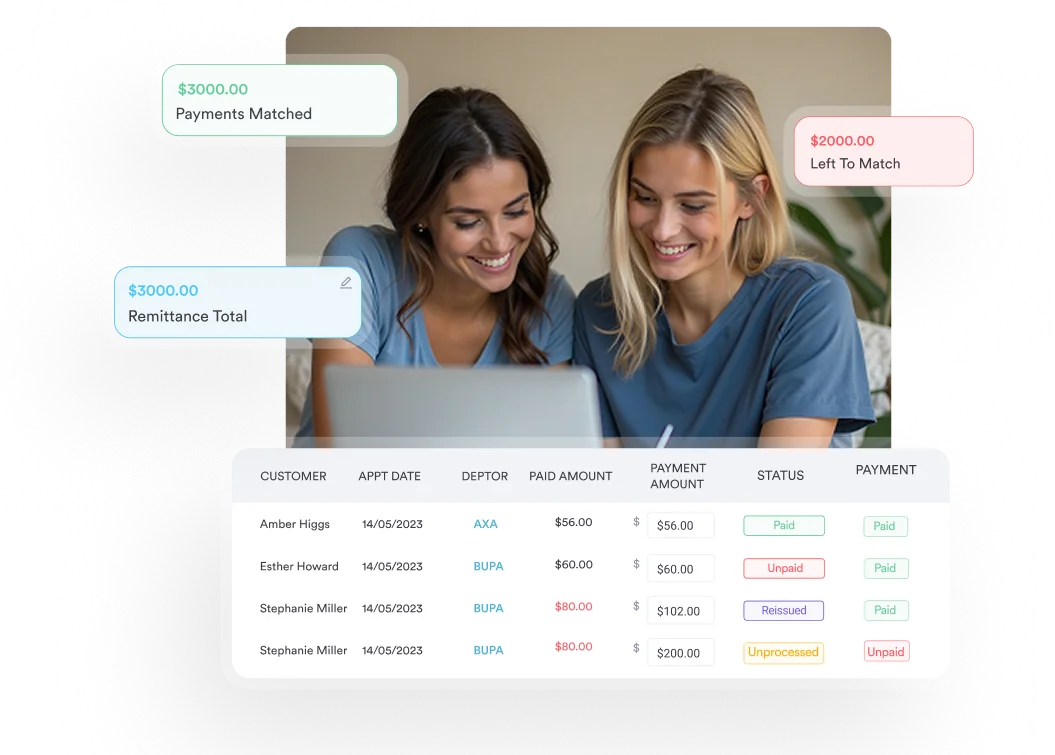
Key workflow capabilities that reduce S60.039S denial exposure:
These tools assist documentation and reduce error exposure. Code selection remains the responsibility of the qualified coder or provider.

Pabau’s claims workflow helps occupational health and musculoskeletal practices submit accurate diagnosis codes. It catches sequela coding errors before submission and tracks denial patterns across payers.

ICD-10 code S60.039S rewards a slow read of the note. Before you assign it, confirm the bruise has resolved, the nail was intact, and the side is undocumented. Then put the residual condition first on the claim.
The trade-off is a little more time at the point of care. A provider who names the residual condition and states that the contusion resolved saves the coder a query and the practice a resubmission.
Book a demo to see how Pabau ties sequela documentation to clean claims for musculoskeletal and occupational injury cases.

Need a framework for managing claim denials across your practice? Denial management in healthcare covers the end-to-end process for tracking, appealing, and preventing payer rejections.
Want to understand what a clean claim looks like before submission? What is a clean claim outlines the technical and documentation requirements payers use to adjudicate without requesting additional information.
Choosing a clearinghouse for US claims? Claim.MD clearinghouse explains how the clearinghouse checks and routes claims to payers.
Filing a claim on paper? The medical insurance claim form template lays out the fields a payer expects on a completed claim.
ICD-10 code S60.039S is the billable diagnosis code for a contusion of an unspecified middle finger without damage to the nail, sequela. The encounter is for a late effect of a resolved contusion, not the original injury. It sits in ICD-10-CM Chapter 19 and needs a companion residual-condition code sequenced before it on the claim.
Yes. S60.039S is a valid, billable 7-character ICD-10-CM code. Its parent code, S60.039 (without the 7th character), is non-billable and will be rejected if submitted on a claim.
The 7th character defines the phase of care, not the visit count. A (S60.039A) is used during active treatment of the acute contusion. D (S60.039D) is used while the injury heals routinely after active treatment ends. S (S60.039S) is used only once the acute phase has fully resolved and the encounter is for a residual late-effect condition.
Yes, and that residual condition code is sequenced first. Under ICD-10-CM Official Guidelines Section I.C.19.a, the residual code, such as a chronic pain or stiffness code, is the primary diagnosis. S60.039S follows as the secondary code identifying the causative injury. Claims submitted with S60.039S as the only diagnosis will typically be denied.
Payers usually deny these claims for one of four reasons. The claim carries no companion residual-condition code, or it lists S60.039S as the primary diagnosis. The record may not show that the original contusion fully resolved. Or the coder reported S while the injury was still healing and D was correct.
Yes, but workers’ comp submissions typically need additional codes. External cause codes from the W series identify the work-related injury mechanism, and the codes must match the original First Report of Injury. Sequela claim rules vary by state, so verify requirements with the state workers’ compensation board and carrier before submission.



