ICD-10 Code S53.013D: Anterior subluxation of unspecified radial head
ICD-10 Code S53.013D: Quick reference summary Use the table below as your first ...

Last Updated: Nov 6, 2026
Billable Code Specific Code
S35.218A is the billable ICD-10-CM code for other injury of celiac artery, initial encounter. It covers a specified celiac artery injury that is not a laceration, such as a traumatic aneurysm, while the patient is in active treatment.
The code sits under S35.21, injury of celiac artery, within S35.2. Lacerations code to S35.211A or S35.212A, and injuries to the hepatic, splenic or gastric arteries code to the S35.29- branch codes.
Let Pabau's smart automation suggest the right codes, reduce claim denials, and keep your practice compliant—effortlessly.
Automate repetitive tasks and focus on what matters most—your patients.
Reduce coding errors and ensure compliance with the latest regulations.
Clean claims, fewer denials, and faster reimbursements.
Powerful insights and reporting to help your practice thrive.
HIPAA compliant SOC 2 certified GDPR-compliant Trusted by 4,000+ clinics worldwide

ICD-10 code S35.218A covers other injury of the celiac artery, initial encounter, under subcategory S35.21 (injury of celiac artery).
Use it only when the record names an injury type other than a laceration, such as a traumatic aneurysm of the celiac artery.
Lacerations code to S35.211A or S35.212A, and injuries to the hepatic, splenic or gastric arteries code to the S35.29- branch codes.
The 7th character A applies while the injury is in active treatment; routine healing-phase visits take S35.218D, and late effects take S35.218S.
Code also any associated open wound (S31.-), and add Chapter 20 external cause codes where your state or payer requires them.
ICD-10 code S35.218A is the billable ICD-10-CM code for other injury of celiac artery, initial encounter. It applies when the record names the celiac artery and documents a specific injury type that is not a laceration. A traumatic aneurysm is the classic example.
The code is easy to define and easy to misuse. It shares a parent with three siblings, and four branch arteries sit right next to it in the tabular list. A wrong pick rarely trips a claim scrubber, because every sibling is a valid code. It tends to surface later, in an audit or a records request.
The code is valid in the FY2027 ICD-10-CM code set, effective October 1, 2026, and the CDC/NCHS ICD-10-CM browser tool lists it as billable. Its parent code, S35.218, is not billable on its own because category S35 requires a 7th character.
The official long descriptor is Other injury of celiac artery, initial encounter. Here, “other” means a specified injury type with no code of its own. It does not mean the provider failed to describe the injury.
S35.218A sits four levels below category S35, inside the subcategory reserved for the celiac trunk itself. The parent chain runs from broad to specific:
The split that matters most sits at S35.2. The celiac trunk has its own subcategory, S35.21, while its named branches do not. Injuries of the gastric, gastroduodenal, hepatic and splenic arteries all go to S35.29, injury of branches of celiac and mesenteric artery.
Every code in category S35 needs a 7th character, and it describes where the patient is in treatment. The three options for S35.218 are:
“Initial encounter” does not mean the first visit. Under the ICD-10-CM Official Guidelines, A applies to every encounter where the patient is receiving active treatment for the injury.
Coder decision rule: The move from A to D follows the documentation, not the calendar. A patient who returns to the operating room for the same injury stays on A. A post-discharge visit to check healing takes D.
Read the attending’s note for the treatment phase. Phrases such as “return to OR” or “repeat angiography for the injury” support A, while “routine follow-up” supports D.
The celiac artery, also called the celiac trunk, is the first major anterior branch of the abdominal aorta. It divides into the left gastric, common hepatic and splenic arteries, which supply the stomach, liver, spleen, pancreas and upper duodenum.
Injury to the celiac trunk is rare and usually follows penetrating abdominal trauma, although blunt and iatrogenic injuries also occur. The ICD-10-CM index sorts each documented injury type to one of the four S35.21 codes:
Penetrating trauma that reaches the celiac trunk often injures nearby organs as well. Each organ takes its own code, such as S36.201A for an unspecified injury of the body of the pancreas.
S35.218 carries no notes of its own, so every instruction that applies to it comes from the category, section or chapter above it.
External cause codes in practice: The guidelines set no national requirement to report Chapter 20 codes. They are required only under a state reporting mandate or by a particular payer. Where you report them, place (Y92), activity (Y93) and status (Y99) codes go on the initial encounter only.
Two questions decide the code: which vessel was injured, and what type of injury the record describes. The decision map below walks through both, then adds the phase of care.
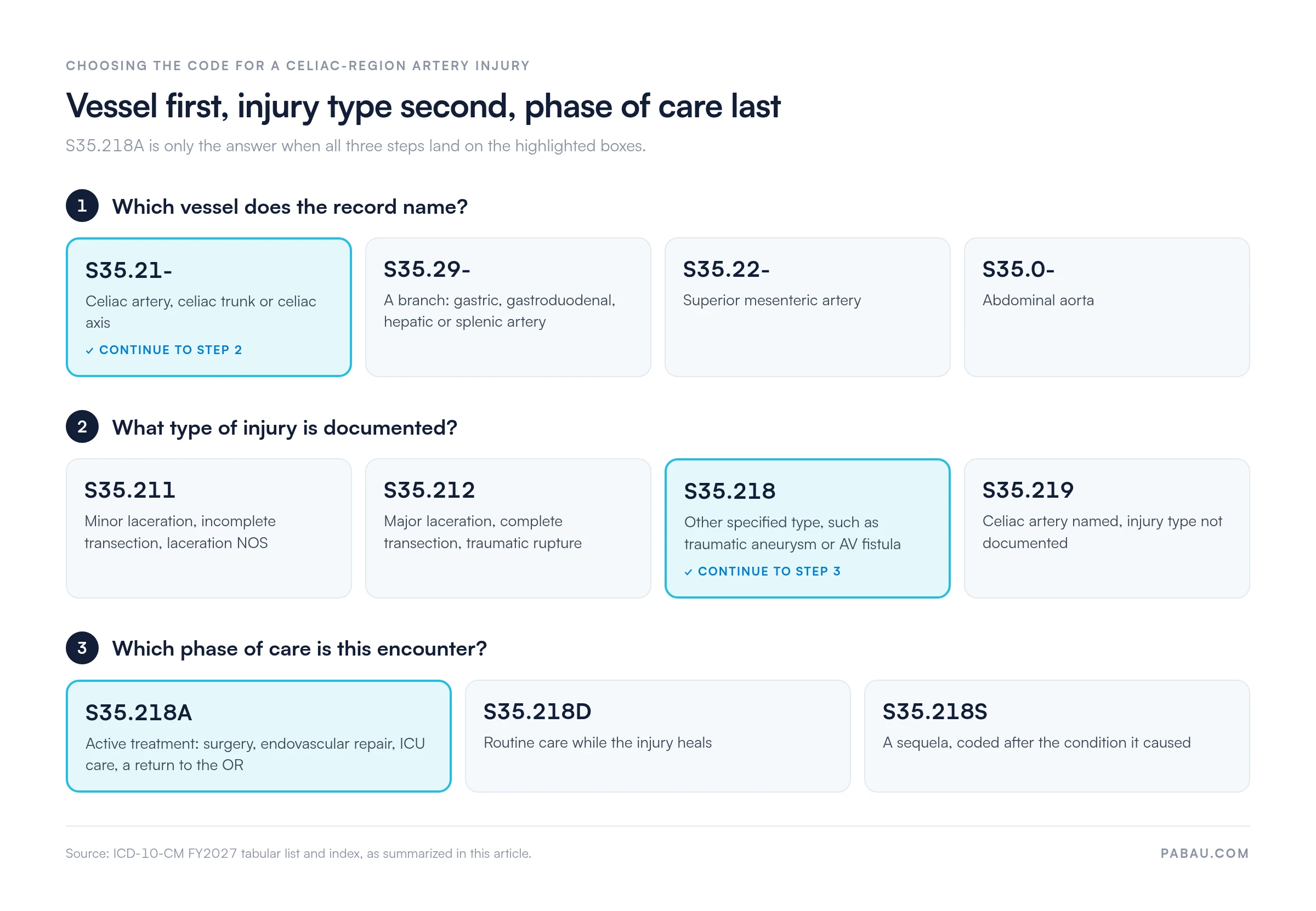
The table compares S35.218A with the codes most often confused with it.
Two vessels, two codes. When the operative note describes injuries to both the celiac trunk and the superior mesenteric artery, report a code for each vessel.
Here is how those rules play out on one patient. A man arrives after a stab wound to the upper abdomen. CT angiography shows a traumatic aneurysm of the celiac trunk, and the surgeon repairs it the same day.
Two weeks later, he returns for a routine wound and imaging check. That visit takes S35.218D. Had he gone back to the operating room for the aneurysm instead, the encounter would stay on S35.218A.
That example worked because the note was specific. Three elements in the operative or clinical record support S35.218A over a less specific code. Without them, the defensible choice is usually S35.219A.
Do not infer the injury type from the repair. Intra-abdominal vascular repairs such as CPT 35221 (direct repair) or 35251 (repair with vein graft) fit both lacerations and other injuries. If the surgeon’s description is unclear, query the provider before choosing between S35.218A and S35.219A.
A trauma claim passes through several hands before it is paid, and each handoff can drop a detail. The usual path looks like this:
Scrubbing catches format errors, not clinical ones. An S35.219A on a well-documented aneurysm passes every edit, so the specificity check has to happen before the claim leaves.
Most problems with this code come from choosing the wrong sibling rather than from the code itself. Effective denial management workflows for trauma billing watch for these patterns:
If a claim does come back denied, our guide to denial codes in medical billing explains each reason code and how to respond.
Before you finalize an S35.21- code, check the operative note for the words “rupture” and “transection”. Both point to a laceration code, not S35.218A.
Legacy data and research datasets sometimes need the ICD-9-CM equivalent. The CMS General Equivalence Mappings (GEMs), last published in 2018, give an approximate match only.
Because four celiac artery codes collapse into 902.24, an ICD-9 crosswalk loses the injury type entirely. Mapping backward does not restore it.
902.24 maps back to four celiac artery codes, with S35.219A as the preferred target and S35.211A, S35.212A and S35.218A as alternatives. So the backward map cannot recover the original injury type, and you should never use it to pick S35.218A.
Trauma claims are often assembled by hand from operative notes, after a long admission. That is where the 7th character slips, or the open wound code never reaches the claim.
Pabau, the practice management and billing platform we build, pre-fills the claim form from the patient record. ICD-10-CM codes come from the recorded problem list, and a searchable ICD-10-CM and CPT library sits beside each field. The claim cannot be sent until required fields such as membership numbers and authorization codes are complete.
US practices submit through Pabau’s Claim.MD integration, with eligibility checks, claim-status tracking and ERA posting. Your coder still chooses between S35.218A and its siblings, but claims management software removes the retyping behind avoidable rejections.

Pabau pre-fills each claim from the patient record, checks required fields before sending, and submits US claims through Claim.MD. See how it fits your trauma billing workflow.

S35.218A rewards patience. Reach for it only after the note confirms the celiac trunk and a specified injury that is not a laceration, rupture or transection.
When either point is unclear, a provider query takes a few minutes. Reworking a denied trauma claim takes far longer, and by then the surgeon may no longer remember the case.
Make that query a standard step and S35.218A stops being a judgment call. Book a demo to see how Pabau carries the diagnosis from the patient record onto a complete trauma claim.

Need to understand how denial codes work after a claim is rejected? Denial codes in medical billing explains CARC and RARC denial reason codes and how to respond to each.
Looking for guidance on electronic claim submission and ERA processing? Electronic remittance advice covers 835 ERA file structure, payment reconciliation, and how automated remittance reduces posting errors.
Want to understand the full revenue cycle context for trauma billing? Revenue cycle management walks through the end-to-end process from eligibility verification to payment posting.
Coding another abdominal vessel injury? ICD-10 code S35.311D covers laceration of the portal vein at a subsequent encounter.
It means other injury of celiac artery, initial encounter. It covers a specified injury of the celiac trunk that is not a laceration, such as a traumatic aneurysm, during active treatment.
Yes. S35.218A is a billable, specific code in the FY2027 ICD-10-CM code set. Its parent, S35.218, is not billable without a 7th character.
A traumatic celiac artery aneurysm codes to S35.218, with A during active treatment. A spontaneous aneurysm is not an injury, so it codes in the circulatory chapter, block I70-I79.
No. The hepatic, splenic, gastric and gastroduodenal arteries are celiac branches, so their injuries code to S35.29-. S35.218A is for the celiac trunk only.
That depends on the repair. Open intra-abdominal vascular repairs include CPT 35221 for direct repair and 35251 for repair with a vein graft. Neither tells you the injury type, so read the operative note.
Only where a state mandate or your payer requires one. Chapter 19 instructs you to add Chapter 20 codes, but there is no national reporting requirement.