ICD-10 code S42.134B: Nondisplaced coracoid process fracture, right shoulder, open
ICD-10 code S42.134B: Quick reference ICD-10 code S42.134B describes a nondispla...

Last Updated: Nov 3, 2026
Billable Code Specific Code
S35.416D is the billable ICD-10-CM code for laceration of unspecified renal vein, subsequent encounter. It reports routine follow-up after active treatment of a renal vein tear has ended, when no note in the record names the injured side.
The code sits in category S35, injury of blood vessels at abdomen, lower back and pelvis level. A documented right or left renal vein moves the claim to S35.414D or S35.415D, and ongoing treatment calls for S35.416A instead.
Let Pabau's smart automation suggest the right codes, reduce claim denials, and keep your practice compliant—effortlessly.
Automate repetitive tasks and focus on what matters most—your patients.
Reduce coding errors and ensure compliance with the latest regulations.
Clean claims, fewer denials, and faster reimbursements.
Powerful insights and reporting to help your practice thrive.
HIPAA compliant SOC 2 certified GDPR-compliant Trusted by 4,000+ clinics worldwide

S35.416D covers a laceration of a renal vein, side not documented, at a subsequent (follow-up) encounter after active treatment has ended.
The 7th character D is valid only once active treatment is complete. Using D during ongoing surgical or interventional care triggers denials.
Documenting the side moves the claim to S35.414D (right) or S35.415D (left), the codes payers expect when laterality is known.
Code also any associated open wound (S31.-), and add a Chapter 20 external cause code (V00-Y99) where the payer or state requires one.
In Pabau, the practice management software we build, claims management scrubs each claim for missing or invalid details before submission.
ICD-10 code S35.416D is a valid, billable code in the FY2027 ICD-10-CM tabular list, effective October 1, 2026. It reports a laceration of a renal vein at a follow-up encounter when the record does not say which side was injured. It belongs to category S35, injury of blood vessels at abdomen, lower back and pelvis level (Chapter 19, codes S00-T88). Picking the right suffix here is the first step in the medical billing workflows that turn a follow-up visit into a paid claim.
Each kidney drains through a renal vein into the inferior vena cava. The left renal vein is the longer of the two and crosses in front of the aorta to reach the vena cava. The right renal vein is short and joins the vena cava almost directly.
Renal vein injuries are uncommon and usually follow penetrating abdominal or flank trauma, such as gunshot and stab wounds. They can also follow blunt deceleration injuries or occur during renal or retroperitoneal surgery.
Two details define S35.416D. The injury is a laceration, and the record does not state the side. Subcategory S35.41 splits renal vessel lacerations by vessel and side:
Unlike the aorta, the inferior vena cava, and the mesenteric arteries, renal vessel lacerations have no minor or major split in ICD-10-CM. The depth of the tear does not change the code. Renal vein injuries that are not lacerations go to S35.40- (unspecified injury) or S35.49- (other specified injury).
Clinical recognition matters here. A report describing “renal hilar bleeding” or “kidney injury” without naming the renal vein does not support S35.416D. A laceration of the kidney itself is coded in category S37.0- (injury of kidney), not in S35.4-.
The 7th character D denotes a subsequent encounter. The patient is receiving routine care for an injury that is healing or has healed, after active treatment has concluded. Per ICD-10-CM Official Guidelines Section I.C.19, a subsequent encounter begins when the patient returns for follow-up care that is no longer part of active treatment.
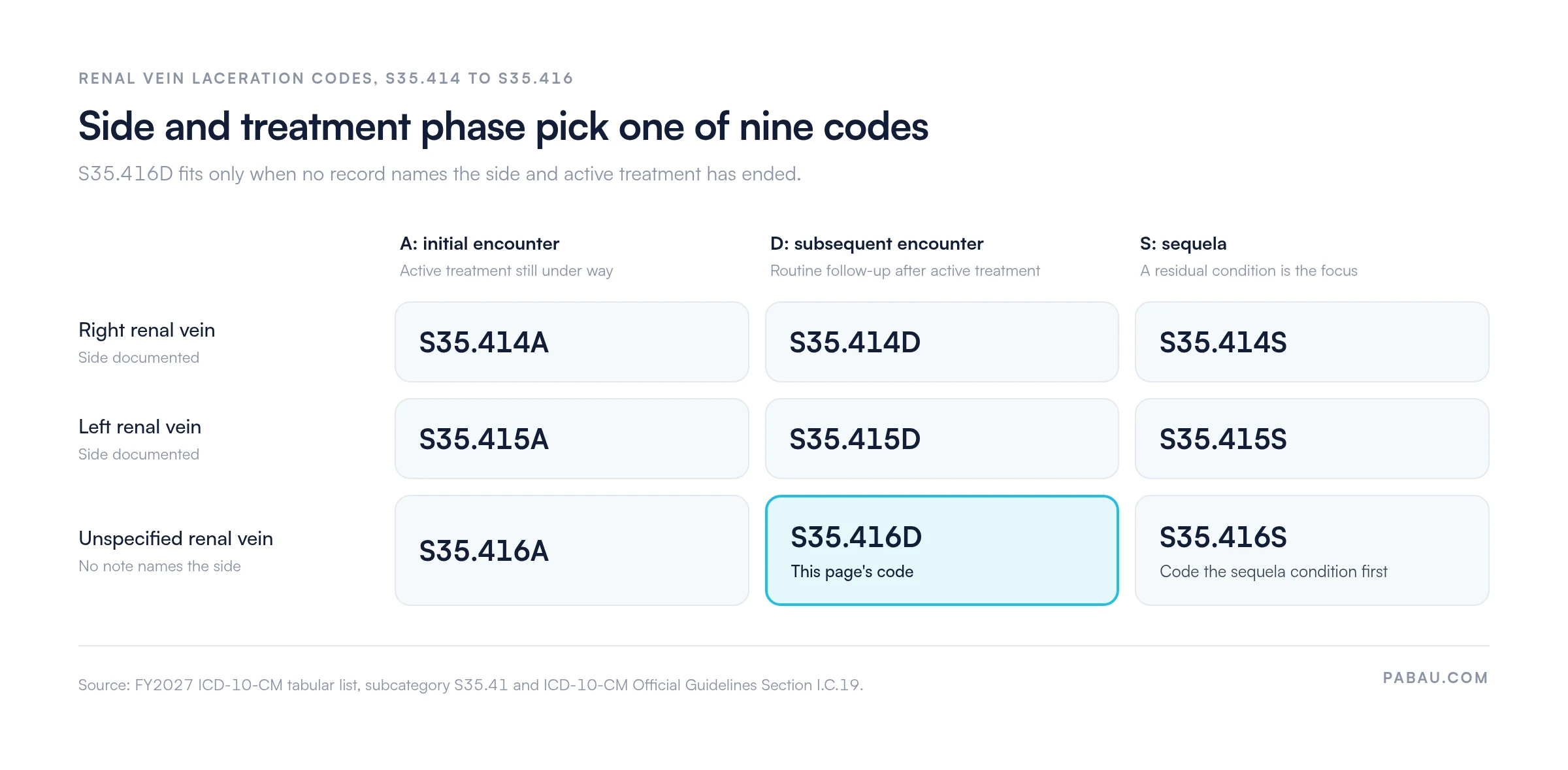
Three encounter types apply across all S35.41- codes. Each maps to a specific clinical scenario:
A common misapplication: Coders switch to D on the first outpatient visit after discharge. That is wrong when the patient returns for a planned reoperation or further interventional radiology. If any active treatment is still occurring, character A remains correct regardless of the care setting.
The treatment phase decides between A, D, and S, whatever the care setting or the number of visits. Apply this three-question logic before selecting the suffix:
Sequela coding under S is less common than coders assume. It applies only when the provider links a distinct late-effect condition to the renal vein injury, such as reduced kidney function. When both the original injury and a developing complication are active, code the injury (with A or D as appropriate) alongside the complication.
Laterality and the treatment phase work together, so the grid below sets all nine renal vein laceration codes side by side.
The S35 category is dense with vessel-specific codes. Selecting the wrong one usually comes down to missing laterality, misidentifying the vessel, or using a laceration code for a different injury type. Accurate renal vascular injury coding depends on distinguishing between the following neighbors:
The practical fix: Query the surgeon or radiologist any time the report describes a renal vein laceration without naming the side. A single clarification addendum moves the claim from S35.416D to S35.414D or S35.415D.
The FY2027 tabular list carries the following instructional notes that apply to S35.416D:
Five documentation elements must be present in the medical record before S35.416D can be coded. Coding from inference instead of explicit documentation is a frequent audit finding on low-volume trauma codes. For this code, medical billing compliance starts in the operative note and the follow-up record.
According to the AAPC ICD-10-CM coding resources, coders should query providers when documentation does not support the most specific code. For S35.416D, the query almost always asks which side was injured.
Flag any trauma chart where the operative note says ‘renal vein laceration’ without naming a side. Submit a provider query before coding and ask whether the right or left renal vein was injured. One query addendum replaces S35.416D with S35.414D or S35.415D and keeps the record auditable.
No National Coverage Determination (NCD) directly addresses S35.416D. Coverage is determined at the Medicare Administrative Contractor (MAC) level through Local Coverage Determinations (LCDs) for the underlying service billed alongside the diagnosis code.
For a subsequent-encounter visit using S35.416D, the E&M or procedure code billed must be medically necessary for the stage of injury recovery. Payers look for documentation that explains why an in-person visit is needed at this point in recovery. CMS publishes the current code files and official guidelines on its ICD-10 coding guidance page.
S35.416D denials cluster around four root causes. Recognizing the pattern behind each denial makes the corrective path straightforward. Effective denial management workflows map each rejection reason to the specific record or claim fix it needs. Treating every denial as generic rework slows recovery.
Match the reason code on the remittance against the table above to find the fix. Our guide to medical billing denial codes explains what each reason code means. Cite the correct ICD-10-CM guideline section and attach the provider addendum in the first appeal, rather than waiting for a second denial.
Low-volume trauma codes like ICD-10 code S35.416D rarely reach a coder’s daily queue. When a code turns up only occasionally, a manual review can miss the 7th character or the external cause code that should travel with it.
Pabau’s claims management software scrubs each claim for missing or invalid details before it leaves the practice. Claims submitted electronically via Claim.MD go to thousands of US payers, and Claim.MD is Pabau’s US clearinghouse partner.
Trauma surgery practices bill the S35 category more often than most. For them, pairing the encounter logic above with a clean claim checklist covers every S35.41- code before it goes out.

Pabau’s claims management and Claim.MD clearinghouse connection scrub each claim for missing or invalid details before submission. Your team spends less time on appeals and more time on patient care.

Treat every S35.416D as a prompt to read the chart once more. If any note names the side, S35.414D or S35.415D is the stronger claim, and one provider query usually settles it. If active treatment is still under way, the visit belongs on S35.416A instead.
Practices handling abdominal trauma billing can reduce S35.416D denials structurally by scrubbing claims for missing or invalid details before submission. Tracking electronic remittance advice against each claim then shows whether a corrected code was paid. Book a demo to see how Pabau scrubs, submits, and tracks trauma follow-up claims in one workflow.

Want a structured approach to appeal S35.416D denials? Medical billing denial codes covers CARC/RARC code interpretations and the appeal documentation your team needs.
Is the kidney itself lacerated too? ICD-10 code S37.049D covers a minor laceration of an unspecified kidney at a follow-up encounter.
Does the report describe bleeding at the vena cava? ICD-10 code S35.10XD covers an unspecified injury of the inferior vena cava at a follow-up encounter.
Coding a laceration of a different abdominal vein? ICD-10 code S35.311D covers a laceration of the portal vein at a follow-up encounter.
Need the main code sets on one page? Medical coding cheat sheet puts CPT, ICD-10, HCPCS, and E/M codes in one printable reference.
ICD-10 code S35.416D is the billable ICD-10-CM code for laceration of unspecified renal vein, subsequent encounter. It applies when a patient returns for routine follow-up after active treatment of a renal vein laceration has ended. The record must not state which side was injured. It sits in category S35, injury of blood vessels at abdomen, lower back and pelvis level, in Chapter 19.
Yes, S35.416D is billable and valid for HIPAA-covered transactions in FY2027, effective October 1, 2026. It is a complete seven-character code. Because it reports an unspecified side, payers expect S35.414D (right) or S35.415D (left) whenever the record names the side.
All three codes describe the same injury, a laceration of a renal vein with the side not documented, at different encounter phases. A covers active treatment, and D covers routine follow-up after active treatment ends. S covers a residual condition caused by the injury. The treatment phase, not the care setting, decides which character applies.
Use D when the injury is still healing and the patient returns for routine surveillance, wound care, or supportive management after active treatment. Use S only when a distinct late-effect condition caused by the injury is now the reason for the encounter. Code the sequela condition first and S35.416S second. If a complication is active alongside the healing injury, code the complication with the injury code and D.
The most common reason is using D at a visit that still involves active treatment, where A belongs. Other causes are a missing external cause code where the payer or state requires one, and S35.416D billed when the record names the side. A procedure code that does not fit a follow-up visit also triggers denials. The denial table above gives the fix for each.
The record must name the renal vein, describe the injury as a laceration, and confirm the visit is follow-up rather than active treatment. It should also document the mechanism of injury for the external cause code. If any note names the side, use S35.414D or S35.415D instead of S35.416D.