

ICD-10 code S61.201A: Open wound of left index finger without nail damage
ICD-10 code S61.201A covers a left index finger wound of unstated type ICD-10 co...

Last Updated: Oct 16, 2026
Billable Code Specific Code
S36.201A is the billable ICD-10-CM code for unspecified injury of body of pancreas, initial encounter. It applies when the record places the injury in the pancreatic body without naming its type. The patient must still be in active treatment.
The code sits in Chapter 19 (Injury, poisoning and certain other consequences of external causes), category S36 (Injury of intra-abdominal organs). Once a CT report or operative note names a contusion or laceration, a more specific S36.2 code replaces it. Routine follow-up visits take S36.201D, and late effects take S36.201S.
Let Pabau's smart automation suggest the right codes, reduce claim denials, and keep your practice compliant—effortlessly.
Automate repetitive tasks and focus on what matters most—your patients.
Reduce coding errors and ensure compliance with the latest regulations.
Clean claims, fewer denials, and faster reimbursements.
Powerful insights and reporting to help your practice thrive.
HIPAA compliant SOC 2 certified GDPR-compliant Trusted by 4,000+ clinics worldwide

S36.201A covers an unspecified injury of the body of the pancreas at the initial encounter, not the head (S36.200A) or tail (S36.202A).
The 7th character A applies only during active treatment. Switch to D for routine healing-phase visits and to S when coding a late effect.
Report external cause codes when the payer, facility or state requires them or the record supports them. There is no national mandate.
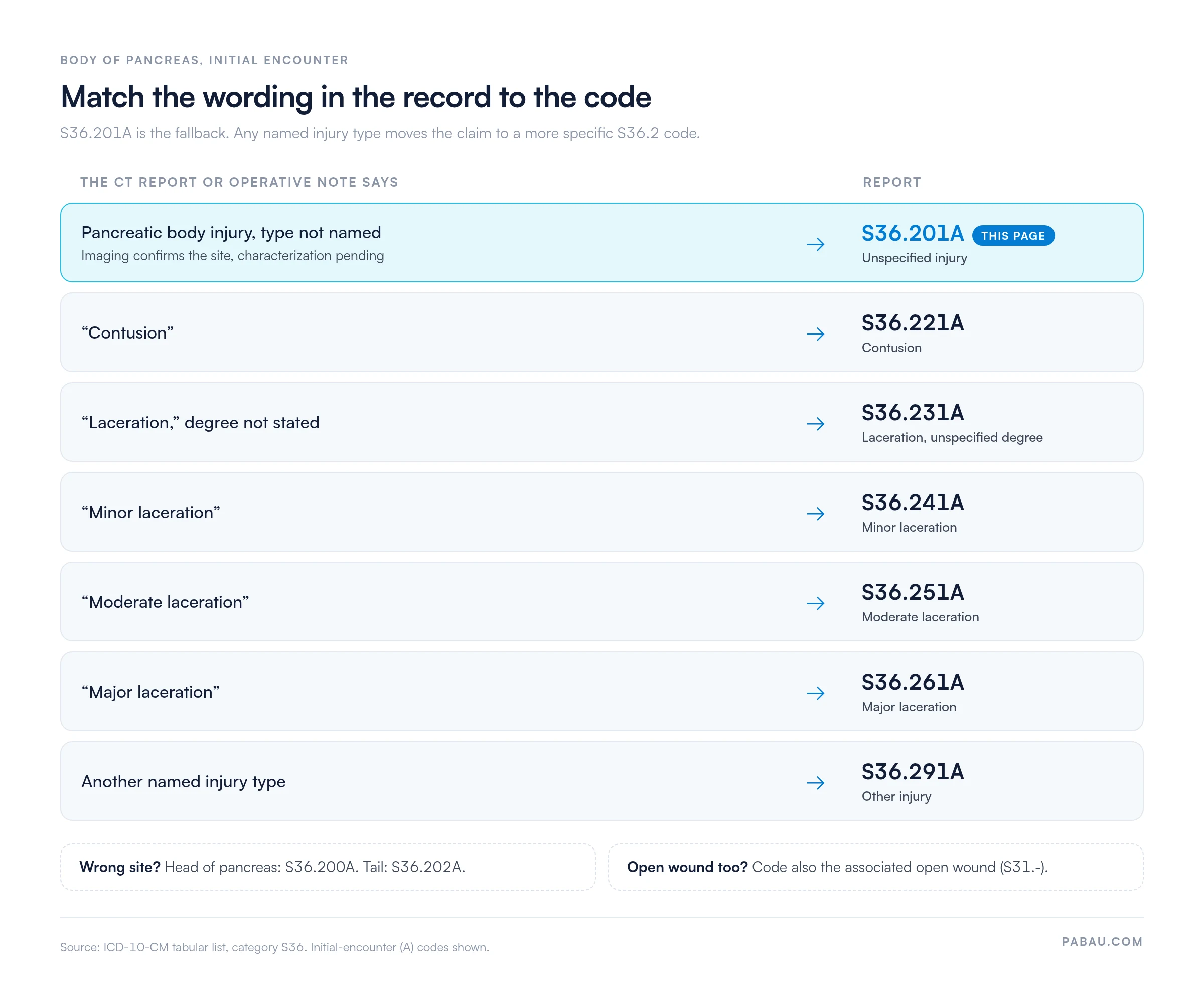
Once the record names the injury type, S36.201A no longer fits. A contusion takes S36.221A, and a laceration takes S36.231A or a degree-specific code.
In Pabau, coders search the ICD-10-CM library and attach S36.201A from the patient record, and the claim’s required fields are checked before it’s sent.
ICD-10 code S36.201A is the billable ICD-10-CM code for an unspecified injury of the body of the pancreas, initial encounter. Use it when imaging or the surgeon confirms damage to the pancreas’s mid-section, but nobody has named the injury type yet.
The code is valid in the current ICD-10-CM code set. The table below holds the reference fields you need before you build the claim.
S36.201A applies to a traumatic injury of the pancreatic body, the central portion between the head and the tail. It fits when the documentation doesn’t say whether the injury is a contusion, a laceration or another defined type. Common causes include car crashes, sports impacts and bicycle handlebar injuries.
Three scope limits trip coders up. The code covers the body only, not the head or tail. It also covers unspecified injury only, so a named injury type calls for a more specific code. Finally, a late complication such as pancreatitis is coded with the sequela version, S36.201S.
S36.201A includes:
Where a different code applies:
The 7th character tells the payer which phase of care the claim covers. ICD-10-CM Official Guidelines Section I.C.19.a sets the rules, summarized below.
A common audit finding is S36.201A on a third or fourth follow-up visit when S36.201D is correct. The switch from A to D happens when active treatment ends. That’s usually at discharge, or when the physician’s note moves from acute management to monitoring.
The same A, D and S logic runs through the whole S36.2 subcategory. A routine follow-up for a pancreatic head laceration, for example, is coded S36.230D.
The S36.2 codes below sit right next to S36.201A, and each one needs different documentation. Picking S36.201A when a more specific or differently sited code applies is a specificity error under the ICD-10-CM Official Guidelines.
S36.201A vs S36.231A is the comparison to check first. If the CT report or surgeon’s note says “laceration,” S36.231A applies (S36.221A if “contusion”). Keep S36.201A for encounters where the documentation can’t classify the injury, or where imaging shows body involvement but characterization is pending.
A stated degree narrows the choice further, as the ladder below shows. Minor, moderate and major lacerations of the body take S36.241A, S36.251A and S36.261A. Any other named injury type takes S36.291A.
Section I.C.20 of the ICD-10-CM Official Guidelines sets no national requirement to report external cause codes. Report them when the payer, facility or state requires them, or when the record supports them. They’re always secondary codes, so S36.201A stays first-listed when the injury drove the encounter.
When you do report them, use this sequence:
Place and activity codes are reported once, at the initial encounter. That makes them an S36.201A job rather than a follow-up job.
State Medicaid programs and commercial payers set their own rules on which of these they want. Check each payer’s policy or companion guide before defaulting to the full four-code set.
A 14-year-old falls onto a bicycle handlebar on a residential street. The ED CT shows injury to the body of the pancreas, but the radiologist doesn’t characterize it. The patient goes to surgery for an exploratory laparotomy.
Here’s how the claim comes together:
Then the operative note arrives and reads “minor laceration of the pancreatic body.” Recode to S36.241A before the claim goes out. If it has already gone, send a corrected claim instead of waiting for the payer to query it.
Code only to the specificity the record supports. Upgrading without clinical backing is as much a compliance risk as downcoding. Sound medical billing compliance starts with the source document.
Before you submit, confirm the physician’s note, operative report or radiology read shows:
Run a two-step check before submitting any S36.201A claim. First, confirm the operative report or radiology read names no injury type. A laceration takes S36.231A, or S36.24-, S36.25- or S36.26- when the degree is stated, and a contusion takes S36.221A. Second, confirm the encounter note shows active treatment to justify the 7th character A.
For inpatient stays, Medicare pays S36.201A claims under the MS-DRG system. The DRG weight depends on whether a major complication or comorbidity (MCC) or a complication or comorbidity (CC) is also coded. A claim with neither lands in the lowest-weighted tier of its DRG family.
Prior authorization rules vary by payer. Medicare generally doesn’t require prior authorization for emergency surgery, while commercial payers often do when the admission doesn’t come through the ED. For non-emergency pancreatic surgery, check the payer’s companion guide or call its utilization management line first.
Surgical care for a pancreatic body injury produces a short list of CPT codes. Verify NCCI edits and payer bundling policies before submission. The pairings below reflect common clinical practice, not guaranteed coverage.
Four denial patterns are worth checking on every pancreatic trauma claim. Each one can be caught before the claim goes out.
When the electronic remittance advice arrives, the claim adjustment reason code on the denied line shows which rule fired. Our guide to decoding common denial codes explains how to act on each one.
If corrections start to pile up, a structured denial management workflow helps the team work through resubmissions in deadline order.
Legacy billing systems, research and historical claim comparisons sometimes need the ICD-9-CM equivalent. The CMS General Equivalence Mappings (GEMs) give an approximate crosswalk. ICD-9 codes haven’t been valid for HIPAA-covered transactions since October 1, 2015.
GEMs mappings are approximate and not one-to-one. The ICD-9 code 863.82 maps to several ICD-10-CM pancreatic body codes, not only S36.201A. For research, note which direction the mapping ran, forward or backward.
On a trauma case, coders often copy codes from a lookup site into the claim form by hand. Each retyped code is a chance to send S36.201D instead of S36.201A, or to leave a required field blank.
Pabau, the practice management platform we build, offers cleaner claims management from inside the patient record. Coders search the ICD-10-CM library and attach S36.201A from the record. The claim’s required fields are then checked before it’s sent.
For US practices, claims go out through the Claim.MD clearinghouse. Eligibility is checked at check-in, ERA payments are posted, and claim status is tracked in one place. Your team spots a denial early instead of weeks after surgery.
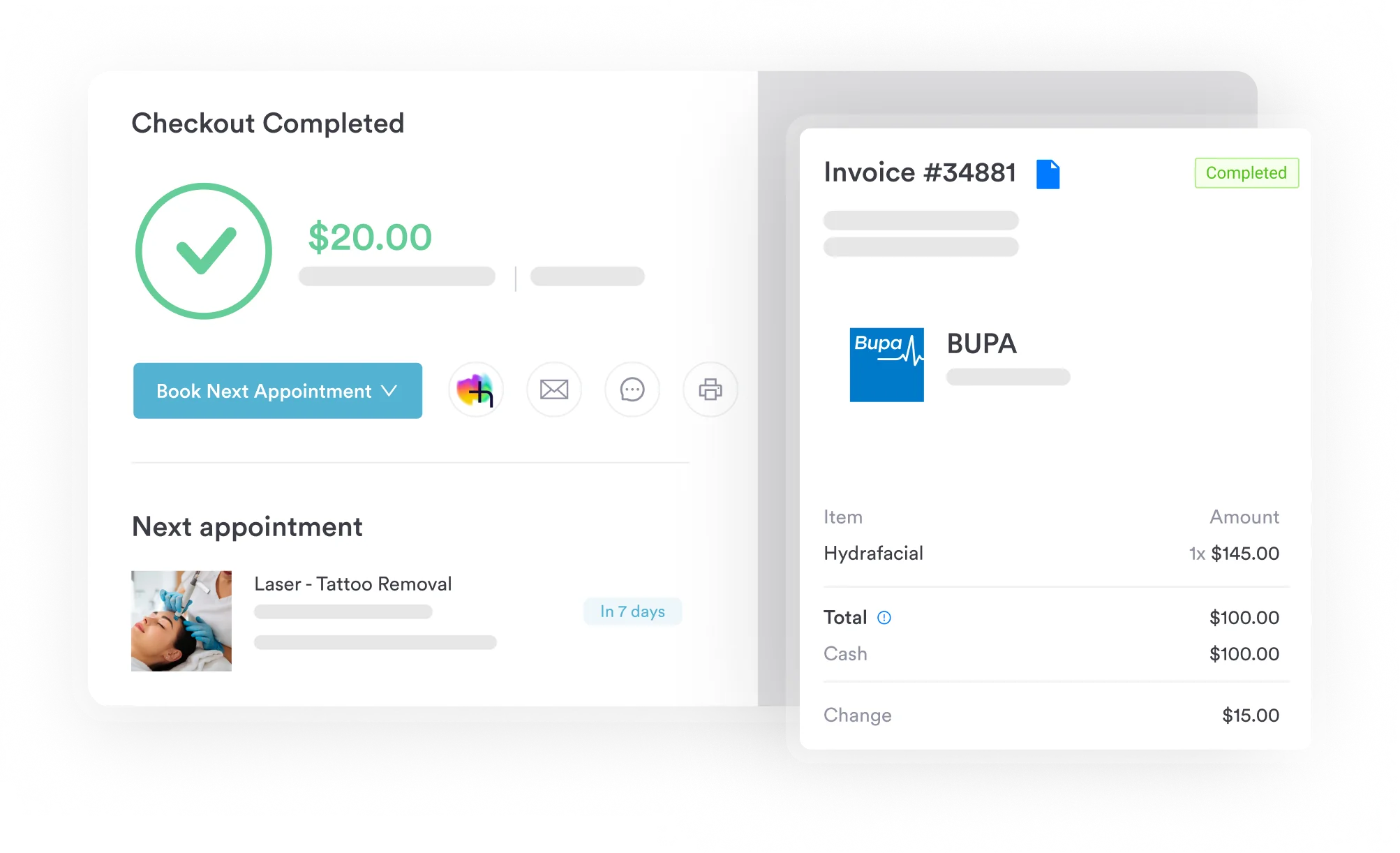

Search the ICD-10-CM library and attach S36.201A from the patient record. The claim’s required fields are checked before it’s sent, so trauma claims go out complete.

S36.201A holds a place in the record for the stretch before anyone has named the injury. Treat it that way. Recheck the code whenever a new CT read or operative note lands, and move to the specific S36.2 code as soon as the wording allows.
The trade-off is speed against precision. Billing on S36.201A during active treatment is fine, but a clean claim depends on the code matching the latest documentation.
Book a demo to see how Pabau helps your billing team attach the right code from the patient record and send complete trauma claims.

Need help managing claim denials on trauma cases? Denial codes in medical billing covers the CARC and RARC codes that appear on S36.201A rejections and explains how to action each one.
Want to understand how clearinghouses process ICD-10 trauma claims? Medical claims clearinghouse explains how 837P files carry ICD-10 diagnosis codes to payers and what happens when a code fails validation.
Looking for the full picture on revenue cycle compliance for trauma practices? Revenue cycle management walks through the end-to-end process from ICD-10 code assignment through payment posting.
It’s the billable ICD-10-CM code for an unspecified injury of the body of the pancreas at the initial encounter. It sits in category S36, Chapter 19, and is valid in the current ICD-10-CM code set.
Yes. S36.201A is a billable, specific code with its required 7th character, so it can go on a HIPAA-covered claim as written.
A marks the initial encounter, while the patient receives active treatment such as an ED visit, admission or surgery. Switch to D for routine healing-phase care.
S36.201A is an unspecified injury of the body of the pancreas. S36.231A covers a laceration of the body of the pancreas (unspecified degree); S36.221A is a contusion. Once the record names the type, use the specific code.
Report them when the payer, facility or state requires them or the record supports them. They cover mechanism (V/W/X/Y), place of occurrence (Y92), activity code (Y93) and external cause status (Y99).
The approximate GEMs equivalent is 863.82, injury to pancreas, body, without mention of open wound into cavity. Use it only for legacy records or research.
Use S36.209A, unspecified injury of unspecified part of pancreas, initial encounter. Query the physician first, because a documented site supports a more specific code.



