ICD-10 Code S92.155P: Nondisplaced avulsion fracture of left talus with malunion
What is ICD-10 Code S92.155P? ICD-10 Code S92.155P is the billable ICD-10-CM cod...

Last Updated: Oct 22, 2026
Billable Code Specific Code
O11.4 is the billable ICD-10-CM code for pre-existing hypertension with pre-eclampsia, complicating childbirth. It applies to the delivery encounter when pre-eclampsia is superimposed on hypertension that predates the pregnancy. A code from O10 is reported with it to identify the hypertension type.
O11.4 is easily confused with O10 and O14, so the record must show both the chronic hypertension and the superimposed pre-eclampsia at delivery.
Let Pabau's smart automation suggest the right codes, reduce claim denials, and keep your practice compliant—effortlessly.
Automate repetitive tasks and focus on what matters most—your patients.
Reduce coding errors and ensure compliance with the latest regulations.
Clean claims, fewer denials, and faster reimbursements.
Powerful insights and reporting to help your practice thrive.
HIPAA compliant SOC 2 certified GDPR-compliant Trusted by 4,000+ clinics worldwide

O11.4 is a billable ICD-10-CM leaf-node code, while its parent category O11 is a non-billable header that is rejected if submitted directly.
The .4 character designates the childbirth episode. Use O11.1, O11.2 or O11.3 for antepartum trimesters and O11.5 for the puerperium.
Documentation must confirm chronic hypertension that predates pregnancy and superimposed pre-eclampsia active at delivery, with attending physician attestation.
Report a code from O10 with O11.4 to identify the type of hypertension, and add a Z37 outcome-of-delivery code on every delivery claim.
Pabau, the practice management platform we build, submits O11.4 claims through its Claim.MD integration and tracks each claim after submission.
ICD-10 Code O11.4 is the billable ICD-10-CM code for pre-existing hypertension with pre-eclampsia, complicating childbirth. Assign it to the delivery encounter when pre-eclampsia is superimposed on hypertension that predates the pregnancy. Report an O10 code with it to identify the hypertension type.
The table below collects the lookup data in one view. Verify the fiscal year against your payer’s accepted code set before submission.
O11.4 captures a patient with chronic (pre-existing) hypertension who develops superimposed pre-eclampsia that is present at the time of delivery. According to the CDC/NCHS ICD-10-CM tabular list, three clinical elements must all be present for this code to be correct:
The clinical distinction drives the code. Gestational hypertension without pre-eclampsia (O13) carries a lower acuity profile than O11.4. Without documented superimposed pre-eclampsia features, the encounter codes to O10 instead. When the delivery record does not identify the hypertension type at all, the encounter codes to O16.4.
Yes. O11.4 is a billable, valid ICD-10-CM leaf-node code accepted for HIPAA-covered claim transactions. Its parent category, O11 (Pre-existing hypertension with pre-eclampsia), is a non-billable header code that cannot be submitted on a claim. A claim that carries O11 instead of a valid child code such as O11.4 is rejected. Clearinghouses and payers stop non-leaf codes at the front-end edit level.
Billability should be re-verified each October when the annual ICD-10-CM FY update takes effect. The CMS ICD-10 codes page publishes the updated tabular list and any addenda affecting the O11 category.
O11 sits within the O10-O16 hypertensive disorders block of Chapter 15. Understanding the full sibling structure prevents under-coding (selecting O11 instead of the correct child) and over-specificity errors (choosing the wrong .x suffix). The complete O11.x map is below.
The .9 unspecified suffix should be a last resort. OGCR Chapter 15 guidelines instruct coders to assign the most specific code supported by the documentation. If an antepartum record does not specify the trimester, query the attending physician before defaulting to O11.9.
O11 carries a “use additional code from O10” instruction. O14 carries an Excludes1 note for O11.-, so pre-eclampsia without pre-existing hypertension is coded O14, not O11. Reporting an Excludes1 pair together can trigger payer edits, because the two codes describe mutually exclusive conditions.
Verify excludes interactions against the current ICD-10-CM tabular list using the AAPC Codify ICD-10-CM lookup or the official CDC tool before finalizing any multi-code claim.
Four codes in maternal hypertension coding are easily confused, and they separate on two questions. Did the hypertension exist before the pregnancy, and has the patient developed pre-eclampsia features? The table maps each code to the clinical presentation that drives it.
The critical documentation phrase to look for is “superimposed pre-eclampsia” or “pre-eclampsia on background of chronic hypertension.” If the attending documents only “hypertension in pregnancy” without pre-eclampsia qualifiers, O10.x is the appropriate choice, not O11.4. The decision grid below adds the encounter type and the codes reported alongside O11.4.
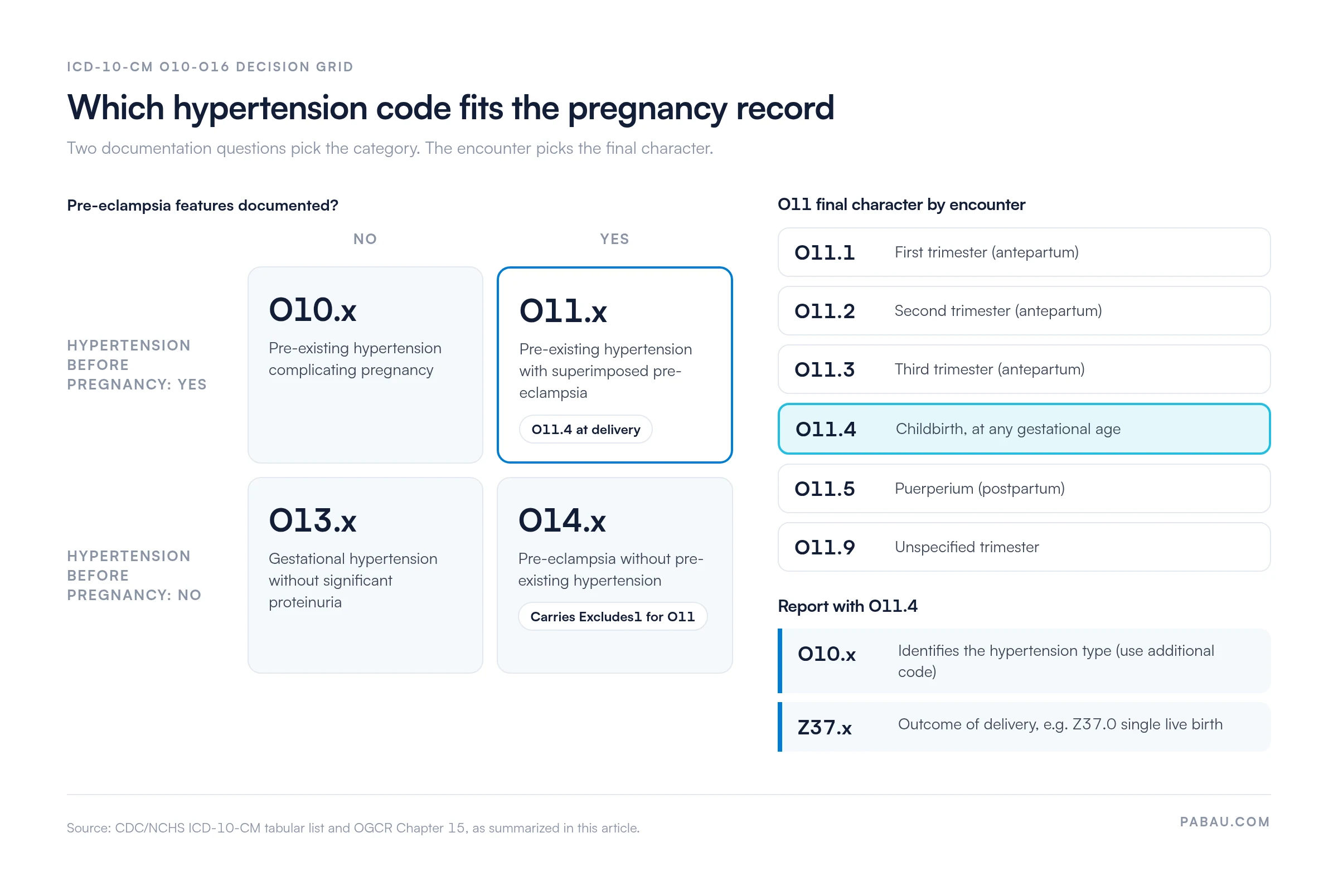
The .4 suffix in O11.4 designates the childbirth episode of care, which corresponds to the intrapartum period. This is distinct from antepartum encounters, where a trimester-specific code such as O11.1, O11.2 or O11.3 applies. The OGCR define the episode-of-care boundaries as follows:
A common coder error is assigning O11.3 (third trimester) to a delivery encounter on the grounds that delivery typically occurs in the third trimester. The delivery encounter is always .4, regardless of gestational age at the time of birth.
Claims submitted with O11.4 require specific physician documentation. Coders cannot infer superimposed pre-eclampsia from elevated blood pressure readings alone. The delivery record must capture each of the following elements at or before the delivery encounter:
When documentation is ambiguous, query the physician using the ICD-10-CM Official Guidelines for Coding and Reporting (OGCR) as the reference standard. Assign the code once the query is answered and documented.
CMS and most commercial payers follow OGCR principal-diagnosis sequencing rules for Chapter 15. For an intrapartum delivery encounter, the obstetric condition that prompted the admission or most prominently influenced the encounter typically sequences as the principal diagnosis. When O11.4 represents the condition that drove the admission, it sequences as principal. If the delivery is the primary reason for admission and O11.4 is a complicating factor, payer-specific sequencing guidance may apply.
Prior authorization rarely applies to the code itself. Associated high-acuity delivery procedures, such as cesarean section or intensive monitoring, may need pre-authorization depending on the plan and the local Medicare Administrative Contractor (MAC). Confirm with the specific payer before the delivery encounter when O11.4 is anticipated.
In medical billing, clearinghouse front-end edits catch non-billable parent codes and Excludes1 conflicts before the claim reaches the payer. Pabau integrates with Claim.MD to submit and track claims electronically. To keep submitting a clean claim routine on delivery encounters, check the O10, O11.4 and Z37 pairing against the documentation before each claim goes out.
O11.4 denials usually trace to one of five root causes. Each has a defined fix action that resolves the denial without reworking the whole encounter.
Structured denial management workflows reduce the cycle time on corrected claims by routing each denial trigger to the team that can fix it. Coding errors (triggers 1, 3 and 4) go to the coding team, and missing documentation (trigger 2) goes to the clinical team. Missing codes (trigger 5) go to billing. The reference of medical billing denial codes maps the CARC reason codes behind these denial types.
Run a monthly audit of O11.x claims. Pull every claim where the parent code O11 was submitted. Then recode each encounter to the billable child code its documentation supports, such as O11.4 for a delivery.
O11.4 is rarely the only code on a delivery claim. The following additional codes are commonly appropriate, and Z37.x and O10.x are required. Efficient revenue cycle management in obstetrics depends on capturing the full code set at coding, not as a correction after the first denial.
Once the full code set is assigned, Pabau’s claims management software helps practices submit these delivery claims and track them after submission.
An O11.4 delivery claim usually passes through three hands. The clinical team documents the pre-eclampsia criteria, and a coder assigns O11.4 with its O10 and Z37 companions. Billing then sends the claim through a clearinghouse.
When those steps sit in separate systems, a denial means chasing the note, the code set and the payer response across three places. Pabau keeps the patient record, clinical notes and claim submission together. Claims go out electronically through the Claim.MD integration, and each one is tracked after it leaves the practice.
Coders still choose the codes. The difference is that the documentation they query and the claim they correct sit side by side. A rejected O11.4 claim gets fixed from one screen.
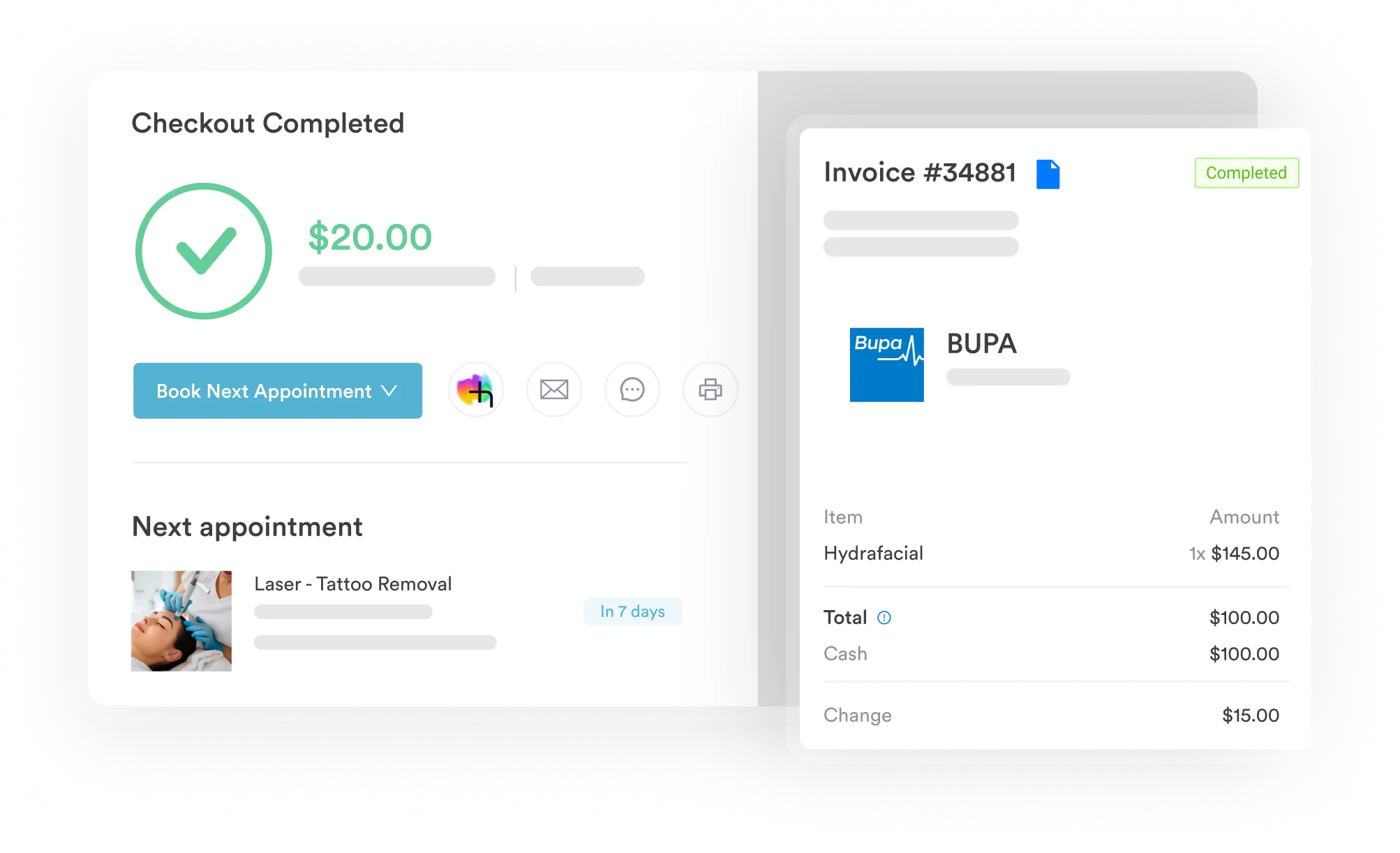

Pabau keeps clinical notes, patient records and electronic claim submission in one system. Your team can document, submit and track O11.4 delivery claims without switching tools.

Assign O11.4 only when the record shows both halves of the diagnosis: hypertension that predates the pregnancy and pre-eclampsia active at delivery. If either half is missing, query before you code rather than correcting the claim after a denial.
Build the claim as a set, with O11.4, the O10 code for the hypertension type and the Z37 outcome code together. The parent code O11 and a trimester character on a delivery encounter cause most avoidable rework, and both are cheaper to catch before submission.
Pabau helps OB-GYN practices keep that documentation and claim submission in one system, so the note and the claim stay aligned. Book a demo to see how it fits your delivery-claim workflow.

Coding an antepartum visit instead of the delivery? ICD-10 code O11.1 covers the same diagnosis in the first trimester.
Coding hypertension outside pregnancy? ICD-10 code I10 explains how essential hypertension is coded when no pregnancy is involved.
New to the claim cycle behind these codes? What is medical billing walks through how a diagnosis code moves from the chart to a paid claim.
Sending claims through Claim.MD? Claim.MD clearinghouse overview covers how the clearinghouse handles claim submission and tracking.
Dealing with recurring denials across your OB-GYN practice? Denial management in healthcare maps the workflow from CARC code to corrected claim.
ICD-10 Code O11.4 is the billable diagnosis code for pre-existing hypertension with superimposed pre-eclampsia complicating childbirth. It means a patient with chronic hypertension documented before pregnancy developed pre-eclampsia features that were active at delivery. It belongs to the O10-O16 hypertensive disorders block of Chapter 15 and is the intrapartum-episode code within the O11 category.
Yes. O11.4 is a valid, billable leaf-node code in ICD-10-CM, accepted for HIPAA-covered transactions. The parent category O11 is a non-billable header and must not be submitted directly on a claim.
O14.x codes cover de novo pre-eclampsia in patients without pre-existing hypertension. O11.4 requires pre-existing chronic hypertension as the baseline condition, with pre-eclampsia superimposed on it. O14 carries an Excludes1 note for O11, so the two are not reported together on the same encounter.
The usual triggers are the non-billable parent code O11, missing documentation of superimposed pre-eclampsia, and O11.3 used in place of O11.4 at delivery. Claims are also denied for an Excludes1 conflict with O14.x or a missing Z37 outcome-of-delivery code. Reporting O10.x with O11.4 is required and is not a conflict.