ICD-10 Code Y76.0: Diagnostic obstetric and gynecological devices
ICD-10 Code Y76.0: Definition and billable status ICD-10 Code Y76.0 is a valid, ...

Last Updated: Oct 23, 2026
Billable Code Specific Code
S82.244F is the billable ICD-10-CM code for a nondisplaced spiral fracture of the right tibial shaft at a subsequent encounter. It covers an open fracture type IIIA, IIIB, or IIIC with routine healing.
The code applies only when the original fracture was open type IIIA, IIIB, or IIIC and is healing routinely at a follow-up. A closed fracture at the same stage takes S82.244D. S82.244F sits in the S82 category, which covers fractures of the lower leg, including the ankle.
Let Pabau's smart automation suggest the right codes, reduce claim denials, and keep your practice compliant—effortlessly.
Automate repetitive tasks and focus on what matters most—your patients.
Reduce coding errors and ensure compliance with the latest regulations.
Clean claims, fewer denials, and faster reimbursements.
Powerful insights and reporting to help your practice thrive.
HIPAA compliant SOC 2 certified GDPR-compliant Trusted by 4,000+ clinics worldwide

S82.244F covers a routine-healing follow-up for a nondisplaced spiral fracture of the right tibial shaft. It applies only for an open fracture type IIIA, IIIB, or IIIC.
ICD-10-CM guidelines Section I.C.19.c define F as subsequent encounter for open fracture type IIIA, IIIB, or IIIC with routine healing. Using A at a follow-up visit is a common audit trigger.
Delayed healing of the same open fracture takes S82.244J, while a closed fracture healing routinely takes S82.244D.
Displacement status and laterality must both be documented explicitly. A note that omits either forces a less specific, denial-prone code.
Pabau’s claims management software automates ICD-10 code validation and clean-claim checks before submission, reducing S82.244F denials at orthopedic and sports medicine practices.
ICD-10 Code S82.244F covers a follow-up visit for a nondisplaced spiral fracture of the right tibial shaft that is healing routinely.
The original fracture must have been open type IIIA, IIIB, or IIIC. The code is billable and valid for the 2026 fiscal year, and the table below gives coders a quick check before they submit a claim.
Each character in S82.244F carries a distinct clinical meaning. Misreading any one segment leads to the wrong code.
The spiral pattern reflects a rotational mechanism of injury, typically a twisting force. On radiographs, the fracture line winds around the tibial shaft in a helical pattern. If the clinical note says “oblique” while imaging describes a spiral line, query the provider before choosing between S82.23- and S82.24-. The pattern carries forward to every follow-up claim.
The 7th character in ICD-10-CM fracture codes sets the encounter type, the open or closed status, and the healing stage. Selecting the wrong one is a common source of claim denials and audit flags on tibial shaft fracture claims.
What “subsequent encounter” means: Under ICD-10-CM Official Guidelines Section I.C.19, a subsequent encounter comes after the patient has completed active treatment of the fracture. The patient is now receiving routine care during the healing or recovery phase. Typical examples are a cast change or removal, an X-ray to check healing, removal of a fixation device, and other follow-up visits. These visits don’t have to be with the original treating provider.
What “routine healing” means: Routine healing means the fracture is progressing as clinically expected, with no complications. A note that says “healing well” or “fracture looks good” isn’t always enough on its own. The clinician’s assessment has to support normal, uncomplicated healing. Callus formation in the expected timeframe with maintained alignment supports it. If the note is ambiguous, the coder can’t infer routine healing.
Critical clarification on S82.244F vs S82.244D: S82.244D is the code for a closed fracture, subsequent encounter, routine healing. S82.244F applies when the fracture was open type IIIA, IIIB, or IIIC at the time of injury. The F suffix does not mean “follow-up for any spiral tibia fracture.” It is tied to the open fracture type at initial treatment, so confirm the original injury documentation before selecting F over D.
The grid below reduces every follow-up character to two questions: what the fracture was at injury, and how it is healing now.
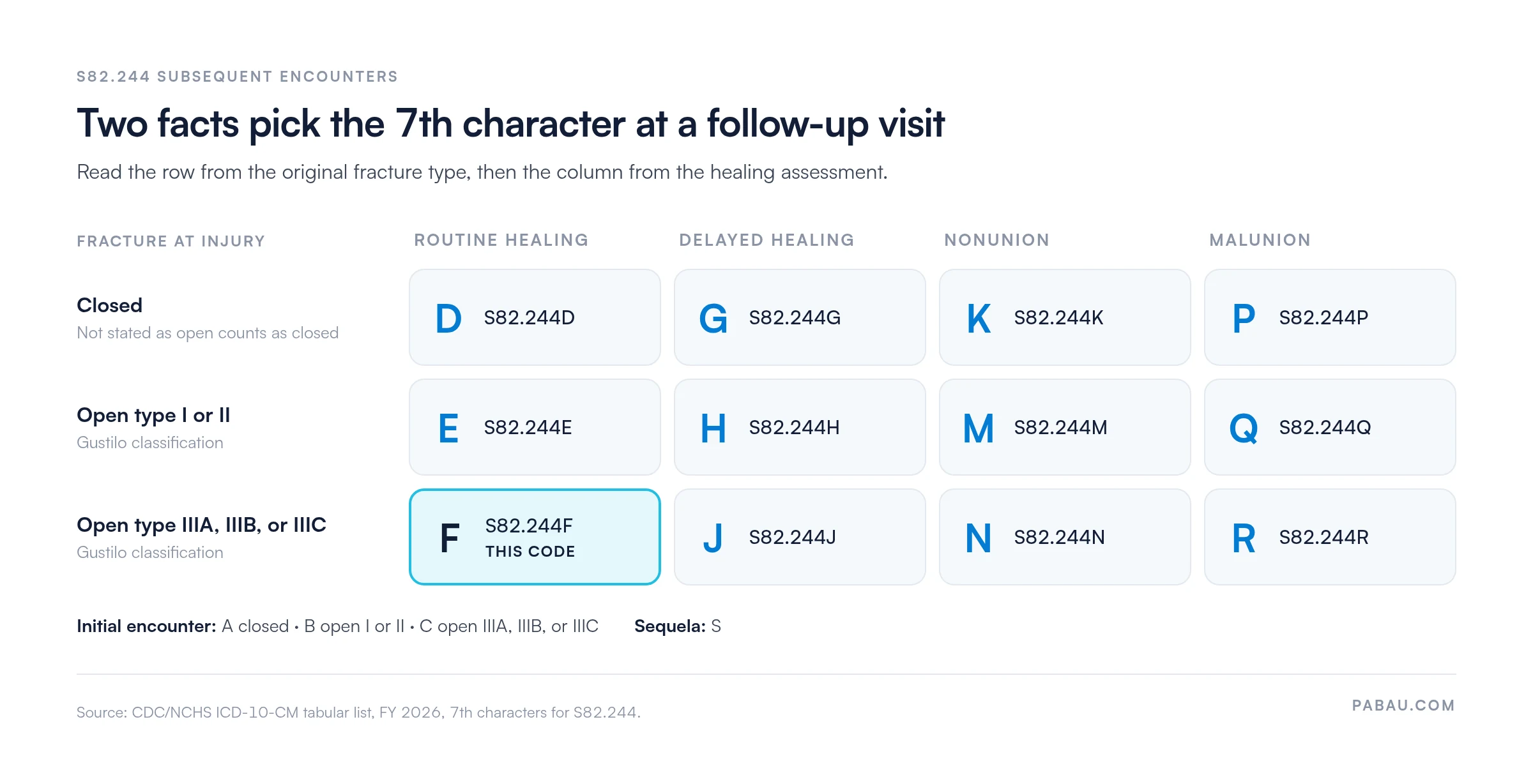
The codes most often confused with S82.244F differ on four axes: displacement, laterality, open or closed status, and healing stage. A single wrong character changes the clinical meaning entirely.
The confusion that matters most is between S82.244F and S82.244J. Both describe a follow-up for the same open type IIIA, IIIB, or IIIC fracture, and only the healing trajectory differs. J applies when the note documents slow callus formation or persistent pain at the fracture site, so selecting F there undercodes the case. When the original fracture was closed, the choice moves to S82.244D for routine healing or S82.244G for delayed healing.
Displacement, side, and Gustilo type each move the code to a different S82.24 entry. A displaced spiral fracture of the left tibial shaft, open type I or II with delayed healing, takes S82.242H.
S82.244F is correct only when all four of these conditions are met:
Practices with high-volume orthopedic or sports medicine caseloads see this code regularly in post-surgical follow-up visits. Examples where S82.244F applies:
Examples where S82.244F does NOT apply, and the correct alternative:
Every element of the code must be traceable to the clinical record. Missing a single axis forces a less specific code, increases denial risk, and creates an audit vulnerability.
Build a fracture follow-up note template with a structured healing assessment field covering callus formation, alignment status, and any signs of delayed healing. Add a field for the Gustilo type recorded at injury. Those two additions settle the F, D, and J decision at every follow-up and keep the coding defensible in a payer audit.
ICD-10 Code S82.244F appears as the diagnosis code alongside procedure codes that describe the service rendered at the follow-up encounter. The pairing must reflect what happened at the visit. Pairing S82.244F with an initial-treatment CPT code at a follow-up visit is a medical necessity mismatch that payers deny.
Visits inside the global period after fixation are reported with 99024, which carries no separate fee. Healing films taken at those visits fall outside the surgical package and are usually coded as 73590, with S82.244F as the supporting diagnosis.
Medicare follows the ICD-10-CM Official Guidelines for encounter-type documentation. CMS does not publish a specific LCD for routine tibial shaft fracture follow-up. Local Coverage Determinations for orthotics and imaging paired with S82.244F may still apply, depending on the service billed. Commercial payers mirror CMS encounter-type rules in most cases, though prior authorization rules for advanced imaging or surgery vary by plan year.
The table below covers the most common denial patterns for S82.244F claims and the recommended resolution for each.
Proactive denial management cuts rework on tibial shaft fracture claims. Checking eligibility and clean claim requirements before the appointment means fewer of those claims come back for rebilling.
S82.244F is valid only for traumatic fractures. The ICD-10-CM tabular list places Excludes1 and Excludes2 notes at the S82 category level. They decide which diagnoses can sit alongside codes in this category.
Pathological fractures sit outside S82 altogether. Use M84.5- for a fracture caused by neoplastic disease, M84.4- for other pathological fractures, and M80.- for osteoporosis with a current pathological fracture. Stress fractures of the tibia take M84.36- codes.
The CDC/NCHS ICD-10-CM web tool and the CMS ICD-10 codes page both publish the annual tabular list with full Excludes notes for S82. Always verify against the current fiscal year release before submitting, as effective dates and Excludes language can change with each annual update. The AAPC ICD-10-CM lookup and ICD List provide searchable interfaces against the same official data.
The other S82 code pages on this site sit in our ICD-10-CM codes archive, which helps when the documentation points to a neighboring code.
A follow-up claim for S82.244F depends on three records agreeing. The initial ED or operative note carries the Gustilo type, the visit note carries the healing assessment, and the imaging report confirms laterality. When they disagree, the error usually surfaces weeks later as a denial.
Pabau, the practice management platform we build, moves that check to the pre-billing stage. Its claims management software validates CPT-to-ICD-10 pairings before submission, so pairing mismatches are caught before the payer sees them. Pabau also integrates with the Claim.MD clearinghouse, which checks diagnoses and procedures against payer rules before the 837P reaches the insurer.
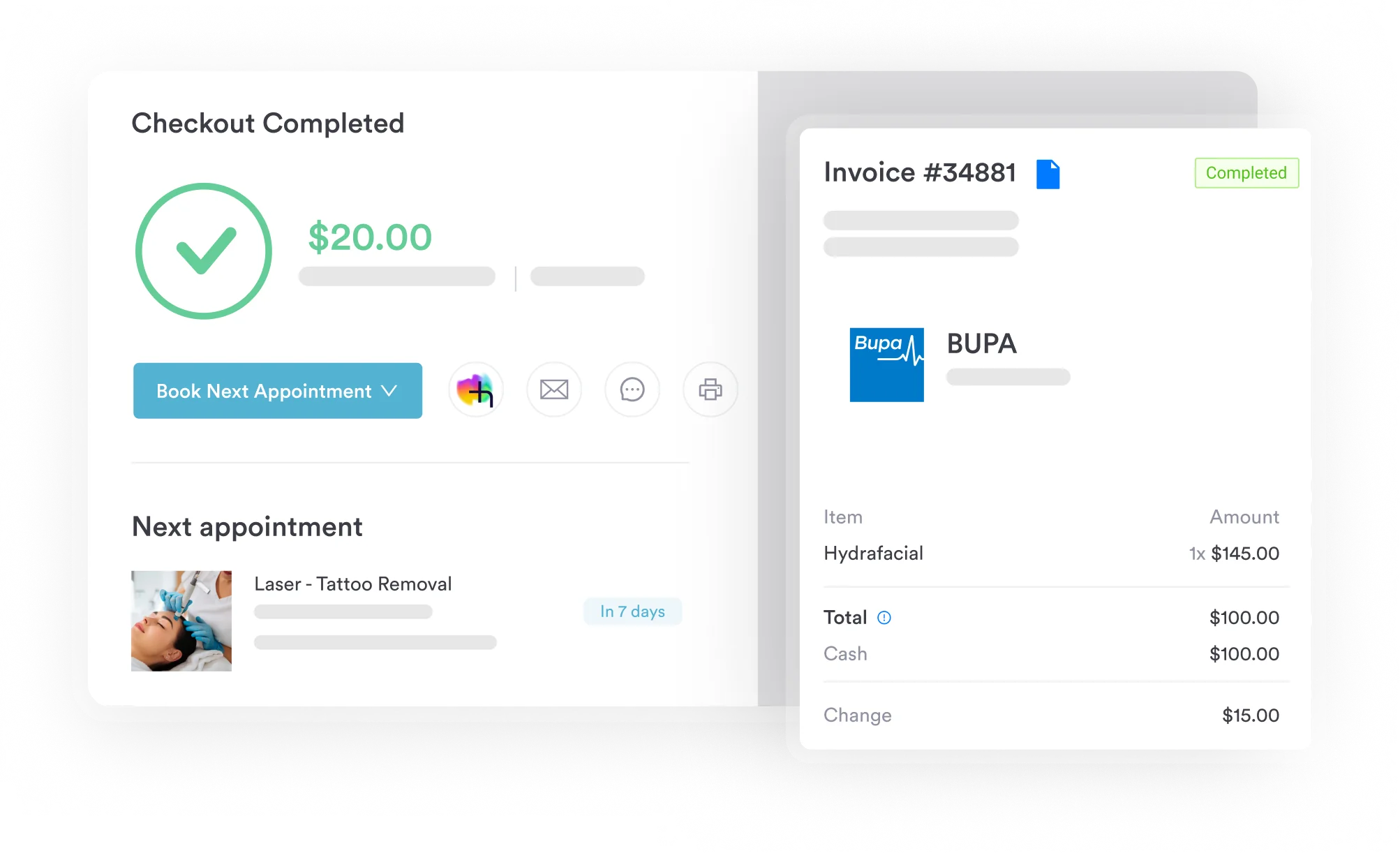
The result is fewer claims bounced for a wrong 7th character or a mismatched procedure code. Your billing team spends less time on rework and more time on claims that are still in flight.

Pabau integrates with Claim.MD to validate ICD-10 and CPT pairings, check eligibility, and flag missing documentation before your claim reaches the payer. Orthopedic and sports medicine practices use Pabau to cut denial rework and speed up revenue collection.

S82.244F is only as defensible as the initial-encounter record behind it. Before coding any follow-up on this fracture, pull the original ED or operative note. Confirm it says open, with a Gustilo type of IIIA, IIIB, or IIIC. If it doesn’t, the code is S82.244D or S82.244E, however well the wound is healing.
The healing assessment decides the rest. Callus and maintained alignment support F, while slow callus formation moves the claim to S82.244J, and a coder should never have to guess between them.
Adding both facts to the follow-up note template costs two fields and removes the most common reasons these claims come back. Book a demo to see how Pabau checks S82.244F follow-up claims against payer rules before they go out.

Need to understand denial codes on returned claims? Denial codes in medical billing explains the most common CARC reason codes and how to appeal them effectively.
Want to see how clearinghouse integration reduces claim rework? How Claim.MD clearinghouse works with Pabau covers real-time eligibility checks, ERA processing, and 837P submission for orthopedic claims.
Looking for a broader overview of medical billing compliance? Medical billing compliance covers HIPAA transaction standards, documentation requirements, and audit preparedness for healthcare practices.
ICD-10 Code S82.244F is the billable diagnosis code for a nondisplaced spiral fracture of the right tibial shaft at a follow-up visit. It applies when the original fracture was open type IIIA, IIIB, or IIIC and is healing routinely. The code is valid under ICD-10-CM for fiscal year 2026.
The 7th character F designates a subsequent encounter for an open fracture type IIIA, IIIB, or IIIC with routine healing. “Subsequent encounter” means the patient has completed active treatment and is receiving routine care while the fracture heals. “Routine healing” means the fracture is progressing without complications such as delayed healing, nonunion, or malunion.
S82.244D applies when the original fracture was closed and is healing routinely at a subsequent encounter. S82.244F applies when the original fracture was an open type IIIA, IIIB, or IIIC injury that is now healing routinely. The distinction rests on the open or closed classification at initial treatment, not on the wound status at the follow-up visit.
S82.244J is the code for the same open type IIIA, IIIB, or IIIC fracture when healing is delayed rather than routine. Use it when the follow-up note documents inadequate callus formation, fracture-site pain beyond the expected timeframe, or an assessment that healing is behind schedule. S82.244G is the delayed-healing code only when the original fracture was closed.
Yes. S82.244F is a valid, billable ICD-10-CM code for fiscal year 2026. It has been active since FY 2016 and has not been modified or deleted in subsequent annual updates. Always verify against the current CMS tabular list before submitting, as code validity is confirmed annually.
No. S82.244F is strictly for traumatic fractures. Pathological fractures use M84.5- when caused by neoplastic disease, M84.4- for other pathological fractures, and M80.- for osteoporosis with a current pathological fracture. Stress fractures of the tibia use M84.36- codes. Using S82.244F for a non-traumatic fracture is a material coding error and an audit risk.