ICD-10 Code Y76.0: Diagnostic obstetric and gynecological devices
ICD-10 Code Y76.0: Definition and billable status ICD-10 Code Y76.0 is a valid, ...

Last Updated: Oct 23, 2026
Billable Code Specific Code
O07.0 is the billable ICD-10-CM code for genital tract and pelvic infection following failed attempted termination of pregnancy. It covers endometritis, oophoritis, parametritis, pelvic peritonitis, salpingitis and salpingo-oophoritis after a termination attempt that did not succeed.
Neighboring codes cover different events. O03.x is for spontaneous abortion, and O04.x is for complications after a completed induced termination. O07.0 needs a documented failed attempt, followed by an infection the provider links to it. Sepsis (O07.37) and urinary tract infection (O07.38) take their own codes.
Let Pabau's smart automation suggest the right codes, reduce claim denials, and keep your practice compliant—effortlessly.
Automate repetitive tasks and focus on what matters most—your patients.
Reduce coding errors and ensure compliance with the latest regulations.
Clean claims, fewer denials, and faster reimbursements.
Powerful insights and reporting to help your practice thrive.
HIPAA compliant SOC 2 certified GDPR-compliant Trusted by 4,000+ clinics worldwide

O07.0 applies only when a termination was attempted and failed, and a genital tract or pelvic infection followed, with all three documented.
The tabular list includes endometritis, oophoritis, parametritis, pelvic peritonitis, salpingitis and salpingo-oophoritis following a failed attempted termination.
A urinary tract infection (O07.38) or sepsis (O07.37) after a failed termination takes its own code, and both are Excludes1 at O07.0.
When sepsis is documented, assign O07.37 first instead of O07.0, with an additional code for the specific infection or organism.
ICD-10 code O07.0 is the billable code for genital tract and pelvic infection following failed attempted termination of pregnancy. It sits in the O00-O08 block (pregnancy with abortive outcome) within Chapter 15 of ICD-10-CM. The table below summarizes the reference fields coders need before claim submission.
O07.0 codes a genital tract or pelvic infection that follows a failed attempted termination. The infection must follow a documented termination attempt that did not achieve its intended result. Infection after a spontaneous abortion, or after a completed induced termination, uses a different code.
The ICD-10-CM tabular list includes the following infection types under O07.0, each following a failed attempted termination:
Two infections that often get grouped with these take their own codes. A urinary tract infection after a failed attempted termination is O07.38, and sepsis is O07.37. Both are Excludes1 notes at O07.0.
The clinical record must document the causal relationship between the failed procedure and the infection. A pelvic infection that predates the procedure can’t support O07.0. Neither can one where the provider doesn’t clearly state the link to the failed attempt.
Check the official Includes and Excludes1 notes before assigning O07.0. They decide which neighboring codes can and can’t appear on the same claim.
The Excludes1 note at the O07 parent level prohibits reporting O07.x together with O03.0-. Spontaneous and failed-attempt scenarios are coded separately, so the record must be clear on which occurred before any O07 subcode is assigned. At O07.0 itself, the Excludes1 notes send sepsis to O07.37 and urinary tract infection to O07.38.
O07.0 is one of five subcodes under parent O07. Each subcode covers a distinct complication type following a failed attempted termination. Selecting the correct subcode requires the provider’s documentation to specify the complication present.
When a patient presents with both infection and hemorrhage after a failed termination attempt, code both O07.0 and O07.1. The O07 family does not prohibit multiple subcode assignment when distinct complications coexist, provided each is documented.
O03.x, O04.x and O07.1 each share surface-level clinical similarities with O07.0. The underlying clinical scenario determines which code applies.
Hemorrhage after a failed attempt is coded separately from the infection. The guide to O07.1 covers the bleeding side of the same scenario, including when both codes appear on one claim.
Put together, the choice comes down to three questions about the record, in a fixed order:
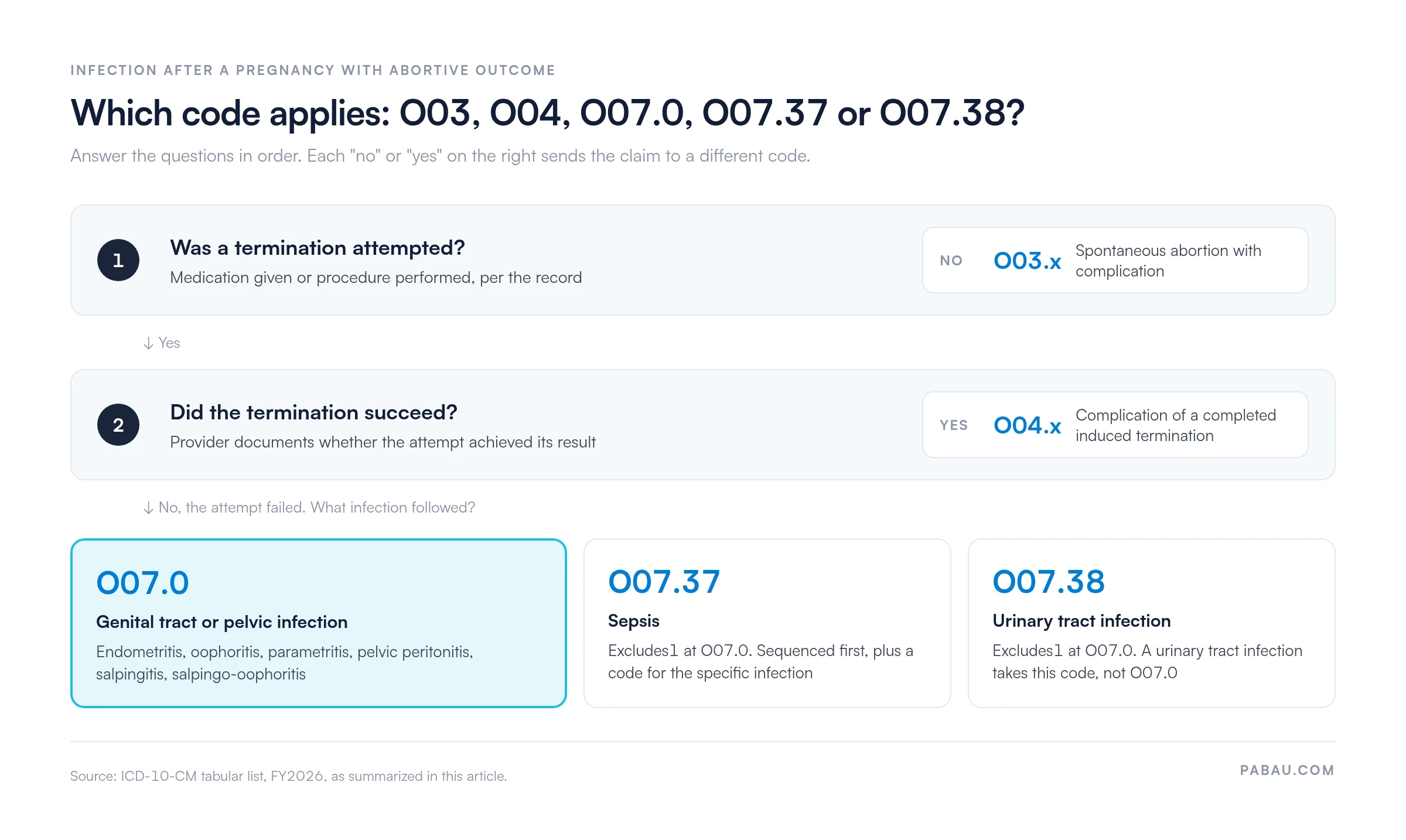
Review the operative note and the discharge summary together before assigning any O07 subcode. The operative note establishes whether the procedure was attempted and failed. The discharge summary (or later visit notes) establishes the complication. If the operative note is absent or only references a completed procedure, O07.0 cannot be assigned – escalate to a coding query.
ICD-10 code O07.0 needs the four elements below documented before it can be assigned. Missing any one leaves the code unsupported.
The organism isn’t one of the required elements. If one is identified (for example, Group B Streptococcus or E. coli), add a code for it from categories B95-B97.
Sometimes the record shows only that infection followed a pregnancy-related procedure, without confirming the procedure failed. The correct code is then more likely O04.x or O03.x. Coders must not infer a failed attempt from clinical context alone.
Under the ICD-10-CM Official Guidelines for Coding and Reporting, O07.0 is the principal diagnosis when no sepsis is present. That holds when a genital tract or pelvic infection is the reason for the encounter after a confirmed failed termination.
When sepsis is documented, O07.0 no longer applies. Sepsis following a failed attempted termination has its own Chapter 15 code, O07.37, and O07.0 carries an Excludes1 note for it. Chapter 15 guidelines give that code sequencing priority, so the claim is built like this:
O07.0 applies only to a genital tract or pelvic infection without sepsis. Check the current guidelines each year on the CMS ICD-10 codes page, as Chapter 15 guidelines receive periodic updates.
Accurate O07.0 assignment depends on four documentation elements. Payers, including Medicaid programs, can audit obstetric complication codes for medical necessity and coding specificity. Intake and procedure forms that prompt for each element make them easier to capture at the point of care.
On the billing side, O07.0 maps to CMS MS-DRG groupings under the obstetric complication DRGs for inpatient encounters. For professional (outpatient) claims, the code is submitted on the CMS-1500 form as the primary or additional diagnosis, based on the encounter reason. Payer policies on termination-related codes vary, so check the payer’s local coverage determinations (LCDs) and national coverage determinations (NCDs).
A clean claim submission for an O07.0 encounter pairs the diagnosis with the correct procedure code. That means ICD-10-PCS for inpatient claims and CPT for outpatient claims. Confirm the code combination doesn’t trigger a Correct Coding Initiative (CCI) edit before it goes out.
Five coding and documentation errors leave an O07.0 claim open to denial or audit.
Structured denial management workflows tag each O07.x denial by root cause. That shows whether the fix is better documentation, coder education or a payer policy query. The AAPC ICD-10-CM code lookup and the CDC/NCHS ICD-10-CM web tool are free references for current descriptors and tabular notes.
For the neighboring codes in this chapter and beyond, browse our diagnostic code guides before you finalize the claim.
Without a connected billing system, a rejected O07.0 claim sends someone hunting for the operative note, the follow-up note and the original submission by hand. That search can take longer than the correction itself.
Pabau, the practice management platform we build, keeps the patient record and the claim in one place. Its trackable claims management shows where each claim sits, from submission to payment. Pabau’s integration with the Claim.MD clearinghouse supports electronic claim submission and tracking for US practices, using the diagnosis codes your team assigns.
You can also build Pabau’s digital forms to prompt for the four documentation elements above. The coder then works from a complete record, instead of sending a query days after the visit.

Pabau’s Claim.MD integration supports electronic claim submission and tracking for US practices, using the diagnosis codes your team assigns. See how it fits your billing workflow.

Treat O07.0 as a narrow code. It holds up only when the chart proves three facts: a failed attempt, a postprocedural infection and the provider’s link between them. If sepsis or a urinary tract infection is documented, the claim belongs to O07.37 or O07.38 instead.
The trade-off is time up front. A coding query before submission costs less than reworking a denied claim weeks later.
Pabau keeps your medical billing workflows and patient records together, and its Claim.MD integration handles electronic submission and tracking for US practices. Book a demo to see how Pabau keeps your O07.0 documentation and claims in one place.

Coding bleeding after the same failed attempt? ICD-10 code O07.1 covers delayed or excessive hemorrhage after a failed attempted termination, and when it pairs with O07.0.
Was the termination completed instead? ICD-10 code O04.6 shows how the O04 family handles complications after a completed induced termination.
Encountering denials on O07.x claims? Denial management in healthcare outlines root-cause categorization and remediation strategies for systematic claim denials.
Submitting claims through a US clearinghouse? Claim.MD clearinghouse overview explains how clearinghouse submission works with ICD-10-CM diagnosis codes on professional and facility claims.
ICD-10 code O07.0 is the billable diagnosis code for genital tract and pelvic infection following failed attempted termination of pregnancy. It covers endometritis, oophoritis, parametritis, pelvic peritonitis, salpingitis and salpingo-oophoritis after a termination attempt that did not achieve its intended result.
Yes. O07.0 is a fully billable, specific ICD-10-CM code valid for FY2026 encounters. It can be a principal or additional diagnosis on professional (CMS-1500) and facility (UB-04) claims. Which one depends on the encounter type and the reason for the visit.
Billing O07.0 requires four documented elements. You need a procedure note confirming a termination was attempted, provider documentation that it failed, and a postprocedure infection diagnosis naming the infection type. You also need an explicit provider statement linking the infection to the failed procedure. Coders cannot infer any of these from clinical context alone.
O07.0 claims are subject to standard ICD-10-CM medical necessity rules and the payer’s local or national coverage determinations for termination-related services. Inpatient claims map to CMS MS-DRG obstetric complication groupings, and outpatient claims are submitted on CMS-1500. Always verify the current ICD-10-CM tabular list and the payer’s policy before submission, as coverage rules vary by payer and state.