ICD-10 Code V28.01XD: E-bike driver noncollision accident, nontraffic, subsequent encounter
ICD-10 Code V28.01XD: Definition and billable status ICD-10 Code V28.01XD is the...

Last Updated: Oct 20, 2026
Billable Code Specific Code
O01.1 is the billable ICD-10-CM code for incomplete and partial hydatidiform mole.
It sits in the O00-O08 range for pregnancy with an abortive outcome, and the 2026 ICD-10-CM edition took effect on October 1, 2025.
Most molar pregnancy coding errors don't happen at diagnosis. They happen at the specificity stage, when a provider documents "molar pregnancy" without saying whether the mole is complete or partial. Coders then default to the unspecified O01.9, and that default costs reimbursement accuracy and invites a payer audit.
Getting the partial-versus-complete call right, and documenting it, keeps the chart, the code, and the claim aligned. Practices charting in OB/GYN EMR software that ties pathology and ultrasound results to the same encounter make that call easier to support. Here's how to make the distinction and document it correctly.
Let Pabau's smart automation suggest the right codes, reduce claim denials, and keep your practice compliant—effortlessly.
Automate repetitive tasks and focus on what matters most—your patients.
Reduce coding errors and ensure compliance with the latest regulations.
Clean claims, fewer denials, and faster reimbursements.
Powerful insights and reporting to help your practice thrive.
HIPAA compliant SOC 2 certified GDPR-compliant Trusted by 4,000+ clinics worldwide

ICD-10 code O01.1 is the billable ICD-10-CM code for incomplete and partial hydatidiform mole, and it took effect October 1, 2025.
The O01 category has three billable codes: O01.0 for a complete mole, O01.1 for a partial mole, and O01.9 when the type isn’t specified.
Coders need pathology confirmation of a partial or incomplete mole before assigning O01.1 instead of the unspecified O01.9.
O01.1 is not POA exempt, so hospitals must report present-on-admission status for it on every inpatient claim.
A pathology result of chorioadenoma destruens or malignant mole (D39.2) excludes O01.1 entirely under the category’s Excludes1 note.
Here’s the core reference data coders and billers need before submitting a claim with O01.1.
A partial mole carries some fetal tissue and a triploid karyotype. A complete mole has neither, and its genetic material is entirely paternal. That distinction, confirmed by pathology, decides whether a claim uses O01.1 or O01.0.
Both types fall under hydatidiform mole, an abnormal pregnancy where trophoblastic tissue proliferates without a viable ongoing pregnancy. They sit within the broader category of gestational trophoblastic disease (GTD), and the complete-versus-partial call is what routes the ICD-10-CM code.
Partial moles carry a lower risk of developing into persistent gestational trophoblastic neoplasia than complete moles, per the American College of Obstetricians and Gynecologists (ACOG). Follow-up with serial beta-hCG monitoring remains standard care either way. That complete-versus-partial call rests on pathological confirmation, not imaging findings alone. Practices that bill a narrow set of services keep a coding guide covering that set rather than the whole schedule. Self-pay patients submitting to their own insurer need the code and the charge on one patient receipt template.
ICD-10 code O01.1 sits within parent category O01, which spans the full range of hydatidiform mole diagnoses. Two Tabular List notes govern how coders use it, and mixing them up is a common miscoding trap. Verify both against the CDC/NCHS ICD-10-CM web tool for the current edition.
The Excludes1 note is a hard coding rule. When a provider documents chorioadenoma destruens or a malignant transformation, coders must use D39.2, not ICD-10 code O01.1. Read every Excludes1 note before finalizing an O01 code. Missing one is an easy way to submit two codes that should never appear on the same claim.
Default to O01.9 only when the pathology report genuinely doesn’t specify complete or partial. The most common error in this category is reaching for O01.9 the moment a provider writes “molar pregnancy.” Coders default there without checking whether a pathology result already answers the question.
Per the CMS ICD-10-CM Official Guidelines for Coding and Reporting, coders should query the provider whenever documentation is ambiguous. That’s especially true when the specificity between O01.1 and O01.9 is determinable from the available test results.
Querying before defaulting to unspecified protects both reimbursement accuracy and the medical record.
When the pathology report is not yet available at discharge, code O01.9 and plan a late-entry addendum process. Once the histology result confirms partial or incomplete mole, update the code to ICD-10 code O01.1 for the final coded claim. Document the query and response in the record.
O01.1 needs five supporting elements in the chart before a coder can assign it over O01.9. Missing any one of them is the single biggest reason O01.9 gets over-used in gynecologic practices. Using digital intake forms and structured clinical templates at the point of care catches most of this early, well before the claim is submitted.

The following five elements support O01.1 assignment. Each one should already be in the record before the code is finalized.
Coders following HIPAA-compliant documentation practices should confirm every supporting record is retrievable within the EHR before the coded claim goes out. Missing pathology results at the time of initial coding are the main driver of O01.9 over-use in gynecologic practices.
The World Health Organization‘s ICD-10 classification confirms O01.1’s place within the O01 category as a distinct, billable entity that requires histological specificity.
The ICD-10-CM Official Guidelines for Coding and Reporting set the sequencing rules for O01.1 encounters. CMS and the National Center for Health Statistics (NCHS) co-maintain them. Getting sequencing right affects DRG assignment, POA reporting, and claim integrity.
O01.1 is the principal diagnosis for inpatient encounters where the patient is admitted to manage an incomplete hydatidiform mole. Any complication codes, covered in the next section, are sequenced as secondary diagnoses.
In outpatient settings, the code representing the reason for the encounter goes first. For a follow-up visit after uterine evacuation, O01.1 stays the primary diagnosis code. Coders apply the same sequencing logic in other reproductive health billing.
O01.1 is not POA exempt. The CMS/CDC FY2026 POA Exempt Code list doesn’t include any code in the O00-O08 range. Hospitals must therefore report present-on-admission status for O01.1 on every applicable inpatient claim. Confirm this against the current CMS POA Exempt List each year, since the list is rebuilt with every ICD-10-CM edition.
O01.1 carries no trimester subclassification. A molar pregnancy is, by definition, a non-viable outcome, so the trimester structure used for codes like O21.x or O60.x doesn’t apply here. No additional trimester code is needed.
Incomplete molar pregnancies often come with complications that need their own ICD-10-CM codes alongside O01.1. Each one. That means it required added treatment or monitoring during the encounter.
Code every complication that meets UHDDS (Uniform Hospital Discharge Data Set) criteria for secondary diagnosis. That means clinical evaluation, added therapeutic treatment, or a diagnostic procedure during the encounter. Skip conditions that were monitored but didn’t change management.
O01.1 is billable and valid for submission to Medicare and commercial payers alike. Coverage policy for molar pregnancy management still varies by payer.
Coders shouldn’t assume universal coverage without checking claims management workflows against the applicable Local Coverage Determinations (LCDs) and National Coverage Determinations (NCDs).
Payers want the record to show medical necessity for the procedure performed, such as suction curettage or uterine evacuation. They also want objective findings behind the diagnosis code.
A pathology report is the strongest document for O01.1. Beta-hCG trends, ultrasound reports, and operative notes should all be retrievable from the chart.
For inpatient encounters, O01.1 coded as the principal diagnosis maps to obstetric DRGs under MDC 14 (Pregnancy, Childbirth, and Puerperium). The exact DRG depends on the complications coded alongside it. Accurately documented complications raise the DRG weight and the reimbursement that follows.
Mismatched procedure-to-diagnosis codes trigger most molar pregnancy claim denials. The evacuation code.
Excludes1 conflicts cause the rest. If pathology comes back D39.2 for malignant hydatidiform mole, O01.1 has to be replaced outright. It can’t be submitted next to D39.2.
Run through a short check before you submit:
The AAPC ICD-10-CM code reference is a useful cross-check for O01.1 pairings against procedure codes.
Flag every molar pregnancy encounter for a pre-submission coding audit. Check three things: (1) pathology result is in the record and supports O01.1 over O01.9, (2) no Excludes1 conflicts exist between the assigned codes, and (3) complication codes meet UHDDS secondary diagnosis criteria. This three-point check catches the majority of denials before they occur.
Accurate O01.1 coding depends on what’s captured at the point of care, not on what happens at the billing desk. Practices that record histological findings, procedure notes, and provider attestations in a structured clinical record reach a clean claim faster.
Practice management software like Pabau brings clinical record management into that same workflow. OB/GYN and fertility teams can build structured encounter templates that prompt for the exact documentation O01.1 needs: procedure type, pathology correlation, and complication monitoring notes. That structure is what keeps O01.9 from becoming the default.
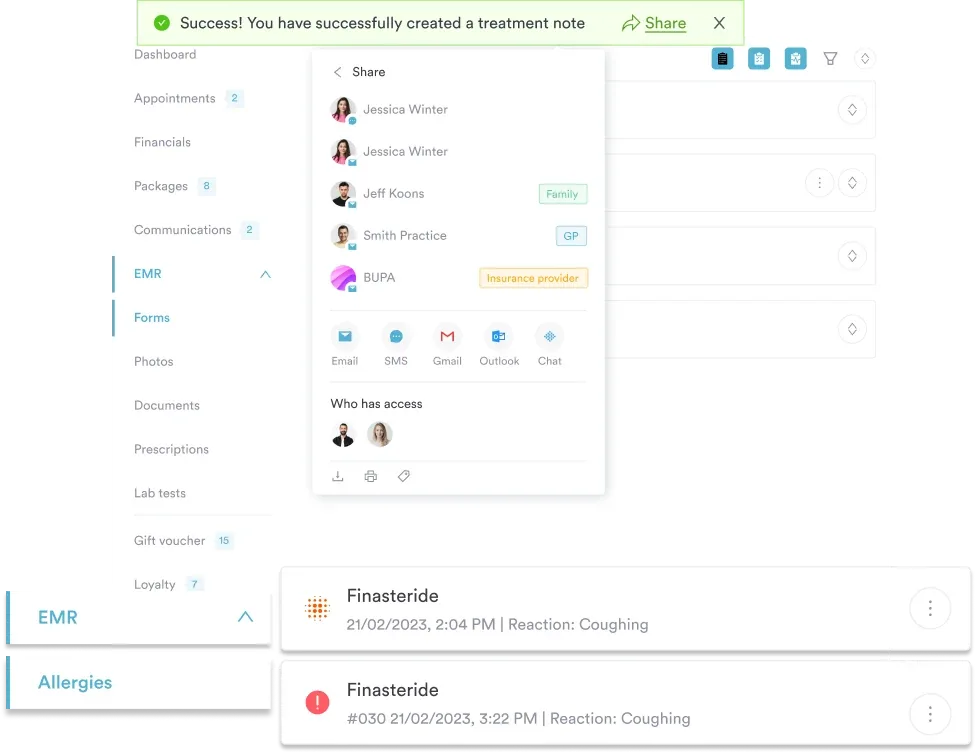
Gynecologic practices using fertility clinic software with integrated coding support see fewer coding queries and faster claims resolution. A standardized medical forms approach means coders already have what they need before the chart is finalized.

Pabau’s clinical record tools help OB/GYN and fertility practices capture the histological and procedural detail that keeps ICD-10 code O01.1 defensible at audit, so claims move faster and denials drop.

Molar pregnancy coding comes down to one question: does the record support specificity? O01.1 is the right code when pathology confirms an incomplete or partial hydatidiform mole. Without that confirmation, O01.9 is the defensible choice until a provider query or a late pathology result settles it.
Practices that build documentation capture into the clinical workflow, instead of chasing it after the fact, land more accurate codes on first submission. Pabau’s structured clinical records and digital forms give gynecologic and fertility teams the documentation trail that makes ICD-10-CM specificity achievable at the point of care.
Book a demo to see how Pabau supports accurate molar pregnancy coding from the first encounter.

Need the anesthesia billing rules for another obstetric procedure? CPT 00842 covers anesthesia for amniocentesis, a related prenatal diagnostic procedure.
Coding other gynecologic diagnoses in the same practice? N83.8 covers other noninflammatory disorders of the ovary, a common companion diagnosis on gynecologic charts.
Billing anesthesia for a delivery instead? CPT 01968 is the add-on code for cesarean delivery anesthesia.
Need the code for a related pelvic infection diagnosis? N74 covers female pelvic inflammatory disorders classified elsewhere.
Coding a patient after their molar pregnancy has resolved? O94 applies to sequelae of a completed pregnancy complication.
No. The CMS/CDC FY2026 POA Exempt Code list does not include any code in the O00-O08 range, so O01.1 is not POA exempt. Hospitals must report present-on-admission status for O01.1 on every applicable inpatient claim.
No. ICD-10-CM diagnosis codes, including O01.1, don’t take modifiers. Modifiers attach to the CPT or HCPCS procedure code billed alongside the diagnosis, such as the evacuation code, not to the diagnosis code itself.
No. ICD-10-CM places no age restriction on O01.1. Molar pregnancy occurs across the reproductive age range, and the code applies whenever pathology confirms a partial or incomplete mole, regardless of the patient’s age.
Serial beta-hCG levels are usually checked every one to two weeks until three consecutive results come back normal. Testing then moves to every three months for about six months, to catch any persistent trophoblastic disease early.