ICD-10 Code Z74.8: Other problems related to care provider dependency
ICD-10 Code Z74.8: Definition and code details ICD-10 Code Z74.8 is the billable...

Last Updated: Oct 19, 2026
Billable Code Specific Code
M62.9 is the billable ICD-10-CM code for disorder of muscle, unspecified.
Let Pabau's smart automation suggest the right codes, reduce claim denials, and keep your practice compliant—effortlessly.
Automate repetitive tasks and focus on what matters most—your patients.
Reduce coding errors and ensure compliance with the latest regulations.
Clean claims, fewer denials, and faster reimbursements.
Powerful insights and reporting to help your practice thrive.
HIPAA compliant SOC 2 certified GDPR-compliant Trusted by 4,000+ clinics worldwide

M62.9 (Disorder of muscle, unspecified) is a billable ICD-10-CM code valid for the 2026 fiscal year under Chapter 13 (M00-M99).
Use M62.9 only when documentation does not support a more specific muscle disorder code; payers may deny claims when specificity is available.
The ICD-9 equivalent is 728.9 (Unspecified disorder of muscle, ligament, and fascia), but the crosswalk is approximate, not exact.
Pabau’s claims management software helps musculoskeletal practices reduce M62.9 claim denials with integrated documentation workflows and coding accuracy tools.
ICD-10 Code M62.9 sits under the parent category M62 (Other disorders of muscle) within Chapter 13: Diseases of the musculoskeletal system and connective tissue (M00-M99), and is valid for the 2026 fiscal year under the CDC/NCHS ICD-10-CM classification system.
Clinicians at physical therapy practices and other musculoskeletal practices reach for this code when a muscle disorder is confirmed but the clinical record does not yet support a more specific diagnosis.
Understanding where M62.9 sits in the ICD-10-CM hierarchy prevents the most common coding error: selecting a sibling code when the correct code is a parent, or vice versa.
| Level | Code | Description |
|---|---|---|
| Chapter | M00-M99 | Diseases of the musculoskeletal system and connective tissue |
| Block | M60-M63 | Disorders of muscles |
| Category | M62 | Other disorders of muscle |
| Subcategory (Specific) | M62.0-M62.89 | Named, site-specific muscle disorders |
| Code (Billable) | M62.9 | Disorder of muscle, unspecified |
The M62 parent category covers disorders that do not fit under myositis (M60), myoneural junction disorders (M61), or the broader soft tissue disorders (M70-M79). Codes under M62 include diastasis of muscle (M62.0), nontraumatic muscle rupture (M62.1), ischemic infarction of muscle (M62.2), immobility syndrome (M62.3), contracture of muscle (M62.4), and muscle wasting and atrophy not elsewhere classified (M62.5).
Coders working in sports medicine practices frequently navigate these distinctions when a single patient presents with overlapping muscle conditions following injury or prolonged immobilization.
M62 also carries formal Excludes1 and Excludes2 notes that decide whether M62.9 can be paired with another code. Excludes1 means “not coded here”: alcoholic myopathy (G72.1), cramp and spasm (R25.2), drug-induced myopathy (G72.0), myalgia (M79.1-), and stiff-man syndrome (G25.82) each need their own code and should never appear alongside M62.9.
Excludes2 means the opposite: nontraumatic hematoma of muscle (M79.81) is a separate condition that can still be coded together with M62.9 when both are documented.
M62.9 is the residual “catch-all” within M62. Its correct use requires that no other M62.x subcategory adequately describes the documented condition.
The ICD List coding reference notes two common synonyms associated with M62.9: “abnormal muscle function” and “absent muscle.” These are not separate diagnoses but alternative clinical descriptors that map to the same unspecified category when documentation does not support a named condition.
Clinically, M62.9 may appear in documentation scenarios such as:
M62.9 carries no anatomical site specificity. Unlike M62.4 (Contracture of muscle) or M62.5 (Muscle wasting and atrophy), which have site-specific subcodes, M62.9 is a single-level billable code with no further subdivision. This simplicity is also its primary weakness from a payer perspective: because the code conveys minimal clinical information, payers reviewing claims may require additional documentation to confirm medical necessity. The Medicare Benefits Schedule sets its own item structure, so a US code has no direct Australian counterpart. Revenue cycle management treats coding, submission and collection as one process rather than three handoffs.
Facilities using digital clinical forms to capture structured intake data often find that limited specificity is a documentation problem, not a clinical one. When practitioners record the nature, duration, and functional impact of a muscle disorder at intake, a more specific code becomes available in most cases.

Before assigning M62.9, run through the M62 subcategory list. Ask: Is this a contracture (M62.4)? Wasting or atrophy (M62.5)? A specified disorder with a known name (M62.89)? If none fits, then M62.9 is appropriate. Document your reasoning explicitly: ‘No specific muscle disorder category applicable based on current clinical findings.’ This one sentence protects you in an audit.
Osteopaths treating these conditions can document diagnoses and sessions in osteopathy practice software.
The most frequent coding error with M62.9 is selecting it when a more specific alternative exists. Four codes appear regularly in the differential.
M62.89 (Other specified disorders of muscle) is the correct choice when the clinical record identifies a named or described muscle disorder that does not match any earlier M62.x subcategory but is still definable. If the practitioner documents “exercise-induced muscle damage” or “delayed-onset muscle soreness with objective findings,” M62.89 captures that specificity.
M62.9 is only appropriate when the disorder cannot be further characterized at all. This distinction matters because payers treat “specified” codes more favorably than “unspecified” ones during medical necessity review.
Tone abnormalities are a common trigger for this mix-up. Documented muscle stiffness, hypertonia, or hypotonia in an adult is usually a better fit for M62.89 than M62.9, since it’s a named, described finding rather than a truly uncharacterized one.
Congenital tone disorders in newborns have their own dedicated codes outside this category entirely: P94.1 (Congenital hypertonia) and P94.2 (Congenital hypotonia), both restricted to newborn records.
M60.9 (Myositis, unspecified) sits in a different parent category: M60 covers inflammatory muscle disease. If the clinical picture includes inflammation, tenderness, elevated CK, or MRI findings consistent with myositis, M60.9 or a more specific M60.x code takes priority over M62.9. Using M62.9 when myositis is documented is a coding error that can trigger claim denial and audit exposure.
Practices managing similar documentation complexity around unspecified ICD-10 diagnosis codes in other specialties will recognize the same pattern: specificity beats residual every time.
M79.9 (Soft tissue disorder, unspecified) covers the broader category of soft tissue conditions. When the clinical documentation does not isolate the problem to muscle specifically and the disorder could equally be tendon, fascia, or other soft tissue, M79.9 is more appropriate than M62.9.
Conversely, when physical exam or imaging confirms the muscle as the primary affected structure, M62.9 (or a specific M62 code) is the better fit. The rule: specificity of anatomical structure drives code selection between these two.
| Code | Description | Use when… |
|---|---|---|
| M62.9 | Disorder of muscle, unspecified | Muscle disorder confirmed, cannot be further specified |
| M62.89 | Other specified disorders of muscle | Named or described disorder not matching earlier M62.x |
| M60.9 | Myositis, unspecified | Inflammatory muscle disease with objective findings |
| M79.9 | Soft tissue disorder, unspecified | Disorder not isolated to muscle; broader soft tissue involvement |
The ICD-9-CM predecessor to M62.9 is code 728.9 (Unspecified disorder of muscle, ligament, and fascia). The crosswalk is approximate, not exact. This distinction matters for practices transitioning historical billing data, conducting retrospective audits, or working with payers that still reference ICD-9 codes in older LCD or NCD documentation.
The approximation flag occurs because ICD-9 code 728.9 covered disorders of muscle, ligament, and fascia collectively. ICD-10-CM Code M62.9 narrows that scope to muscle only. Ligament disorders and fascia disorders have their own pathways under ICD-10-CM.
This means a patient whose ICD-9 claim carried 728.9 may require a different ICD-10 code depending on which structure is documented as affected. The CMS ICD-10 codes page provides the official General Equivalence Mappings (GEMs) for practitioners working through these historical crosswalks.
For practices that adopted ICD-10-CM at the October 2015 transition, the approximate flag should have been resolved at the time of conversion. Any residual claims still carrying 728.9 are non-billable under current payer systems and require resubmission with an appropriate ICD-10-CM code.
Practices working through coding compliance reviews can find additional guidance in our overview of how unspecified ICD-10 codes are handled across specialties.

Pabau helps physical therapy and musculoskeletal practices link clinical documentation directly to ICD-10 codes, reducing unspecified-code denials and keeping audit risk low.

M62.9 is billable under Medicare, Medicaid, and most commercial payers. However, the AAPC Codify ICD-10-CM reference and payer Local Coverage Determinations (LCDs) consistently flag unspecified codes as higher-risk for denial review. Submitting M62.9 on a clean claim does not guarantee payment; medical necessity documentation must support the diagnosis and justify why greater specificity is not available.
Effective documentation for M62.9 includes three elements:
Practices using structured clinical record management tools can build templates that prompt clinicians to capture these three elements at the point of care. A well-structured encounter note reduces the likelihood of M62.9 being challenged during post-payment review.
Medicare Administrative Contractors (MACs) may have LCDs that list M62.9 as a covered diagnosis for specific procedure codes, particularly musculoskeletal rehabilitation CPT codes. Practitioners should check their MAC’s LCD database before assuming coverage.
For physical therapy services, M62.9 may require a functional limitation note alongside the diagnosis to satisfy Medicare’s functional limitation reporting requirements. Practices managing high-volume musculoskeletal billing benefit from claims management software that flags unspecified codes pre-submission for documentation review.
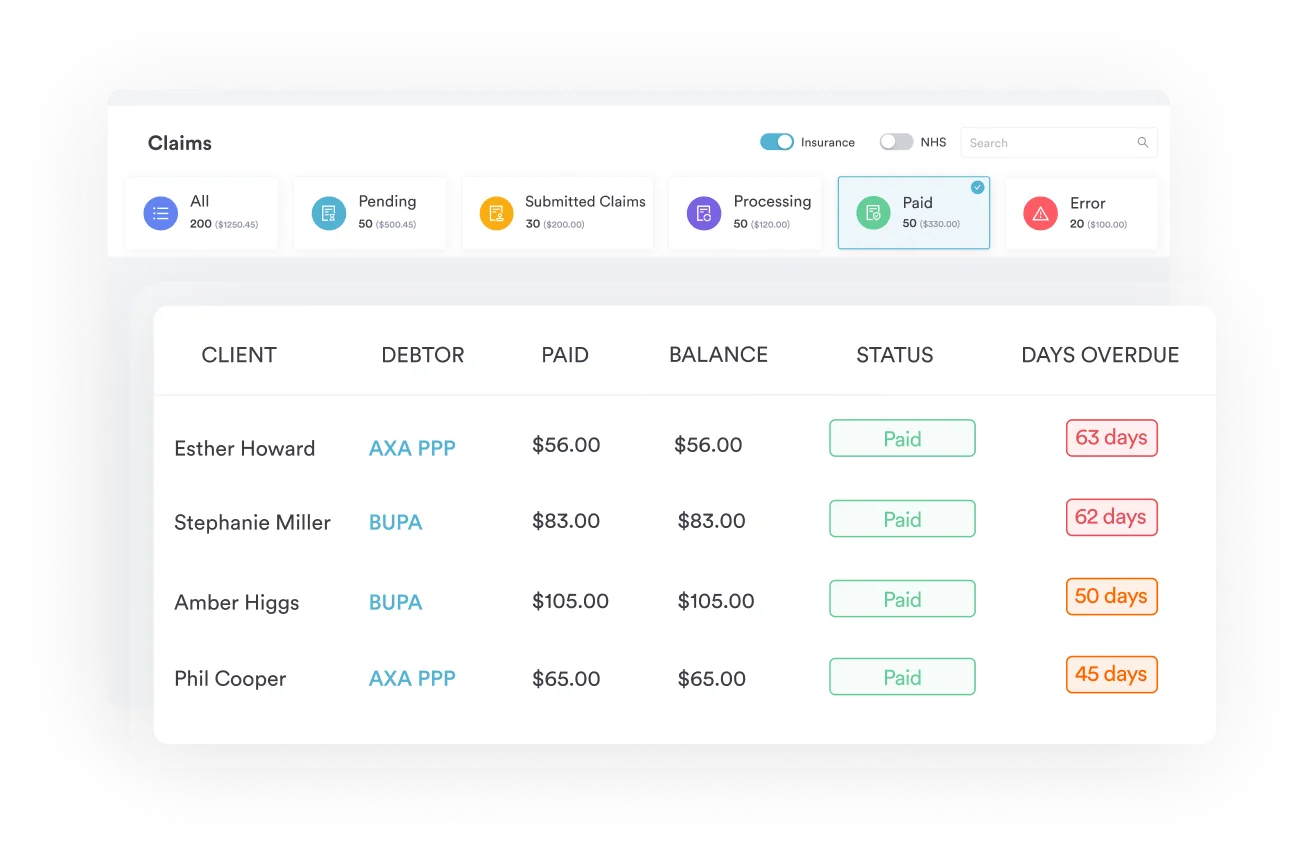
Three denial patterns are most common with M62.9:
When M62.9 generates a denial, pull the Remittance Advice remark code before recoding. Remark codes CO-4 (insufficient documentation), CO-16 (claim lacks information), and N130 (more specific diagnosis required) each point to a different corrective action. Recoding to M62.89 without addressing the root denial reason often results in a second denial.
Unspecified muscle disorder codes create workflow risk at two points: code selection at the time of documentation and claim submission review. Practices that catch both with systematic checks see significantly fewer M62.9-related denials than those relying on coder judgment alone.
At the documentation stage, structured intake forms that prompt clinicians to specify muscle type, anatomical site, and functional impact reduce the frequency with which M62.9 is the only available code. This is particularly relevant in physiotherapy clinic management settings where high patient throughput can pressure clinicians to default to residual codes.
At the billing stage, pre-submission claim scrubbing catches M62.9 on claims where documentation in the record supports a more specific code, flagging them for coder review before submission.
Practices managing physiotherapy clinic compliance requirements know that documentation quality and coding accuracy are audited together. An unspecified code on a claim with a detailed clinical note raises fewer concerns than an unspecified code paired with a sparse SOAP note. The note and the code must tell the same clinical story.
For practices exploring ICD-10 coding in adjacent diagnostic categories, the approach to specificity is consistent across musculoskeletal and other systems. Reviewing how ICD-10 coding works across other diagnosis groups can reinforce the logic applied here.
Unspecified codes like M62.9 are valid tools when documentation genuinely cannot support greater specificity. The risk is not in the code itself but in using it as a default rather than a considered choice.
When a practice builds the documentation and review workflows to distinguish that use from avoidable under-coding, M62.9 stops being a denial risk and becomes a properly applied residual code.
Pabau’s practice management software helps musculoskeletal and physical therapy practices connect clinical documentation to coding workflows, so the right specificity level is captured before a claim is submitted. To see how Pabau handles this in practice, book a demo.

Coding a kidney contusion instead? kidney contusion code S37.011A is the billable FY2026 code for a minor contusion of the right kidney.
Coding a kidney injury follow-up visit? kidney contusion follow-up code S37.029D applies once active treatment for a major kidney contusion ends and follow-up care begins.
Coding a fallopian tube injury instead? fallopian tube injury code S37.502S is the complete, billable sequela code for a bilateral, unspecified fallopian tube injury.
M62.9 is the billable ICD-10-CM code for “Disorder of muscle, unspecified,” valid for fiscal year 2026 under Chapter 13 (Diseases of the musculoskeletal system and connective tissue). It applies when a muscle disorder is confirmed but does not meet criteria for any specific M62 subcategory.
Yes. M62.9 is billable to Medicare, Medicaid, and commercial payers, but as an unspecified code it carries higher denial risk. Include a specificity rationale in the clinical note explaining why a more precise code was not available.
Use M62.9 only when documentation confirms a muscle disorder but does not support a named subcategory such as contracture (M62.4), wasting and atrophy (M62.5), or other specified disorders (M62.89). It should be a deliberate clinical determination, not a default.
The approximate ICD-9-CM equivalent is 728.9 (Unspecified disorder of muscle, ligament, and fascia). The crosswalk is approximate because 728.9 covered muscle, ligament, and fascia collectively, whereas M62.9 is limited to muscle disorders only.
M62 includes: M62.0 (Diastasis of muscle), M62.1 (Nontraumatic rupture), M62.2 (Ischemic infarction), M62.3 (Immobility syndrome), M62.4 (Contracture), M62.5 (Wasting and atrophy), M62.89 (Other specified disorders), and M62.9 (Unspecified). All subcategories except M62.9 have site-specific subdivisions.
M62.9 is specific to muscle disorders; M79.9 (Soft tissue disorder, unspecified) covers broader soft tissue including tendons and fascia. Use M62.9 when exam or imaging isolates the muscle as the primary structure affected; use M79.9 when involvement is not limited to muscle.
Not usually. Muscle stiffness, hypertonia, and hypotonia are named tone abnormalities, so in adults they typically code to M62.89 (Other specified disorders of muscle) rather than the truly unspecified M62.9. Newborns have their own dedicated tone-disorder codes: P94.1 (Congenital hypertonia) and P94.2 (Congenital hypotonia).