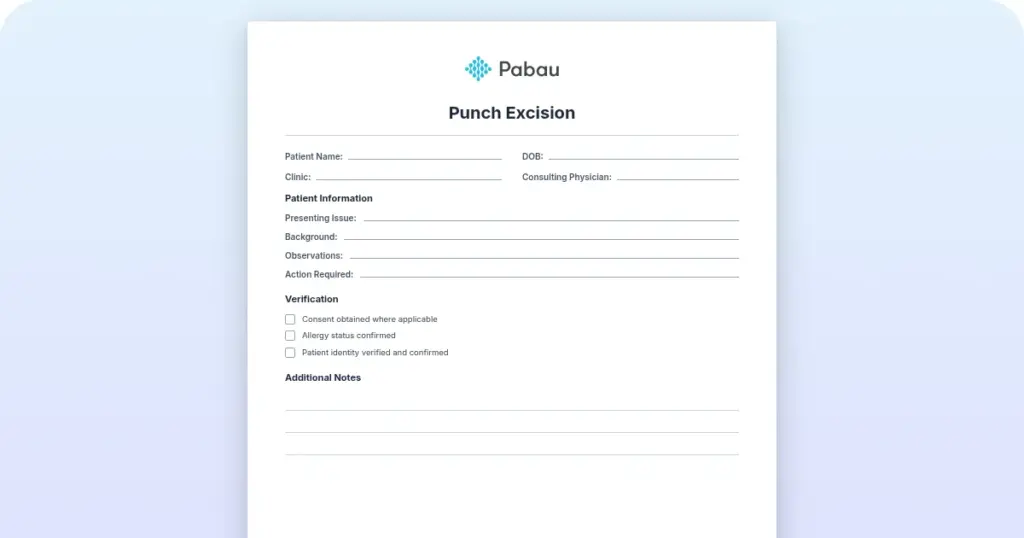
Punch excision aftercare instructions template
Punch excision is a minor procedure that removes a small cylinder of skin with a...

3
Last Updated: Oct 15, 2026
Billable Code Specific Code
L86 is the billable ICD-10-CM code for keratoderma in diseases classified elsewhere.
Let Pabau's smart automation suggest the right codes, reduce claim denials, and keep your practice compliant—effortlessly.
Automate repetitive tasks and focus on what matters most—your patients.
Reduce coding errors and ensure compliance with the latest regulations.
Clean claims, fewer denials, and faster reimbursements.
Powerful insights and reporting to help your practice thrive.
HIPAA compliant SOC 2 certified GDPR-compliant Trusted by 4,000+ clinics worldwide

ICD-10 code L86 (Keratoderma in diseases classified elsewhere) is a billable ICD-10-CM code valid for 2026 fiscal year claims
L86 is a manifestation code: the underlying etiology (e.g. Reiter’s disease, hypothyroidism, or an associated malignancy) must be sequenced first on every claim
Skipping the Code First instruction is the most common denial trigger; payers reject claims where L86 appears without a paired etiology code
Keratoderma climactericum, aquagenic keratoderma, and punctate palmoplantar keratoderma are commonly miscoded as L86, but index to L85.1, L85.2, or Q82.8 depending on presentation
Pabau’s claims management software helps dermatology practices enforce correct code sequencing and reduce L86-related claim errors
ICD-10 Code L86 describes keratoderma in diseases classified elsewhere. It falls under ICD-10-CM Chapter 12 (Diseases of the skin and subcutaneous tissue), within the L80-L99 sub-range covering other disorders of the skin and subcutaneous tissue, as confirmed by the CDC/NCHS ICD-10-CM web tool.
Keratoderma refers to abnormal thickening of the skin, most commonly affecting the palms and soles (palmoplantar distribution). When it arises as a consequence of a systemic disease rather than as a primary dermatological condition, L86 is the appropriate code. The skin change is the manifestation; the underlying disease is the root cause.
The ICD-10-CM Tabular List gives a Code First example of Reiter’s disease (reactive arthritis, M02.3-). Other systemic causes of acquired keratoderma include hypothyroidism and lymphoma or other malignancies; diabetes mellitus is sometimes cited but is a less established association. The code is valid for the 2026 ICD-10-CM fiscal year with no changes noted in the current update cycle.
| Field | Detail |
|---|---|
| ICD-10-CM Code | L86 |
| Full description | Keratoderma in diseases classified elsewhere |
| Chapter | Chapter 12 – Diseases of the skin and subcutaneous tissue (L00-L99) |
| Sub-range | L80-L99: Other disorders of the skin and subcutaneous tissue |
| Billable | Yes – valid for 2026 ICD-10-CM fiscal year |
| Code type | Manifestation code (requires etiology code sequenced first) |
| Code First note | Underlying disease, such as Reiter’s disease (M02.3-) |
| Excludes1 | Gonococcal keratoderma (A54.89); keratoderma due to vitamin A deficiency (E50.8) |
L86 carries no inclusion terms of its own. Its only Tabular List notes are the Code First instruction and an Excludes1 list (gonococcal keratoderma, and keratoderma due to vitamin A deficiency, E50.8).
Primary inherited blistering disorders such as epidermolysis bullosa are coded in Chapter 17 (Q81.-), not here, even when they involve palmoplantar thickening. Practices using dermatology EMR software can configure L86 pairings to flag etiology requirements at documentation time, reducing sequencing errors before claims go out.
The etiology-manifestation convention is the most clinically significant coding rule attached to L86. It applies whenever a condition has both an underlying cause and a body-system manifestation of that cause.
The rule, as defined by the CMS ICD-10 coding guidelines, requires the underlying etiology code to be sequenced first, with the manifestation code (L86) listed second. This is not optional. The ICD-10-CM Tabular List contains a “Code First” instruction at L86, which coders must follow for compliant claim submission.
Understanding the distinction between etiology-manifestation coding conventions across code families helps coders avoid applying the Code First rule inconsistently between chapters. The pattern is the same whether the manifestation is neurological, ophthalmological, or dermatological: underlying disease comes first, manifestation second. Sequela coding inverts that cause-and-effect order: an injury code such as S61.119S is sequenced after the residual condition it caused.
When the etiology is not documented or is uncertain, coders should query the provider rather than sequencing L86 alone. Submitting L86 as the only code on a claim is the most common trigger for denial on these encounters.
Accurate coding requires distinguishing L86 from adjacent codes that describe similar-appearing skin changes. The key differentiator is always the clinical context: is this skin thickening a manifestation of a systemic disease, or is it an independent condition?
The most clinically tricky distinction is between L85.1 (acquired keratosis palmaris et plantaris) and L86. Both produce palmoplantar thickening, but L85.1 is appropriate when no systemic disease etiology is documented. If the provider notes “keratoderma in the context of diabetes” or similar, L86 applies with the Code First pairing.
If the documentation says nothing about an underlying systemic cause, L85.1 or L85.8 may be the better fit. Accurate skin clinic software that flags missing etiology documentation at encounter close can prevent this ambiguity from reaching billing.
Not every palmoplantar keratoderma diagnosis indexes to L86, even when the presentation looks similar. Three specific subtypes come up often enough in dermatology documentation that they’re worth naming individually, because coding them as L86 is a common – and avoidable – error.
Punctate palmoplantar keratoderma describes small, discrete keratotic papules on the palms and soles, rather than the diffuse thickening L86 covers. When the presentation is hereditary – the more common form – it indexes to Q82.8 (other specified congenital malformations of skin), per the ICD-10-CM Index entry for keratoderma, congenital, punctate.
A non-hereditary punctate presentation is more specifically captured by L85.2 (keratosis punctata, palmaris et plantaris). L86 doesn’t apply to either, since punctate keratoderma isn’t classified as a manifestation of a separately coded systemic disease.
Two other subtypes are frequently miscoded the same way. Keratoderma climactericum (Haxthausen’s disease), the menopause-associated palmoplantar thickening, indexes to L85.1, not L86, because it’s classified as a primary condition rather than a manifestation of a separately coded systemic disease.
Aquagenic keratoderma (also called aquagenic wrinkling of the palms) indexes to L85.1 as well, even though it’s frequently associated with cystic fibrosis – the FAQ below covers both in more detail.
Document the underlying systemic condition explicitly in the clinical note before closing the encounter. Phrases like ‘keratoderma secondary to hypothyroidism’ give your billing team the clinical link they need to sequence codes correctly. Vague notes that mention thickened skin without naming the etiology force coders to query or guess, delaying claims and increasing denial risk.
Documentation for L86 must support three distinct components: the skin finding, the underlying disease, and the clinical link between them. Any one of these missing from the note makes compliant coding difficult and increases audit exposure.
Payer reviewers look for explicit language connecting the keratoderma to a systemic cause. “Palmoplantar thickening” in isolation does not support L86 unless the note also establishes the etiology. Providers who use claims management software with built-in coding checks can catch this issue before submission rather than after denial.
For related guidance on how secondary diagnosis codes interact with primary conditions in other specialties, the sequencing logic follows the same Code First principle.

For encounters involving malignancy as the etiology, document whether the lymphoma or other cancer is active or in remission. The active vs. historical distinction affects which malignancy code is selected and, in turn, the sequencing of L86.

Pabau helps dermatology and skin practices capture the right documentation at the point of care, enforce code sequencing rules, and submit cleaner claims. See how it works for your practice.

L86 is a valid billable code, but billing it in isolation will result in a denial on most payer edits. Every claim that includes L86 must also include the etiology code as the primary diagnosis.
This is not a payer quirk. It reflects the Code First instruction in the ICD-10-CM Tabular List, which the AAPC Codify ICD-10-CM reference confirms is a mandatory coding convention.
Reimbursement for keratoderma-related encounters varies significantly by payer. Treatment of keratoderma secondary to a systemic condition may be covered under the systemic disease management benefit rather than a standalone dermatology benefit, depending on how the claim is structured.
Coverage for any specific keratoderma treatment should be verified with the individual payer before the encounter, as policies differ across commercial plans and Medicare. Every payer sets its own timely filing window, and a correctly coded claim still fails once that window closes.
Patient record management tools that flag incomplete diagnostic pairings at the time of chart closure catch most of these errors before they reach the billing queue.
Using patient record management software with structured clinical data fields makes the etiology-manifestation pairing visible to both the provider and the coder in a single workflow, without relying on free-text parsing to identify the link.
Good skin condition documentation practices built into the consultation workflow are one of the most effective ways to reduce downstream billing errors on codes like L86.
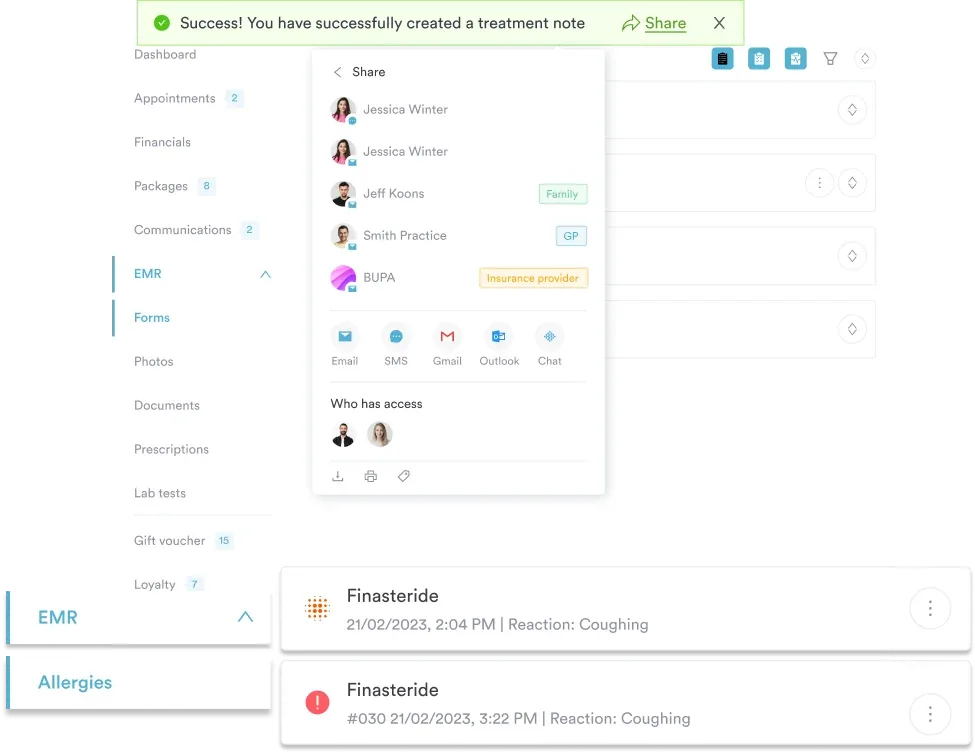
Run a quarterly audit of all L86 claims submitted in the previous 90 days. Filter for any claims where L86 appears as the first listed code, or where it appears without an accompanying Chapter 4 (endocrine), Chapter 2 (neoplasm), or other systemic disease code. These are your sequencing failure points. Fixing the documentation template for the encounters where errors cluster will address the root cause faster than reviewing individual denials.
Understanding where L86 sits within the broader code landscape helps coders build accurate encounter records for complex patients. Dermatology patients with systemic disease often present with multiple skin findings, and accurate coding requires selecting the right code for each distinct clinical finding.
The ICD List reference places L86 adjacent to the L87 range (transepidermal elimination disorders) and within the same L80-L99 sub-range that includes acanthosis nigricans (L83), corns and callosities (L84), and the L85 epidermal thickening group. Knowing how other manifestation codes in ICD-10-CM behave helps build consistent coding habits across specialties. A busy coder reaches for a coding reference sheet rather than re-deriving modifier and E/M rules each time.
When multiple systemic conditions coexist and either could plausibly explain the keratoderma, the provider should specify in the note which condition is clinically responsible for the skin finding. Coders should not make this determination independently.
Querying the provider and documenting the response is the compliant approach, and it protects the practice in the event of a payer audit. The WHO ICD-10 browser provides the international classification context for L86 and adjacent skin codes, which is useful when reviewing claims involving internationally trained clinicians or cross-border documentation.
Practices that use dermatology coding workflows with structured templates for systemic-disease-related skin conditions consistently produce cleaner code pairings than those relying on unstructured notes.
Structured digital intake forms that prompt for underlying conditions at registration capture the etiology information before the consultation even begins, giving the provider the clinical context they need to document the causal link accurately. The clinical documentation practices that reduce errors in one specialty apply equally to dermatology coding.

Keratoderma claims fail not because the code is wrong, but because the sequencing is. L86 is a clean, billable code when used correctly: etiology first, manifestation second, and clinical documentation that explicitly names the link between them.
Pabau’s compliance management tools help dermatology and skin practices build the documentation discipline that makes L86 billing straightforward: structured encounter templates, built-in code pairing checks, and claim submission workflows that flag sequencing errors before they reach the payer. To see how Pabau handles dermatology billing compliance end to end, book a demo.

Confirmed a muscle disorder without a precise subcategory? Disorder of muscle, unspecified covers the code hierarchy, documentation requirements, and the ICD-9 crosswalk.
Coding a tendon rupture with no site documented? Spontaneous rupture of unspecified tendon covers when M66.9 applies after a provider query comes back empty.
Coding bursitis without a documented location? Bursopathy, unspecified covers the narrow circumstances where this code is the correct choice.
ICD-10 code L86 is a billable ICD-10-CM diagnosis code for keratoderma in diseases classified elsewhere. It describes abnormal skin thickening (keratoderma) that occurs as a manifestation of an underlying systemic disease, such as hypothyroidism, lymphoma, or Reiter’s disease (reactive arthritis). The code is classified under Chapter 12 (L80-L99) and requires the etiology code to be listed first on any claim.
No. L86 is a manifestation code with a mandatory Code First instruction, meaning it must always be paired with the underlying etiology code sequenced before it. Submitting L86 as the only diagnosis code on a claim will typically result in a denial. The etiology code (for example, a diabetes or thyroid disorder code) must appear first on the claim.
L85.1 (acquired keratosis palmaris et plantaris) describes palmoplantar thickening that arises as an independent primary condition, without a documented systemic disease cause. L86 applies when the keratoderma is explicitly documented as a manifestation of a systemic disease. The clinical note must establish the causal link for L86 to be the correct code choice.
Common etiology pairings for L86 include hypothyroidism (E03.9), lymphoma or other malignancies from the C81-C96 code range, and Reiter’s disease (M02.3-), the example named in the ICD-10-CM Tabular List. Diabetes mellitus is sometimes cited but is a less established association and should only be paired when the provider explicitly documents it as the cause.
Payer reviewers look for three elements: documentation of the skin finding, documentation of the underlying systemic disease, and explicit clinical language linking the two. Claims where the note describes skin thickening without naming a systemic etiology, or where the sequencing is reversed, are high-risk for denial or recoupment. Quarterly audits of L86 claims are a practical safeguard.
No. Keratoderma climactericum (Haxthausen’s disease) is a menopause-associated palmoplantar keratoderma classified as a primary condition, not a manifestation of a separately coded systemic disease, so it indexes to L85.1 (acquired keratosis [keratoderma] palmaris et plantaris) rather than L86.
Aquagenic keratoderma (aquagenic wrinkling of the palms) also indexes to L85.1, even though it’s frequently associated with cystic fibrosis. L86 only applies when palmoplantar keratoderma is explicitly documented as a manifestation of a separately coded systemic disease, which isn’t how aquagenic keratoderma is classified in the ICD-10-CM index.