ICD-10 code S61.201A: Open wound of left index finger without nail damage
ICD-10 code S61.201A covers a left index finger wound of unstated type ICD-10 co...

Last Updated: Oct 16, 2026
Billable Code Specific Code
K60.1 is the billable ICD-10-CM code for chronic anal fissure.
Chronic anal fissures are commonly encountered in gastroenterology, colorectal surgery, and general surgery practices.
Let Pabau's smart automation suggest the right codes, reduce claim denials, and keep your practice compliant—effortlessly.
Automate repetitive tasks and focus on what matters most—your patients.
Reduce coding errors and ensure compliance with the latest regulations.
Clean claims, fewer denials, and faster reimbursements.
Powerful insights and reporting to help your practice thrive.
HIPAA compliant SOC 2 certified GDPR-compliant Trusted by 4,000+ clinics worldwide

K60.1 (Chronic anal fissure) is a billable ICD-10-CM code valid for reimbursement claims with dates of service on or after October 1, 2015.
K60.0 covers acute anal fissure (typically under 6 weeks); K60.1 is used once the fissure has become chronic; K60.2 applies when duration is unspecified.
K60 carries two Excludes2 notes – abscess or cellulitis of anal and rectal regions (K61.-) and anal sphincter tear (K62.81) – both of which may be reported alongside K60.1 when each is separately documented.
Pabau’s claims management software supports accurate ICD-10-CM diagnosis code capture and billing workflow integration for colorectal and gastroenterology practices.
K60.1 is a valid, billable ICD-10-CM code. Below is a summary of the key reference data coders and billers need when working with this code.
Claims with a date of service on or after October 1, 2015 require ICD-10-CM codes for reimbursement. Submitting legacy ICD-9 codes for encounters after this date is not compliant with HIPAA compliance requirements for medical offices.
Understanding the full coding hierarchy helps coders navigate from the broad chapter down to the billable code. K60.1 sits four levels deep in the ICD-10-CM structure.
The K60 category also contains fistula codes (K60.3 Anal fistula, K60.4 Rectal fistula, K60.5 Anorectal fistula). These are separate clinical entities and should not be confused with fissure codes during documentation review.
The anal fissure ICD-10 code is not one code but three. Anal fissures map to three billable options in the K60 category, and the correct one depends on duration and documentation clarity. K60.0 covers an acute fissure, K60.1 covers a chronic fissure, and K60.2 applies when the note names neither. Choosing between them is one of the most common coding decision points for this condition.
The 6-week threshold for acute vs chronic classification is a widely referenced clinical convention; however, the ICD-10-CM guidelines do not state a specific week cutoff. What matters for coding purposes is the clinician’s documented characterization of the fissure. If the note says “chronic anal fissure,” K60.1 is correct. If the note describes only “anal fissure” without duration, K60.2 applies. Anal fissure coding depends on the precise phrasing the provider uses.
K60.2 should not become a default fallback. Coders should query the clinician when documentation is ambiguous rather than defaulting to unspecified. Payer auditors frequently flag a pattern of unspecified codes as potential upcoding or incomplete documentation.
Query the provider whenever the clinical note says only ‘anal fissure’ without duration or chronicity. A brief addendum confirming ‘chronic’ saves the claim from downgrading to K60.2 and reduces future audit exposure.
The K60 parent category carries excludes notes that affect how K60.1 is used alongside other codes. K60 has no Excludes1 note; it carries two Excludes2 notes. An Excludes2 note means the excluded condition is not part of K60, but a patient may have both, so the two codes may be reported together when each is separately documented.
K60 lists an Excludes2 note for abscess or cellulitis of anal and rectal regions (K61.-). Because it is an Excludes2 note, an anal abscess or cellulitis is not included in K60.1, but the two can be coded together when the patient has both a chronic fissure and a documented abscess. Assign the appropriate K61 code (for example, K61.0 Anal abscess) in addition to K60.1 in that scenario.
K60 also lists an Excludes2 note for anal sphincter tear (healed) (nontraumatic) (old) (K62.81). This code covers a distinct clinical entity: a healed, non-traumatic disruption of the sphincter muscle, as opposed to a mucosal fissure. As an Excludes2 note, K62.81 may be reported alongside K60.1 for the same patient when both conditions are separately documented.
Insufficient documentation is the leading cause of K60.1 claim denials and audit flags. Strong clinical documentation must clearly support the chronic designation.
Practice management software like Pabau lets practices build anorectal assessment templates in their patient intake software and structured patient records that prompt clinicians to document duration, prior treatments, and examination findings at every encounter. This reduces coding ambiguity without adding physician workload.

Tools built around AI clinical documentation and Pabau’s AI medical scribe can also flag incomplete notes before they leave the exam room, catching missing chronicity descriptors that would otherwise trigger a coder query or a downgraded claim.
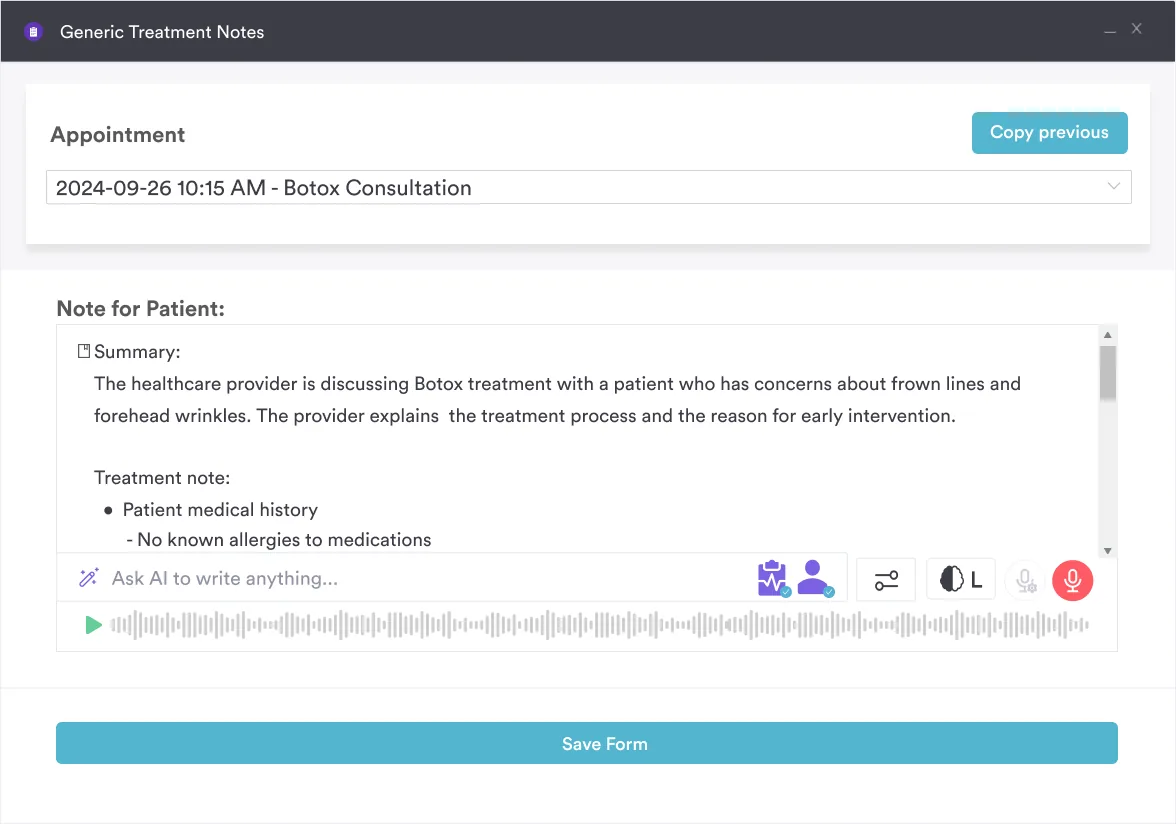

Pabau’s claims management software helps gastroenterology and colorectal surgery practices capture diagnosis codes accurately, reduce denials, and keep documentation audit-ready. See it in action.

K60.1 is assigned as the principal or supporting diagnosis code. The CPT codes listed below represent the procedures most frequently billed alongside it. Pairings depend on the treatment pathway chosen for the specific patient.
Botulinum toxin injections into the internal sphincter (a conservative non-surgical approach) are typically billed under injection CPT codes. In colorectal and gastroenterology practices, K60.1 encounters also sit alongside other lower-GI procedure codes such as CPT 45380 (colonoscopy with biopsy), CPT 45385 (colonoscopy with lesion removal).
Accurate pairing of these procedures with K60.1 is central to clean medical billing. Coders should verify current CPT descriptors for each code year, as descriptions and bundling edits are updated annually by the AMA. The AAPC Codify ICD-10-CM lookup provides crosswalk functionality to confirm CPT-to-ICD-10 medical necessity alignment for these pairings.
For inpatient hospital claims, K60.1 maps to MS-DRG groupings under Medicare Severity Diagnosis Related Group version 43.0. The specific DRG assigned depends on the presence of complications and comorbidities (CCs) or major complications and comorbidities (MCCs) documented in the encounter. Medicare billing rules for this code differ from commercial payer rules, including the documentation asked for.
Chronic anal fissure is managed surgically or conservatively on an outpatient basis in most cases. Inpatient admissions are uncommon unless the patient presents with significant comorbidities, failed outpatient procedures, or concurrent conditions requiring inpatient-level care. When an inpatient stay does occur, the principal diagnosis assignment and any secondary diagnoses (such as K61.0 Anal abscess, if present) will affect DRG grouping and reimbursement.
Confirm the active MS-DRG version with your facility’s coding team each fiscal year, as CMS updates MS-DRG weights and groupings annually and publishes the annual update files and grouper documentation.
Flag K60.1 encounters for dual-coding review when the clinical note also mentions abscess, fistula, or sphincter dysfunction. Each of these may warrant a separate code, but adding codes without documented clinical support increases audit exposure. Review against the K60 excludes notes before submitting.
Clinicians may use varied terminology in their notes. Coders need to recognize these synonyms as mapping to K60.1 when the clinical context supports chronic classification.
These terms should lead the coder back to K60.1 when the encounter and documentation support the chronic designation. If the term is “anal fissure” without a qualifier, K60.2 applies until clarification is obtained from the provider. Practices that generate a clean superbill with structured diagnosis code capture can map synonym libraries to code selections, reducing manual lookup time at the point of billing.
Coding errors around K60.1 are largely documentation-driven. The most frequent issues encountered in audits and claim reviews include the following.
Reducing these errors requires both documentation improvement at the point of care and a coding workflow that flags incomplete records before submission. Valid and excluded code references can be built into pre-submission claim scrubbing routines to catch these issues automatically.
Practices treating chronic anal fissure face a narrow but meaningful coding decision between K60.0, K60.1, and K60.2. Getting it right depends on documentation that explicitly supports the chronic designation, awareness of the K60 excludes notes, and a workflow that catches ambiguous records before they become claim denials.
Pabau’s claims management software helps colorectal and gastroenterology practices build structured documentation and coding workflows that reduce K60.1 audit risk. To see how Pabau supports accurate ICD-10-CM coding and billing across specialties, book a demo.

Need a reliable ICD-10 lookup tool for your coding team? ICD List provides free ICD-10-CM/PCS lookup with DRG groupers and code edits for quick reference.
Coding thumb arthritis after an injury? ICD-10 code M18.30 guide covers thumb base arthritis that developed after a prior fracture, ligament injury, or dislocation.
Documenting thumb osteoarthritis with a cause? ICD-10 code M18.4 guide covers bilateral secondary osteoarthritis of the first carpometacarpal joints for the FY2026 code set.
There is no single code. The condition maps to three billable codes in the K60 category, chosen by duration: K60.0 for an acute tear, K60.1 for a chronic one, and K60.2 when the record does not specify. Use K60.2 only when the note gives no duration or chronicity, and query the provider before defaulting to it.
K60.1 is the specific code once a tear has failed to heal and the provider documents chronicity. Supporting evidence includes fibrotic edges, a sentinel pile, exposed internal sphincter, or failed conservative treatment. Without that language, the encounter downgrades to unspecified K60.2.
ICD-10 Code K60.1 is the billable ICD-10-CM diagnosis code for chronic anal fissure, a persistent tear in the anal canal lining that has not healed with initial conservative treatment. It sits under the K60 parent category (Fissure and fistula of anal and rectal regions) within the K55-K64 block of diseases of the intestines.
K60.0 is used for acute anal fissure, where the condition is of recent onset and the tissue is fresh. K60.1 applies when the fissure is documented as chronic, typically evidenced by fibrotic edges, a sentinel pile, or failure to respond to conservative treatment. The provider’s documentation must explicitly support whichever code is assigned.
Yes, K60.1 is a fully billable and specific ICD-10-CM code valid for reimbursement claims with dates of service on or after October 1, 2015. The parent code K60 is not billable; only the child codes (K60.0, K60.1, K60.2) may be submitted on claims.
The most common CPT codes paired with K60.1 are CPT 46200 (fissurectomy), CPT 46080 (sphincterotomy, anal), and CPT 45990 (anorectal exam under anesthesia). Botulinum toxin injections used as conservative treatment are billed under relevant injection CPT codes. Always verify current CPT descriptors for the applicable code year.
K60 carries two Excludes2 notes: abscess or cellulitis of anal and rectal regions (K61.-) and anal sphincter tear (K62.81). Because both are Excludes2 notes, these conditions are not part of K60.1 but may be reported together with K60.1 when each is separately documented in the record. K60 has no Excludes1 note.
K60.1 is grouped within MS-DRG v43.0 for inpatient hospital claims. The precise DRG assigned depends on documented complications, comorbidities, and the principal diagnosis sequencing for the encounter. Chronic anal fissure is typically managed in an outpatient setting, so inpatient DRG assignment is less common.