ICD-10 Code Z74.8: Other problems related to care provider dependency
ICD-10 Code Z74.8: Definition and code details ICD-10 Code Z74.8 is the billable...

Last Updated: Oct 19, 2026
Billable Code Specific Code
E58 is the billable ICD-10-CM code for dietary calcium deficiency.
Let Pabau's smart automation suggest the right codes, reduce claim denials, and keep your practice compliant—effortlessly.
Automate repetitive tasks and focus on what matters most—your patients.
Reduce coding errors and ensure compliance with the latest regulations.
Clean claims, fewer denials, and faster reimbursements.
Powerful insights and reporting to help your practice thrive.
HIPAA compliant SOC 2 certified GDPR-compliant Trusted by 4,000+ clinics worldwide

ICD-10 code E58 is the billable diagnosis code for dietary calcium deficiency, valid for dates of service from October 1, 2015.
E58 is classified under subchapter E50-E64 (Other nutritional deficiencies) within ICD-10-CM chapter E00-E89.
E58 is a terminal, leaf-level code with no further subcodes, so it is billed directly without an “unspecified” variant.
A Type 1 Excludes note means E58 must never be coded simultaneously with parathyroid disorders (E20-E21) or vitamin D deficiency (E55.-).
Pabau’s claims management software helps practices reduce billing errors when submitting E58 and related nutritional deficiency codes.
ICD-10 code E58 is the billable ICD-10-CM diagnosis code for dietary calcium deficiency. It classifies a condition in which calcium intake from food or supplements is insufficient to meet the body’s physiological requirements, distinct from metabolic or endocrine causes of low calcium.
Clinicians documenting this condition must distinguish dietary cause from underlying pathology to select the correct code. For practices managing metabolic health patients, accurate code selection directly affects reimbursement and clinical continuity.
Calcium deficiency from inadequate dietary intake is far more common in clinical practice than coders often assume, appearing across primary care, dietetics, endocrinology, and integrative medicine. Getting the documentation right is what separates a clean claim from a denial.
According to the Centers for Medicare and Medicaid Services (CMS), E58 sits within the following hierarchy in the ICD-10-CM tabular list.
| Level | Code Range / Code | Description |
|---|---|---|
| Chapter | E00-E89 | Endocrine, nutritional and metabolic diseases |
| Subchapter | E50-E64 | Other nutritional deficiencies |
| Code | E58 | Dietary calcium deficiency |
E58 has no further subcodes. It is a terminal (leaf-level) code, meaning it is directly billable without requiring additional specificity. Reimbursement claims with a date of service on or after October 1, 2015 require ICD-10-CM codes, making E58 valid for all current billing cycles including the 2026 ICD-10-CM code set, effective October 1, 2025.
The ICD-10-CM alphabetic index maps the following terms to E58.
When a clinician documents “low calcium intake,” “calcium-poor diet,” or “inadequate dietary calcium,” coders should verify the context and, where the cause is nutritional rather than metabolic, code to E58. Documentation that identifies an endocrine or parathyroid origin requires a different code entirely (see Excludes notes below).
E58 carries a Type 1 Excludes note, which is among the most clinically significant rules attached to this code. A Type 1 Excludes note means the excluded condition is never coded simultaneously with E58. These are mutually exclusive; the presence of the excluded condition indicates a different code should be used instead.
Misapplying E58 when a parathyroid or vitamin D condition is the root cause is a common coding error. Audits flag this pattern, so documentation must explicitly support the dietary etiology before a coder assigns E58.
Review the clinical notes for any mention of PTH levels or vitamin D status before assigning E58. If the record shows concurrent vitamin D deficiency (E55.-) or parathyroid disorder (E20-E21) as the cause of low calcium, the Type 1 Excludes rule applies and E58 cannot be coded alongside those conditions.
The most common confusion in calcium deficiency coding is between E58 and E83.51 (hypocalcemia). These codes look similar but describe entirely different clinical situations, and using the wrong one is a documentation accuracy problem. Functional medicine practices encounter this distinction regularly in nutrition-focused workups.
| Feature | E58 (Dietary calcium deficiency) | E83.51 (Hypocalcemia) |
|---|---|---|
| Cause | Insufficient dietary calcium intake | Metabolic/endocrine disorder of calcium regulation |
| ICD-10-CM chapter | E50-E64 (Nutritional deficiencies) | E83 (Disorders of mineral metabolism) |
| Serum calcium | May or may not be low | Abnormally low serum calcium (lab-confirmed) |
| Primary driver | Dietary/intake insufficiency | Regulation failure (PTH, vitamin D, renal) |
| Documentation requirement | Evidence of dietary cause noted by clinician | Lab values and metabolic etiology required |
A patient can have low dietary calcium intake (E58) without having hypocalcemia on labs. Conversely, a patient can have hypocalcemia (E83.51) with adequate dietary calcium if a metabolic process is disrupting absorption or regulation. The clinician’s documented assessment of the cause drives the code selection, not the lab result alone.
Clean E58 claims depend on documentation that explicitly supports the dietary etiology. Payers reviewing E58 claims look for evidence of a nutritional cause rather than a systemic or metabolic one. Practices using digital intake forms can capture dietary history at the point of intake, which supports more complete documentation in the clinical record.
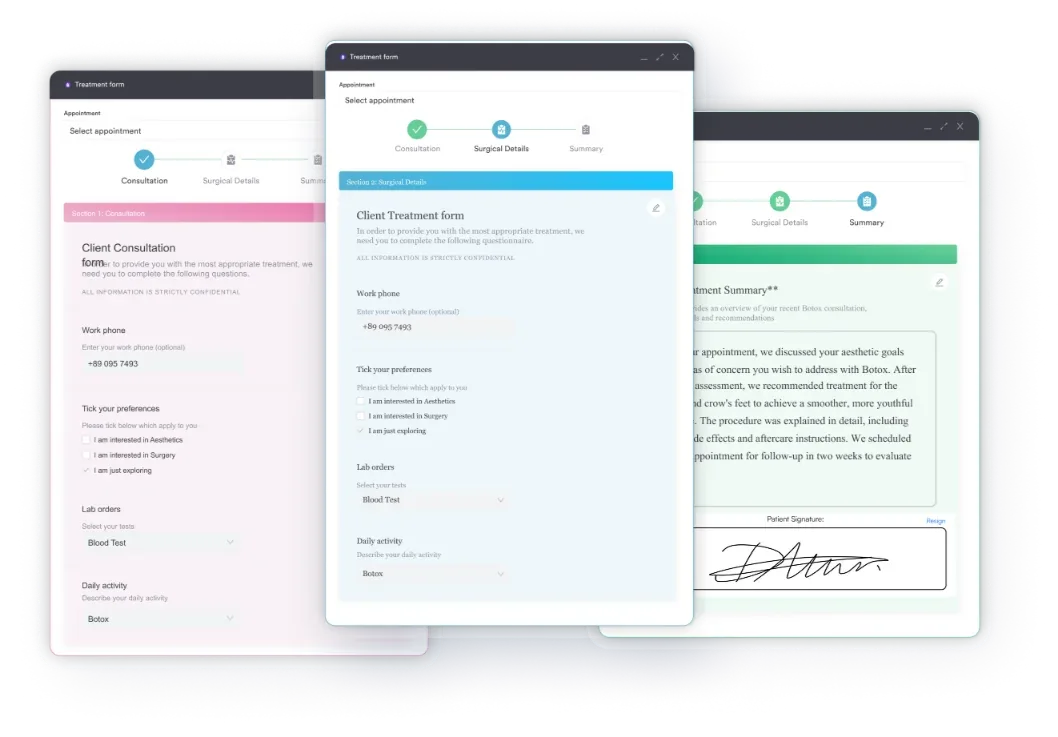
Practices managing patient records across multiple visits benefit from longitudinal documentation that shows the dietary deficiency was identified, monitored, and addressed over time. This is particularly useful when E58 appears as a secondary diagnosis alongside a primary condition such as osteoporosis. The same record carries the joint injuries that follow, S53.193D among them.

E58 frequently appears as a secondary diagnosis coded alongside a primary condition. Common pairings include osteoporosis, rickets, tetany, and post-bariatric nutritional workups. Fracture care belongs on that list too, with S52.614D running through a healing period. When coded secondarily, E58 still requires documentation support for the dietary etiology.
The Uniform Hospital Discharge Data Set (UHDDS) guidelines and AHIMA coding guidance both require that secondary codes meet the threshold for “additional diagnoses” — conditions that affect patient management, require clinical evaluation, or extend the episode of care. A malunion coded S52.579R plainly extends it, which is why both codes stay on the claim.

Pabau helps practices streamline clinical documentation and billing workflows, reducing the risk of ICD-10 coding errors on nutritional deficiency claims like E58.

E58 sits within a subchapter that covers a range of dietary deficiencies. Coders working with nutritional deficiency claims should be familiar with the adjacent codes, particularly when combination coding or sequencing decisions arise. For practices documenting a range of neurological or systemic comorbidities.
| Code | Description | Relationship to E58 |
|---|---|---|
| E55.- | Vitamin D deficiency | Type 1 Excludes when causative; separate code if distinct condition |
| E59 | Dietary selenium deficiency | Adjacent in subchapter; separate nutritional deficiency |
| E60 | Dietary zinc deficiency | Adjacent in subchapter; may co-occur with E58 |
| E61.- | Deficiency of other nutrient elements | Adjacent; covers copper, chromium, iodine, manganese deficiencies |
| E64 | Sequelae of malnutrition and other nutritional deficiencies | Late effects code; used when residual effects of E58 persist after deficiency resolved |
| E20-E21 | Parathyroid disorders (hypo/hyperparathyroidism) | Type 1 Excludes with E58; never coded simultaneously |
| E83.51 | Hypocalcemia | Metabolic cause; separate from dietary deficiency (see comparison section) |
Practices that track patients with complex nutritional profiles, such as weight loss clinic patients post-bariatric surgery, often encounter E58 alongside E59, E60, or E61 codes in the same encounter. Multiple nutritional deficiency codes may be assigned simultaneously when each is separately documented and meets the threshold for an additional diagnosis.
Medicare, Medicaid, and commercial payers accept E58 for claims with service dates on or after October 1, 2015. Pabau’s claims management software supports billing accuracy for nutritional deficiency codes including E58, helping reduce submission errors and track denial patterns.

E58 is most commonly used as a secondary diagnosis. When a patient presents primarily for management of calcium deficiency with no other established primary condition driving the visit, E58 may serve as the principal diagnosis. More often, it supports a primary condition such as osteoporosis or a post-operative nutritional workup.
According to AAPC’s ICD-10-CM code reference, coders should sequence E58 to reflect the condition chiefly responsible for the encounter. If a patient presents for osteoporosis management and dietary calcium deficiency is identified as a contributing factor, osteoporosis is the principal diagnosis and E58 is additional.
Not all payers reimburse E58 as a standalone primary diagnosis for all service types. Practices billing E58 for nutrition counseling or dietitian services should verify coverage under the patient’s plan, particularly for Medicare Advantage plans, which may apply additional medical necessity criteria.
Documenting the clinical impact of the deficiency — for example, its contribution to bone density loss or muscle weakness — strengthens medical necessity arguments. A residual coded S53.013S is another finding worth naming in that note.
For integrative medicine and functional medicine practices managing similar nutritional deficiency profiles.
When E58 appears alongside a condition like osteoporosis, code the primary condition first and sequence E58 as additional. Document the clinical relationship between the dietary deficiency and the primary condition in the notes to support medical necessity and avoid payer denials.
Certain patient populations carry a higher burden of dietary calcium deficiency. Coders working with these groups should be particularly attentive to the documentation requirements for E58.
Older adults often consume less dairy and have reduced intestinal calcium absorption. E58 may appear alongside codes for osteoporosis (M80.- or M81.-) or fracture risk conditions. The clinical note should document both the dietary deficiency and the clinician’s assessment of its contribution to bone health or fall risk. A wrist fracture coded S52.551C after a fall is usually where that assessment gets written.
Bariatric procedures alter gastrointestinal anatomy, reducing calcium absorption. E58 is used when the deficiency is attributed to dietary insufficiency or post-surgical dietary restrictions rather than a metabolic disorder. Coders should review the operative notes and nutritional assessment documentation. The CMS ICD code lists and official guidelines provide sequencing direction for post-procedural nutritional deficiencies. Revenue cycle management treats coding, submission and collection as one process rather than three handoffs. Practices that bill a narrow set of services keep a coding guide covering that set rather than the whole schedule.
Dietary calcium deficiency in children can contribute to rickets when combined with vitamin D deficiency. Coders must be careful here: If vitamin D deficiency is the primary driver, the E55.- code takes precedence under the Type 1 Excludes rule. E58 is appropriate only when the documentation clearly identifies inadequate dietary calcium as the causative factor independent of vitamin D status.
For coders handling complex cases with neurological or developmental comorbidities.
Patients following vegan diets, elimination diets, or culturally restricted dietary patterns may present with documented inadequate calcium intake. When the clinician notes the specific dietary restriction as the cause, E58 is appropriate. Documentation should identify the dietary pattern by name and connect it to the calcium insufficiency.
The United States introduced E58 with ICD-10-CM implementation on October 1, 2015, replacing the ICD-9-CM code 269.3 (mineral deficiency, not elsewhere classified). The code has remained stable across annual updates with no additions to the E58 code range. The 2026 ICD-10-CM code set, effective October 1, 2025, retains E58 without modification.
For ICD-9 to ICD-10 crosswalk needs, the ICD List lookup tool provides a free reference for code verification and crosswalk data. The WHO ICD-10 browser provides the international equivalent classification context, noting that the global ICD-10 equivalent appears in Chapter IV (Endocrine, nutritional and metabolic diseases).
The CDC/NCHS ICD-10-CM web tool remains the authoritative US lookup resource for verifying current code validity, tabular list entries, and index cross-references.
Practices managing complex patient records across conditions such as neurological ICD-10 code documentation benefit from practice management tools that support multi-code encounter workflows and reduce sequencing errors at the point of billing. Laterality is a frequent casualty there, and S53.194D names the side explicitly.
Dietary calcium deficiency is a straightforward concept clinically, but E58 coding demands precise documentation. The critical steps are confirming the dietary etiology, applying the Type 1 Excludes rules correctly, and distinguishing E58 from metabolic calcium disorders like E83.51.
Practices that invest in structured clinical documentation workflows catch these distinctions before claims go out. Pabau’s practice management platform supports clinical teams with structured note templates, digital intake forms, and claims management tools designed to reduce coding errors across nutritional and metabolic diagnosis codes. Book a demo to see how Pabau handles multi-code encounter workflows.

Billing a single-view abdominal X-ray? abdominal X-ray billing guide CPT code 74018 covers a single-view abdominal X-ray, with descriptor, modifier, and Medicare rate details.
Billing a PET/CT scan for oncology? PET/CT billing guide CPT code 78815 is a frequently submitted oncologic imaging code, and denials often trace to missing documentation or modifier errors.
Managing post-bariatric or weight management patients? Weight loss clinic software supports the multi-code nutritional workflows common in post-surgical patient populations.
ICD-10 code E58 is the billable ICD-10-CM diagnosis code for dietary calcium deficiency, classified under subchapter E50-E64 (Other nutritional deficiencies) within the Endocrine, nutritional and metabolic diseases chapter. It is valid for claims with service dates on or after October 1, 2015.
E58 describes dietary calcium deficiency caused by inadequate intake; E83.51 describes hypocalcemia caused by a metabolic or regulatory disorder. The clinician’s documented assessment of the cause — not lab values alone — determines the correct code.
Yes, E58 is a fully billable ICD-10-CM code requiring no additional characters, accepted by Medicare, Medicaid, and commercial payers for dates of service from October 1, 2015 onward.
E58 carries a Type 1 Excludes note for parathyroid disorders (E20-E21) and vitamin D deficiency (E55.-), meaning these must never be coded simultaneously with E58 when either is the primary cause of low calcium.
The record must include a clinician statement attributing the deficiency to inadequate dietary intake, supported by dietary assessment findings. It should also confirm that metabolic causes were assessed and ruled out as the primary driver.
Yes, multiple codes from E50-E64 (such as E59 or E60) can be assigned simultaneously when each is separately documented. E58 may not be coded alongside its Type 1 Excludes conditions (E20-E21, E55.-) when those are causative.
The correct code depends on the cause. If low calcium comes from inadequate dietary intake, E58 applies; if it’s a metabolic or endocrine problem confirmed by labs, E83.51 (hypocalcemia) is the correct code instead.
No. E58 is already a terminal, leaf-level code with no further subcodes, so it’s billed directly for dietary calcium deficiency without an additional “unspecified” variant.