Scapular assistance test: Procedure, interpretation and free template
The scapular assistance test is a manual examination in which the clinician supp...

2
Last Updated: Oct 19, 2026

Screening for lead poisoning means testing blood before symptoms appear, because no blood lead level is safe in children.
Current AAP and CDC guidance favors risk-based screening, with universal testing for high-prevalence areas, Medicaid-enrolled children, and state mandates.
The CDC reference value is 3.5 µg/dL, lowered from 5 µg/dL on October 28, 2021.
A fingerstick only screens. Confirm every elevated capillary result with a venous draw before you act on it.
Confirmation timing scales with the number, from three months at 3.5 µg/dL down to 48 hours at 45 µg/dL.
Nearly 500,000 US children aged 1 to 5 have blood lead levels above the CDC’s reference value. Most show no symptoms at all. By the time a child looks unwell, the harm to a developing brain has usually already been done.
The screening for lead poisoning has to find which children you test, how you collect the sample, and how fast you confirm a high result all matter. Get any of it wrong and the chart says the screen was done while the exposure carries on.
There is no safe blood lead level in children. The American Academy of Pediatrics (AAP) and the CDC both hold that position. Even low-level exposure is linked to reduced IQ, attention problems, and behavioral difficulties that surface years later.
Blood lead level, or BLL, is measured in micrograms per deciliter. The CDC lowered its reference value for children from 5 µg/dL to 3.5 µg/dL on October 28, 2021.
That number is a population marker and flags the highest 2.5% of children by exposure, and any child at or above it needs follow-up.
Adults need testing too, though the picture differs. Occupational exposure, renovation work on pre-1978 housing, and hobbies like shooting, stained glass, and pottery all raise blood lead. In adults, the consequences are cardiovascular, renal, and reproductive, and they build quietly over years.
Current AAP and CDC guidance favors targeted screening built on a risk assessment, rather than a blood test for every child. You ask the risk questions at well visits from 6 through 24 months, then annually from ages 3 to 6. A blood test follows when the answers point toward exposure.
Universal testing applies in high-prevalence areas, for children enrolled in Medicaid, and wherever a state mandates it. Medicaid is the widest of the three. Every enrolled child must be tested at 12 and 24 months. Any child aged 24 to 72 months with no record of a test needs one too.
The risk questions themselves are short. Ask about:
These questions belong in the same part of the visit as the standardized developmental screen you already bill under 96110. Staff are asking structured questions there anyway, so one more block of them barely changes the flow. If your intake paperwork skips housing age, add it to the new patient questionnaire instead of leaving it to memory.
Does a clean risk assessment mean the child never needs a test? No. Risk changes when a family moves, a parent switches jobs, or a new caregiver enters the picture. That is why the questions repeat at every well visit rather than once.
For adults, targeted screening covers construction, battery manufacturing, smelting, firing ranges, and radiator repair. Pregnant patients with known occupational or residential exposure should be assessed as well.
Two groups need testing whatever the questionnaire says. Refugee children under 16 are tested on arrival in the US. Children under 6 are then tested again three to six months after they settle into permanent housing.
That second test is the one that goes missing, because it often belongs to a different program than the pediatric chart. Practices running arrival visits on separate travel clinic software should set the repeat test as a recall there.
Your state health department, not the CDC, sets the rule you actually follow. High-prevalence states mandate a test at 12 and 24 months and take the questionnaire out of the decision. Lower-prevalence states leave the call to the risk assessment.
New York, for example, requires a blood lead test for every child at ages 1 and 2. It also requires one for any child aged 3 to 6 with no previous test. Policies differ enough that reading your own state’s rule is worth twenty minutes of somebody’s morning.
Lead exposure produces almost no early symptoms, which is why clinical presentation cannot drive testing decisions. Below 10 µg/dL, most children look completely well. A pediatric physical examination can be entirely normal in a child whose level already warrants action.
Symptoms that do appear are easy to blame on something else. Irritability, fatigue, abdominal pain, constipation, headache, and trouble concentrating all show up at higher levels. Encephalopathy, seizures, and coma sit at the severe end and count as a medical emergency.
Most children found through a screening program will be well below the symptomatic range. That is the whole point of screening, and it is also why sources tell you more than signs do.
Children carry the heavier burden, because a developing nervous system absorbs more and tolerates less.
The main effects are neurodevelopmental, including lowered IQ, weaker executive function, attention and behavior problems, and poorer school performance. At sufficient exposure, none of it reverses.
Adults show a different pattern. Chronic exposure is associated with hypertension, chronic kidney disease, peripheral neuropathy, and poor reproductive outcomes. Cognitive effects occur as well, but they need higher cumulative exposure.
The sources, though, barely change between the two groups:
In a high-risk area, the environmental history belongs in every well-child visit, and it takes about ninety seconds to ask. Once it points toward exposure, the next decision is how you take the blood.
The blood lead level test is the only tool that identifies lead exposure in a patient. You can collect the sample two ways, and the choice determines what you are allowed to do with the number that comes back.
Capillary collection is quicker, cheaper, and far kinder to a one-year-old, which is why most pediatric offices start there. It also picks up lead sitting on the skin, and that is the usual cause of a falsely high result. ARUP Consult and state programs alike treat an elevated capillary value as a screen, never a diagnosis.
Four steps keep the sample honest:
Venous blood is the confirmatory and follow-up method. It gives a more accurate result, and it is required whenever a capillary value reaches the reference value. The draw is coded separately from the lead assay, under 36415.
Over-the-counter lead kits test surfaces, not people. They check paint, dust, and water, and they say nothing about what is in a child’s blood.
Parents sometimes arrive believing a clear kit rules out exposure. Only a blood test answers that question, and it is worth saying so directly in the room.
A blood lead result carries two separate decisions. First, is the level elevated? Second, how quickly do you need a venous sample to confirm it?
The reference value answers the first question. The confirmation schedule answers the second, and it tightens sharply as the number climbs.
That third column is the one that changes your afternoon. A capillary result of 46 µg/dL needs a venous draw inside two days, and your recall system has to know it.
Reference values do get revised as population data accumulates, so check the current published guidance when you are making the decision.
Record the collection method next to every BLL result in the patient record. When a capillary result triggers a venous draw, log both values and mark the venous one as the figure you acted on. That single line saves arguments later, during mandatory reporting, case management handovers, and any medicolegal review.
Most US states require providers to report blood lead results to the state health department, elevated or not. New York, for example, requires reporting of every result for children under 18. States with universal screening laws usually apply the same rule to every child tested.
What varies between states is worth checking line by line:
That last one causes the most trouble. Teams often assume the lab has it covered, and in several states that assumption leaves the practice out of compliance.
Reporting also sends identifiable results into a public health registry, which your privacy documentation needs to cover. Practices already working through HIPAA compliance can slot lead reporting into the permitted-disclosure logic they built for communicable disease reporting. Keeping patient data security controls consistent across both saves writing the policy twice.
Reporting is one obligation, and treating the child is the other. Once a venous BLL sits at or above the reference value, the pathway looks the same almost everywhere. The order matters more than the speed of any single step.
Chelation is indicated when a child’s blood lead level reaches 45 µg/dL. Mayo Clinic guidance and current AAP recommendations agree on that threshold. Below it, the drugs carry more risk than benefit.
DMSA, also called succimer, is the first-line oral agent in children. EDTA is held back for very high levels, or for cases where DMSA cannot be used. Either route needs specialist management, plus close monitoring of renal function and blood counts.
Chelation also does nothing about the house. Removing the child from the source is still the step that decides the long-term outcome.
The clinical protocol above is well documented. The operations around it are where children quietly drop out of the program, and four failure points account for most of it:
None of that is clinically hard. It is scheduling, naming an owner, and writing things down.
Recall is the load-bearing piece. The 12-month appointment tends to book itself, since families come in for vaccines anyway. The 24-month lead test only happens if something remembers it, which is what patient recall software is built to do.
Size changes how you run it. In a solo practice, one person can hold the list in their head, and it usually works. A group practice cannot lean on that, because no single clinician sees every 12-month visit. The tracking has to live in the system rather than in someone’s memory.
Then check your own work. A quarterly chart audit against the 24-month cohort shows you the completion rate you have, rather than the one you assume. Pair it with the immunization record form review, since the same children and the same visits are involved.
Every failure point above is a tracking problem rather than a clinical one. Practice management software like Pabau holds those pieces in one place, so the program stops depending on who is in the building that week.
Automated recall workflows flag each patient at 12 and 24 months, so no child ages past the window without a prompt. When a capillary result comes back elevated, the same workflow books the confirmatory venous draw instead of leaving it on a sticky note.
Digital intake forms carry the lead risk questions into the pre-visit paperwork, and the answers land in the clinical record on their own. Nobody retypes a questionnaire while a toddler is in the room.
Client records then hold the capillary value and the venous value with timestamps. That is exactly what a case manager or a state registry asks for. Practices running primary care on GP clinic software get the recall list, the documentation, and the reporting trail from one system. Nothing has to be reconciled by hand at the end of the month.
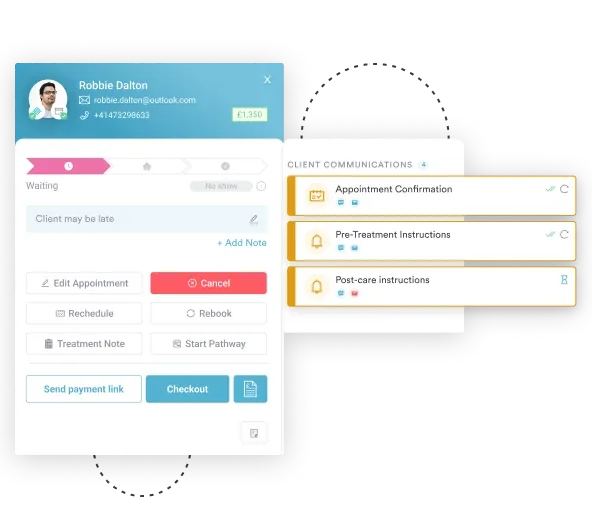

Pabau flags children due for testing at 12 and 24 months, then books the confirmatory venous draw after an elevated fingerstick. Both results stay in one record for reporting, so your team stops tracking it by hand.

Lead screening rewards practices that are boring about it. The clinical decisions are few and well defined. Almost everything that goes wrong is a date nobody tracked or a result nobody owned.
So pick two numbers and hold on to them. At 3.5 µg/dL, the result needs follow-up rather than reassurance. Reach 45 µg/dL and the child needs a specialist, plus a venous draw inside 48 hours. Everything between those points is process, and process can be fixed.
If your screening program runs on one person remembering, it holds until that person takes a vacation. Book a demo to see how Pabau tracks lead screening recalls, confirmatory draws, and state reporting in one place.

Running a CMS-compliant health risk assessment? Health risk assessment questionnaire covers the CMS-required domains, from psychosocial risks to advance care planning.
Documenting a breathing pattern care plan? Breathing pattern nursing care plan covers assessment prompts, nursing diagnosis, goals, and an interventions checklist.
Need a developmental screen alongside the lead result? Denver developmental screening test gives you a structured way to track milestones.
Building out your well-child documentation? Pediatric review template covers the history and exam findings worth capturing at every visit.
Screening for early cognitive impairment? Interlocking finger test template takes 5 to 10 minutes and needs no specialized equipment.
Lead in the blood has a half-life of roughly 30 days, so a blood test mostly reflects the past month. What moves into bone stays for decades and can leach back out later. A normal result today does not rule out an older exposure.
No. A complete blood count or metabolic panel will not report lead, so you have to order the blood lead level specifically. Anemia can appear alongside a high level, but it is far too common to use as a signal on its own.
No. Blood lead testing needs no fasting and no special preparation. The one thing that matters is clean, dry hands before a fingerstick, because dust on the skin can push the reading up.
Not reliably. Hair and urine tests are not validated for screening or diagnosis, and outside contamination skews them. Blood lead is still the only measurement that guides clinical decisions.
No. Lead-safe means the hazard is contained, usually by sealing or covering old paint. Lead-free means the lead is gone. Most remediation produces a lead-safe home, so families still need to keep surfaces and hands clean.
Most laboratories report within a few business days. Some offices use a point-of-care analyzer that reads a capillary sample during the visit. An elevated reading from either route still needs a laboratory-run venous test.