Scapular assistance test: Procedure, interpretation and free template
The scapular assistance test is a manual examination in which the clinician supp...

2
Last Updated: Oct 19, 2026
The general appearance physical examination is the opening step of every physical exam: an overall picture of the patient, formed by observation alone. It covers six domains, which are level of distress, level of consciousness, nutritional status, hygiene and grooming, gait, and apparent vs stated age. In practice, a normal result is charted as “well-nourished, well-developed adult in no acute distress,” and every abnormal finding is named precisely.
The Clinical Methods chapter on general appearance on NCBI Bookshelf treats it as the first domain of the standard exam. For example, a patient who walks in pale, short of breath, and guarding their abdomen has told you a lot before saying a word. This guide covers normal and abnormal findings, how to record them, and where the step sits in a head-to-toe nursing assessment.

General appearance is the opening domain of the physical exam, assessed by observation before any hands-on exam begins.
Six core domains are assessed: level of distress, consciousness, nutritional status, hygiene and grooming, gait, and apparent vs stated age.
The standard normal entry is “well-nourished, well-developed adult in no acute distress.” Expand it whenever the chief complaint calls for more detail.
Acute distress or altered consciousness changes the exam order, moving airway and breathing ahead of the rest of the head-to-toe sequence.
Practice management software like Pabau keeps findings comparable across visits by giving every clinician the same structured exam fields.
A general appearance physical examination is the careful, observation-based exam that opens a patient visit. It captures how the patient looks overall before any organ-specific exam begins. In short, it answers one question: what does this patient look like right now, and does anything need immediate attention?
Clinicians assess it through sight, hearing, and sometimes smell, before touching the patient at all. Internal medicine often calls the same step the “general survey.” It sits at the top of the exam for a practical reason, because its findings set the direction for the rest of the visit. For instance, a patient in acute respiratory distress moves the exam straight to airway and breathing. Similarly, a patient who looks malnourished prompts a more detailed nutritional and social history.
Six clinical domains make up the general appearance exam. Each one yields specific observations that carry diagnostic weight. As a result, recording them in the same order every time lets any provider read the patient’s baseline at a glance.
Some frameworks add a seventh domain, affect and mood, when the visit has a psychiatric dimension. For example, in dermatology, skin color and turgor often get folded into general appearance before the dedicated skin exam begins. Either way, keep the same set in the same order at every visit.
You need a clear picture of normal before you can reliably flag the abnormal. The table below maps each domain to what’s normal and to its most clinically important abnormal versions. An abnormal finding doesn’t always mean disease, so read it in context. An older patient who looks their stated age is normal, while a 40-year-old who looks 60 warrants further investigation.
Jaundice deserves a special mention. Scleral icterus (yellowing of the whites of the eyes) seen during the general appearance check may point to liver or bile-duct disease. In fact, it prompts investigation, not a diagnosis. The same principle applies to every abnormal general appearance finding, which directs clinical reasoning but doesn’t complete it.
General appearance and the mental status examination (MSE) overlap, but they serve different purposes. General appearance is part of the physical exam, assessed by any clinician in any field. In contrast, the MSE is a thorough psychiatric tool for checking cognitive, emotional, and behavioral function in detail.
The overlap shows up around appearance and behavior, which both methods note. However, the difference lies in depth and intent.
In SOAP note format, general appearance goes in the Objective (O) section, usually as the first line of the physical exam findings. Our SOAP notes examples show how that section reads in complete notes. The rule for general appearance is to record what you observed, not what you inferred. “Patient appears anxious” is an interpretation, while “Patient is fidgeting, makes poor eye contact, and reports feeling ‘on edge'” is an observation.
Joint Commission accreditation standards require documented physical exams. The entry should also support the clinical reasoning recorded elsewhere in the note. Five principles keep general appearance charting accurate and legally sound:
Adapt these phrases to your specialty and your EMR fields. As a result, saving them as structured patient records means every clinician picks from the same wording.
Normal findings:
Abnormal findings:
These entries belong in the exam section of the full visit record. A history and physical form gives them a home alongside the patient’s history and the rest of the exam findings.
First, before you settle on ‘NAD’, picture a covering clinician reading this note at 2 AM. Would they know exactly how the patient presented? If ‘NAD’ leaves any doubt given the chief complaint, write out the full observation.
In a head-to-toe nursing assessment, general appearance always comes first, before vital signs and the system-by-system check. The order is not random. A patient who looks acutely distressed may need intervention before the full exam can go ahead. The depth of each domain varies by field, but the order holds in primary care and physical therapy alike.
The standard sequence in a head-to-toe nursing assessment looks like this:
General appearance shapes each later step. For example, if the patient looks short of breath at the opening observation, the clinician moves the respiratory component forward and may defer lower-priority checks. The diagram below maps the three routes out of that first impression.
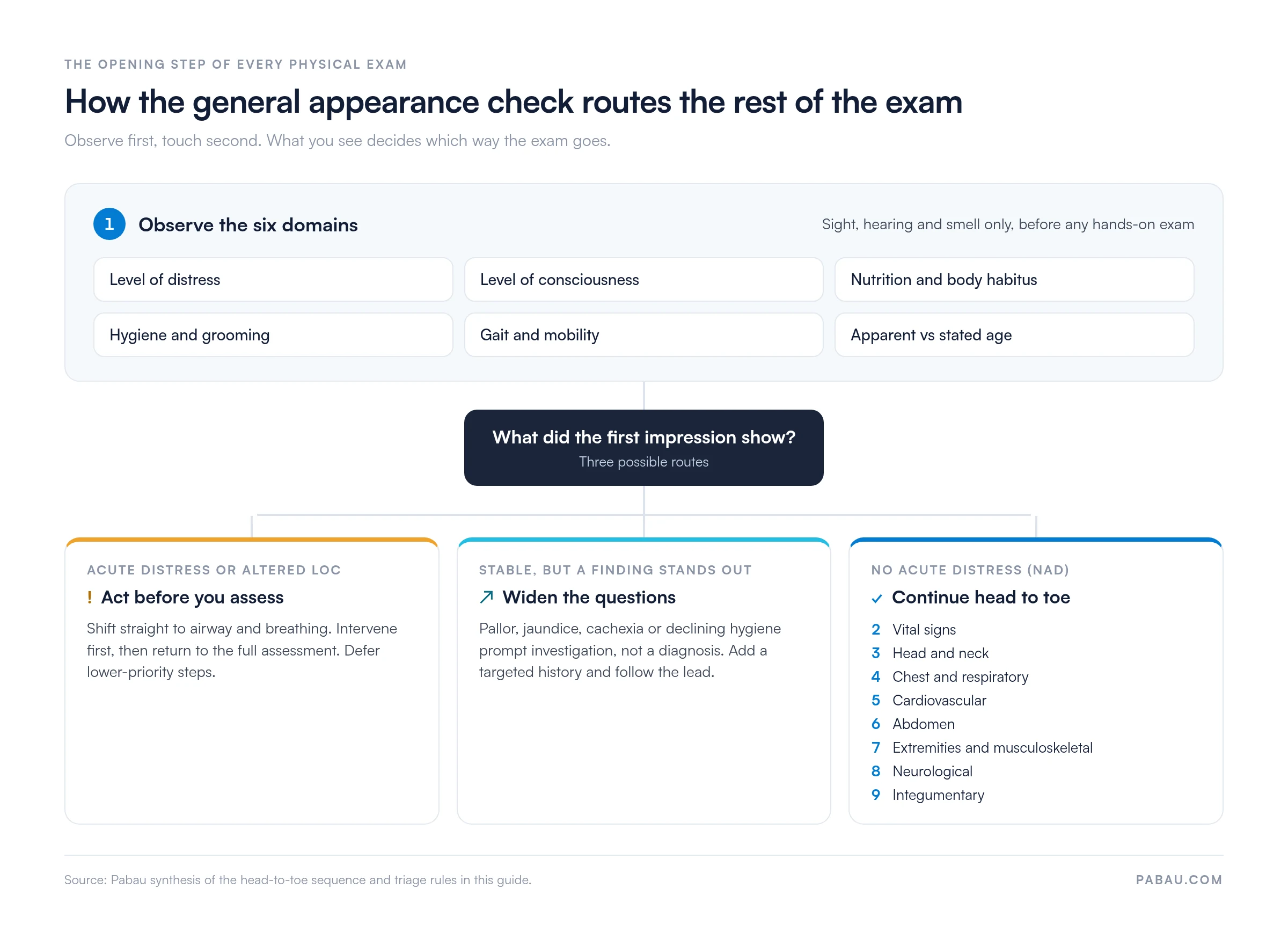
The general appearance check costs nothing and adds no delay, yet it often gives the first diagnostic lead. Several serious conditions show themselves here before any lab value is available. That makes the first impression the clinician’s main triage tool in time-sensitive cases.
Consistent documentation across visits is a clinical asset in its own right. When general appearance is charted in the same standard language each time, changes stand out in the record. A patient described as “well-groomed” at visit one and “unkempt, body odor noted” at visit three has a chart that raises concern on its own, so no verbal handover is needed.
General appearance is where mismatched wording most often enters the patient record. With free-text fields, one provider writes “NAD,” another writes “comfortable,” and a third writes “no distress apparent.” All three mean the same, but the variation muddies audits and makes serial visits harder to compare.
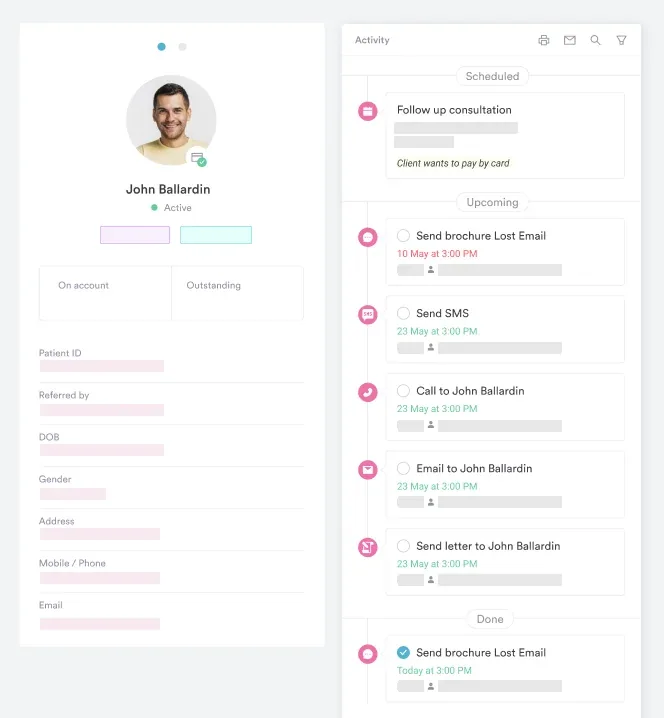
Practice management software like Pabau replaces that free text with structured patient intake forms and exam templates. You can set distress level, consciousness, nutritional status, and gait as required fields, so no one skips them. As a result, every clinician in the practice records the same domains in the same language.
Pabau Scribe, our AI scribe, drafts the consultation note from the conversation. You review and confirm it instead of writing from memory. A clinician seeing 25 patients a day who saves three minutes per note gets back 75 minutes daily. Because every visit uses the same fields, earlier findings sit alongside today’s in the patient’s Client records.

Pabau’s digital forms and Pabau Scribe help every clinician record general appearance in the same fields and wording. Serial visits stay comparable, and notes are ready for audit.

Treat the general appearance check as the decision point that sets the course of the exam. If the first moments of contact point to distress or altered consciousness, act on it before you finish assessing. If the patient looks well, chart it in the same standard phrase every time, so the next abnormal entry stands out.
The trade-off to remember is speed against detail. “NAD” is fast, but it only works when it leaves no doubt given the chief complaint. When it doesn’t, write out the full observation. Book a demo to see how Pabau keeps general appearance charting consistent across every clinician in your practice.

Assessing consciousness in more depth? Level of consciousness assessment gives you a structured way to grade and chart alertness beyond A&Ox4.
Pairing the exam with the history? Constitutional review of systems covers the whole-body symptom questions that sit alongside the general appearance exam.
Running a full nursing assessment? Nursing assessments brings structured forms to the body-system steps that follow general appearance.
Charting around one patient concern? Focus charting explains the DAR format for recording findings tied to a specific patient problem.
Want wording for the rest of the note? Nurse charting cheat sheet gives quick-reference phrasing for charting beyond the general appearance line.
General appearance in a physical exam is the careful, observation-based exam of how the patient looks overall, done before any hands-on check begins. It covers distress level, consciousness, nutritional status, hygiene, gait, and apparent age, and it gives context to the findings that follow.
Normal general appearance findings include no acute distress (NAD), alert and oriented x4 (A&Ox4), and a well-nourished, well-developed body habitus. Hygiene and grooming are proper, gait is steady, and skin color is normal for the patient’s baseline, with no jaundice, pallor, or cyanosis.
Document general appearance as the first line of physical exam findings, under the Objective (O) section of the SOAP note. Use plain, objective details rather than guesses, and state relevant negatives clearly. A standard normal entry reads “well-nourished, well-developed adult in no acute distress, alert and oriented x4.”
Abnormal findings include acute distress or guarding, altered consciousness (confusion, lethargy, unresponsiveness), jaundice or scleral icterus, and pallor or cyanosis. Cachexia or severe obesity, declining hygiene, and antalgic, ataxic, or shuffling gait also count. Each finding directs further checking, not a diagnosis.