GLP-1 usage by state: Who’s taking, searching and paying in 2026
GLP-1 usage by state peaks in West Virginia, America’s GLP-1 capital, with...

Last Updated: Oct 16, 2026

PatientFi is an online lender for elective and cosmetic procedures, with higher funding limits and fixed monthly payments.
CareCredit is a healthcare credit card with broader network acceptance and promotional deferred interest periods.
PatientFi pre-qualifies patients on a soft credit inquiry, while CareCredit runs a hard inquiry that lands on the credit report.
CareCredit usually charges practices a lower merchant discount rate, but PatientFi approves larger amounts on high-value elective cases.
Trustpilot reviewers rate PatientFi 3.8/5 across 282 reviews and CareCredit 1.1/5 across 414 reviews.
Patients walk away from elective treatment when they cannot cover the cost upfront. Financing removes that barrier, and the platform you offer decides how well it works.
For aesthetic and elective practices, PatientFi is usually the stronger default. CareCredit earns its place with dental and vision work, and with patients who already carry the card.
The PatientFi vs CareCredit decision comes down to four trade-offs. Those are the credit check, the funding limits, what the practice pays per transaction, and how the payment structure lands with patients. This guide works through each one.
Here is where each platform stands on the measures that matter most to practices and patients.
PatientFi is an online lender built for elective and cosmetic medical procedures. It concentrates on aesthetics, plastic surgery, and wellness treatments, so it is designed around higher per-patient loan amounts.
Practices weighing med spa business financing against patient-side credit will meet it as the elective-specific alternative to a general healthcare card.
Pre-qualification runs on a soft credit inquiry, so patients can check their options without affecting their credit score. That removes hesitation at the point of booking, especially for patients who watch their credit closely.
CareCredit is a healthcare credit card issued and managed by Synchrony Financial. It has been on the market for decades and carries one of the largest provider networks in the US. Patients who already hold the card can use it at any enrolled practice without applying again.
Its promotional financing offers no-interest periods when the balance is paid in full by the promotion end date. That deferred interest structure draws steady scrutiny from the Consumer Financial Protection Bureau (CFPB). Patients who miss the deadline owe interest on the original purchase amount, backdated to the purchase date.
Neither platform publishes an approval percentage. What separates them is the check each one runs, and what that check costs the patient.
PatientFi’s soft-pull pre-qualification lets patients see their options before they commit to an application. No hard inquiry appears on the credit report at that stage. Patients who are rate-shopping or unsure about eligibility abandon the process far less often when no hard check is involved.
CareCredit applies a hard credit inquiry on application. A hard credit inquiry stays on a patient’s credit report for up to two years. Patients already carrying several credit lines often decline at exactly that moment.
Approval still turns on the individual credit profile, and neither platform guarantees it.
The per-patient funding ceiling matters most on high-value elective work. Rhinoplasty, full-mouth restoration, and multi-session aesthetic packages all push past what a general healthcare card usually covers.
PatientFi is built around those larger loan amounts. CareCredit spans more healthcare categories at lower per-patient limits, which suits mid-range and routine spending better.
Exact funding limits move with each patient’s creditworthiness, and neither platform publishes them as fixed figures. Verify current limits with each provider before you present financing options at the consultation.
The merchant discount rate (MDR) is the percentage of each transaction the practice pays the financing platform. It is the direct cost of offering financing, and it comes straight off net revenue per patient.
PatientFi carries higher MDRs than CareCredit. In exchange it approves larger amounts on elective cases, which can mean fewer declined patients and more completed bookings.
For a plastic surgery practice with treatment values in the thousands, MDR is a revenue-per-patient question rather than a flat fee comparison. Practices comparing integrated payment tools can track net revenue after financing fees across the whole patient ledger.
CareCredit’s MDR is lower, but it shifts with the promotional plan the patient picks. Longer promotional periods usually carry higher MDRs for the practice, so the headline “lower fees” claim needs context.
Neither platform publishes its MDR percentages. Both negotiate them through the provider enrollment process.
The payment structure is what patients remember months after treatment. It also shapes how they describe your practice to the next person who asks.
PatientFi offers fixed monthly installment plans. The patient knows the exact monthly payment from day one, and no interest is ever backdated. That predictability cuts billing disputes and the frustration that ends up in reviews.
CareCredit’s deferred interest model works differently. Patients get a no-interest promotional period, often 6, 12, or 18 months. Clearing the balance before that period ends means no interest at all. Missing the deadline means interest on the full original amount, backdated to the purchase date.
In December 2013 the CFPB issued a $34.1 million refund order against GE Capital Retail Bank over how CareCredit was enrolled and disclosed. Synchrony Financial took the card business over in the 2014 spin-off and issues it today.
CareCredit’s Trustpilot rating sits at 1.1/5 across 414 reviews, and much of that volume traces back to the interest structure. PatientFi’s rating is 3.8/5 across 282 reviews, where people cite the easy application and the fixed terms.
PatientFi’s core advantage is how closely it lines up with elective and aesthetic work. The soft credit check reduces friction at the point of sale, and fixed terms build trust. Larger loan amounts put premium procedures within reach for more patients.
CareCredit’s network breadth is its strongest card. Patients who already hold an account can use it immediately at any enrolled practice, which skips the application step. The familiar brand also shortens the education conversation at the front desk.
Neither PatientFi nor CareCredit publishes fixed pricing for practices. Enrollment runs through a direct application, and the MDR you pay depends on patient volume, procedure mix, and the promotional plans you enable. Contact both platforms for current quotes.
Before you enroll in either platform, ask your patient coordinator to log how many financing applications are declined or abandoned each month. That number shows which approval structure is costing you bookings, well before any MDR quote does.
PatientFi holds 3.8/5 on Trustpilot from 282 reviews. Reviewers there point to the easy application, transparent payment terms, and provider support that answers quickly.
CareCredit holds 1.1/5 from 414 reviews, among the lowest scores in healthcare finance. Complaints center on deferred interest. Patients believe they signed up for no-interest financing, then receive backdated charges.
That spread has practical consequences for your practice. Patient complaints about a financing product reflect on the practice that recommended it. In aesthetics and elective care, where reputation drives repeat bookings, one billing dispute can cost referrals.
For aesthetic and elective practices, PatientFi wins on most counts. CareCredit is the better fit where the procedure mix runs broader, or where the patient already holds the card.
That verdict is practice-level. Case by case, four questions route an individual patient faster than a policy does.
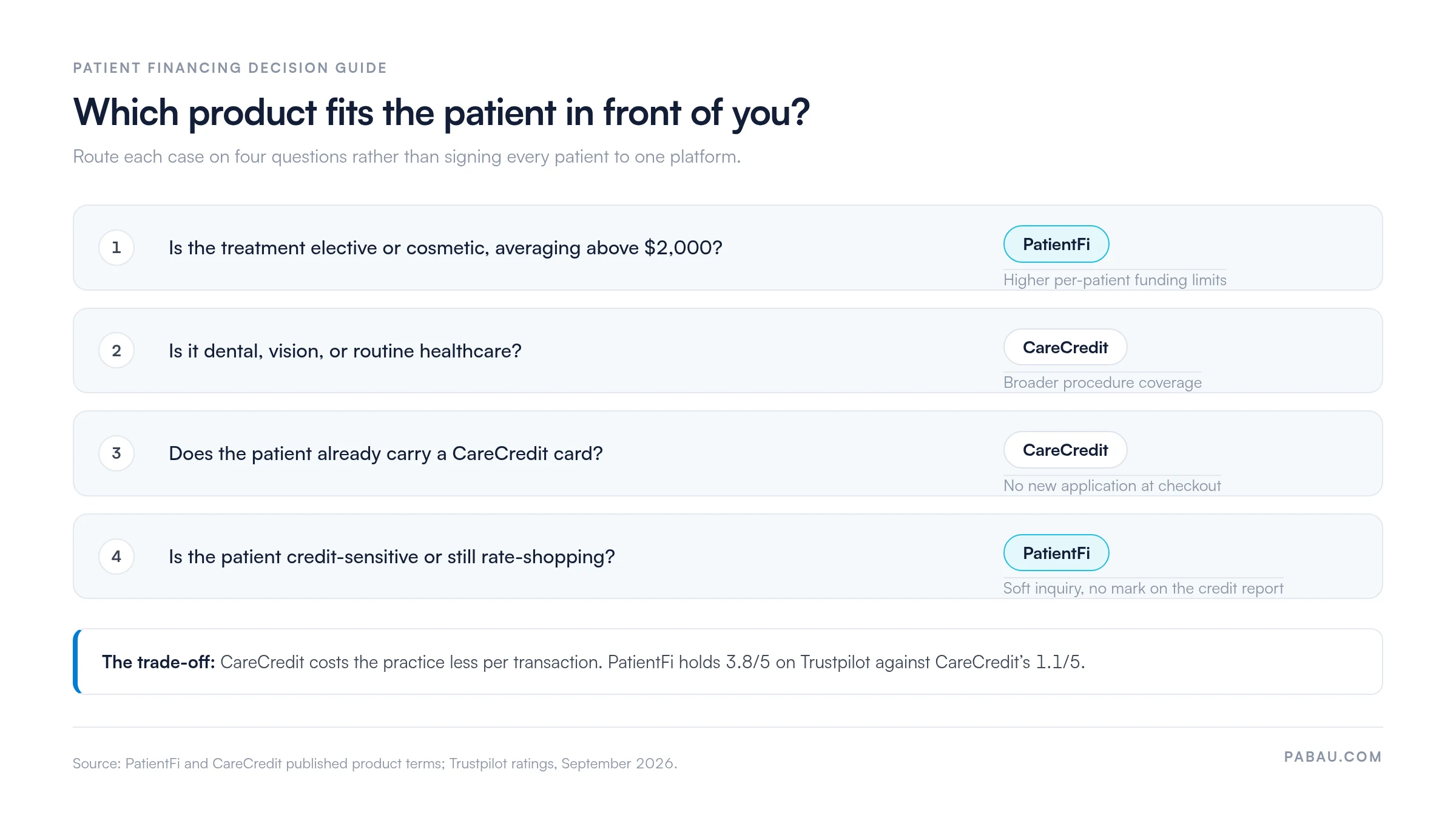
At the practice level, three profiles cover most decisions.
The complaint data deserves weight in that decision. A financing product carrying CareCredit’s review score creates reputational exposure in specialties where satisfaction drives word-of-mouth referrals. For aesthetics and elective practices, one deferred interest dispute attributed to you can outweigh the MDR savings.
Practice management software like Pabau does not replace PatientFi or CareCredit. It gives your front desk one view of where each patient’s payment stands, whoever funded the treatment.
Most practices reconcile three sources today: the financing portal, the card terminal, and the appointment book. Deposits get chased over email, and the balance owed depends on which system you happen to open.
In Pabau, outstanding balances, deposits taken, and payment plan status sit beside the appointment and the treatment note.
Software for med spas and plastic surgery practice management both work this way, so your team knows where an account stands before the consultation starts.
Pabau’s payment processing tools also let you take deposits at the moment of booking. That reduces how often smaller treatments need third-party financing at all, and it keeps cash flow steadier across the month.

Pabau tracks patient payments, deposits, and outstanding balances in one place, whichever financing partner you work with. Book a demo to see how it fits your practice.

Pick the product that matches the treatment values you actually invoice. For most aesthetic and elective practices that is PatientFi, and the 3.8/5 review score against CareCredit’s 1.1/5 is part of why.
CareCredit still earns its place where the procedure mix is broad, or the patient already holds the card. Brief your coordinators on how the promotional period ends, because your practice absorbs the complaint when a patient misses it.
Track declined and abandoned applications for one quarter before you commit, and the choice stops being a judgment call. Book a demo to see how Pabau reports on deposits, balances, and net revenue per patient.

Setting prices before you set up financing? Med spa pricing strategy guide shows how to structure service prices so a payment plan looks reasonable to the patient.
Want to spread cost without a third-party lender? Med spa membership packages covers how recurring plans smooth patient spend and give the practice predictable revenue.
Need a clearer view of practice finances? Medical spa accounting software compares the systems that track net revenue once financing fees come out.
PatientFi is an online installment lender specializing in elective and cosmetic procedures, offering fixed monthly payments and a soft credit check. CareCredit is a revolving healthcare credit card issued by Synchrony Financial, offering promotional deferred interest financing with a hard credit inquiry on application. The core difference is the credit check and the payment structure. PatientFi uses fixed terms with no deferred interest. CareCredit uses promotional periods that can trigger backdated interest if the balance is not cleared in time.
PatientFi uses a soft credit inquiry for pre-qualification, which does not affect a patient’s credit score. CareCredit applies a hard credit inquiry on application. That inquiry stays on the patient’s credit report for up to two years.
Yes. Paying the full balance before the promotional period ends means no interest. Missing that deadline means interest on the original purchase amount, backdated to the purchase date. In December 2013 the CFPB ordered GE Capital Retail Bank to refund $34.1 million over how CareCredit was enrolled and disclosed. Synchrony Financial took the card business over in the 2014 spin-off.
PatientFi charges higher merchant discount rates than CareCredit, though neither platform publishes fixed MDR percentages. Exact fees vary by provider contract, patient volume, and promotional plan selections. CareCredit’s MDR also varies. Longer promotional periods typically carry higher practice fees. Request current quotes from each platform’s provider enrollment team before you compare costs.
Cherry is the most commonly cited alternative. It offers soft-credit approvals with tiered payment plans, aimed at the same aesthetic and elective practices as PatientFi. Other options include Alphaeon Credit and Proceed Finance. Many practices run two financing products at once, so they cover different patient credit profiles and procedure types.