Fertility clinic marketing: Strategies that attract & convert patients
Fertility clinic marketing is how a fertility practice attracts, educates, and c...

Last Updated: Oct 14, 2026

Med spa membership packages come in two forms: a membership billed every cycle, and a package the patient pays for upfront.
A recurring membership smooths cash flow, because the fee arrives every month whether the member books a treatment or not.
A prepaid package hands you the cash on day one, then leaves treatment credits you owe until the last session is redeemed.
Choose between them by asking when you want the money, and how large an unredeemed balance you are willing to carry.
Practice management software like Pabau tracks the recurring billing, credit balances, and expiry dates that a spreadsheet quietly loses.
Med spa membership packages come in two forms, and the money behaves very differently in each one. A membership charges the patient again on every billing cycle. A package is paid once, upfront, and becomes treatment credits you owe for months afterwards. If you plan to sell both, check how each platform handles memberships in our comparison of the best medical spa software.
Designing the tiers is the easy half of a medical spa membership. The harder half starts after the card is charged. What can you count as earned, what is still owed, and what happens when a member walks away with credits unused?
This guide covers the choice between the two models and the arithmetic that keeps either one profitable. It also covers what your system has to track, and how to handle cancellations.
Choose a membership for predictable monthly cash, and a package when the patient commits to a defined course of treatment. Two questions settle almost every case. When do you want the money, and how much unredeemed balance can you comfortably carry?
| Model | When you get paid | What you still owe afterwards | Admin load | Best for |
|---|---|---|---|---|
| Recurring membership | Every cycle, for as long as the member stays | The current cycle’s included treatments, and no more | Low once billing runs itself, higher at sign-up and cancellation | Maintenance treatments people repeat, like injectables and facials |
| Prepaid treatment package | Once, in full, at the point of sale | Every session the patient has paid for and not yet taken | Moderate: someone has to track the balance on every visit | A defined course, like six laser sessions or four microneedling appointments |
| Hybrid (membership with credits) | Every cycle, with part of the fee banked as credit | The current cycle, plus whatever credit has rolled over | Highest, because rollover and expiry rules apply per member | Mixed menus where members want to choose what they spend on |
A membership keeps revenue and delivery roughly in step, because both happen inside the same cycle. A package pulls all the revenue forward and leaves the delivery trailing behind it for months.
That is why the hybrid carries the most admin. It takes the recurring billing of a membership and adds the carried balance of a package, so you are tracking both at once.
Treatment packages are bought once and drawn down over time, while a membership charges again every cycle for as long as the patient stays enrolled. That single difference drives the pricing, the admin, and the refund conversation.
A recurring membership charges a flat fee on a fixed cycle, usually monthly. In return the member gets some mix of included treatments, member pricing, and priority booking. The fee arrives whether the member turns up or not, which makes a med spa membership the steadiest line on your revenue report.
Building the tiers themselves is a bigger job than it looks. Our guide to running a med spa membership program covers the menu and the tier structure. It also shows how to launch a spa membership program to the patients you already have.
A package is one payment for a fixed number of sessions, usually of the same treatment. Six laser or IPL sessions, four microneedling appointments, a course of chemical peels. The patient pays once and books at their own pace.
You take the whole amount immediately, which is why packages are popular when a practice needs working capital for equipment or stock. The trade is that those treatments sit ahead of you, already paid for, waiting to be booked.
A hybrid charges monthly and converts part of the fee into treatment credits the member spends on whatever they like. A plan might include Botox units redeemable every three months, one Hydrafacial a month, and a discount on the rest of the menu.
Rollover is the rule that decides how expensive this gets. Let unused credits carry forward and the member feels looked after, while the balance you owe keeps climbing. Expire them at the end of each cycle and the balance stays small, but expect the conversation at the front desk.

Cash from a prepaid package arrives before you have done the work, so a strong sales month can flatter a thin delivery month. The balance of treatments you still owe is the number that tells you where you stand.
The table below follows one package through its life. The figures are illustrative, chosen to show the shape of the problem rather than drawn from any practice’s books.
| Stage | What just happened | Cash in the bank | What you can count as earned | What you still owe the patient |
|---|---|---|---|---|
| Package sold | Patient pays upfront for six laser sessions | $1,200 | $0 | Six sessions |
| First session redeemed | One session delivered a month later | $1,200 | $200 | Five sessions |
| Part redeemed | Three sessions delivered by month three | $1,200 | $600 | Three sessions |
| Fully redeemed | All six sessions delivered | $1,200 | $1,200 | No sessions remain |
| Expired or cancelled | Two sessions never booked before the expiry date | $1,200 | Set by the terms you wrote | Whatever those terms promised |
Read the columns across and the pattern shows up. Cash stops moving the moment the package is sold. The amount you have earned climbs one session at a time over the following months.
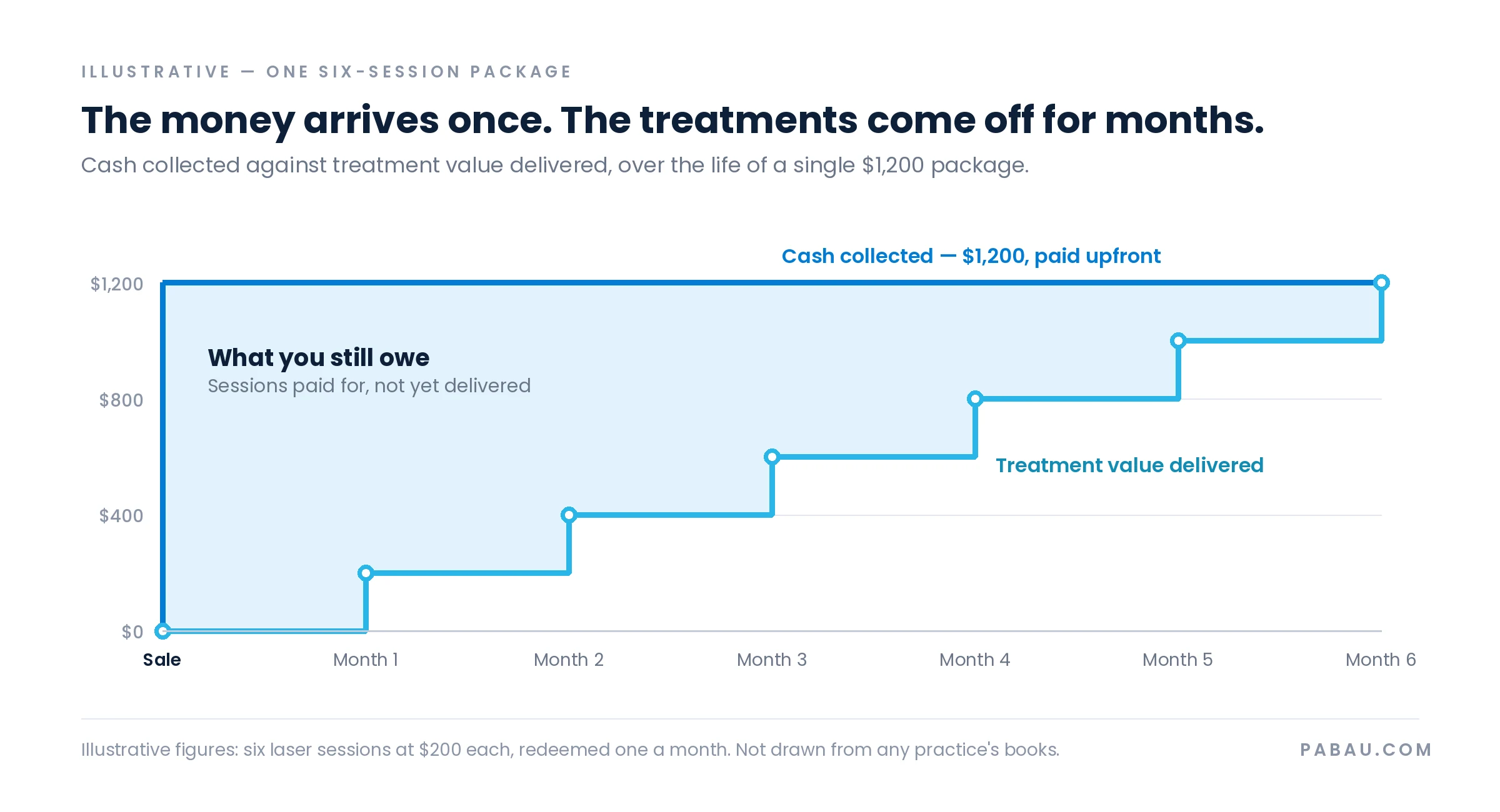
Say that package sells in January. January reads as a $1,200 month, though no treatment has been delivered yet. By March the patient has taken three sessions, so half the money has been worked off and half is still an obligation.
Three consequences follow, and all land later than the sale does:
How prepaid balances should be recorded, and how they are taxed, depends on how your business is set up and where you operate. Confirm the treatment with your own accountant before you change how you report them.
Price from your delivered cost and a realistic redemption rate, rather than from a discount off your menu price. Delivered cost is product, consumables, practitioner time, and the room. Work it out per treatment first, because it is the floor every plan has to clear.
The discount ceiling falls out of that number. A $300 treatment that costs $120 to deliver earns you $180. Take 20% off for members and you keep $120, so a fifth off the price has taken a third of the margin.
Here is an illustrative Botox membership, using round numbers. The plan charges $99 a month, or $1,188 a year, and includes four treatments across the year. If each one costs $150 to deliver, full redemption costs $600 and leaves $588.
That $588 only holds if every member takes every treatment. Assume a 70% redemption rate and the delivered cost drops to roughly $420. That makes the plan look far healthier than it may turn out to be.
Redemption rates tend to rise as the habit sets in, and a plan priced on light usage stops working once members get organized. Price so the plan survives full redemption, then treat unused sessions as upside rather than as budget.
Practitioner time is easy to leave out of the sum. Two members redeeming on a Saturday occupy slots a full-price patient would have booked, so count the chair as well as the syringe. If you want the fee itself to read better, charm pricing is worth a look.
Med spa membership management is mostly record-keeping, and these are the records that rot quietly. A spreadsheet holds them for a while. It stops being trustworthy the first week two people edit it and neither mentions it.
| What the system has to track | What breaks when it lives on a spreadsheet |
|---|---|
| Recurring billing on a stored card | Someone has to remember to take payment, and a member nobody charges is a member you treat for free |
| Failed payments and retries | An expired card ends the plan silently, and you find out when the member arrives for a treatment |
| Credit balance per patient | The front desk guesses, then honors the guess, so sessions go out that nobody was paid for |
| Rollover and expiry rules | Dates get applied unevenly, and the member who argues hardest ends up with the best deal |
| Redemption at checkout | Sessions come off the wrong plan, or never come off at all, and the balance stops matching what was delivered |
| Proration on mid-cycle changes | Upgrades and downgrades get worked out by hand, differently each time, and refunds turn into arguments |
| Reporting on the unredeemed balance | Nobody can say what you owe in treatments, so the next plan gets priced on guesswork |
Most med spa software covers the billing side of that list. The row worth testing in a demo is the last one, because reporting on the balance you carry is where lighter tools tend to stop.
One more test for whoever runs your front desk. Ask them to tell you, without opening a spreadsheet, how many sessions a named member has left. If that takes more than a few seconds, med spa membership management has already outgrown your current setup.
An unredeemed balance is worth whatever your written terms say it is worth, so write those terms before you sell the first plan. Improvising at the front desk is how one generous exception becomes the policy everyone else hears about.
Three situations come up again and again. A member cancels mid-cycle. A package hits its expiry date with sessions left. A card fails and the plan lapses without anyone deciding to end it.
The hardest of the three is the half-used package. A patient who has taken four of six sessions had all four at the bundle rate, which was only ever available because they bought six.
Refunding at the bundle rate hands them the discount twice. Charging the sessions they took at menu price and refunding the difference is the version most practices can explain without an argument.
Put each of these in writing, in language a member can read in one pass:
Consumer protection rules covering prepaid services and expiry dates vary by state. Have your terms reviewed locally before you publish them, and keep the signed version attached to the patient record.
Pabau is an all-in-one practice management system, and memberships and packages live inside it rather than beside it. The plan, the card, the balance, and the appointment all sit on the same patient record.
You build a plan by choosing the services it covers, the number of sessions, how long it runs, and the price. Pabau then charges the stored card on the cycle you set, so renewals happen without anyone chasing them.
Members can buy online alongside vouchers and products, at any hour. Your team sees the plan on the client card. It shows when the member joined, which tier they are on, what balance is left, and when it expires.
Because redemption happens at checkout in the same system, the balance drops as the session is delivered. Built-in reporting then shows what you are still carrying, so you can price the next plan on a number instead of a hunch.
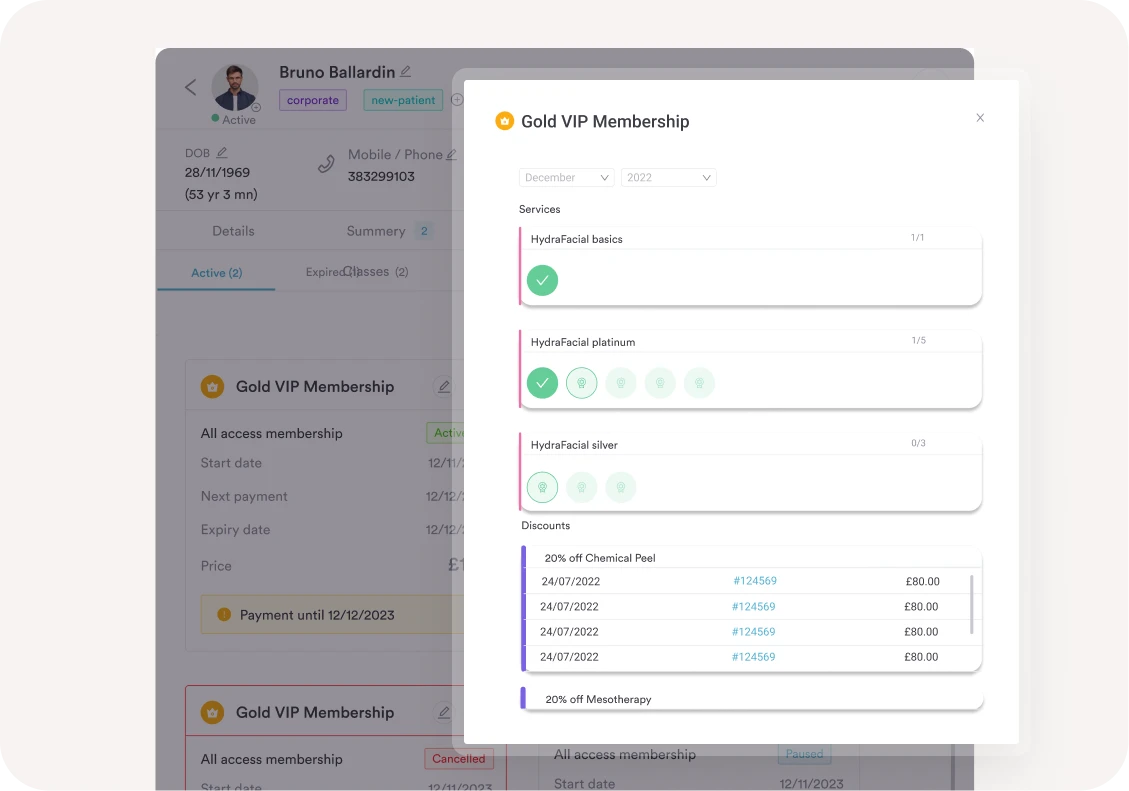

Pabau charges membership fees on the cycle you set, and draws package sessions down at checkout. Your front desk always knows what a member has left. Built-in reporting shows the unredeemed balance you are carrying before you price the next plan.

Which model you sell matters less than whether you can produce one number on demand. That number is how much treatment you owe patients who have already paid.
Practices that know that number price their next plan properly, staff their calendar for the redemptions coming, and handle a cancellation in one conversation. Practices that do not find out the hard way, usually in a quiet month.
So pick the model that suits your treatment menu, and write the terms before you sell. Then make sure the balance sits somewhere your team can see it. Book a demo to see how Pabau runs membership billing and package balances from one patient record.

Still setting your headline prices? How to choose a med spa pricing strategy works through cost-plus, value-based and competitive pricing before you discount for members.
Asked to spread a big treatment cost? Patient payment plans covers instalments, third-party financing, and the paperwork each one needs.
Need bundles patients say yes to? Med spa package ideas gives you ready-made bundles with example pricing you can adapt to your own menu.
Structuring more than one plan? Tiered med spa memberships shows how to space the tiers so each one earns its keep instead of undercutting the one below.
Writing the rules for late cancellations? Cancellation policy guide covers notice periods, deposits, and how to enforce them without losing the patient.
A membership bills on a repeating cycle for as long as the patient stays enrolled. A package is one upfront payment for a fixed number of sessions, drawn down over time. The membership smooths your monthly cash. The package pulls the cash forward and leaves treatments owed until every session is redeemed.
Most run recurring billing against a card stored on file, charged automatically on the same date each cycle. Packages are charged once at the point of sale, then held as a session balance on the patient record. Each visit draws that balance down at checkout rather than raising a new invoice.
Whatever the written terms say, which is why they need writing before the first sale. Common approaches are refunding the unused portion, converting it to credit against another treatment, or forfeiting it after a stated expiry date. Consumer protection rules on prepaid services vary by state, so have your terms reviewed locally.
Practice management platforms that combine scheduling, payments, and patient records handle this best, because redemption happens at checkout. Pabau runs recurring billing, plan setup, and credit balances from the same system as the calendar. Whichever you shortlist, check that it reports the unredeemed balance you are carrying.