Slocum test: How to perform, interpret and record it
The Slocum test is a knee drawer test performed with the tibia rotated. It check...

3
Last Updated: Oct 21, 2026

Neer’s test is a passive shoulder maneuver that screens for subacromial impingement syndrome; Charles S. Neer first described it in 1972.
A positive result is pain reproduced in the anterior or lateral shoulder during passive forward flexion with the arm internally rotated.
Sensitivity ranges from 0.59 to 0.89 and specificity from 0.31 to 0.75, making it a useful screening tool rather than a standalone diagnostic.
Practice management software like Pabau stores special test findings as structured fields, so shoulder assessment outcomes stay trackable over time.
Neer’s test is a passive shoulder maneuver that screens for subacromial impingement. You stabilize the scapula, internally rotate the arm, then lift it into forward flexion. Pain in the anterior or lateral shoulder counts as a positive result.
The test takes seconds. Reading the result well takes longer, because sensitivity and specificity vary widely across published studies. A positive finding raises your suspicion rather than settling the question.
This guide covers technique, interpretation, diagnostic accuracy, and where Neer’s test sits alongside the other shoulder special tests. The last section covers how to record those findings in physical therapy practice software so they stay useful months later.
Neer’s test is a passive examination maneuver that screens for subacromial impingement syndrome of the shoulder. Orthopedic surgeon Charles S. Neer first described it in his 1972 paper on anterior acromioplasty for chronic impingement. It is now a standard part of shoulder physical examinations worldwide.
The test works by mechanically reproducing the impingement mechanism. Passive forward flexion with the shoulder internally rotated drives the greater tuberosity toward the anterior undersurface of the acromion.
That compresses the supraspinatus tendon inside the subacromial space, and the long head of the biceps tendon to a lesser extent. If impingement is present, the patient’s familiar pain comes back.
Neer’s test loads three structures:
Subacromial impingement syndrome involves repeated compression of these soft tissues between the humeral head and the coracoacromial arch. Subacromial impingement syndrome affects overhead athletes, manual workers, and older adults with degenerative rotator cuff changes most often.
Consistent technique is critical for reproducibility. Small changes in arm position or hand placement alter which structures bear the load and whether the maneuver genuinely reproduces pain.
The patient may be seated or standing. Most examiners prefer the seated position, since it limits patient movement and gives you better control of the scapulothoracic rhythm. The patient should be relaxed, with the arm resting at the side.
Stand to the side of the patient, on the affected limb. Use one hand to stabilize the scapula by pressing firmly down on its superior aspect.
That stops scapular elevation during the arm raise, which would otherwise let the patient compensate and dodge the impingement position. Place your other hand on the forearm or distal humerus to guide the movement.
To check whether scapular position itself is driving the symptoms, run the lateral scapular slide test. It records resting and loaded measurements across three arm positions, and a side-to-side difference of 1.5 cm or more counts as positive.
The maneuver stays passive throughout. Any active muscle contribution changes the loading pattern on the subacromial structures and can produce a false negative.
A positive Neer’s test is pain in the anterior or lateral shoulder during passive forward flexion. The criterion is reproduction of the patient’s familiar symptoms, not any discomfort at all. End-range stiffness or acromioclavicular joint pain in a different location does not count.
Where the pain sits also matters. Anterior or lateral pain points toward subacromial impingement. Posterior shoulder pain during the same maneuver points instead toward internal impingement, which is common in overhead throwing athletes.
A positive result suggests compression of the supraspinatus or biceps tendon in the subacromial space. It does not confirm the diagnosis. Neer’s test is a screening tool, so a positive finding raises suspicion and warrants further investigation.
A negative result does not rule impingement out. The test’s moderate sensitivity means some patients with true subacromial pathology will not reproduce pain during the maneuver. Your clinical reasoning has to account for the full picture.
This distinction trips up students and is worth stating clearly. The two terms describe different procedures.
In everyday practice, both terms refer to the physical maneuver. Clinicians reserve the injection version for diagnostic uncertainty or pre-operative planning. When you document the finding, name which procedure you performed so the record is unambiguous.
Published accuracy data varies widely across studies. Study populations, reference standards, and technique protocols all differ, so the reported ranges are broad. The figures below summarize what the literature reports.
These ranges come from multiple published studies that Physiotutors reviewed, and peer-reviewed literature corroborates them. The spread reflects genuine variation in study design rather than measurement error. For a mixed shoulder pain population, treat the lower bound of 0.59 as your conservative estimate.
Neer’s test makes the same point as the Ottawa ankle rules and the Pittsburgh knee rules. A single decision tool or special test narrows the field. It never carries the diagnosis on its own.
Knowing what Neer’s test cannot do matters as much as knowing how to perform it.
Four tests are routinely combined with Neer’s test in shoulder impingement assessment. Knowing how they differ helps you pick the right combination for each presentation.
The Hawkins-Kennedy test flexes the shoulder to 90 degrees and applies internal rotation. That drives the supraspinatus against the coracoacromial ligament. It often yields higher specificity than Neer’s in well-controlled studies, which makes it the most common pairing in practice.
The painful arc test stands out for its specificity of 0.81 to 0.85, which makes it useful for ruling impingement in. Pain between roughly 60 and 120 degrees of active abduction is the positive criterion.
The drop arm test serves a different purpose. Its low sensitivity means it misses most rotator cuff tears. But its very high specificity of 0.88 to 0.97 means a positive result strongly suggests a full-thickness tear. Use it to separate impingement from structural cuff disruption.
Run Neer’s test, Hawkins-Kennedy, and the painful arc together as a cluster. If all three are positive, the probability of subacromial impingement syndrome is substantially higher than with any single positive result. Document each test result individually in your clinical notes to support clinical reasoning and referral letters.
A positive Neer’s test starts the clinical workup rather than ending it. These steps map the pathway from finding to plan.
For complex presentations or significant comorbidities, structured intake forms capture the history before the physical examination starts. Occupation, sport, previous shoulder injury, and cervical symptoms all shape how you read the test.
Clinicians record most shoulder findings once, then hunt for them later. A positive Neer’s test written on a paper chart or in a free-text box is hard to retrieve at the follow-up appointment. Practice management software like Pabau stores it as a structured field instead.
Pabau’s digital intake forms and structured client records let you build a standard shoulder assessment template. It captures special test results next to range of motion, strength grading, and differential diagnosis notes. Pabau timestamps every field and ties it to the client record.

Documenting special test results consistently earns its keep in three ways:
A practice seeing high shoulder volumes can check whether its positive rate matches imaging confirmation. That is useful data for service development. The same record carries through to coding. Coders assign S46.191A to a first-encounter right-arm injury of the long head of biceps, for example.
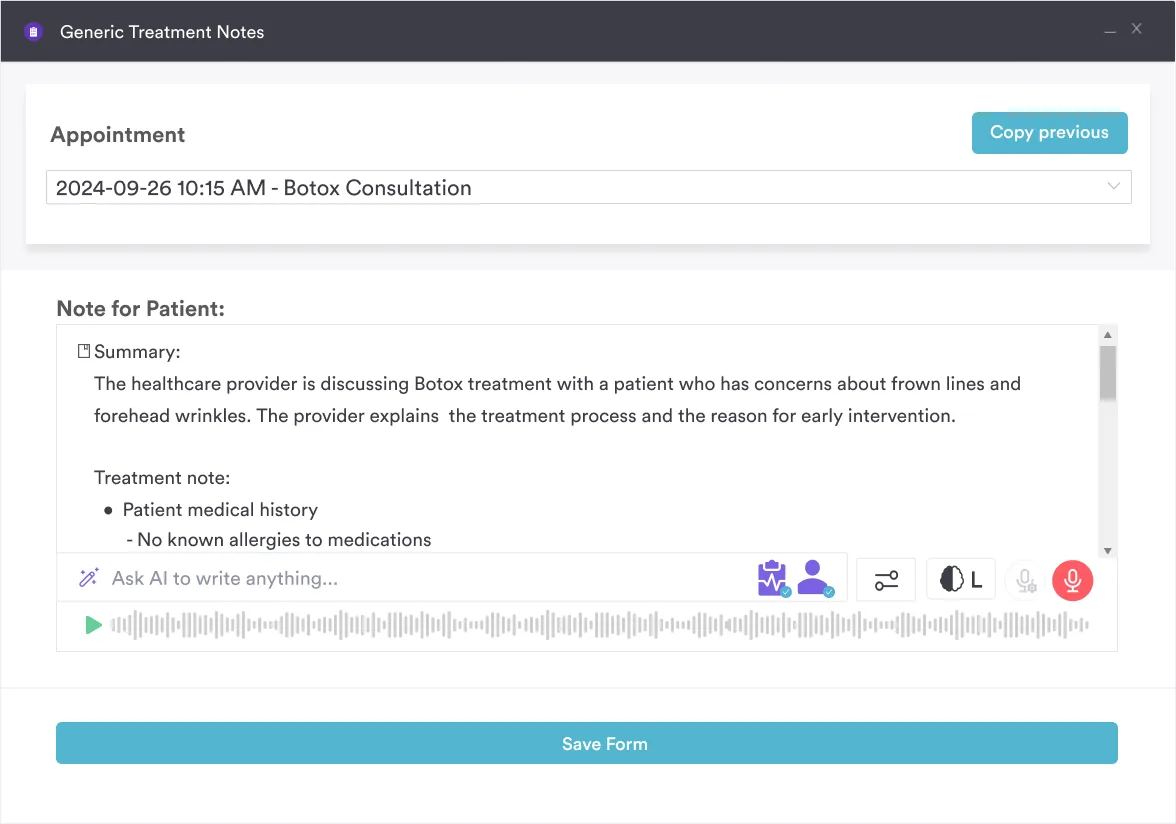
Pabau Scribe, our AI scribe, drafts SOAP note content from your dictated findings. That cuts the time you spend writing up assessments after clinic. For note structure, the safer clinical notes guide covers frameworks that suit musculoskeletal presentations.
Practices running sports medicine software or a physical therapy EMR gain most from this kind of standard workflow. It matters most when several clinicians share a caseload and every note has to read the same way.

Pabau lets physical therapy and sports medicine practices document special test findings and track shoulder assessment outcomes in one client record. Follow-up workflows run automatically, with no separate systems and no paper trails.

Neer’s test still earns its place in a shoulder examination, moderate specificity and all. Its value is in the cluster rather than in isolation. Pair it with Hawkins-Kennedy and the painful arc, and your post-test probability of impingement climbs meaningfully.
Apply consistent technique, stabilize the scapula every time, and be clear about what a positive result does and does not confirm. Then record the finding somewhere you can retrieve, compare, and audit it later.
That last step decides whether the finding is still useful in three months. Book a demo to see how Pabau keeps shoulder assessment findings in one client record, from first test to discharge.

Choosing software for your practice? Best physical therapy software compares the top platforms and shows how the wrong choice creates documentation gaps and billing headaches.
Managing rehabilitation timelines after the assessment? Return-to-running protocol walks through the progressive loading stages of musculoskeletal recovery.
Opening or scaling a physical therapy practice? Opening a physiotherapy clinic covers the operational and compliance decisions involved.
Recording shoulder movement alongside your special tests? Range of motion assessment explains how to measure and document joint movement consistently.
Tracking whether the shoulder plan is working? Functional status questionnaire gives you a patient-reported outcome measure to repeat at follow-up.
Neer’s test is a passive shoulder maneuver that screens for subacromial impingement syndrome. That condition involves compression of the supraspinatus tendon and subacromial bursa beneath the acromion. Use it when a patient presents with anterior or lateral shoulder pain, particularly with overhead activity or arm elevation.
A positive Neer’s test means passive forward flexion with the arm internally rotated reproduces the patient’s familiar shoulder pain. This suggests subacromial impingement may be present, but it does not confirm a structural diagnosis. Further testing, including Hawkins-Kennedy, the painful arc, and imaging, clarifies the underlying pathology.
Neer’s sign refers to the physical finding of pain reproduced during passive forward flexion with internal rotation. Neer’s test, in its original strict definition, refers to an injection confirmation procedure where the examiner injects subacromial lidocaine and repeats the maneuver. If the injection abolishes the pain, clinicians consider the result positive for subacromial impingement. In everyday clinical use, clinicians often use the two terms interchangeably to mean the physical maneuver.
No. Neer’s test cannot differentiate impingement from a rotator cuff tear. A positive result indicates pain consistent with subacromial compression but does not identify whether a tendon is structurally intact or torn. The drop arm test and empty can test are more specific for rotator cuff integrity. Confirming a tear requires MRI or diagnostic ultrasound.