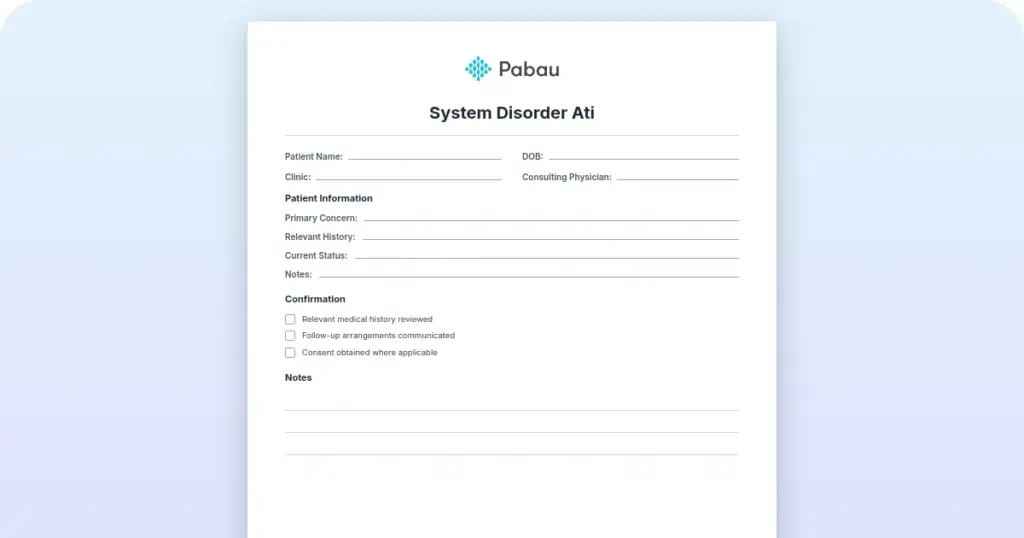
Nursing narrative note template
A nursing narrative note template is a structured PDF that guides you through re...

3
Last Updated: Oct 21, 2026

The Pittsburgh Knee Rules tell you whether a patient with acute knee trauma needs an X-ray.
A positive result needs a fall or blunt blow, plus either an age under 12 or over 50, or inability to take four weight-bearing steps.
The mechanism criterion is mandatory, so knee pain that starts without a fall or a blow sits outside the rule.
The Pittsburgh Knee Rules are more specific than the Ottawa Knee Rules, so they send fewer patients for imaging without missing more fractures.
Pabau’s structured clinical records capture the mechanism, the walk test result, and your reasoning, so the imaging decision stays auditable.
A point-of-care reference card covering patient details, the mandatory mechanism screen, and the age and walk test qualifiers. It also walks through how to administer the walk test, how to read the result, and where to record your clinical reasoning.
Download templateThe Pittsburgh Knee Rules tell you whether an acutely injured knee needs an X-ray. Imaging is indicated when the patient fell or took a blunt blow to the knee. On top of that, the patient must be under 12 or over 50, or unable to take four weight-bearing steps.
Emergency clinicians, physical therapists, and sports medicine providers make that call every day. This guide covers the criteria, the walk test, and how the rule compares with the Ottawa Knee Rules. The free template above turns all of it into one bedside reference card.
The Pittsburgh Knee Rules are a validated clinical decision tool that tells you when a knee X-ray is warranted after acute injury. The rule screens the mechanism first, then asks whether the patient is at either extreme of age or unable to bear weight. That structure identifies patients at risk of fracture while sparing everyone else the imaging.
The rule was developed and validated in emergency departments, where unnecessary imaging adds cost, radiation exposure, and delay. Seaberg and Jackson established its diagnostic accuracy in the American Journal of Emergency Medicine in 1994. Later multicenter work replicated the finding and tested the rule against the Ottawa Knee Rules.
Any practice that keeps structured clinical records can build the rule into the encounter. The same questions then get asked and recorded every time.

A positive result, meaning an X-ray is indicated, needs the mechanism criterion plus at least one of the two qualifiers below. It does not need all three.
Read it as mechanism AND (age OR walk test). A 34-year-old who fell down the stairs and cannot take four weight-bearing steps is positive, even though the age criterion is nowhere near met. A 68-year-old who was hit on the knee by a car door is positive on age alone, even if she walks in unaided.
The result is negative in two situations. Either the mechanism criterion is absent, or the mechanism is met and neither qualifier applies. A negative result means imaging is not indicated by this rule alone. Your clinical judgment remains the final arbiter, because the rule is a decision aid rather than a replacement for assessment.
The walk test is the most practical part of the rule, and it only holds up if you run it properly. Here is the point-of-care protocol.
Administering it loosely invalidates the result. Allowing partial weight-bearing, offering an arm, or accepting the patient’s own report without watching all break the rule. Clinical assessment documentation should capture the observed result and the context around it. A note such as “patient declined weight-bearing due to severe pain” tells the next clinician what happened.
Interpreting the result comes down to one question after the mechanism screen: does either qualifier apply?
Digital assessment forms that encode this logic let clinicians record each criterion as they assess, then flag the result automatically. That removes the mental arithmetic and leaves a consistent record behind. When the film confirms a distal femur fracture such as S72.455S, the diagnosis attaches to the same encounter.

The rule’s value lies in what it rules out. A 1998 multicenter comparison in Annals of Emergency Medicine applied both rules to the same patients and reported the figures below.
In that cohort, applying the Pittsburgh Knee Rules could have cut radiography by 52% at the cost of one missed fracture. The trade-off is worth stating plainly. Both rules catch almost every fracture, but the Pittsburgh rule sends far fewer negative patients to X-ray.
Both rules are evidence-based, and they differ mainly in how much imaging they tolerate. Sports medicine clinicians tend to pick one based on their patient mix and their risk tolerance.
The Pittsburgh Knee Rules suit lower-suspicion patients, non-emergency settings such as sports medicine and occupational health practices, and any team trying to reduce imaging. Higher specificity means fewer X-rays, which saves cost and radiation exposure.
The Ottawa Knee Rules suit high-acuity departments and trauma centers, where the priority is catching every fracture. They use five criteria, including tenderness at the patella or fibular head and an inability to flex the knee to 90 degrees.
One practical difference decides it for many teams. The Pittsburgh rule needs a trauma mechanism, so it does not apply to atraumatic knee pain at all. Pick the rule that matches your setting’s risk profile, and apply it consistently rather than switching case by case.
Even a validated tool has boundaries. These are the ones that change management most often.
A decision rule is only as defensible as the note behind it. In most practices, the mechanism, the walk test, and the reasoning end up in free text, phrased differently by every clinician. When a complaint or an audit arrives months later, nobody can show that the rule was applied correctly.
Practice management software like Pabau handles this with structured digital forms attached to the appointment. You capture mechanism, age, walk test result, and interpretation as discrete fields. Every knee assessment in the practice then reads the same way, and any of them can be pulled up in seconds.
Pabau Scribe, our AI scribe, drafts the narrative note from the consultation while you stay with the patient. It writes into the same chart as the structured fields, so the assessment and your SOAP progress notes sit together. Follow-up reminders then keep the patient moving through review or imaging without manual chasing.

Pabau’s digital forms and clinical records capture the mechanism, the walk test result, and your reasoning in the patient’s chart. Your knee assessments stay consistent, auditable, and easy to find.

The Pittsburgh Knee Rules are easy to apply once the logic is clear. Screen the mechanism first. If there was a fall or a blunt blow, ask two more things. Is the patient outside the 12 to 50 age band, or unable to take four weight-bearing steps? Either one sends the knee for imaging.
The gain is fewer X-rays with almost no loss of sensitivity, and the cost is discipline. The walk test has to be observed rather than reported, and the rule has to be left alone when there was no trauma. Print the template, keep it where the assessment happens, and record the result the same way every time.
Book a demo to see how Pabau turns clinical decision rules into structured fields your team fills in once and can defend later.

Need another bedside knee measure? Knee to wall test walks through how to perform, measure, and interpret the test.
Assessing the ankle as well? Ottawa Ankle Rules calculator applies the same imaging logic to foot and ankle trauma.
Testing hamstring flexibility in your practice? 90-90 hamstring test template provides equipment, single-leg test instructions, and a binary outcome section for standardized results.
Managing an Achilles tendon rupture? Achilles tendon rupture guidelines handout covers rehab phases, weight-bearing progression, exercise protocols, and return-to-sport criteria.
Choosing software for a therapy practice? Best physical therapy EMR software compares the platforms clinicians actually document in.
The rule has one mandatory criterion and two qualifiers. The mechanism must be a fall from any height or a blunt blow to the knee. Then either the patient is younger than 12 or older than 50, or the patient cannot walk four weight-bearing steps. One qualifier is enough for a positive result.
Use the Pittsburgh Knee Rules in lower-suspicion cases and non-emergency settings where reducing unnecessary imaging matters. They are far more specific, so they produce fewer false positives. Use the Ottawa Knee Rules in high-acuity departments where catching every fracture outweighs the extra X-rays.
A 1998 multicenter comparison reported 99% sensitivity and 60% specificity for the Pittsburgh Knee Rules. The Ottawa Knee Rules scored 97% and 27% in the same patients. In that cohort, the Pittsburgh rule could have reduced radiography by 52% with one missed fracture.
Yes. Age under 12 is one of the two qualifiers, so a child under 12 with a fall or blunt trauma meets the rule. A child of 12 or older can still be positive through the walk test, since only one qualifier is needed. Clinical judgment should still guide imaging in pediatric trauma.
Yes. The template at the top of this article covers the criteria, walk test instructions, result interpretation, and space for your documentation. It is a free PDF, ready to print or use on screen.
The rule applies when the injury came from a fall from any height or a direct blunt blow to the knee. This criterion is mandatory. Spontaneous knee pain with no documented trauma sits outside the rule entirely.