Pabau Engage inbox

Pabau Engage is here: every patient conversation in one inbox.

Learn more
Book a demo Book a demo
☰
Musculoskeletal & Pain Management

PT SOAP note

Avatar photo Maja Popovska
Last Updated: September 29, 2026

A PT SOAP note is the four-part format physical therapists use to document a visit: Subjective, Objective, Assessment and Plan. Each section answers one question. What does the patient report, what did you measure, what do the findings mean, and what happens next?

Written well, the note shows a payer that therapy is skilled, measurable and working, which is what Medicare looks for at review. This guide walks through each section, shows a completed note from a post-op ACL case, and includes a free template you can adapt.

Found our content helpful?

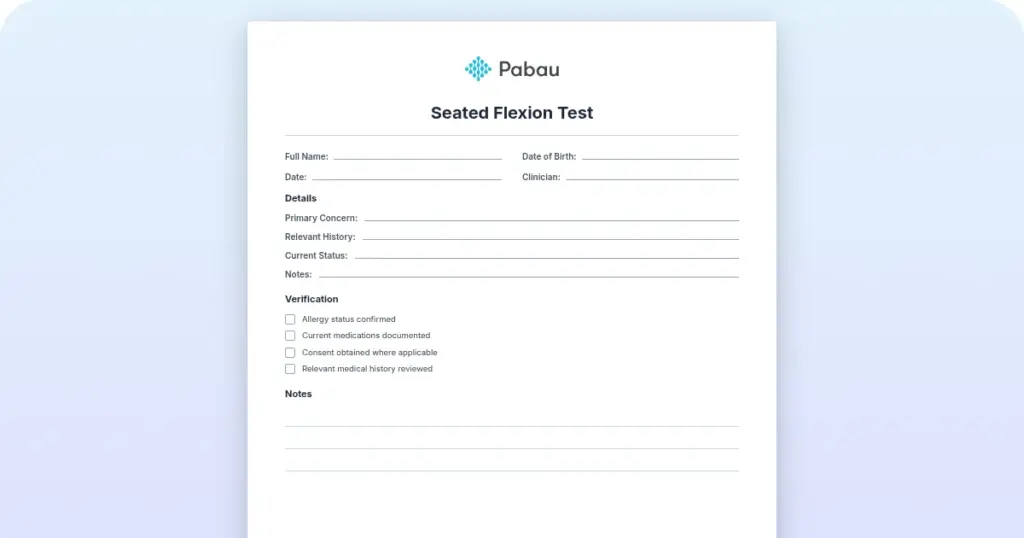
Download your free PT SOAP note template

A ready-made structure for movement assessment and rehabilitation, covering baseline range of motion and strength through return-to-activity criteria. Download the PDF and adapt the fields to your own practice. It keeps documentation complete, comparable and easy to evidence at review.

Download template
Key takeaways

Key takeaways

A PT SOAP note splits every visit into four parts: What the patient reports, what you measure, what it means, and what comes next.

The Subjective section records the chief complaint, pain rating, injury history and functional limits in the patient’s own terms.

The Objective section holds numbers you can compare at the next visit, such as ROM in degrees, MMT grades and functional test times.

The Assessment ties those findings to function and explains why skilled therapy is still needed, which is what Medicare reviewers look for.

The Plan sets interventions, frequency, and short- and long-term goals that are specific and dated, so progress can be measured.

What is a PT SOAP note?

A PT SOAP note splits a physical therapy visit into four sections: Subjective (S), Objective (O), Assessment (A) and Plan (P). Because every note follows the same order, you can find a finding fast at a follow-up visit, an insurance audit or a legal review.

The SOAP structure has been used in healthcare since the 1960s, and it remains the most widely recognized format in allied health. It mirrors the clinical process. You listen to the patient’s story, measure and observe, interpret the findings, and plan the next step.

Practice management software like Pabau turns the format into a digital form, so the same four headings appear at every visit. That consistency matters when a payer reviews a run of notes for functional progress.
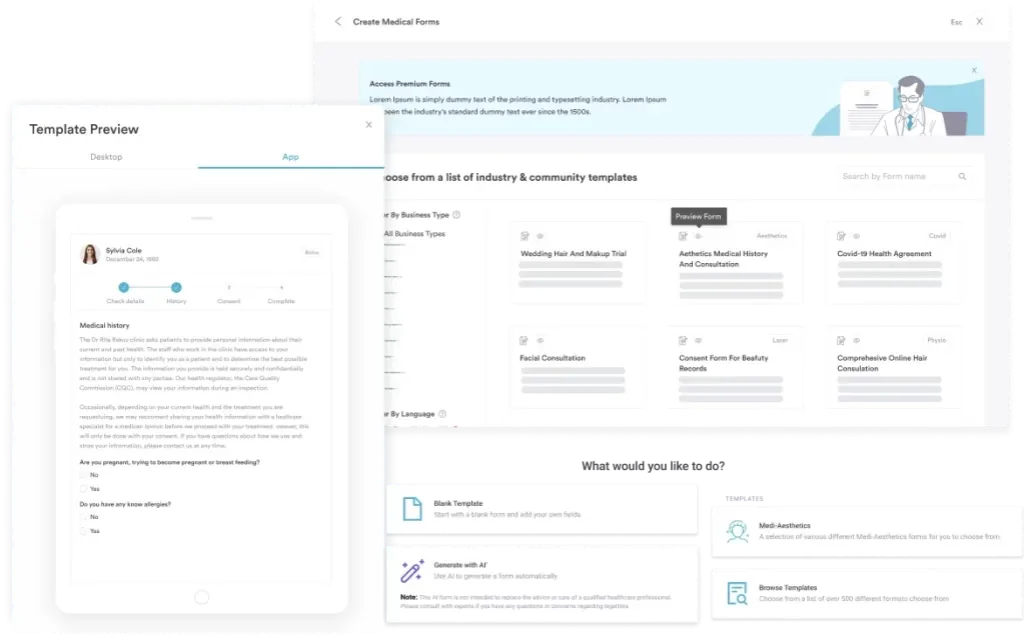
Digital forms
Setting up the SOAP note as a Pabau digital form gives every clinician the same four sections, so notes stay comparable from visit to visit.

The four sections at a glance

Each section of a SOAP note answers a different question about the visit.

  • Subjective (S): What the patient reports, including chief complaint, pain level, how the injury occurred, functional limitations, medical history and goals.
  • Objective (O): Measurable clinical findings, such as range of motion (ROM), strength testing, gait observations, vital signs, muscle tone and special tests.
  • Assessment (A): Your clinical reasoning. It covers how you interpret the findings, the response to treatment, progress toward goals and changes in functional status.
  • Plan (P): What happens next. That means therapy frequency and duration, short- and long-term functional goals, the home exercise program and an estimated return-to-activity timeline.

The grid below lays the four sections side by side with what a payer checks each one for. It then fills them in for the ACL case used later in this guide.
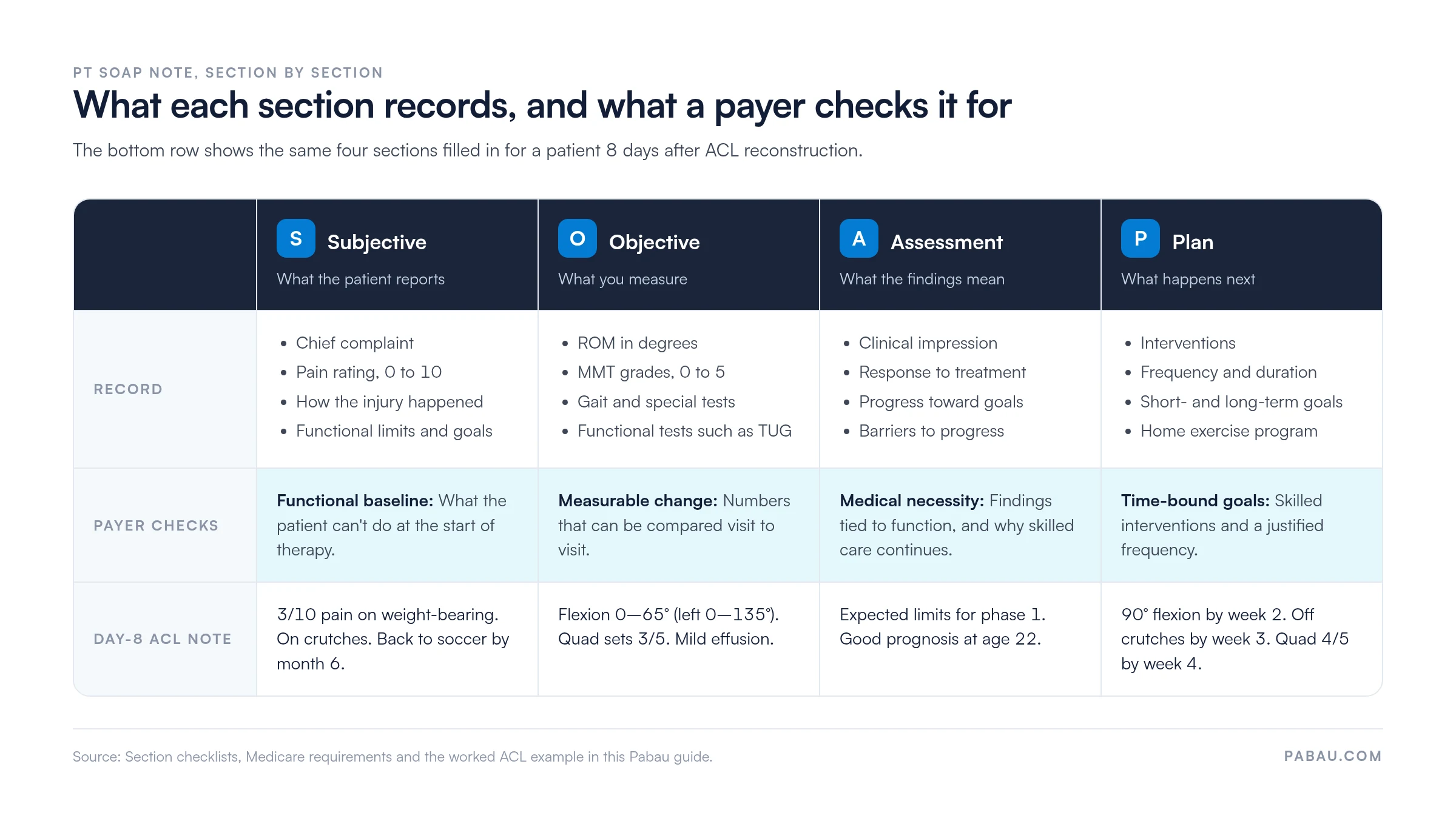
PT SOAP note grid: Subjective records chief complaint, 0 to 10 pain rating and functional limits; Objective records ROM in degrees and MMT grades 0 to 5; Assessment records response to treatment and progress; Plan records interventions, frequency, goals and home exercises. Payers check functional baseline, measurable change, medical necessity and time-bound goals. Day-8 ACL example: 3/10 pain, flexion 0 to 65 degrees, quad sets 3/5, goal of 90 degrees flexion by week 2.
Each SOAP section has its own job at review, from the functional baseline in Subjective to dated goals in the Plan. Figures come from this guide’s day-8 ACL example.

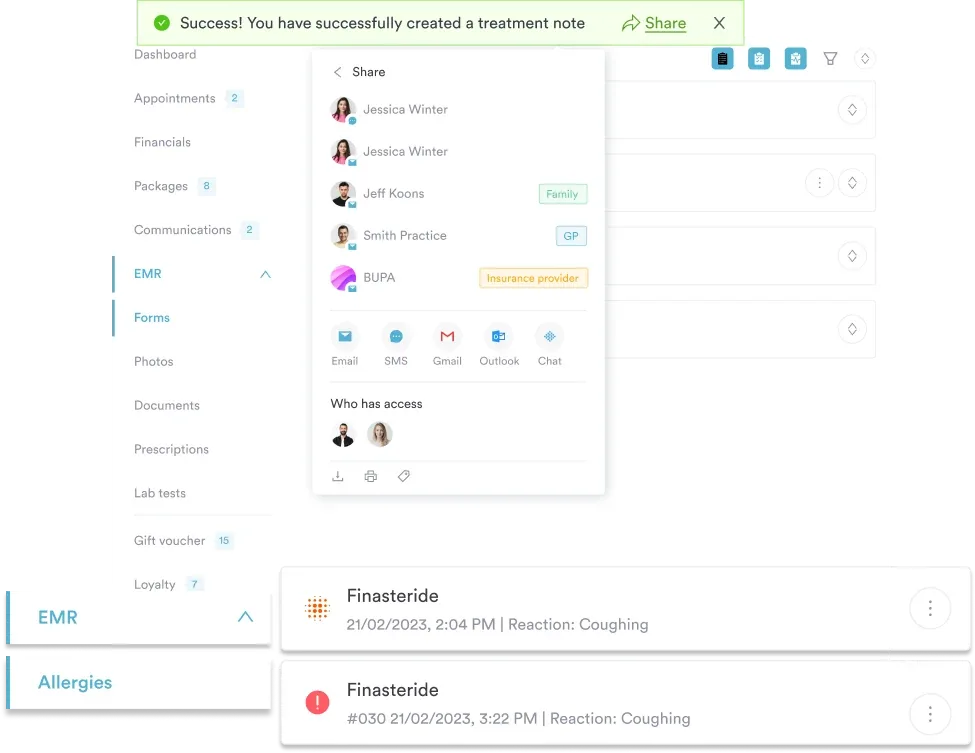
Keeping each note in the patient record, rather than in a paper file, puts the baseline next to today’s figures when you write the Assessment.
Comprehensive EMR & patient record management
Pabau’s Client records keep every SOAP note on the patient’s file, so you can compare today’s ROM with the baseline before you write the Assessment.

Subjective section: Capturing the patient’s story

The Subjective section documents what the patient tells you. It captures the context and the patient’s own experience of their condition.

  • Chief complaint: The primary reason for the visit (e.g., “right knee pain after ACL reconstruction”).
  • Pain rating: A numeric pain scale (0–10) or verbal descriptor at the time of assessment.
  • History of present illness: How the injury happened, when it occurred, and what makes it better or worse.
  • Functional limitations: What activities the patient cannot do or must modify (stairs, running, sitting, sleeping).
  • Medical history: Relevant past injuries, surgeries, comorbidities, medications and allergies.
  • Goals: Short-term (next two to four weeks) and long-term (return to sport, work or independent living) objectives.

Adherence to the home program belongs here too, recorded as what the patient says they did between sessions.

Objective section: Measurable clinical findings

The Objective section documents what you observe and measure during the visit. These data points are the basis of your clinical reasoning.

  • Range of motion (ROM): Active and passive ROM measurements, in degrees, for each relevant joint. Note any restrictions or asymmetry.
  • Strength testing: Manual muscle testing (MMT) grades (e.g., 4/5 quadriceps) or dynamometer readings if available.
  • Gait analysis: Observations of walking pattern, such as stride length, weight-bearing asymmetry and compensatory movements.
  • Vital signs: Blood pressure, heart rate and respiratory rate if relevant to the presentation.
  • Special tests: Lachman test, McMurray test, Ober test, or other orthopedic and neurological tests specific to the condition.
  • Palpation findings: Swelling, warmth, tenderness, muscle tone and trigger points.
  • Functional tests: Timed up and go (TUG), the 6-minute walk test, single-leg stance, or task-specific assessments.

Record strength as a 0–5 grade, using the method set out in our guide to manual muscle testing. Repeating the same tests at each visit gives you figures a reviewer can compare.

Assessment section: Clinical reasoning and diagnosis

The Assessment section turns the Subjective and Objective data into clinical meaning. It records your interpretation of what the findings say about the patient’s condition.

  • Clinical impression: A brief summary of the patient’s primary problem and how it relates to their functional limitations. For example, “Limited right knee extension and quadriceps weakness after ACL reconstruction, limiting stair negotiation and return to running.”
  • Response to treatment: How the patient has changed since the last session (e.g., “Pain decreased 2 points; knee flexion improved 15 degrees”).
  • Progress toward goals: Whether the patient is on track, progressing faster than expected, or plateauing.
  • Barriers to progress: Factors limiting improvement, such as poor home program adherence, medical complications or psychosocial factors.
  • Functional status changes: Improvements in activities of daily living, work, or sport-specific function.

Medicare and most payers expect the Assessment to link functional limitations to the need for continued therapy. It is one of several physical therapy compliance rules your notes need to meet. A purely anatomical description won’t satisfy it.

Plan section: Next steps and treatment goals

The Plan section sets out what comes next for the patient. It documents your therapeutic approach, visit frequency and measurable goals.

  • Upcoming interventions: Specific treatment techniques (manual therapy, therapeutic exercise, modalities) you will use in the next one to two weeks.
  • Frequency and duration: How many times per week the patient will attend, and for how long (e.g., “3x/week for 6 weeks”).
  • Short-term functional goals (two to four weeks): Specific, measurable outcomes (e.g., “Achieve 90 degrees active knee flexion”, “Pain <4/10 with stairs”).
  • Long-term functional goals (six to 12 weeks): Return-to-activity outcomes (e.g., “Return to running 3 miles without pain or effusion”).
  • Home exercise program (HEP): Exercises the patient does between sessions. Specify each exercise, its frequency, sets and reps.
  • Patient education: Activity modification, load management, pain science concepts or lifestyle advice.
  • Estimated return to work or sport: A realistic timeline, if relevant.

Clear functional goals tell the patient what to expect and hold clinician and patient accountable for progress. A written home exercise program turns the HEP line in your Plan into something the patient can follow at home.

Completed example: ACL reconstruction, day 8 post-op

Here is a completed PT SOAP note for a patient in the early stage of rehabilitation after ACL reconstruction.

Section Sample content
Subjective Patient reports 3/10 right knee pain during weight-bearing activities. 8 days post-op ACLR. Chief complaint: Unable to walk without crutches, wants to return to soccer in 6 months. Reports no pain at night. Denies giving way. Goals: Wean off crutches in 2 weeks, walk without limp in 6 weeks, return to soccer by month 6.
Objective Right knee effusion present (mild). ROM: 0-65 degrees flexion (L: 0-135), 0 degrees extension. Quad sets: 3/5. Pain at end-range flexion. Palpation: Incision line intact, no erythema. Gait: Non-weight-bearing on right, using bilateral crutches. Lachman test: Unable to test due to guarding and pain.
Assessment Patient is 8 days post-op ACL reconstruction with expected limitations in ROM, strength, and weight-bearing tolerance. Current functional status appropriate for phase 1 rehabilitation. Prognosis for return to soccer is good given patient’s age (22), motivation, and absence of complications to date.
Plan Continue phase 1 ACL rehab protocol: Quad sets, glute sets, supine hamstring flexion, short-arc quads, knee flexion active-assisted range (-60 degrees). Progress weight-bearing as tolerated with crutch support. Home exercise program 2x daily. Recheck ROM in 2 days. Goals: Achieve 90 degrees flexion by week 2, quad strength 4/5 by week 4, walk without crutches by week 3.

Writing a note this detailed after every visit takes time. Automated clinical documentation tools can draft it from the session while keeping the four-section structure intact.
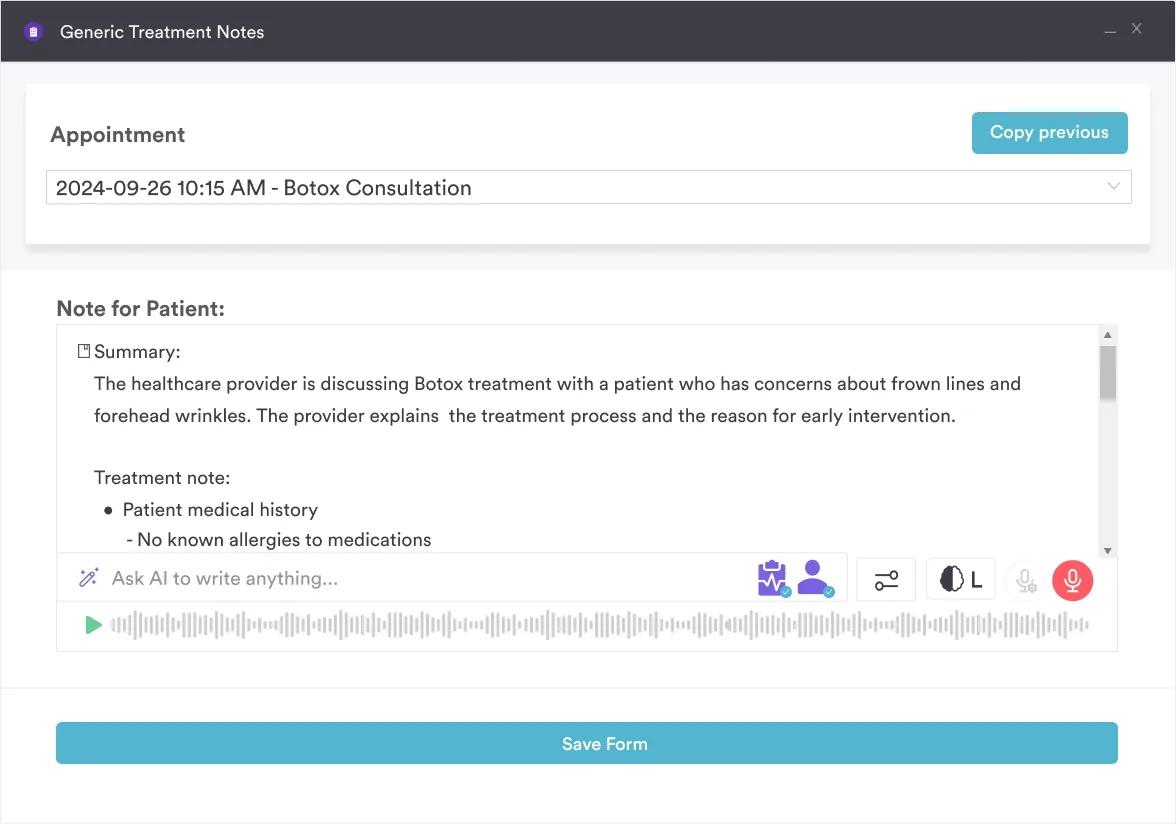
Creating treatment notes with Pabau Scribe
Pabau Scribe, our AI scribe, drafts the treatment note from the session, so you review and sign it instead of typing it from memory.

Common PT SOAP note mistakes to avoid

A poorly written SOAP note creates audit risk and makes patient progress hard to track. Watch for these errors.

  • Vague language in Subjective: “Patient reports feeling better” gives the next clinician no usable detail. Record specific pain ratings, functional changes, and measurable improvements or setbacks.
  • Missing measurements in Objective: “ROM improved” is not objective. Always use degrees, numeric grades (MMT 4/5), distances or times. Vague findings here cost you at audit.
  • No functional connection in Assessment: Avoid purely anatomical interpretation (“anterior deltoid strain”). Link each finding to a functional limitation (“limiting the overhead reaching an electrician needs for work”).
  • Absent or unmeasurable goals in Plan: “Improve strength” is not a goal. Use “Achieve 5/5 quadriceps strength” or “Walk 1 mile without pain.”
  • Unclear home program: Never write “Do quad sets for pain relief.” Write “Quad sets: 3 sets of 10 reps, 2x daily, hold 3 seconds each rep.”
  • Medicare non-compliance: Medicare requires the Assessment and Plan to link clinical findings to the functional limitations that justify continued physical therapy. A note that documents anatomy without functional loss risks denial.

An audit-ready physical therapy EMR flags incomplete sections before the note is signed, which cuts documentation errors and audit exposure.

Medicare and payer documentation requirements

Medicare and most insurance payers require physical therapy documentation to support medical necessity and functional outcomes. Your SOAP note is the evidence that therapy is justified and working.

  • Functional baseline: The Subjective and Objective sections must establish what the patient cannot do at the start of therapy, tied to the condition being treated.
  • Measurable progress: The Assessment must show objective change from one session to the next. ROM, pain, strength or functional capacity should move. Payers deny care when notes show no progress.
  • Specific, time-bound goals: The Plan must include short-term goals achievable within two to four weeks. Add long-term goals that project a return to function or independence. Vague goals like “improve mobility” won’t support medical necessity.
  • Skilled intervention: Your Plan must document skilled physical therapy techniques, not just general exercise or advice. Skilled therapy is what justifies payment.
  • Frequency justification: If you recommend 3x per week, your Assessment and Plan must explain why that frequency is needed. For example, “3x/week needed to progress safely through phase 2 ACL protocol; 1x/week insufficient to prevent deconditioning.”

Auditors read a patient’s notes as a series. When the objective measures stay flat across that series, expect a medical-necessity denial review.

How Pabau keeps SOAP notes complete and audit-ready

Many physical therapy practices still write SOAP notes on paper or in a blank Word document. The clinician retypes the same headings every visit, measurements end up in free text, and missing goals only surface when an auditor asks.

Pabau gives you a SOAP note template built as a digital form, with the four sections and their fields laid out for every visit. Required fields stop a note from being signed without Objective measurements or dated goals. Each signed note is timestamped against the clinician who wrote it.

Pabau Scribe, our AI scribe, drafts the note from the session, so you review and sign instead of typing from memory. The note sits in the same patient record as appointments and invoices. ROM trends and goal progress are then in one place at the progress review.

Write complete PT SOAP notes in less time

Pabau builds your SOAP template into a digital form, drafts notes with Pabau Scribe, and keeps every signed note in the patient record. Your documentation stays consistent and ready for payer review.

Pabau clinic management dashboard

Conclusion

The template is the easy part. What protects a claim is the habit of writing numbers instead of adjectives, and tying each finding to something the patient can’t yet do.

Start with your next new evaluation. Fill in the downloaded template, then check the note against the payer row in the grid above before you sign. If the Assessment doesn’t explain why skilled care is still needed, rewrite it before the patient leaves.

The trade-off is a few extra minutes per note in the first weeks, which costs far less than defending a denied claim with vague notes. Book a demo to see how Pabau keeps your physical therapy notes complete, signed and ready for review.

Continue your research

Continue your research

Opening a new PT practice? Opening a physiotherapy clinic checklist covers staffing, compliance and systems setup for new PT practices.

Need the first-visit paperwork too? Physical therapy intake form collects the history you’ll need for the Subjective section.

Documenting chiropractic visits as well? SOAP notes for chiropractic adapts the same four-section structure to spinal care.

Looking for a quick functional test? Timed up and go test explains how to run and score TUG for your Objective section.

Frequently asked questions

What is a PT SOAP note?

A PT SOAP note is a structured documentation format with four sections. Subjective covers what the patient reports, Objective what you measure, Assessment your clinical interpretation, and Plan the next interventions and goals. It is the standard format in physical therapy and allied health documentation.

What goes in the Subjective section?

The Subjective section documents the patient’s chief complaint, pain level (numeric or verbal) and how the injury happened. It also covers functional limitations, relevant medical history, and short- and long-term goals. It records what the patient tells you rather than what you observe.

What is the difference between a SOAP note and a progress note?

SOAP describes how a note is organized, while a progress note is defined by when it is written. An initial evaluation, a daily note and a progress note can all follow the SOAP structure. A progress note focuses on changes since the last review and adjustments to the plan.

How would you document knee pain in SOAP format?

Subjective: Patient reports 5/10 right knee pain with stairs and can’t climb more than two flights. Objective: Knee flexion 110 degrees (limited by pain), quad strength 4/5, knee effusion present. Assessment: Mild knee effusion and quadriceps weakness limiting stair negotiation post-injury. Plan: Quad strengthening, ROM exercises and a return to stairs in two weeks.

Do physical therapists use SOAP notes for Medicare documentation?

Yes, and the format fits Medicare’s rules well. Medicare doesn’t require the SOAP format by name. It does expect notes to establish a functional baseline, document objective progress and justify continued skilled therapy. A SOAP note covers all three when it includes specific measurements and functional goals.

How long should a physical therapy SOAP note be?

Initial evaluation SOAP notes typically run 400 to 800 words, depending on the complexity of the case. Progress notes are shorter, at 200 to 400 words. Length should follow the clinical detail needed. Specific, measurable detail matters more than word count.
Found our content helpful?
×