Health appraisal form
A health appraisal form is a record a licensed provider signs to document someon...

2
Last Updated: Oct 13, 2026

Software covered: 1. Pabau, 2. athenahealth, 3. eClinicalWorks, 4. NextGen Healthcare, 5. Carepatron, 6. Epic Systems, 7. Veradigm (Allscripts)
ModMed (Modernizing Medicine) is a specialty EHR built for dermatology, ophthalmology, and gastroenterology in the US, with custom-quoted pricing suited to mid-to-large group practices
Most ModMed competitors fall short on aesthetics and private-pay workflows; insurance-heavy billing and US payer connectivity vary widely across platforms
Pabau is the strongest alternative for aesthetic, medspa, and multi-specialty clinics running private-pay models, with transparent subscription pricing from $65/month
ModMed (Modernizing Medicine) dominates specialty EHR for dermatologists, ophthalmologists, and gastroenterologists in the US. It earned the top Black Book ranking for integrated practice management, RCM, and EHR in surgical specialties for four consecutive years through 2022.
Both EMA and gGastro also outperformed 239+ competitors in the January 2026 Black Book Physician Practice and Ambulatory Solutions survey. That reputation comes at a cost: Custom pricing, intensive onboarding, and a narrow specialty focus mean alternatives are worth evaluating seriously, particularly for practices outside its core US-payer billing model or outside its supported specialties.
This guide covers seven ModMed competitors and Modernizing Medicine alternatives in depth: Pabau, athenahealth, eClinicalWorks, NextGen Healthcare, Carepatron, Epic Systems, and Veradigm. Each platform is assessed on features, pricing, user reviews, and who it suits. You can also compare practice management platforms side by side on Pabau’s comparison hub.
Pabau is an all-in-one clinic management platform built for aesthetic clinics, medspas, dermatology practices, and multi-specialty clinics running private-pay or hybrid billing models.
ModMed EHR is engineered around US insurance billing and specialty certification. Pabau, by contrast, is designed for the operational reality of clinics that sell treatments directly to patients, manage high appointment volumes, and need consumer-facing booking tools alongside clinical documentation.
That difference shows up immediately in workflow. Pabau’s drag-and-drop calendar handles multi-room and multi-practitioner scheduling with built-in deposit capture and online booking. In addition, its clinical documentation layer includes treatment-specific templates for injectables, laser procedures, IV therapy, and other aesthetic treatments, with injection plotting and before-and-after photo management built in.
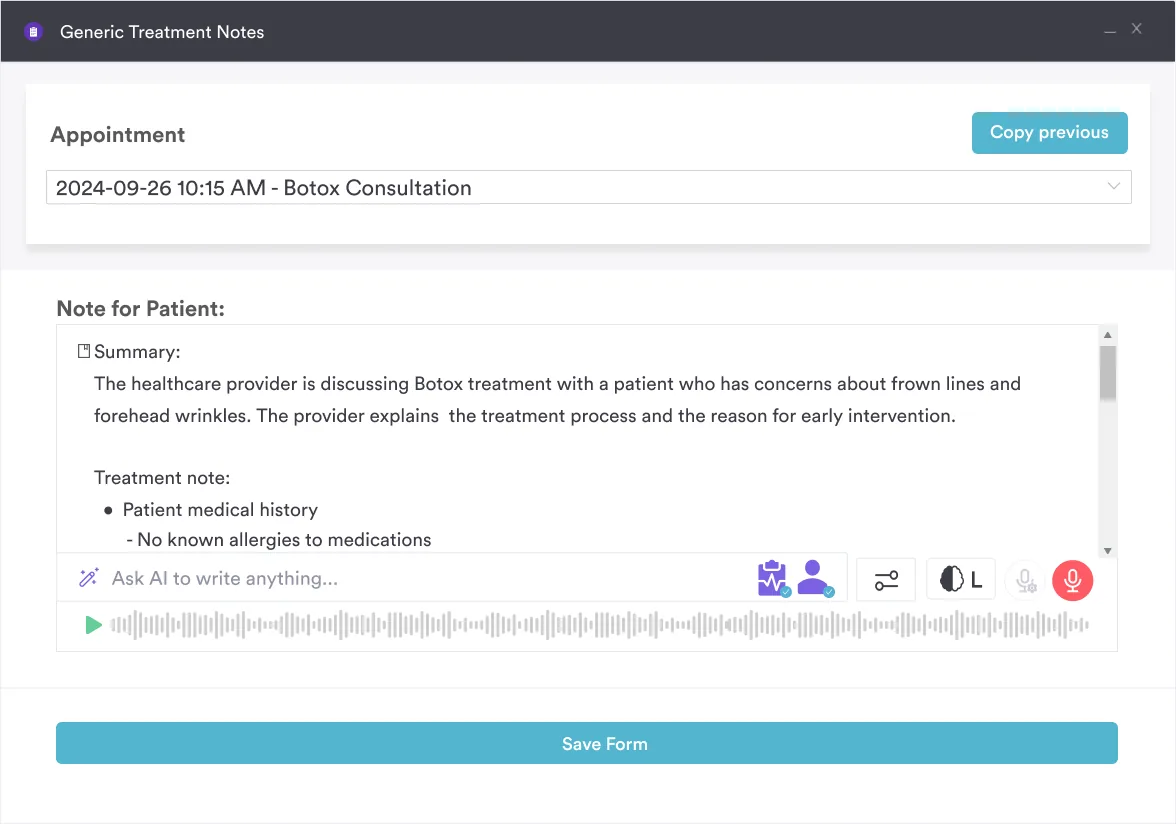
Moreover, its AI medical scribe, Pabau Scribe, generates clinical notes from consultations automatically, cutting documentation time for busy practitioners.
| Plan / Tier | Price | Details |
|---|---|---|
| Starter | From $65/month | Per practitioner; billed monthly |
| Team / Group | Scales by location and user count | Volume-based pricing |
| Enterprise | Custom pricing | Contact sales for a quote |
According to Capterra reviewers, Pabau earns 4.7 out of 5 from 600+ verified reviews. Users consistently highlight the comprehensive aesthetic clinic toolset, the automation features that reduce admin time, and the quality of the scheduling and client management system. Some reviewers note an initial learning curve when configuring workflows for the first time.

Book a 30-minute demo to see Pabau’s aesthetic and multi-specialty workflows, private-pay billing, and AI clinical documentation in action.

athenahealth (acquired by Bain Capital and Hellman & Friedman in 2022 for $17 billion) is one of the largest ambulatory EHR and practice management platforms in the US. Notably, its core strength is payer network connectivity: Athenahealth’s clearinghouse handles claims across thousands of US payers and tracks denials, underpayments, and authorization requirements at scale.
According to third-party market intelligence from 6sense, athenahealth holds approximately 16.48% of the US EHR market by technology adoption, making it one of the most widely deployed EHRs in ambulatory care. As a result, its cloud-based platform suits multi-specialty groups that need centralized billing across multiple providers and locations.
athenahealth earns 3.8 out of 5 on Capterra. Reviewers in specialty practices value its payer connectivity and claims tracking; common criticisms focus on implementation complexity, dated UI, and customer support inconsistency.
eClinicalWorks (eCW) is one of the most widely deployed EHR platforms in the US, serving primary care, family medicine, and specialty practices. Indeed, its breadth is its main selling point: A single platform covering scheduling, EHR documentation, billing, patient engagement, and telehealth.
According to third-party market data from 6sense, eClinicalWorks holds approximately 13.37% EHR market share, making it one of the most significant alternatives by volume of installed practices.
eCW suits mid-size practices that want a comprehensive feature set without paying enterprise prices. Moreover, its telehealth integration is embedded rather than bolted on, and its patient portal handles messaging, appointment requests, and visit summaries.
eClinicalWorks holds 3.3 out of 5 on Capterra. Positive feedback focuses on feature breadth and the value for larger practices; negative themes center on UI complexity, support response times, and the platform’s historical compliance issues.
NextGen Healthcare is a long-established EHR and practice management platform focused on ambulatory specialty and multi-specialty group practices. In particular, its differentiator is deep specialty customization: Practices can configure documentation templates, order sets, and workflow rules for specific specialties without the vendor’s involvement.
Furthermore, NextGen’s interoperability features are strong by ambulatory EHR standards, with FHIR-based integrations and patient access tools that meet ONC/CEHRT requirements for Promoting Interoperability and information blocking compliance under the 21st Century Cures Act.
NextGen Healthcare earns 3.6 out of 5 on Capterra. Specialty practices value the configurability and interoperability depth. Frequent criticisms include cumbersome reporting and high implementation complexity.
When evaluating ModMed competitors, separate your billing model from your clinical documentation needs. A practice with heavy insurance billing needs an ONC-certified EHR with clearinghouse connectivity. A private-pay aesthetic or wellness clinic needs consumer-facing booking, treatment templates, and private-pay invoicing instead. These are different product categories and the wrong choice costs both money and months of retraining.
Carepatron targets the opposite end of the market from ModMed. Where ModMed is an enterprise-oriented specialty EHR with complex onboarding, Carepatron is a lightweight, affordable practice management platform designed for solo practitioners, small clinics, and allied health professionals including physiotherapists, occupational therapists, counselors, and nutritionists.
Notably, its free tier makes it the only platform on this list with a genuine no-cost entry point, though the paid plans unlock the features that make it genuinely useful for growing practices.
Counselors and behavioral health teams often need a more specialized system. Software built around therapy-specific note formats and insurance billing suits them better, and our roundup of alternatives to TherapyNotes covers those options.
| Plan / Tier | Price | Details |
|---|---|---|
| Free | $0/month | Unlimited clients; telehealth; 1GB storage; AI scribe |
| Plus | $22/month per user | Save 50% for 6 months |
| Advanced | $27/month per user | Save 50% for 6 months |
| Custom/Enterprise | Contact sales | No specific price listed |
Carepatron earns 4.4 out of 5 on Capterra. Small practice owners and allied health professionals rate it highly for ease of use and affordability. Larger practices note that the platform’s feature depth does not scale well beyond a handful of practitioners.
Epic is the dominant EHR in large US hospital systems and academic medical centers. It is rarely a direct competitor to ModMed in independent specialist practices. Epic becomes relevant when a specialist group is acquired by or affiliated with a health system already running it, or when a large multi-specialty group needs the depth of clinical data integration that only Epic provides.
Epic’s MyChart patient portal, interoperability tools, and care coordination features are industry-leading at the enterprise level. Its implementation cost and complexity, however, make it entirely unsuitable for independent practices or clinics with fewer than several hundred providers.
Epic does not have a meaningful public Capterra or G2 review profile for ambulatory comparison purposes. Its reputation comes from enterprise IT and clinical leadership surveys, where it consistently ranks at the top for large health systems. G2 and Capterra ratings at the enterprise level are less meaningful given Epic’s sales and implementation model.
Veradigm, formerly known as Allscripts, rebranded in 2022 to reflect its expanded focus on physician network data and life sciences analytics alongside its EHR and practice management offering. Today, it remains a credible alternative in ambulatory care, particularly for practices that value integration with pharmaceutical research networks or population health programs.
Veradigm’s EHR capabilities are mature but less specialist-focused than ModMed or NextGen. Instead, its stronger differentiator is its physician network, which connects practices to life sciences companies and data analytics programs in ways that more specialist-oriented competitors do not.
Veradigm (Allscripts) does not have a current public Capterra review profile with a meaningful rating for this comparison period. Its reputation in the market is mixed, with some users citing improved analytics capabilities post-rebrand and others noting uncertainty about product roadmap.
Ultimately, the right alternative depends on your billing model, specialty mix, and whether you operate in a US insurance-heavy environment or a private-pay one. These five criteria cut through the noise.
Overall, ModMed (Modernizing Medicine) serves a specific and well-defined need: Deep specialty EHR for US-based dermatology, ophthalmology, and gastroenterology practices with complex insurance billing. The Modernizing Medicine competitors and alternatives in this guide each address a different slice of the market, from enterprise health systems (Epic) to allied health solo practitioners (Carepatron) to aesthetic and medspa operators running private-pay models.
For aesthetic clinics, medspas, and multi-specialty private practices that need consumer-facing booking, aesthetic treatment templates, private-pay billing, and multi-location management, Pabau is the strongest alternative.
Transparent subscription pricing from $65/month, a 4.7/5 rating from 600+ Capterra reviewers, and specialty workflows built for aesthetics and wellness make it the natural ModMed alternative for this segment. Explore the best medical spa software options or book a demo to see Pabau in action for your specific clinic type.

Comparing Acuity against fuller practice platforms? Acuity scheduling alternatives compares Acuity to broader systems covering patients, billing, and operations.
Wondering what Booksy really costs? Booksy pricing plans compares its plans, features, and hidden fees for salons and spas.
Looking for a DrChrono alternative? DrChrono alternatives for practices ranks options for private-pay and aesthetic clinics, plus other practice types.
The best ModMed alternatives depend on your specialty and billing model. For instance, athenahealth and NextGen Healthcare suit US insurance-billing specialist groups. Pabau is the strongest alternative for aesthetic, medspa, and multi-specialty private-pay clinics. Meanwhile, Carepatron suits very small or allied health practices. eClinicalWorks covers a broad mid-market across primary and specialty care.
ModMed is generally not suited to small independent practices. Its enterprise-oriented pricing model, intensive onboarding process, and US payer-focused billing architecture are designed for mid-to-large specialist group practices. Instead, small practices, including solo practitioners, typically find more value in Carepatron, Pabau, or eClinicalWorks depending on their specialty and billing model.
ModMed and athenahealth both target US specialist practices with integrated EHR and RCM, but they differ in focus. ModMed is specialty-specific, with purpose-built clinical modules for dermatology, ophthalmology, and gastroenterology. By comparison, athenahealth is broader across specialties, with its main strength in payer network depth and claims management. ModMed’s 2022 and 2026 Black Book rankings place it ahead of athenahealth in surgical specialty EHR, while athenahealth leads by market share volume at approximately 16.48% of the US EHR market, according to 6sense data.
For US insurance-billing dermatology practices, ModMed EMA is the benchmark, with NextGen Healthcare and eClinicalWorks as the most comparable full-EHR alternatives. However, for aesthetic dermatology or hybrid aesthetic/medical practices running significant private-pay volume, Pabau is the most relevant alternative, offering dermatology EMR software with aesthetic treatment templates, injection plotting, and before-and-after photo management.
If you’re deciding between ModMed or eClinicalWorks, the practical test is whether your documentation needs are narrow and specialty-specific or broad and multi-specialty. eClinicalWorks has broader specialty coverage and a lower entry price than ModMed, making it suitable for practices that need a generalist EHR across multiple specialties. In contrast, ModMed’s EMA offers deeper specialty-specific documentation for dermatology, ophthalmology, and gastroenterology, with stronger Black Book rankings in surgical specialty EHR. eClinicalWorks holds approximately 13.37% US EHR market share (6sense), versus ModMed’s smaller but more specialist-focused installed base. A notable consideration: eClinicalWorks reached a $155 million DOJ settlement in 2017 over false EHR certification claims.
Choose ModMed if your practice already fits its three core specialties (dermatology, ophthalmology, or gastroenterology) and needs the deepest specialty-specific documentation available. Choose NextGen Healthcare if you need broader specialty configurability across dermatology, gastroenterology, orthopedics, and other ambulatory specialties, plus ONC/CEHRT compliance tools for MIPS/MACRA reporting. Both target similar US insurance-billing practices, so the deciding factor is usually how narrowly your specialty mix matches ModMed’s three supported fields.
ModMed dermatology, ophthalmology, and gastroenterology workflows all run on the same EMA platform, with specialty-specific EHR tools, certified coding support, and photo documentation built for each field. Orthopedics sits outside ModMed’s core specialties, so orthopedic groups typically evaluate NextGen Healthcare or eClinicalWorks instead. Practices researching EHR for ophthalmology or gastroenterology, or a dermatology EMR software built for private-pay work, should note that ModMed’s specialty depth still assumes US-payer billing. Pabau covers those same three specialties with a private-pay or hybrid billing model instead.
ModMed doesn’t publish pricing publicly. Getting a quote requires a sales call, and the final cost depends on provider count, which specialty modules you need, and whether RCM billing services are bundled in. Pabau publishes transparent subscription pricing starting at $104/month, and Carepatron is the only other platform in this guide with a public price list. Every other alternative here, including athenahealth, eClinicalWorks, NextGen Healthcare, Epic, and Veradigm, also requires a vendor quote.
ModMed EMR holds a 4.4 out of 5 rating on Capterra from 360+ verified reviews. Reviewers consistently praise its dermatology-specific clinical logic and ease of use, with one dermatologist reporting three times more patients seen after switching. The most common complaints are inconsistent customer support response times and slower report-building than newer cloud-based competitors.