









CQC inspection: what it is, how to prepare, and what happens
A CQC inspection is the Care Quality Commission’s formal assessment of whe...

Last Updated: Sep 11, 2026


Florida med spa regulations settle ownership and clinical authority separately, so owning a med spa never carries the right to treat patients.
Florida has no corporate practice of medicine (CPOM) statute, so a non-physician can legally own a med spa’s business entity, unlike in California and Texas.
Ownership freedom isn’t the same as practice freedom. Florida’s autonomous-practice law for nurse practitioners, Fla. Stat. §464.0123, excludes injectables, lasers, and hormone therapy.
Every Florida med spa still needs a medical director, regardless of who owns it. The Board of Medicine or Board of Osteopathic Medicine licenses that physician.
No single medical spa license exists in Florida. Practitioner licenses come from the Department of Health, and facility licensing runs through AHCA.
Florida med spa regulations answer two questions that owners routinely treat as one. The state settles who may own the business separately from who may legally perform the treatments.
Here is the short version. Florida has no corporate practice of medicine doctrine, so an investor, a nurse, or an esthetician can hold the entity outright. That freedom stops at the treatment room, where a licensed medical director still answers for every clinical decision.
Confuse the two and you can build a business model on a permission you never had. What follows is the ownership rule, the licenses Florida issues, and the board behind each staff member. It also marks where Florida parts company with California and Texas.
The corporate practice of medicine doctrine is the dividing line. Where it applies, only a licensed physician can own a medical practice, or in some states a short list of other licensed professionals. A med spa counts as one, because injectables, lasers, and chemical peels are legally medical treatments.
Read down a list of states and the pattern is hard to hold. Side by side, it takes a second. The table below lines up how five states answer the ownership question.
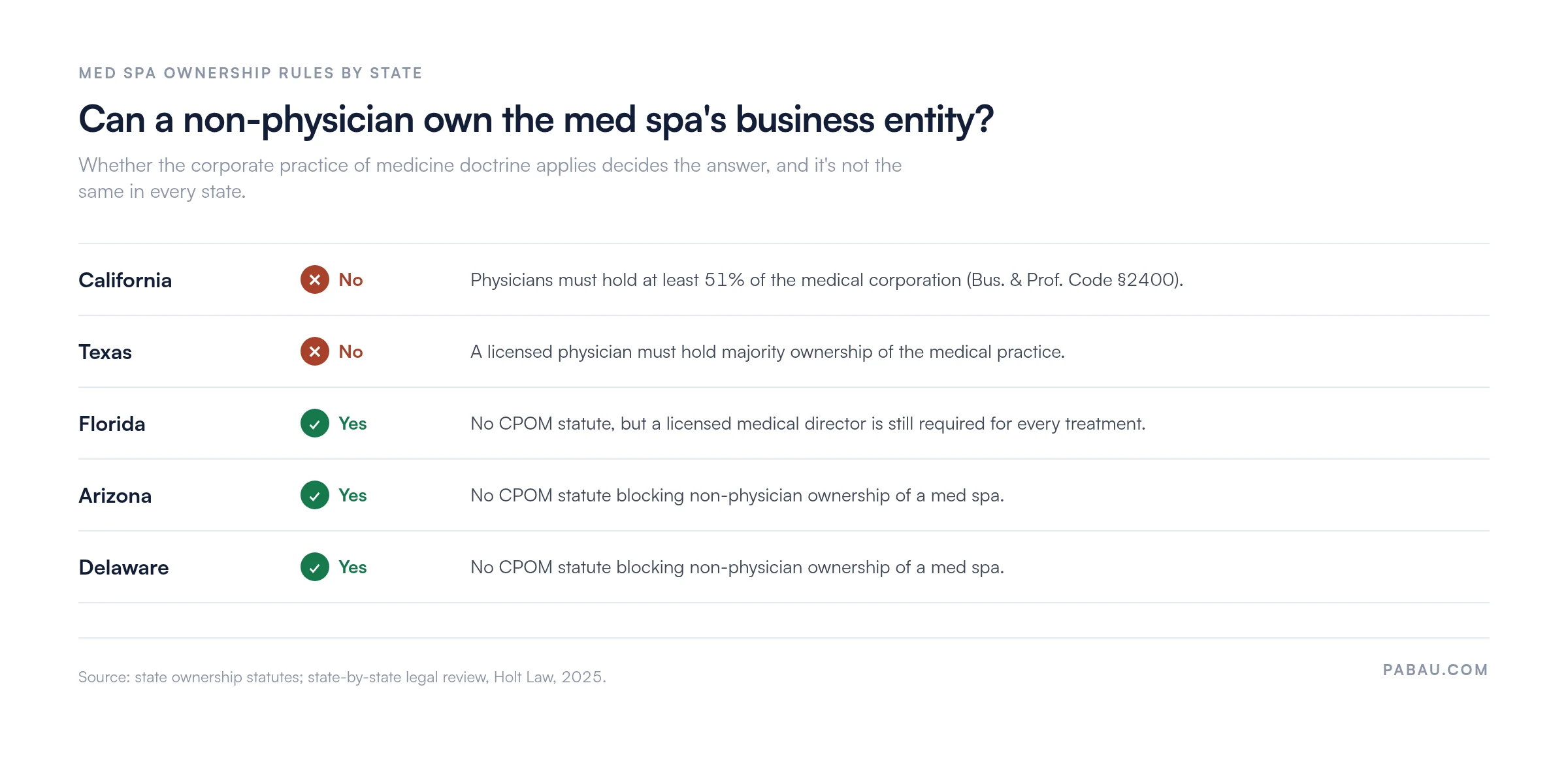
The same review lists Arizona, Delaware, Iowa, Louisiana, Maine, Michigan, Mississippi, and New Hampshire alongside Florida. In those states, CPOM doesn’t block non-physician ownership.
There is also less federal cover here than owners expect. The American Medical Association found that 36 states have no medical-spa-specific regulatory statute. It also reports that 44 states have no dedicated patient-protection rule for the industry. So your own state’s boards are the only reliable starting point.
For the two strictest examples, our California med spa licensing guide and Texas med spa licensing guide cover those states in full.
Florida law doesn’t require a physician to own a med spa’s business entity. That is because the state never adopted a corporate practice of medicine statute for aesthetic treatment. A business owner, investor, registered nurse, or esthetician can legally hold the LLC or corporation.
That freedom has one major exception. AHCA, the Agency for Health Care Administration, runs the Health Care Clinic Act, Fla. Stat. §400.9905. A practice that isn’t wholly owned by licensed health care practitioners needs a Health Care Clinic License. That applies once it also bills insurance or another third-party payor.
Two questions decide it, and they run in order. Work down the diagram below and you will land on the same answer AHCA would give you.
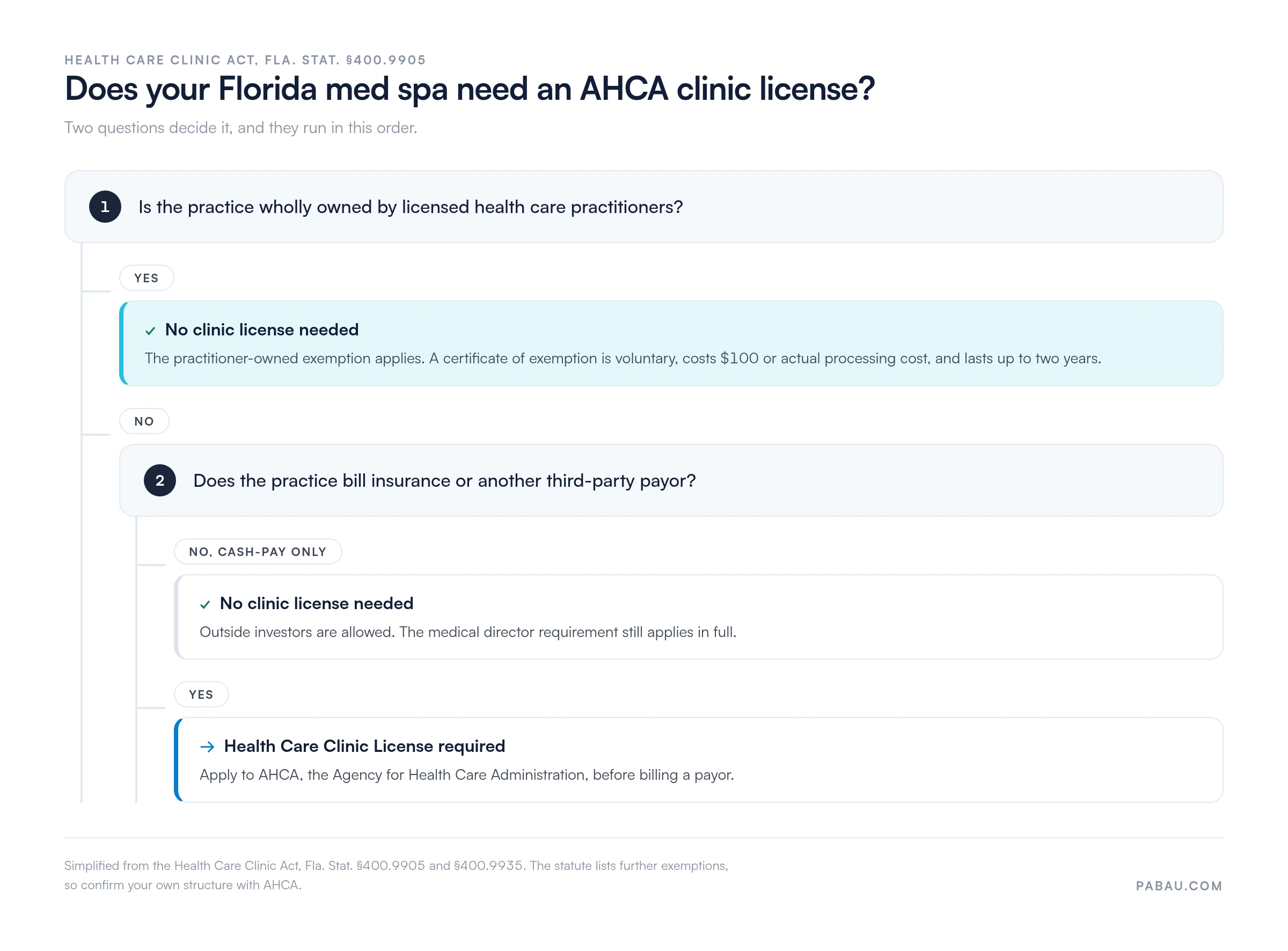
Most cash-pay med spas land in the practitioner-owned exemption without extra paperwork. The trap is a structure that mixes outside investors with insurance billing. That combination can trigger licensure requirements owners never budgeted for.
Whoever holds the entity, Florida still separates owning the business from practicing medicine. That second half is where the medical director comes in.
Florida issues no medical spa license to the business itself. A med spa draws its authority from each practitioner’s license and, in some cases, a facility license. Three registrations do the work one license would do in another state.
That third registration also catches liposuction removing more than 1,000 cubic centimeters of fat. The department inspects the office before registering it, then inspects annually unless the office holds accreditation from a recognized accrediting body. Most med spas never reach that threshold, though a practice adding surgical body contouring does.
The certificate of exemption is voluntary under Fla. Stat. §400.9935(6), so a cash-pay, practitioner-owned med spa can operate without one. The certificate runs for up to two years and cannot be transferred to a new owner. AHCA charges $100 or its actual processing cost, whichever is less.
Filing anyway puts the agency’s own answer on the record, in writing, before an inspector raises the question. It also brings an obligation worth pricing in first.
An entity applying for that certificate has to publish and maintain a schedule of charges. The schedule lists the cash prices an uninsured patient pays. It goes in the reception area, on a sign of at least 15 square feet. That sign also has to cover the 50 services the practice provides most often.
For a small treatment menu that is a real piece of work. Weigh it against the comfort of a written answer from AHCA before you apply.
Verifying a Florida license takes two lookups. The Department of Health and DBPR keep separate databases, and neither one shows the other’s licensees.
Both records show current status and the expiration date. MQA also publishes disciplinary actions in a separate search. Run that one on any physician before you sign them as medical director.
Renewals go through the MQA online services portal at FLHealthSource.gov, which opens in the last three months of a licensee’s cycle. DBPR renews facial specialists on its own schedule, so the two dates rarely line up.
In practices we onboard, staff licenses sit in a spreadsheet or a drawer, and nobody owns the renewal date. Running both lookups once a quarter catches a lapse before a patient books with an expired provider.
Florida came close to adding one more registration on top of all this. Senate Bill 1728, titled Licensure of Medical Spas, would have moved oversight to the Board of Pharmacy. That license would have applied to any med spa handling prescription medication.
The bill would have taken effect July 1, 2026, and listed each spa’s supervising provider in a public database. Senate Bill 1728 died in the Health Policy committee on March 13, 2026, so Florida still has no med spa registry.
Legislators have now filed med spa bills in back-to-back sessions, including HB 625 in 2025. A practice that keeps practitioner licenses, delegation records, and an AHCA exemption current will have most of the paperwork ready when one passes.
Florida splits oversight by profession rather than by business type. So a single med spa usually answers to several boards at once.
The medical, osteopathic, and nursing boards all sit under the Florida Department of Health. Each one only has authority over its own license type. So an esthetician complaint travels a different route than a physician complaint, and the two rarely meet.
Yes, a nurse practitioner can own a Florida med spa outright. Florida’s lack of a CPOM statute applies to NPs the same way it applies to any other non-physician owner.
Can that same NP then inject on their own authority? Usually not, and the reason sits in one statute.
Florida passed HB 607 in 2020, creating an autonomous-practice pathway for advanced practice registered nurses under Fla. Stat. §464.0123. A qualifying APRN can practice without physician oversight, after at least 3,000 supervised clinical hours in the previous five years.
But that autonomy only covers primary care fields, meaning family medicine, general pediatrics, and general internal medicine. Injectables, laser treatments, and hormone therapy sit outside primary care, so they sit outside autonomous practice too.
An NP who owns the med spa still needs a collaborating physician under Fla. Stat. §464.012 for those services. Look for relevant training in dermatology or plastic surgery, not just a license and a signature.
So an NP can hold 100% of the business and still need a collaborating physician for nearly every treatment on the menu.
Florida judges an aesthetic treatment by what it does to the body, and the marketing name carries no weight. Anything that meets the state’s definition of practicing medicine needs the right license and, in most cases, physician delegation.
CoolSculpting, IV hydration, and hormone therapy follow the same rule, including testosterone replacement and bioidentical hormone therapy. If a treatment changes body tissue or needs a prescription, a licensed prescriber has to stand behind it, even when someone else administers it.
Florida requires a licensed medical director for any med spa performing procedures that count as the practice of medicine. That requirement holds no matter who owns the business.
The medical director has to be an actively licensed Florida physician or osteopathic physician. That person carries statutory responsibility for the practice’s clinical records. The job covers chart reviews, confirming each provider’s license matches their delegated tasks, and certifying that the practice operates within Florida law.
For a med spa that holds the AHCA clinic license, Fla. Stat. §400.9935 adds more. The director has to run systematic reviews of the practice’s billing for fraudulent or unlawful charges, then correct any they find straight away.
One line in that same statute deserves a second read. A medical director contract signed in violation of the Health Care Clinic Act is void as contrary to public policy. In other words, the agreement meant to protect the arrangement may not exist at all.
Those reviews get easier when charts, licenses, and delegation records live in one system. Our comparison of med spa EMR software covers how each platform handles that documentation.
Many Florida med spas also look for board certification in dermatology or plastic surgery. Florida law doesn’t require that certification by name, so treat it as a hiring standard rather than a legal one. Our guide to hiring a medical director walks through the interview and the contract terms.
One last warning. Signing on as medical director without reviewing charts is a common route to a Board of Medicine complaint.
Florida bans paying or receiving anything of value in exchange for a patient referral. That rule covers med spas exactly as it covers hospitals.
Fla. Stat. §456.054 makes fee-splitting and kickbacks grounds for licensing discipline against the physician involved. Fla. Stat. §817.505 goes further and makes patient brokering a criminal felony.
This bites hardest in management services organization (MSO) structures. A non-clinical company runs the business side, and the medical entity pays it a management fee.
Picture two versions of that fee. One is a flat monthly amount benchmarked to office space, staffing, and marketing, which is what regulators expect fair market value to look like. The other is a percentage of treatment revenue, which rises with patient volume and reads as fee-splitting, whatever the contract calls it.
A Florida med spa answers to two ownership structures and several licensing boards at once. Consent forms, delegation records, and chart reviews all have to trace back to the right provider.
Software for med spas keeps that trail in one place, instead of spread across paper files and spreadsheets. Practice management software like Pabau ties every treatment note to the provider who performed it and the physician who delegated it.
So a medical director reviews a day’s charts in one system rather than five. Consent forms and delegation records sit against the same client record, ready to hand to an inspector who asks.

Pabau ties every treatment note to the provider who performed it and the physician who delegated it. A medical director reviews a day’s charts in one system instead of five.

Florida’s missing CPOM statute makes ownership more flexible than in California or Texas. It has no effect at all on who may perform the treatments.
So put the effort where the risk actually sits. Get the medical director, the collaborating-physician agreement, and the delegation paperwork right, and the ownership structure becomes the easy part of opening.
The habit worth building now is a records habit. Keep licenses, delegation orders, and chart reviews current, and both an inspector and the next Florida med spa bill will find you ready. Book a demo to see how Pabau keeps a Florida med spa’s ownership, delegation, and compliance records in one system.

Wondering who can open a med spa in other states? Who can open a medical spa? State ownership rules compares ownership rules across more of the US.
Operating in California instead? California med spa licensing laws: a complete guide covers the state’s CPOM rules in full.
Operating in Texas instead? Texas med spa licensing laws: what you need to know breaks down majority-ownership requirements there.
Knowingly operating an unlicensed health care clinic is a third-degree felony under Fla. Stat. §400.9935. Each day of operation counts as a separate offense. Charges from that practice are also unenforceable, so you can’t collect the revenue.
No. The role needs an active, unencumbered Florida medical license. Florida’s out-of-state telehealth registration under Fla. Stat. §456.47 doesn’t help either, because a registered provider can’t open a Florida office or treat patients in person.
At least five years from the last patient contact, under the Board of Medicine’s records rule. The medical director is the records owner, so that clock stays their responsibility even after a provider leaves.
Florida physicians must carry malpractice coverage or otherwise demonstrate financial responsibility. A physician who qualifies for an exemption and goes uninsured has to post a notice in the reception area telling patients so.
Any health care provider who knows about one. Fla. Stat. §400.9935 requires them to report the practice to AHCA, and a provider who stays quiet gets reported to their own licensing board.


