Free model waiver form + what it is and when your practice needs one
A model waiver form is a signed document that lets a healthcare practice use a p...

2
Last Updated: Sep 29, 2026

CQC registration cost depends on which regulated activity your clinic carries out, so run the CQC scope test before you read any fee table.
Registering for surgical cosmetic procedures costs £1,743 a year at one location, and prescriber-led clinical treatment costs £1,867.
Dermal fillers and botulinum toxin given purely for appearance fall outside both regulated activities, so no CQC fee applies.
Practices outside CQC scope are covered instead by the voluntary JCCP and Save Face registers.
CQC publishes no separate application fee, because the annual fee already covers initial registration as well as inspection.
Budget separately for enhanced DBS checks, professional indemnity cover, and any compliance consultant you bring in.
CQC registration cost starts at £1,743 a year for a single-location cosmetic surgery provider. A single-location clinic carrying out prescriber-led clinical treatment pays £1,867 a year. Most purely cosmetic, non-surgical clinics pay nothing at all.
Which of those three a practice lands in is settled by the CQC-regulated activity it carries out. We call that decision the CQC scope test, and this guide walks it before the fee table. For a large share of UK aesthetic clinics, no fee applies at all.
There is also no separate one-off application charge to budget for. CQC’s own fees page states that the annual fee covers initial registration, changes to a registration, and the monitoring, inspection and rating that follow.
CQC registration is the legal permission a healthcare provider must hold before carrying out any CQC-regulated activity at a location in England. The Care Quality Commission grants it under the Health and Social Care Act 2008. Carrying on a regulated activity without registration is a criminal offense.
The registered provider is the legal entity responsible for the activity. A provider can be an individual sole trader, a partnership, or an organization. CQC registers each provider with conditions attached, and those conditions name the locations and the regulated activities the provider may deliver.
Registration does not end at approval. Adding a location, changing a regulated activity or replacing a registered manager all need a further application. Our guide to the CQC’s role covers what the regulator does with that information once you are on the register.
CQC covers England only. A practice opening a site elsewhere in the UK registers with that nation’s own regulator instead:
Not every aesthetic clinic needs CQC registration, because the answer turns on which CQC-regulated activity, if any, the clinic carries out. Fillers and anti-wrinkle injections given for appearance alone are not regulated activities. Surgery and prescriber-led clinical treatment are.
Your fee depends on which of three positions your treatment list puts you in. That three-way decision is the CQC scope test, and the diagram below walks it end to end.

CQC’s Surgical procedures regulated activity covers cosmetic procedures where a healthcare professional uses instruments or equipment inserted into the body. CQC names liposuction as its worked example, and says the activity applies whether the procedure uses general or local anesthesia.
The same guidance names four exclusions that matter to an aesthetic clinic:
External ultrasound counts as an exclusion too, where no incision is made and no instrument goes into the body.
A practice in this position registers for Surgical procedures. CQC prices it under independent healthcare, healthcare single speciality services, which is the band cosmetic surgery falls into.
CQC’s Treatment of disease, disorder or injury activity covers treatment delivered by, or under the supervision of, a listed healthcare professional. CQC’s list includes doctors, dentists and registered nurses. The same list leaves out physiotherapists, pharmacists, dietitians and nursing associates working on their own.
Intravenous vitamin and wellness drips are the clearest aesthetic example. CQC’s guidance states that administering vitamins and prescription-only products intravenously to improve or enhance wellbeing counts as treating a disease or disorder.
Three conditions have to be met together for that to need registration:
A practice in this position registers for Treatment of disease, disorder or injury. CQC prices it under independent healthcare, community healthcare services.
CQC’s guidance excludes interventions carried out purely for cosmetic purposes from Treatment of disease, disorder or injury. Set that alongside the surgical exclusion for subcutaneous injections to enhance appearance, and filler and botulinum toxin work sits outside both regulated activities.
So a practice offering only dermal fillers, anti-wrinkle injections, skin boosters and similar appearance-led treatments has nothing to register, and pays no CQC fee. Laser and IPL hair removal usually sits outside too, unless the service is delivered as part of clinical care.
Those practices are covered instead by voluntary registers. The Joint Council for Cosmetic Practitioners (JCCP) runs a practitioner register accredited by the Professional Standards Authority. Save Face accredits clinics and practitioners on a similar basis. Neither register substitutes for CQC registration where a regulated activity is involved.
Falling outside CQC scope does not change the prescribing rules. Botulinum toxin is a prescription-only medicine, so a prescriber must see the patient and prescribe for them by name. In practice that means a GMC-registered doctor or dentist, or an NMC-registered independent prescriber.
CQC registration requirements cover a registered manager, enhanced DBS checks, a statement of purpose, and premises that can keep people’s records secure. Organizations and partnerships must also name a nominated individual to be CQC’s main point of contact.
CQC assesses fitness rather than a checklist of diplomas. What you are evidencing is that named people are suitable and that the service is safe and well-led. The paperwork behind both has to be in place before you submit.
Secure record-keeping is the requirement that costs aesthetic clinics the most preparation time. Consent forms in a filing cabinet, before-and-after photos on a practitioner’s phone and treatment notes in three places are hard to evidence as secure. Our UK GDPR checklist covers the same records from the data-protection side.
You will also need the policies that sit underneath the application, including safeguarding, infection control, complaints and incident reporting. A standard incident report form is a sensible starting point for the last of those.
CQC registration fees are annual rather than one-off, starting at £1,743 a year for a single-location cosmetic surgery provider. A single-location prescriber-led clinical provider pays £1,867. Both bands rise with the number of registered locations.
The cost of CQC registration in the UK rests on two variables only, and CQC says so plainly. Those two are the type of services you provide and the scale of them. There is no per-treatment charge, no headcount element and no negotiation. The table below gives both activity groups.
One exception is worth knowing. A provider registered as an individual, and registered solely for diagnostic and screening procedures, pays £309 a year. Every figure above comes from CQC’s provider fees payable: independent healthcare page, last updated on June 10, 2024.
There is no separate CQC application fee. Several third-party guides quote a one-off figure. CQC’s fees page states that fees cover initial registration, changes to your registration, and the monitoring, inspection and rating that follow. The number to budget for is the annual regulatory fee, once a year.
CQC fees are invoiced rather than collected at the point of application. CQC sends an invoice stating your exact fee before it falls due, and the annual fee covers every location registered on your anniversary date. Adding a location is what moves the CQC registration fee up a band.
Searches for commissioning fees often land on CQC pages, but CQC doesn’t charge one. Commissioning is an NHS purchasing term. What CQC charges is the annual regulatory fee for your activity group and location count, set by its published fees scheme.
Among the UK aesthetic clinics we onboard, the size of the fee is rarely the surprise. Owners are more often startled to find the fee was never due, because the treatment list never met a regulated activity.
Beyond the CQC fee itself, budget for enhanced DBS checks, professional indemnity cover, and any compliance consultant you bring in to prepare the application. Two of those three recur every year.
Professional indemnity cover is the one figure nobody can put in a table honestly. Premiums are quoted individually against your treatment list, your claims history and the cover limit you choose. Get a quote rather than a benchmark, and get it before you set your opening prices.
The basic DBS check cost is £21.50, falling to £20.00 on October 5, 2026. A basic check is not what CQC accepts, though, so budgeting against that figure understates the bill.
CQC requires an enhanced DBS check with the appropriate barred-list information for every person it registers. The enhanced DBS cost is £49.50, dropping to £41.00 on the same date. The Disclosure and Barring Service announced both reductions on September 9, 2026.
Care-sector employers often call this a care check, and the DBS cost is identical to any other enhanced check. Applicants who are not registered healthcare professionals need a CQC countersigned enhanced check, which can take up to 60 working days.
Registrants of the GMC, NMC, General Dental Council, General Pharmaceutical Council, Health and Care Professions Council or Social Work England can skip the countersigning. CQC still wants the original paper certificate, not a copy or an online print.
The CQC DBS cost is a recurring line, not a one-off. CQC rejects applications supported by a check more than 12 months old, and it does not accept DBS Update Service certificates for registration at all.
You can prepare a CQC application yourself at no cost beyond the fee, or pay a compliance consultant to prepare the documents. What a consultant can’t do is submit it for you.
CQC is explicit that the applicant must complete the application themselves. So the money buys drafting and rehearsal, not delegation. A consultant typically writes the statement of purpose, builds the policy set, maps evidence to the regulations and runs mock fit person interviews.
Whichever route you take, the work lands in the same place. You have to produce the document CQC asks for, on the day it asks. Practice management software like Pabau keeps consent forms, treatment notes, staff certificates and audit history in one system. Producing the document CQC wants becomes a search rather than a hunt.
If you are weighing a consultant against doing it in-house, price the hours first. The application itself is unpaid time from whoever writes it, and compliance software for practices is what keeps that time from being spent twice.
You apply for CQC registration by form and email, then CQC assesses the application through document checks, an interview, and sometimes a site visit. CQC rejects incomplete applications rather than holding them, so the sequence below matters.
CQC says its registration process is rigorous and can take a few months, and you can’t carry on the regulated activity until registration is confirmed. CQC instructs applicants to apply only once their locations and staff are ready. Full detail sits on CQC’s register as a provider guidance.
Our walkthrough of getting CQC registered takes the application step by step if you want the longer version.
Preparing for registration means producing evidence that already exists, just not in one place. It sits across a shared drive, an email inbox, a filing cabinet and somebody’s phone. Assembling it takes days, and the picture goes stale the moment a new practitioner starts.
Pabau holds that evidence where the work already happens. Each staff profile carries their documents and training records, so an enhanced DBS certificate and a training certificate live against the person they belong to. Consent forms are signed digitally and filed to the client record automatically.
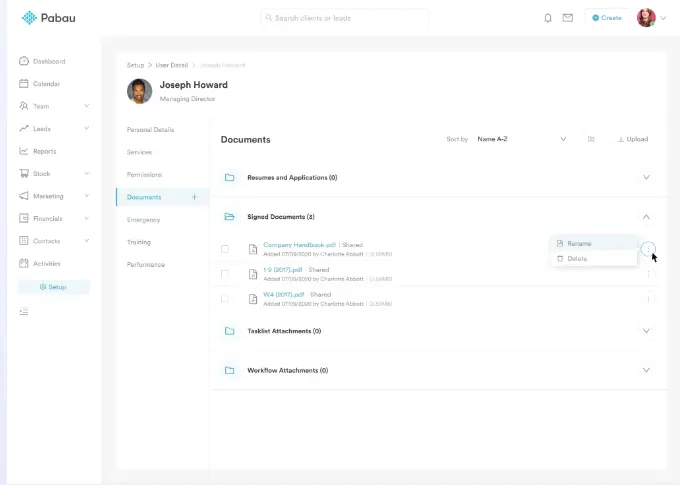
Treatment notes, before-and-after photos and the consent that authorized the treatment sit on one client timeline, with a record of who changed what and when. A fit person interview or an inspection asks for that audit trail, and ordinary appointments build it.
Software doesn’t make a practice CQC compliant. It shortens how long compliance takes to prove, so less of your week goes on paperwork instead of patients.

Pabau keeps policies, digital consent, staff certificates and treatment records in one system, with a full audit trail. Your team finds the document CQC asks for in seconds instead of hours.

Work out your position before you work out your fee. Run the CQC scope test against your treatment list first. A good number of aesthetic clinics find the CQC question closes there, with a voluntary register as the next step.
If you are in scope, the number is knowable to the pound. The fee is £1,743 or £1,867 a year at one location, then up the band table as you add sites. The cost that varies is the preparation, and preparation is under your control.
The trade-off worth remembering is that CQC registration is an ongoing obligation rather than a purchase. CQC invoices the fee every year and inspects the service against the regulations. Build the records habit before you apply, not after. Book a demo to see how Pabau keeps consent, staff certificates and treatment notes inspection-ready for aesthetic clinics.

Ready to start the application? How to get CQC registered walks the forms, the manager interview and the evidence CQC expects, step by step.
Want to know what the regulator does once you are registered? The role of the Care Quality Commission explains monitoring, inspection and ratings once you are on the register.
Handling patient data as well? UK GDPR checklist covers the records and consent obligations that sit alongside CQC registration.
Preparing for inspection? Medical chart audit shows how to check your own notes before someone else does.
Unsure what to keep and for how long? How long to keep medical records sets out retention periods for clinical records.
The fee is the straightforward part. The difficulty is documentary: a statement of purpose, a policy set, an enhanced DBS for every registered person, and a fit person interview. CQC rejects incomplete applications rather than asking for the missing piece, so the effort belongs before you submit.
CQC assesses fitness rather than a set qualification. A registered manager needs relevant skills, experience and an enhanced DBS check. Clinical treatment must be delivered or supervised by a listed healthcare professional. That means a GMC-registered doctor or an NMC-registered nurse, among others.
CQC registration is mandatory only for providers carrying out a CQC-regulated activity in England, and doing so unregistered is a criminal offense. Purely cosmetic non-surgical treatments, including dermal fillers and botulinum toxin given for appearance, are not regulated activities, so those clinics do not register.
CQC says its registration process is rigorous and can take a few months. The enhanced DBS check alone can take up to 60 working days if CQC has to countersign it. You cannot carry on the regulated activity until CQC confirms your registration.
CQC does not publish an interactive CQC registration fees calculator. You work the figure out from the published fee table instead. Find your activity group, count the locations you are registering, and read the annual fee off that row.
Search the clinic name in the Find care services directory on cqc.org.uk. A CQC registration check there shows the registered provider, its locations, the regulated activities it may carry out, and any published rating.