CMMC compliance checklist
A CMMC compliance checklist lists every security practice a Department of Defens...

Last Updated: Oct 6, 2026
A clinical supervision form is a structured record of one supervision session. It captures who attended, what was discussed, what the supervisee agreed to do next, and the supervisor’s sign-off. You can download the free template below.
Five documents cover supervision, and each one is completed at a different point. The agreement is signed once, before supervision begins. The session form is filled in after every meeting. A competency evaluation comes around once a cycle.
HCPC, CQC, BACP and US state licensing boards all expect written evidence that supervision took place. Practices that run supervision on digital intake forms keep that evidence searchable rather than buried in a filing cabinet. This guide covers what each document records and what each regulator wants to see.

A clinical supervision form is a structured record of one supervision session, covering what was discussed, how the supervisee is progressing, and the supervisor’s sign-off.
Essential fields include supervisee details, the session date, goals, cases covered, supervisee feedback, action items, and a supervisor signature.
Supervision runs on five separate documents, and each one is completed at a different point in the supervisory relationship.
HCPC, CQC, BACP and US state licensing boards all expect documented supervision, though none of them mandates one specific form.
Practice management software like Pabau stores supervision records alongside staff files, so an audit request takes one search rather than an afternoon.
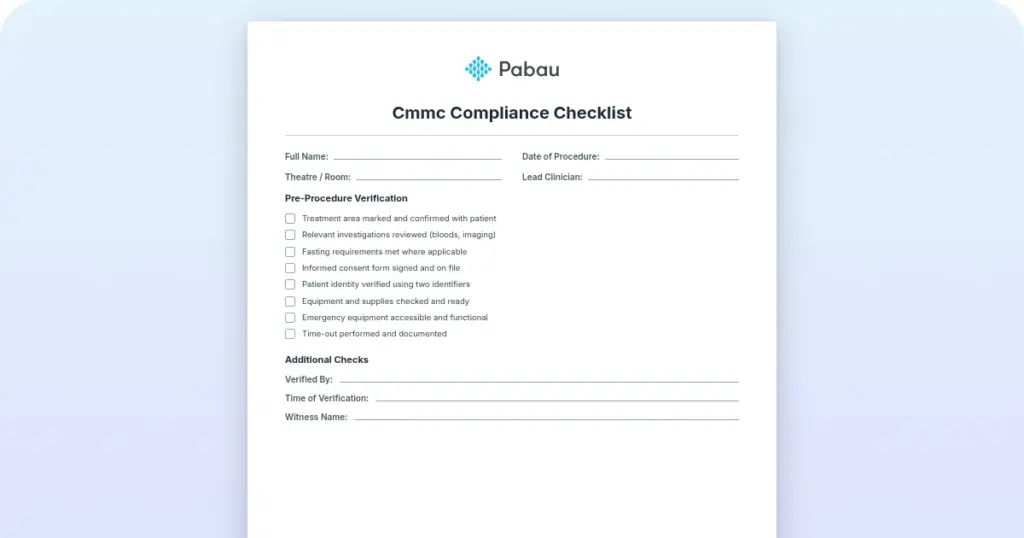
A ready-to-use supervision form covering supervisee information, session goals, cases discussed, progress tracking, reflective practice notes, action items, and supervisor sign-off.
Download templateA clinical supervision form is a documentation tool that records a supervision session between a supervisor and a supervisee. It captures what was discussed, how the supervisee is progressing, and which actions came out of the meeting. The form does three jobs at once. It satisfies the regulator, it holds both parties accountable, and it tracks the supervisee’s development.
The Health and Care Professions Council (HCPC) requires UK registrants to take part in regular supervision and to keep records of it. The Care Quality Commission (CQC) treats supervision as a marker of practice quality during an inspection.
In the US, state licensing boards for social workers, counselors, and marriage and family therapists set a required number of supervised hours. Most of them also want each session documented at the time it happens.
Beyond compliance, the form creates a shared record. The supervisee sees their goals tracked, the supervisor has evidence of what was covered, and the practice can produce that evidence on request. Supervision stops being a private conversation and becomes a documented professional relationship.
Fill the form in during the session, or immediately after it. These five steps keep the record consistent enough to stand up in an audit.

Document the session within 24 hours, while the clinical detail and the agreed actions are still fresh. Waiting a week invites memory errors and leaves a stretch of time with no record. Completing the form on a tablet during the session itself is better again, because the timestamp then matches the session.
Supervision records turn up across healthcare and behavioral health, anywhere supervision is either a regulatory requirement or established practice.
Compliance and audit readiness: HCPC, CQC, and state boards ask for supervision records during inspections. A completed form in each supervisee’s file shows that supervision happened, what it covered, and when.
Accountability and continuity: When the discussion is written down, both parties hold the same version of it. That matters if a supervisee questions feedback months later, or if another supervisor takes the relationship over.
Development tracking: Reading a supervisee’s forms in sequence shows patterns. Recurring struggles, emerging strengths, and progress against agreed goals all become visible, which makes appraisals and training decisions easier to justify.
Less administrative friction: Paper and email forms get forgotten after a long day. A digital form with an automatic reminder after each supervision slot removes the “I meant to fill it in” problem.

A reflective practice culture: A form with a reflection section builds learning into every session. Over time, clinicians reflect because the structure asks them to, not because an inspection is due.
Supervision does not run on a single document. Five separate forms cover the relationship, and each one is completed at a different point. The table below shows which one to reach for, and when.

The individual form documents a one-to-one session between a supervisor and a single supervisee. It carries the supervisee’s name, the date, the start and end times, and the session goals. Below that sit the cases discussed, the supervisee’s self-assessment, the supervisor’s feedback, the action items, and both signatures. This is the form most HCPC-regulated, BACP-accredited, and state-board-supervised practices use.
Group forms document sessions where several supervisees are supervised together. The structure shifts away from one person’s goals. Instead the form records the group agenda, who attended, the cases or topics discussed collectively, and an action item for each supervisee. Many group forms use a table, with one row per attendee.
The agreement is a separate document, completed before supervision sessions begin. It sets the terms of the relationship: how often you will meet, for how long, and on what basis. It also names the supervisor’s credentials and approach, the limits of confidentiality, what happens when a session is missed, and how performance concerns get handled.
Both parties sign it, and it stays on file as evidence that supervision was properly established. Unlike the session form, you complete it once and refer back to it in later records.
Session notes are the lighter option. They capture the date, the supervisee, the key topics, the action items, and the sign-off, without a case-by-case breakdown or a long reflection. Some practices use notes for routine supervision and keep the fuller form for annual reviews or performance concerns.
Periodic evaluations, annual or once per supervision cycle, assess the supervisee’s overall competency and their readiness for independent practice. They answer a question no single session form can: is this supervisee developing as intended? Most include supervisor ratings of clinical skill and professional behavior, plus the areas still to work on. Our clinical evaluation form gives you a rating structure to adapt.
Documentation requirements vary by jurisdiction and by profession. Knowing which body governs your practice tells you what an inspector will look for in the record.
The HCPC expects registrants to take part in regular supervision, including nurses, allied therapists, paramedics, and psychologists. Supervision has to be meaningful, regular, and documented. The record should show the date, who attended, the topics covered, and the actions agreed. HCPC also emphasizes reflective practice, so a form with a reflection section sits well against its standards.
The British Association for Counselling and Psychotherapy and the British Association for Behavioural and Cognitive Psychotherapies both require regular supervision for accredited members and trainees. Their ethical frameworks reference record-keeping, but they prescribe less about form content than HCPC does. What matters is that supervision is documented and that both parties can access the record.
Requirements vary by state. Most boards ask clinical social workers, licensed professional counselors, and marriage and family therapists to complete a set number of supervised hours before licensure. That figure often runs between 1,000 and 4,000 hours, depending on the state and the setting.
Either the supervisee or the supervisor has to retain records of the hours, the dates, and the content. Some states specify what the form must contain, while others leave it open. A form carrying the date, the hours, and a session summary usually satisfies the board.
SAMHSA sets guidelines for behavioral health programs that receive federal funding, and many of its contracted providers have to document clinical supervision. A form that records the clinical issues raised, the supervisee’s progress, and their engagement in the session meets what those programs ask for.
Supervision paperwork usually lives in three places at once. Some forms sit in a filing cabinet, some are attached to an email, and some were never completed after a long session. When an inspector asks for evidence, someone loses an afternoon to assembling it.
Pabau is practice management software for healthcare and behavioral health practices. It keeps supervision records in the same system as the rest of the practice’s files. You build the form once, complete it on a tablet or laptop, and store it in the supervisee’s file through Pabau’s medical records management.
Completion then stops depending on anyone’s memory. An automated workflow can prompt the supervisor the moment a supervision appointment ends, while the detail is still fresh.
The result is one search instead of that lost afternoon. You can pull every supervision session for every clinician when an inspector asks. A supervisee’s file also shows their full arc of development, not just last month’s session.


Pabau’s digital forms and team management tools document, store, and retrieve supervision records alongside staff files. An audit request then takes one search instead of an afternoon.

Supervision happens whether or not anyone writes it down. What a structured form changes is that the practice can prove it, and the supervisee can see their own progress.
Start with the template above, then decide which of the five documents your setting actually needs. A solo counselor may only ever need the session form and an agreement. A multi-clinician practice training new clinicians will want the competency evaluation as well.
The trade-off worth remembering is timing. A form completed a week later is a compliance record, while a form completed in the session is also a teaching tool. Book a demo to see how Pabau keeps supervision records beside your staff files, ready for the next inspection.

Need to assess a supervisee’s competency at the end of a cycle? The clinical evaluation template gives you a rating structure for clinical skill and professional behavior.
Wondering how the cases raised in supervision should be written up? Our clinical progress notes template covers the note that sits behind each case you discuss.
Moving your staff and clinical paperwork off paper? This guide to clinical documentation software compares what to look for before you commit to a system.
Supervising nurses or allied health staff? Our guide to nursing documentation sets out the record-keeping standards those teams are held to.
Record the supervisee’s name and role, the date and time of the session, and the session goals. Then note the cases or clinical issues discussed, using patient initials only. Add the supervisee’s own reflections, the supervisor’s feedback, the action items agreed, and both signatures or a digital confirmation. Many forms also leave space for reflective practice, in line with HCPC standards.
A supervision agreement is signed once at the start of the relationship. It sets out frequency, duration, confidentiality, and the terms both parties work to. The session form is completed after each meeting to document what was discussed and agreed. You need both. The agreement sets the framework, and the forms evidence what happened in each session.
Yes. The HCPC expects registrants to take part in regular supervision and to keep documentation of it. It does not mandate a specific form, but you need written records showing when supervision happened, who took part, and what was covered. A supervision form template satisfies that requirement.
Document every session, ideally within 24 hours of it ending. Most practices complete one form per session. A periodic evaluation form sits on top of that, assessing overall competency and progress against learning goals once a cycle.
The core structure is the same across mental health, counseling, and other clinical settings. BACP-aligned and counseling-focused practices weight reflective practice and the supervisee’s learning more heavily than medical models do. Their forms carry larger reflection sections as a result. US licensure contexts for an LCSW, LPC, or MFT lean instead toward documented hours and clinical skill development.
Yes. A practice management system like Pabau keeps supervision forms searchable and timestamped in one place, filed with the supervisee’s record. It can also remind supervisors to complete a form and produce an audit report on demand. Many practices move off paper for exactly that reason.