Professional development record
A professional development record is a structured log of a healthcare practition...

8
Last Updated: Oct 8, 2026
In Texas, you can run the business side of a med spa, but you cannot legally own the medical side unless you are a licensed physician. Whichever side you hold, our ranking of the top med spa software includes a pick for medical-director-led med spas.
That one rule is the Corporate Practice of Medicine doctrine. It shapes how you structure the company, who you appoint as medical director, and which staff can pick up a needle or a laser. Those treatments dominate the most common cosmetic procedures, with neurotoxins and fillers alone passing 15 million a year.
It also explains why first-time owners stumble. There is no single “med spa license” you apply for once. Instead, the med spa requirements in Texas come from three agencies: the Texas Medical Board, the TDLR, and the Department of State Health Services. Federal HIPAA rules apply on top.
This guide pulls the Texas med spa licensing laws into one place, in plain English. It walks through who can own a med spa, what you need to operate, who can perform each treatment, and what changed in 2026.
Texas follows the Corporate Practice of Medicine (CPOM) doctrine. It shapes California’s med spa licensing laws and most other states’ rules too. Only licensed physicians can own or control a medical practice, and that means an MD (Doctor of Medicine) or a DO (Doctor of Osteopathy).
Under CPOM and the Texas Medical Board’s enforcement, two rules stand out:
If your med spa offer botox, dermal fillers, laser treatments, or prescription-based procedures, Texas treats those as the practice of medicine, so they fall under physician supervision. Ownership then breaks down like this:
Non-physicians still play a vital role. For example, they can manage operations, marketing, or customer service. They just cannot make or influence medical decisions.
The penalties are steep. A non-compliant structure can trigger license suspension, fines for unlicensed practice, or even forced closure.
A Travis County jury drove the point home with a $10 million verdict after a management company improperly controlled medical decisions. That case involved a hospital staffing arrangement, not a med spa, but the CPOM principle still applies.
Once you know who can own a med spa in Texas, the next question is what you actually need to operate.
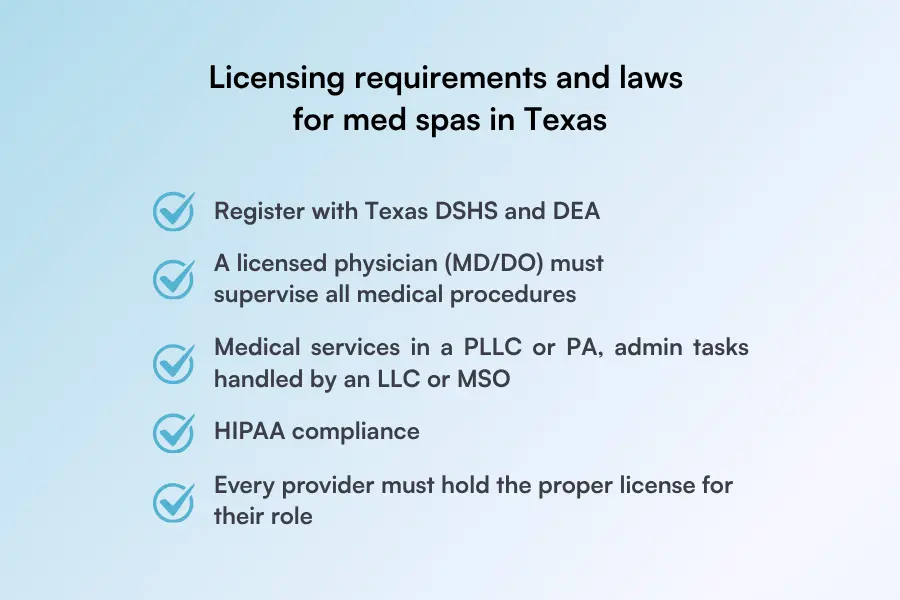
No. No single medical spa license authorizes a med spa on its own. Instead, you build a compliant med spa from several separate approvals, and the exact med spa requirements in Texas depend on the treatments you offer.
At a minimum, most medical spas need:
So when owners search for a medical spa license in Texas, the practical answer is simple. Compliance comes from stacking these pieces correctly, not from pulling one permit.
Not every med spa in Texas needs a facility license, but certain treatments trigger registration.
The laser devices themselves must be registered with the Texas Department of State Health Services (DSHS), which handles radiation control.
That registration covers the devices, Class 3B and 4 lasers, whatever the treatment. Laser hair removal adds a separate layer. Since 2019, the Texas Department of Licensing and Regulation (TDLR), not DSHS, certifies laser hair removal facilities and the individuals who perform the procedure, so a certified Laser Hair Removal Professional must carry it out.
For other laser treatments, such as skin resurfacing or vascular lasers, the Texas Medical Board’s physician-delegation rules apply instead.
Handling controlled substances, such as injectables must be supported by a DEA registration in the supervising physician’s name. That keeps controlled medications legal to store, handle, and prescribe.
One mix-up is worth clearing up: the Texas Health Spa Act does not govern medical spas. That act, under Occupations Code Chapter 702, covers businesses that sell exercise-facility memberships. They register with the Texas Secretary of State and post a bond that protects members’ prepaid fees.
The Texas Medical Board regulates a med spa that offers injectables or lasers as a medical practice, not a “health spa.” So unless you also sell fitness memberships, the Health Spa Act will not apply to you.
Every Texas med spa that provides medical treatments must have a licensed physician as its medical director.
A medical director’s duties usually include:
The physician does not have to be on-site every day, but they do have to stay actively involved in oversight and patient-care decisions.
Texas’s Corporate Practice of Medicine (CPOM) laws mean you have to structure a med spa carefully.
The clinical services run through a Professional Limited Liability Company (PLLC) or Professional Association (PA). Only licensed medical professionals can own those entities.
A separate LLC or Management Services Organization (MSO) handles the business and administrative side, such as marketing, scheduling, payroll, or packaging services into profitable med spa packages. This lets non-physicians run the business without breaking medical-ownership rules.
The PLLC plus MSO dual-entity model is the standard structure Texas med spas use to keep medical oversight and business operations legally separate.
Like any healthcare facility, a med spa must follow the Health Insurance Portability and Accountability Act (HIPAA) to protect patient privacy. That means securing patient data, keeping consultations confidential, and storing or transmitting records properly.
Non-compliance with HIPAA carries civil and criminal penalties, plus mandatory breach-notification requirements. Investing in compliant software, such as a HIPAA-compliant CRM, and in staff training keeps patient data protected and documented.
Every person who performs treatments in your med spa must hold the right license or certification for their role.
Nurses who administer injectables need an active Texas nursing license. Estheticians need a license from the Texas Department of Licensing and Regulation (TDLR).
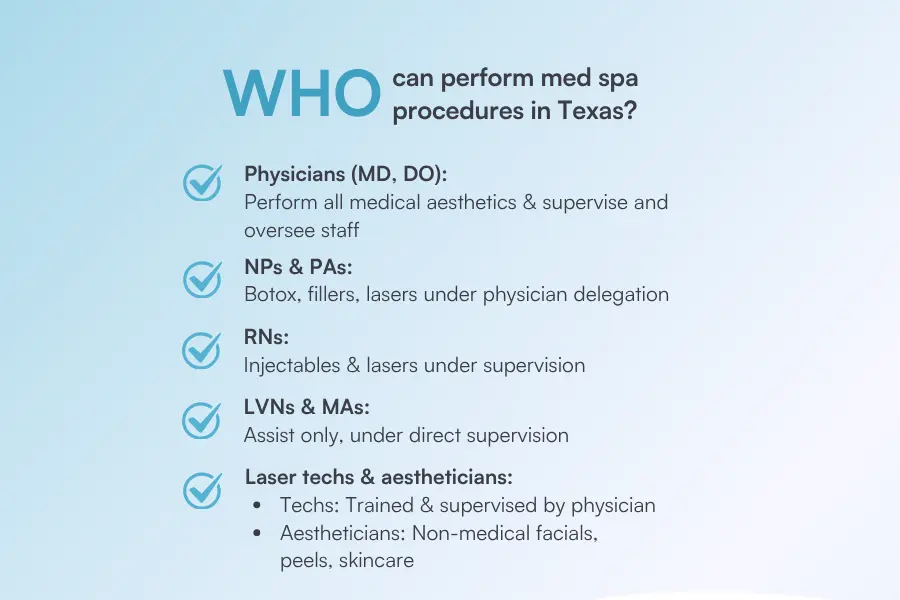
Every role, from physician to esthetician, operates within a defined scope of practice. Here is who can do what in a Texas med spa at a glance, before we get into each role in detail:
In Texas, licensed physicians (MDs and DOs) have the broadest scope of practice for aesthetic medical procedures. Both hold full Texas practice rights, even though their training routes differ, as our MD vs DO comparison explains. They can perform virtually every treatment, from injectables and lasers to chemical peels and IV therapy.
Physicians also supervise every delegated procedure their staff perform. They write the protocols, review treatment plans, and hold responsibility for the care their team delivers.
One recent change matters here. On September 1, 2025, Texas enacted House Bill 3749, the Texas IV Therapy Bill. It spells out who can administer IV therapy and under what supervision, adding standards for IV hydration and wellness clinics.
Under the law:
Nurse practitioners (NPs) and physician assistants (PAs) can perform many popular med spa procedures, such as Botox, dermal fillers, and laser treatments. They work only under delegation from a supervising physician.
That delegation runs through a written agreement, a prescriptive authority agreement for an NP or a delegation and supervision agreement for a PA. It spells out their scope of practice, the standing protocols they follow, how often the physician reviews charts, and any limits on which procedures they can perform. It is the document that keeps the physician on the hook for all delegated tasks.
Registered nurses in Texas can also perform injectables, microneedling with PRP, and laser treatments, but only under supervision.
Their supervising provider may be a physician (MD/DO), an NP, or a PA. An NP or PA can supervise only if the delegating physician has granted that authority in writing and set specific treatment protocols.
However, RNs cannot diagnose patients or create treatment plans on their own. Their job is to carry out procedures safely within physician-approved guidelines.
Licensed vocational nurses (LVNs) have a narrower scope.
They can assist with treatments, such as prepping patients or handling equipment, but only under direct, on-site supervision from a physician, NP, PA, or RN. They cannot independently perform injectables, laser procedures, or other medical aesthetic treatments.
Medical assistants (MAs) play an essential support role, and Texas is more permissive here than many states. A physician can delegate non-surgical cosmetic procedures, including injections, to a properly trained MA. First, though, a physician, PA, or APRN has to examine the patient and sign a patient-specific order, backed by written protocols and supervision (22 TAC §169.25–169.28).
What an MA can never do is examine the patient, choose the treatment, or write that order. That part stays the practice of medicine.
For laser and skincare services, laser technicians must complete a state-approved training program and work only under a licensed physician or designated medical professional.
You must register laser devices with the Texas Department of State Health Services (DSHS).
Estheticians hold a license from the Texas Department of Licensing and Regulation (TDLR). They can perform non-medical skincare, such as cleansing facials, exfoliation, masks, and light peels.
However, they cannot perform medical-grade procedures like injectables or medical lasers unless they hold extra certifications and a qualified provider supervises them.
To become a medical esthetician in Texas, you complete a 750-hour esthetician program at a TDLR-licensed school, pass the state written and practical exams through PSI, and hold an active esthetician license.
“Medical esthetician” is not a separate Texas license. It simply describes a licensed esthetician who works in a medical setting alongside clinical providers. The title does not widen your scope.
In practice, you can perform facials, exfoliation, superficial peels, and non-medical microdermabrasion. Injectables, medical-grade lasers, and microneedling stay off-limits unless a qualified provider performs them under physician delegation.
Put those requirements together and the setup follows a fairly predictable order. Here is how most compliant Texas med spas come together:
Run through this before you open, or before your next audit:
The right med spa scheduling software can enforce checklist steps like the Good Faith Exam automatically at booking.
Most enforcement problems trace back to a handful of avoidable errors:
Even a well-organized setup has to keep pace with the rules, and Texas tightened them in 2025. Three developments still shape compliance in 2026: two in the Texas Medical Board rules and one new state law.
First, the new Texas Medical Board disclosure rules (effective January 2025). The board’s updated rules confirm that non-surgical cosmetic procedures, including cosmetic injections, count as the practice of medicine. As a result, every med spa now has to put delegation in writing. You also post the supervising physician’s name and license number in treatment areas, and delegated staff wear ID showing their name and credentials.
Next, the IV therapy law (effective September 1, 2025). House Bill 3749, the Texas IV Therapy Bill, set clearer standards for elective IV therapy. A physician may delegate prescribing to a physician assistant or advanced practice registered nurse. A PA, APRN, or registered nurse can then administer it under proper supervision.
Finally, the bill that did not pass. Senate Bill 378, nicknamed the “Botox party bill,” would have banned estheticians and cosmetologists from performing injections. However, Governor Abbott vetoed it on June 2, 2025, so it never took effect. Even so, that opens no loophole. Injecting Botox or fillers without physician delegation was already illegal under Texas Medical Board rules, and it still is.
By 2026, the rules that passed are fully in force, and Texas Medical Board enforcement has intensified, with more inspections and closer coordination between state agencies. In short, these are the Texas med spa laws most likely to change how you staff and document treatments.
Most of what keeps a Texas med spa compliant comes down to staying organized: current provider licenses, clear delegation, signed protocols, and clean patient records. That only gets harder as the schedule fills up.
Pabau is practice management software built for medical and aesthetic clinics. It handles the operational and documentation side of compliance, staff credentials, patient records, consent forms, and access controls, in one system:
Software will not replace legal counsel or the right entity structure, but it keeps the day-to-day paperwork that proves you are compliant in one place. See how Pabau can simplify your staff management. Dedicated medical spa software keeps licensing, delegation, and patient records aligned as the practice grows.
Every rule in this guide comes back to the same idea: medicine stays medicine, no matter who is holding the device or signing the form. A physician owns the medical side, a medical director sets the protocols, and every treatment traces back to a license that actually covers it. Get that structure right, and delegation, documentation, and device registration tend to fall into place around it.
Book a demo today, and see how Pabau handles staff credentials, consent, and compliance records day to day, so nothing slips through simply because nobody was watching.
Book a free demo and see how Pabau keeps licenses, protocols, and patient records audit-ready in one place.
Book a free demo
Who should run the medical side? Hiring a medical director walks through vetting, contracting, and defining the role before you open.
Wondering where HIPAA fits in? Med spa HIPAA compliance breaks down what is actually required beyond a signed form.
Operating outside Texas too? California med spa laws show how differently the same questions get answered on the West Coast.
Still at the planning stage? Starting a med spa lays out the full launch sequence, from business plan to opening day.
Only a licensed physician can inject Botox in Texas without supervision. A physician can delegate injections to a nurse practitioner, physician assistant, or registered nurse. Texas even allows delegation to a properly trained unlicensed assistant. First, though, a physician, PA, or APRN must examine the patient and sign a patient-specific order. Estheticians cannot inject at all.
Not on an esthetics license alone. Texas treats microneedling as a medical procedure under the Texas Medical Board, not as a TDLR esthetics service. A physician has to delegate and supervise it, and a qualified provider has to perform it. Deeper microneedling and microneedling with PRP always stay in medical hands.
Not automatically. In Texas, the tool decides the rules, not a standard esthetics license. A razor-type blade calls for a Class A Barber license from TDLR. A medical scalpel turns it into a delegated medical procedure under Texas Medical Board oversight. So an esthetics license alone does not cover dermaplaning, and you should confirm which tool and license apply before you offer it.
Only under tight conditions. Texas Medical Board rules let a physician delegate cosmetic injections to a properly trained assistant. First, a physician, PA, or APRN has to examine the patient and sign a patient-specific order, backed by written protocols and supervision (22 TAC §169.25–169.28). A medical assistant cannot examine patients, choose treatments, or write orders, so they never inject on their own judgment.
No. A physician (MD or DO) licensed by the Texas Medical Board has to fill the role, because overseeing injectables, lasers, and other cosmetic medical treatments is the practice of medicine. The Texas State Board of Dental Examiners licenses dentists, and they can use Botox only for dental purposes, so they cannot serve as the medical director for a med spa’s medical side.