Medicare charting cheat sheet
A Medicare charting cheat sheet is a one-page reference that lists what Medicare...

2
Last Updated: Oct 21, 2026

Software covered: 1. Pabau, 2. Clinicea, 3. MedicoPlus, 4. Unite EMR, 5. SimplexHIMES, 6. Yolo Clinic.
The DHA publishes no public list of NABIDH-connected vendors, so treat every “NABIDH approved” badge as a claim to check.
NABIDH connection is tied to your DHA license, not sold as a separate certification. It applies to a solo practice the same way it applies to a hospital group.
Only Clinicea and Yolo Clinic publish figures on their own sites. The other four quote per practice after a sales call.
Pabau is DHA NABIDH-approved, with reporting built into the core platform rather than held behind a higher tier.
EMR software in Dubai comes with a badge you cannot check. Almost every vendor writes “NABIDH approved” somewhere on its homepage, and the DHA publishes no list of connected systems to test that against.
Connecting is a condition of holding a DHA license, whether you run one treatment room or a hospital group.
We applied a stricter test to the six systems and read what each vendor’s own site says about how its connection works. Below you will find what each one claims, what it costs, and the questions worth asking before you sign.
Here is how the six compare before the detail on each one.
Dubai practices choose from a small group of NABIDH-connected systems, plus the enterprise hospital platforms larger facilities run. Which exchange your software has to reach depends on your license, not your preference.
The UAE runs three exchanges:
A practice with sites in more than one emirate reports to more than one platform, and finding that out at renewal is an expensive surprise.
For a Dubai practice, the shortlist then splits in two. On one side sits clinic management software with NABIDH reporting built in, like the six systems below.
On the other sit enterprise hospital systems, which usually connect through a NABIDH connector instead of replacing the core platform.
The search term barely matters, by the way. Type “clinic management software dubai” or “emr software dubai” and you land on much the same shortlist.
Picking software with the right badge is only part of the job. Your facility license ID has to reach every clinical message, and so does each practitioner’s Sheryan ID.
The data also has to be coded the way the DHA specifies, not typed freely. Our guide to what NABIDH means for a Dubai practice covers those mechanics in full.
Type “NABIDH approved” into any Dubai practice software homepage and it is usually already there.
By mid-2025, 91 medical record systems were connected to NABIDH, according to the DHA. The DHA does not name those 91 publicly, so a buyer has no registry to check a claim against.
That is unusual for this market. The federal health ministry, MOHAP, publishes a public list of the EMR systems connected to Riayati. NABIDH has no equivalent. We checked the DHA’s NABIDH developer portal and its main platform site, and neither one names connected systems.
So we read what each vendor’s site claims instead. A specific claim names the Sheryan facility and clinician IDs, the HL7 message types sent, or how delivery acknowledgments surface.
A vague claim is a checkmark next to a logo. Each score below reflects how specific the published claim is, whether the vendor publishes a price, and how well the system fits a working practice.
The grid below shows how little most of those pages commit to.
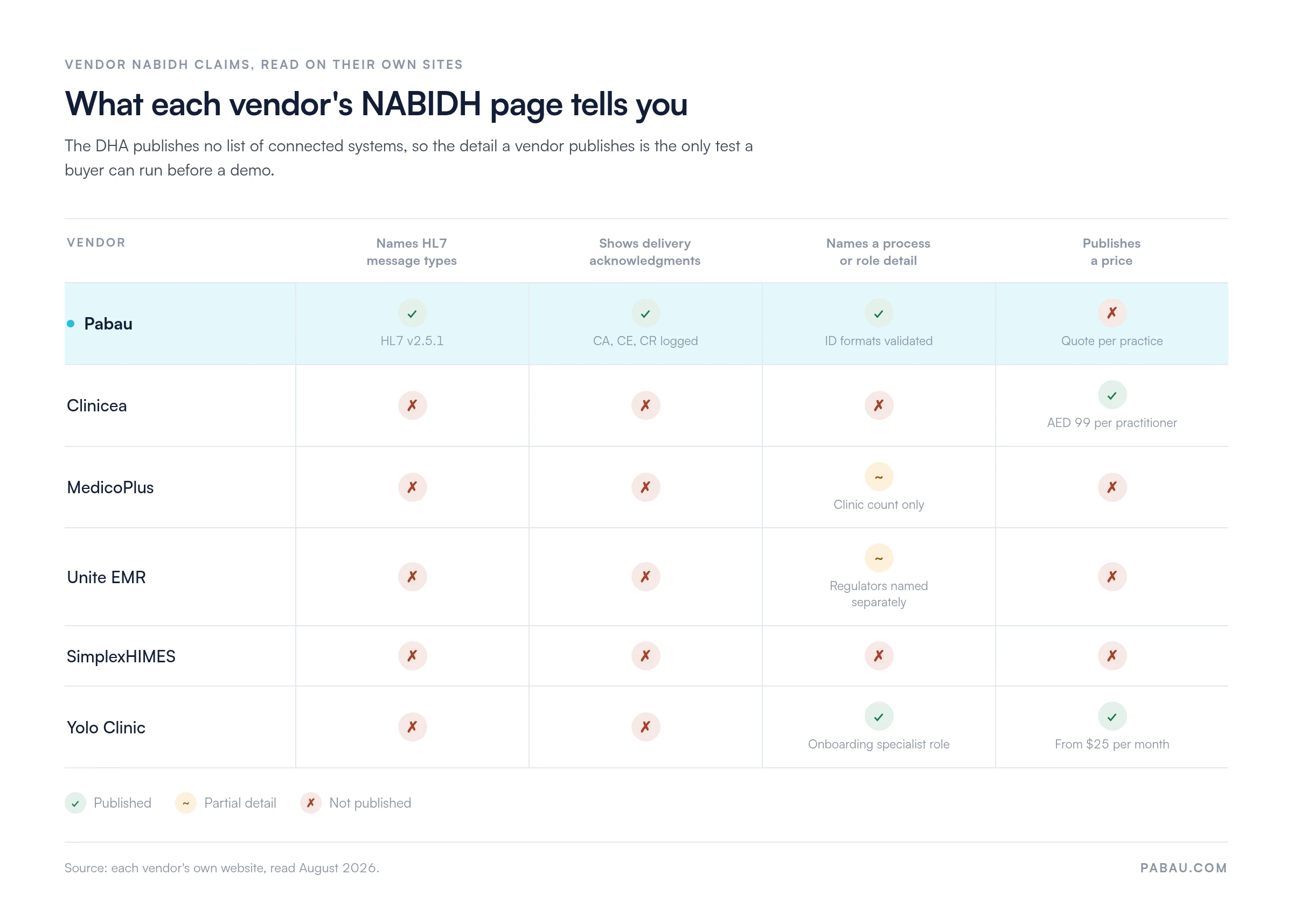
Before a demo, ask two questions any genuinely connected vendor can answer on the spot. Which HL7 v2.5 message types does your system send to NABIDH? And where do I see the acknowledgment code, CA, CE or CR, for a specific patient visit? A vendor that cannot answer either has not built the connection yet, whatever the homepage says.
NABIDH messages are built from the records your team already keeps, and every send is logged.
Pabau is practice management software built for clinics and med spas, and it is DHA NABIDH-approved.
Scheduling, clinical records, payments, marketing and reporting sit in one system instead of several tools stitched together. So the data NABIDH wants is already in one place before the first message goes out.
Registrations and demographic updates leave as ADT messages automatically. Visits, prescriptions, lab results and documents are separate message types your team switches on, mapped to the HL7 v2.5.1 format the DHA specification asks for.
Our NABIDH integration validates Emirates ID formats, UAE phone numbers, and the seven-digit facility and eight-digit clinician IDs before a message leaves.
Delivery status gets logged for every message, and that matters more than it sounds. You can see whether a message came back CA, CE or CR. So a coding problem gets caught in days instead of sitting unreported for a quarter.
Pabau does not publish fixed rates. Pricing scales with your location count and team size, and every plan includes the full platform, NABIDH reporting included.
The only vendor here that shows a per-practitioner price before you speak to sales.
Clinicea markets itself as built for Dubai’s healthcare market, while also selling into other countries. Its site calls the product a “fully compliant NABIDH connected clinic management platform” and cites a “100% track record” of implementations. Neither phrase names an HL7 message type or a Sheryan ID field.
Its user reviews on Google are strong, which is one of the few outside signals available here. In a market with no vendor registry, that counts for something.
Clinicea is one of the few vendors here that publishes a number instead of routing every visitor to a sales call. Confirm whether the promotional rate is time-limited before you sign, since the page states no end date.
One vendor for every UAE exchange, with an only-certified claim that does not hold up.
MedicoPlus, also branded Clinic Software UAE, covers NABIDH, DHA, Riayati, MOHAP and Malaffi from one platform. It sells to clinics, medical centers, polyclinics and hospitals, and cites 50+ clinics reporting to NABIDH through it, plus 12 years in the UAE market. Its Google reviews are positive.
The “Dubai’s only” claim is where it stumbles. Clinicea, Unite EMR, SimplexHIMES and Yolo Clinic all publish NABIDH-connection claims of their own. So at least one of those “only” statements is marketing rather than fact. Worth remembering when a rep repeats it on a call.
No pricing appears anywhere on the MedicoPlus site. Budget for a sales conversation before you get a number you can compare.
The most carefully worded NABIDH claim here, next to heavy insurance claims automation.
Unite EMR says it serves more than 400 clinics across the UAE and has automated over $100 million worth of insurance claims since 2015. It targets small and medium practices, healthcare chains and wellness spas, and lists ophthalmology and dental practices among its clients.
Its NABIDH claim is worded more carefully than most here. The site separates “DHA for NABIDH” from “MOHAP for Riayati” instead of folding every UAE compliance term into one line. That wording at least shows it knows the two regulators are different. Message-level detail is still missing.
Like MedicoPlus, Unite EMR keeps pricing off its site entirely. Ask for a written per-user quote if you want to compare it against Clinicea or Yolo Clinic.
Built for hospitals and diagnostic centers rather than a single-site practice.
SimplexHIMES sells a full hospital information management system rather than a clinic-only EMR, in cloud or on-premise form. It says it serves over 200 healthcare facilities, spanning hospitals, clinics, diagnostic centers and pharmacies.
“The preferred cloud EMR in Dubai” is a self-declared label, not a ranking anyone verifies. Its NABIDH page names no message types or ID fields either. Ask for that detail directly if the system reaches your shortlist.
No published tiers here either. SimplexHIMES quotes per facility, and its site offers value language where a figure would be more useful.
The cheapest entry price on this list, though NABIDH starts on the middle tier.
Yolo Clinic publishes three tiers, from a $25 Basic plan up to a $150 Golden plan with 24/7 support. It is the only vendor here with a full public price list rather than one promotional rate.
Read the fine print before you pick the cheapest option. Yolo’s site lists NABIDH integration as a Pro plan feature, not a Basic one. A practice that signs up at $25 expecting NABIDH reporting would have to upgrade first.
To its credit, Yolo names the role that does the work. A NABIDH onboarding specialist handles the DHA agreements and the production IDs, which is more concrete than most competitor pages get about the connection itself.
Yolo prices per plan rather than per practitioner, so check the user caps carefully. Three practitioners cost $75 on the Pro plan, against AED 297 a month at Clinicea’s rate.
Every vendor on this list will answer yes when you ask whether they are NABIDH connected. These five checks separate a live connection from a plan to build one:
A vendor who answers all five on the first call is usually further along than one who sends a compliance brochure.
Most Dubai practices split this job across tools. The front desk books in one system, notes live in another, and someone exports data at month end to satisfy the reporting requirement. Every handoff is a chance for a mismatched ID or a missing field.
Pabau keeps the chain in one place. A receptionist registers the patient, the practitioner writes the note, and the NABIDH message is built from those records without a separate export. ID formats get validated before the message leaves, so a typo surfaces at the front desk rather than at the exchange.
Practices running several services under one license feel that most. A med spa arm, a dermatology room and a follow-up appointment all sit in the same records, so each one reports the same way. When a message fails, your team sees the acknowledgment code and fixes the record that day.
Every subscription includes NABIDH reporting, so compliance never depends on which plan you picked. Onboarding is structured too, with your facility and practitioner IDs mapped before you go live.

Book a live walkthrough and see how registrations, visits and clinical notes turn into NABIDH messages automatically, with delivery status you can actually see.

A “NABIDH approved” banner tells you a vendor wants your business in Dubai. It does not tell you whether the connection survives a DHA integration test, and no public list exists for you to check it against.
So make the specifics part of the demo. Ask for the message types, the acknowledgment codes, and the screen where failed messages appear. A vendor who answers those three in the call has earned a place on your shortlist.
Price transparency is the other half of the decision. Clinicea and Yolo Clinic publish figures you can compare today, while the rest quote per practice. Book a demo to see how Pabau reports to NABIDH alongside booking, records and payments in one system.

Want the full mechanics of NABIDH compliance? Our guide to what NABIDH means for a Dubai practice covers the message types and acknowledgment codes the DHA checks.
Not sure how practitioner IDs work? Our explainer on Sheryan and the DHA walks through the licensing IDs every clinical message has to carry.
Running an aesthetic practice specifically? Our roundup of medical spa software in the UAE looks at booking, marketing and payments alongside compliance.
Not sure EMR and EHR mean the same thing? Our EHR meaning explainer breaks down the difference and why it matters for reporting.
Fixing registration data before it reaches the exchange? Our guide to patient onboarding software shows how clean intake data prevents rejected messages.
Plan for weeks, not days. Registering through the NABIDH provider portal is quick. Mapping every practitioner and facility identifier takes longer. Then comes testing in the DHA sandbox, which rarely passes on the first attempt.
Yes, but ask about the export format first. Structured data like demographics and appointments usually transfers cleanly. Scanned documents and free-text notes often need manual work. Get the migration scope written into the contract before you sign.
In most cases, yes. UAE federal law on health data restricts storing or processing it outside the country unless the health authority allows an exception. So ask any cloud vendor where its servers sit, and get the answer in writing.
No. NABIDH moves clinical records between providers, so it is not a billing channel. Dubai insurance claims still go through eClaimLink, the DHA platform for claims. Check whether your EMR submits to both, because some cover one and not the other.