HIPAA compliant texting: What you can send patients & how to communicate securely
HIPAA compliant texting is possible when a text holds no protected health inform...

Last Updated: Oct 16, 2026

Malaffi is Abu Dhabi’s health information exchange, run by Abu Dhabi Health Data Services with the Department of Health, Abu Dhabi.
Connecting to Malaffi is mandatory for DOH-licensed facilities in Abu Dhabi, with narrow exemptions like military and university facilities.
Malaffi is separate from Dubai’s NABIDH, under a different authority and a different mandate, so a practice in both emirates connects to each one.
Malaffi exchanges demographics, encounters, labs, medications, and clinical documents, and patients can view their own record on the Malaffi Health Portal.
Pabau is a NABIDH-compliant medical clinic software for Dubai practices, while Abu Dhabi sites connect to Malaffi through its own Provider Portal.
Malaffi is Abu Dhabi’s health information exchange, run by Abu Dhabi Health Data Services with the Department of Health, Abu Dhabi. It links patient records across every licensed hospital, practice, and pharmacy in the emirate.
It launched in 2019 and now connects more than 3,000 facilities. A patient’s labs, medications, and visit history follow them between providers, instead of staying locked inside one practice’s system.
If you already run a Dubai practice, this will look familiar. Practice management software like Pabau is already NABIDH-compliant for the Dubai side. But Malaffi runs on different rules, under a different authority, in a different emirate.
Here’s what it connects, who has to join, and what changes if your practice has sites in both Dubai and Abu Dhabi.
Malaffi is operated by Abu Dhabi Health Data Services (ADHDS), an M42 company, as a public-private partnership with the Department of Health, Abu Dhabi (DOH). It was the first health information exchange of its kind in the region.
The point is to give a clinician one unified view of the patient, rather than the fragment sitting in their own EMR.
The rollout has been fast. Malaffi now connects more than 3,000 healthcare facilities and over 50,000 clinical users. That covers close to 100% of hospitals and 99% of patient episodes across Abu Dhabi.
For a practice, that means almost every other provider a patient sees is already on the network. A record you contribute is visible to the next clinician they visit, rather than filed away in isolation.
Yes. Every DOH-licensed healthcare facility in Abu Dhabi has to connect to Malaffi. The only exemptions are military, police, and aviation medical facilities, universities, and any other category DOH designates as sensitive or exceptional. That leaves hospitals, practices, diagnostic centers, dialysis centers, and pharmacies all in scope.
This isn’t a soft recommendation. A facility that hasn’t completed its Malaffi connection can’t renew its DOH license. If it holds an agreement with Daman, it also can’t submit claims until the connection is done.
For a practice owner, that puts Malaffi alongside every other licensing requirement, rather than on the list of integrations to get to eventually. A new practice meets the requirement sooner, because the connection is one of the approvals for a permanent Abu Dhabi facility license.
Connected facilities exchange a broad clinical picture, not just a name and a date of birth:
Clinicians see this through a Provider Portal. It can sit embedded inside a connected EMR, so authorized staff aren’t switching screens to pull a patient’s history.
Patients get their own view too, through the Malaffi Health Portal. There they can check their labs, medications, allergies, and past visits without calling the practice that treated them.
It’s easy to assume NABIDH and Malaffi are the same idea running under two names. They aren’t. NABIDH is Dubai Health Authority’s exchange, built around HL7 v2.5.1 messaging straight from a practice’s own system.
Malaffi is Abu Dhabi’s exchange, run by ADHDS with DOH. It connects mainly through a Provider Portal embedded in the practice’s EMR. The regulator, the mandate, and the technical route in are all different. Clearing one says nothing about a facility’s standing with the other.
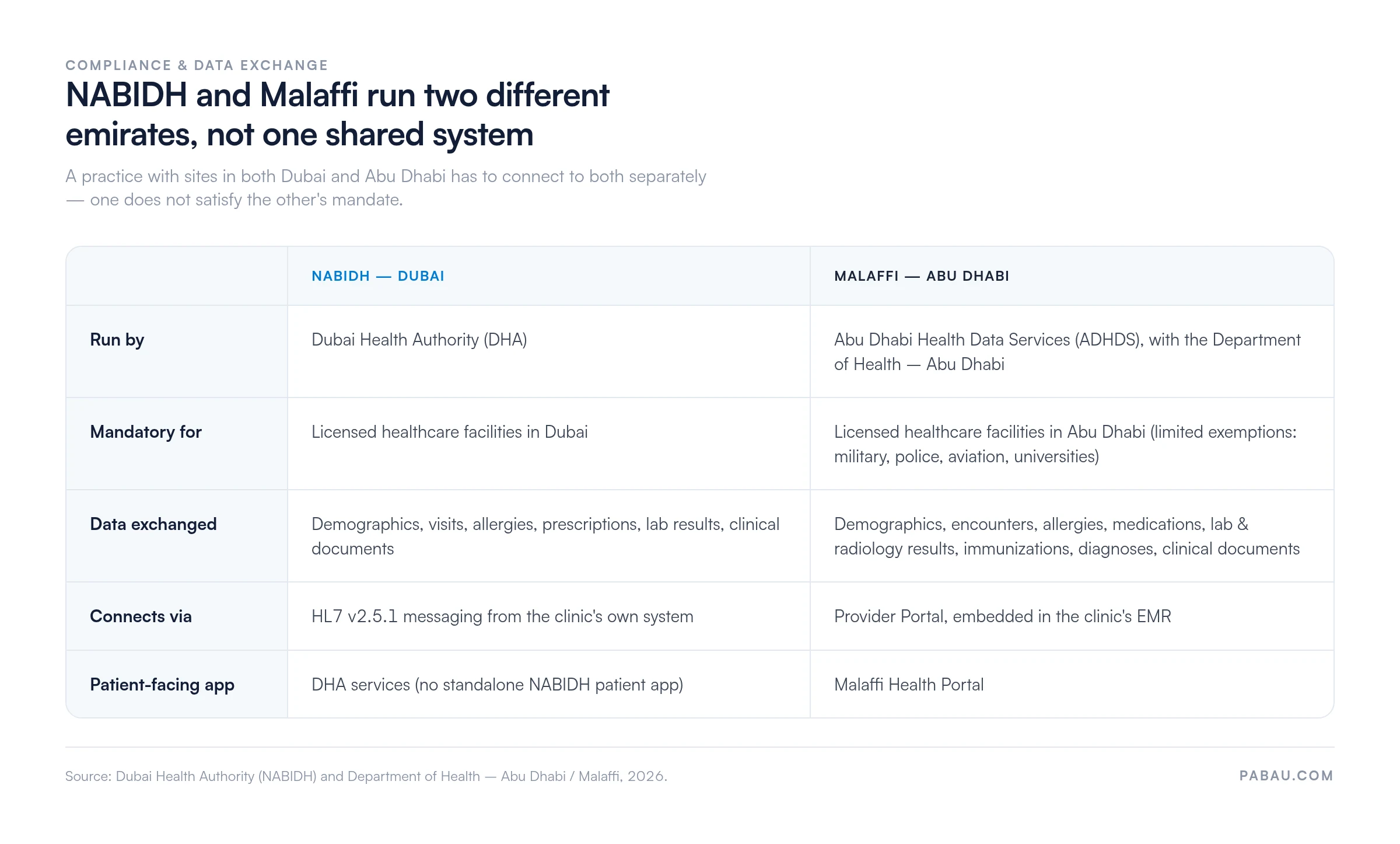
There’s a third layer above both of them. The UAE Ministry of Health and Prevention runs Riayati, a federal exchange covering the other five emirates. It’s designed to eventually link up with NABIDH and Malaffi at a national level.
For a Dubai or Abu Dhabi practice, though, Riayati doesn’t replace either system. NABIDH and Malaffi are still the exchanges you’re licensed against.
Run a single site in Dubai, and NABIDH is your entire obligation. Run a single site in Abu Dhabi, and it’s Malaffi alone. The moment a group operates in both emirates, both obligations apply at once, in full, with no overlap between them.
In practice, that means running two projects side by side:
Connecting your Dubai practice to NABIDH does nothing for your Abu Dhabi site’s Malaffi status, and the reverse is just as true. Treat them as one shared UAE interoperability project internally. But budget the connection work, and the compliance ownership, for each emirate separately. Staff licenses split too, so your Abu Dhabi clinicians need a DOH Abu Dhabi license, while your Dubai nurses need a DHA nursing license.
For the Dubai side of that picture, Pabau is NABIDH-compliant, built against the DHA’s HL7 v2.5.1 specification. Patient demographics register and update automatically. A Dubai practice can also send visits, allergies, prescriptions, lab results, documents, and letters through the same connection.
Abu Dhabi works differently today. Pabau doesn’t currently connect to Malaffi. An Abu Dhabi site still links up through Malaffi’s own Provider Portal or a connected-EMR route. That’s the same path it would take with any practice management system.
What Pabau does for that site is the work around the connection. Scheduling, treatment notes, consent, inventory, billing, and patient communication sit in one record, ready whenever the practice reports into Malaffi. It works the same way for a skin clinic in Dubai as for a hair transplant clinic in Abu Dhabi.

Pabau’s NABIDH connection registers patient demographics automatically and can send visits, allergies, prescriptions, and lab results. Your Dubai practice keeps clinical records, scheduling, and billing in one place while staying compliant.

Malaffi and NABIDH solve the same underlying problem, which is a patient’s record scattered across providers. But they solve it as two separate systems, answering to two separate regulators. Treating them as interchangeable is the mistake that catches multi-emirate practices out.
If your group operates in both Dubai and Abu Dhabi, plan the two connections as separate projects with separate owners. The same clinical team can feed both.
For the Dubai side, that groundwork is already built in. Book a demo to see how Pabau’s NABIDH connection keeps a Dubai practice compliant without extra admin.

Running practices across more than one UAE emirate? Our roundup of multi-location practice software compares how the leading platforms handle scheduling and reporting across sites.
Shopping for aesthetic practice software in the UAE? UAE medical spa software breaks down how each option handles Dubai and Abu Dhabi compliance.
Licensing a practice or practitioner in Dubai? Our guide to Sheryan walks through the DHA portal, from an inactive license to activation.
Choosing a records system for a Dubai site? EMR software in Dubai compares the NABIDH-ready options and what each one connects.
No. Malaffi is Abu Dhabi’s health information exchange, run by Abu Dhabi Health Data Services with the Department of Health, Abu Dhabi. NABIDH is Dubai Health Authority’s separate exchange for Dubai. A facility’s connection to one has no bearing on its standing with the other.
Yes, for almost every DOH-licensed healthcare facility in Abu Dhabi. The only exemptions are military, police, and aviation medical facilities, universities, and categories DOH specifically designates as sensitive. Facilities that aren’t connected can’t renew their DOH license.
Malaffi is operated by Abu Dhabi Health Data Services (ADHDS), an M42 company, as a public-private partnership with the Department of Health, Abu Dhabi (DOH).
Yes. The Malaffi Health Portal lets patients in Abu Dhabi view their own visit history, lab and radiology results, medications, allergies, immunizations, and discharge summaries online.
No, only Abu Dhabi. Dubai has its own exchange, NABIDH. The other five emirates connect through Riayati, the federal platform run by the UAE Ministry of Health and Prevention.