Medicare charting cheat sheet
A Medicare charting cheat sheet is a one-page reference that lists what Medicare...

3
Last Updated: Oct 21, 2026

ModMed delivers deeper specialty workflows for dermatology, orthopedics, and ophthalmology, while eClinicalWorks covers 40+ specialties with broader breadth.
eClinicalWorks publishes its rates: $499 per provider per month for the EHR, or $599 with practice management.
ModMed does not publish pricing at all, so every figure comes through its sales team.
Capterra reviewers rate ModMed 4.5/5 across 568 reviews and eClinicalWorks 3.3/5 across 396 reviews.
Aesthetic, wellness, and multi-location practices suit neither platform, so weigh purpose-built options like Pabau as well.
Picking the wrong EHR costs a specialty practice months of rework. ModMed and eClinicalWorks land on the same shortlists constantly, yet they serve quite different audiences.
Here is the short version. ModMed suits single or dual-specialty practices inside its core verticals. eClinicalWorks suits multi-specialty groups that need coverage across many departments.
This guide compares the two on clinical documentation, revenue cycle management, specialty depth, pricing, and user satisfaction. Only one of them publishes a rate, which is where most comparisons stop short.
Before the feature-by-feature detail, here is how the two platforms position themselves.
This is where the two platforms diverge most sharply, and where your specialty mix decides the winner.
ModMed’s Electronic Medical Assistant (EMA) learns from each physician’s documentation habits over time. It surfaces relevant procedure codes and auto-populates note templates. It also adjusts suggested content based on the specialty and the clinician’s past charting behavior.
Dermatologists, ophthalmologists, and orthopedic surgeons consistently praise this in reviews. They point to shorter documentation times once the system is trained on their workflow.
The trade-off is scope. ModMed EMA works best inside its supported specialties. Practices operating outside those verticals find templates less relevant and adaptation slower.
eClinicalWorks takes the opposite approach. It covers a reported 40+ specialties with configurable templates rather than specialty-native adaptive logic. AI-powered voice dictation and ambient documentation tools help reduce charting time across the board.
For multi-specialty groups running primary care alongside two or three specialist departments, that breadth matters more than any single specialty’s depth. The Healow patient portal then connects clinical documentation to patient-facing communications, which keeps pre-visit and post-visit work inside one system.
Revenue cycle management separates software that pays for itself from software that doesn’t. Both platforms offer integrated claims management, but their approaches differ in structure and target audience.
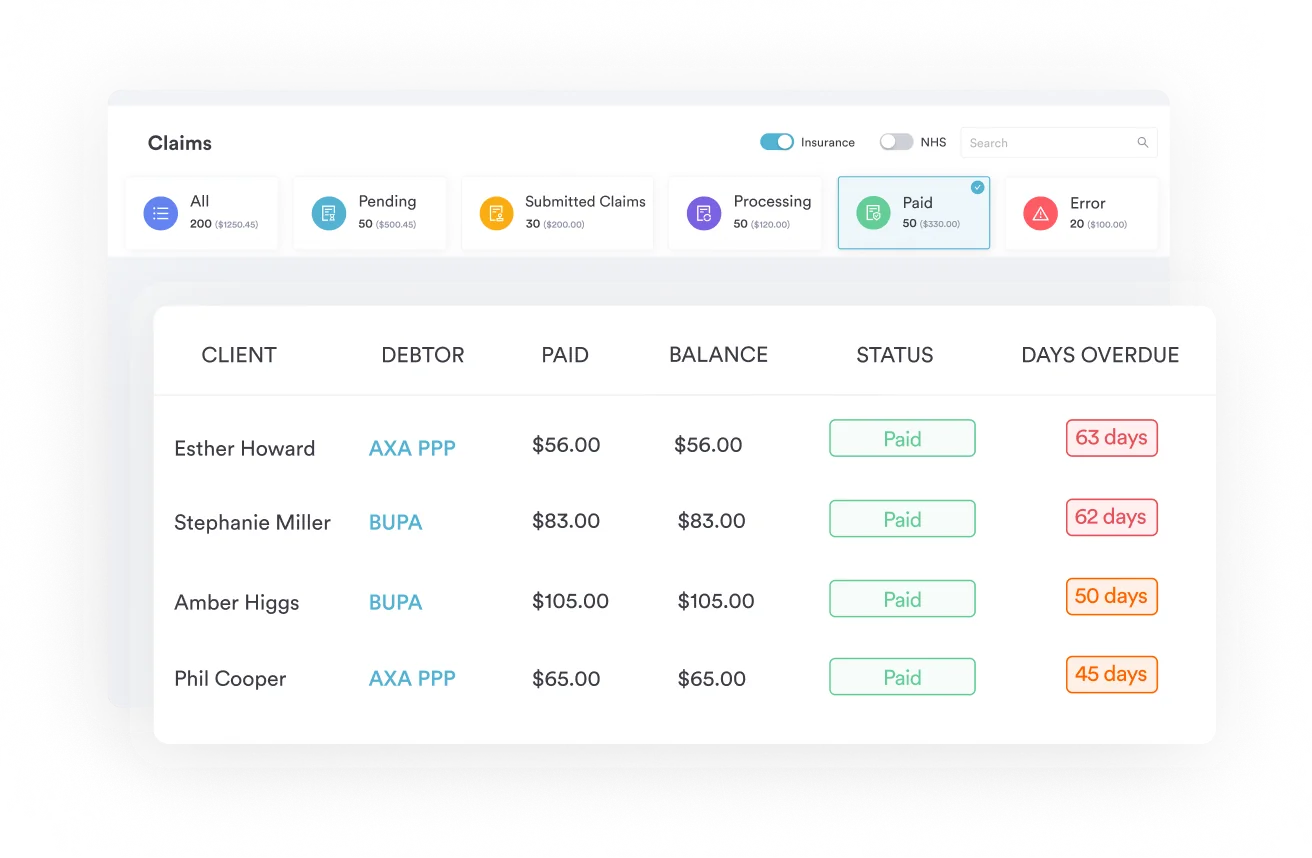
ModMed RCM: ModMed’s revenue cycle service combines specialist billing staff with its own technology stack. Practices outsource the billing function to ModMed’s RCM team, which handles claims scrubbing, denial management, and follow-up. That appeals to specialty practices that want one accountable vendor, and it carries a premium price.
eClinicalWorks RCM: eClinicalWorks offers in-house RCM services alongside tools practices can use to manage billing themselves. Automated coding suggestions, clearinghouse integration, and denial tracking are built into the platform. Large multi-specialty groups with dedicated billing teams tend to use these tools internally rather than outsourcing.
Quality reporting matters to both. According to CMS, practices participating in MIPS must meet specific quality reporting thresholds. Both platforms provide dashboards to track those measures.
Specialty fit is the core decision driver for most practices evaluating these two platforms.
ModMed is widely regarded as one of the strongest dermatology EHRs on the market. Its EMA system includes dermatology-specific body diagrams, cosmetic and medical workflow separation, procedure-specific templates, and a 3D body map with condition-linked coding. Dermatologists reviewing the platform on Capterra consistently cite reduced documentation time as the primary benefit.
eClinicalWorks supports dermatology through configurable templates and standard EHR workflows. It works, but it does not offer the same native dermatology depth. Practices with a mixed dermatology and primary care book may find eClinicalWorks more practical, given its breadth.
ModMed builds dedicated modules for orthopedics, ophthalmology, and plastic surgery. Each one carries adaptive templates, imaging integrations, and procedure-specific coding inside that specialty’s workflow. eClinicalWorks supports these specialties at a configurational level, without native adaptive logic for each one.
For single-specialty groups running one of ModMed’s core verticals, ModMed is the stronger clinical tool. For practices spanning three or more specialties, eClinicalWorks’ breadth usually wins on total operational efficiency.
eClinicalWorks publishes its rates. ModMed does not, and that is the sharpest practical difference between the two on cost.
eClinicalWorks lists $499 per provider per month for the EHR on its own site. Adding practice management takes it to $599 per provider per month. Both figures are per provider, so a four-physician group multiplies them by four.
ModMed justifies an opaque quote through practice-size customization and module bundles. It sits at the premium end, given the specialty depth and the managed RCM service it delivers.
Ask both vendors to price implementation, training, and RCM separately from the core subscription, so the comparison holds up over three years.
Patient communication tools are increasingly a differentiator. Both platforms offer telehealth, appointment reminders, and patient portals, but the implementation differs.
eClinicalWorks’ Healow platform is a mature, widely used patient engagement suite. Patients can book appointments, message their care team, read visit summaries, and join telehealth sessions in the Healow app. For high-volume practices that want a standalone-capable portal, Healow is a genuine strength.
ModMed’s patient-facing tools sit closer to specialty workflows. Booking, reminders, and telehealth are built into each specialty module rather than offered as a separate patient app. For specialty practices that want clinical and communication work in one place, that reduces friction at the point of care.
When evaluating patient portal demos, ask each vendor to walk through the exact steps a new patient follows from booking to post-visit note access. The number of clicks and app downloads required tells you more about day-to-day patient adoption than any feature checklist.
Review data across Capterra and G2 tells a clear story on user satisfaction, though volume and context matter as much as the raw scores.
According to Capterra reviewers, ModMed’s specialty-specific workflows reduce documentation time noticeably once physicians are past the initial learning curve. Negative themes center on implementation complexity and the cost of the managed RCM service.
According to Capterra reviewers, eClinicalWorks earns consistent praise for its breadth and the Healow portal. It scores lower on support responsiveness and a UI that some users describe as showing its age. On G2, eClinicalWorks scores 3.6/5 across 150 reviews, with similar positive and negative themes.
The 2017 DOJ settlement comes up independently in several eClinicalWorks reviews as a factor those practices weighed during evaluation.
Both platforms are complex enterprise systems. Go-live timelines vary with practice size, specialty mix, and data migration requirements.
ModMed’s implementation process is tied closely to specialty onboarding for its EMA modules. Reviewers note that the system delivers once staff are trained, but the learning curve during implementation is steep. Support quality gets mixed feedback, with some practices reporting delayed responses during peak periods.
eClinicalWorks implementation for large multi-specialty groups is reported to be complex, particularly when migrating data from legacy systems. Training resources are available online, but practices frequently cite the need for dedicated support staff during go-live. The broad feature set means there is more to configure upfront.
What ModMed does well: The EMA adaptive engine cuts specialty documentation time once it learns a physician’s habits. Dermatologists and ophthalmologists in particular report significant savings on charting. The integrated RCM service removes billing complexity for practices that want a single accountable vendor.
Where ModMed falls short: Cost is the most consistent complaint. Pricing is opaque and typically higher than general-purpose EHRs, which is hard to justify for practices outside ModMed’s core specialty set. Limited flexibility for unsupported specialties is a constraint for mixed practices.
What eClinicalWorks does well: Breadth is its defining advantage. Over 40 supported specialties sit inside one platform. Add a mature patient engagement suite in Healow, strong reporting, and established interoperability, and it works for large medical organizations.
Where eClinicalWorks falls short: User satisfaction scores sit well below ModMed’s, particularly on support quality. The 2017 DOJ settlement of $155 million, related to EHR certification practices, appears in independent reviews and belongs in any evaluation. Some users report a dated interface relative to newer EHR entrants.
The answer depends on your specialty mix and practice size more than on any feature list. Put the review scores next to coverage and price, and the trade-off lands in one frame.
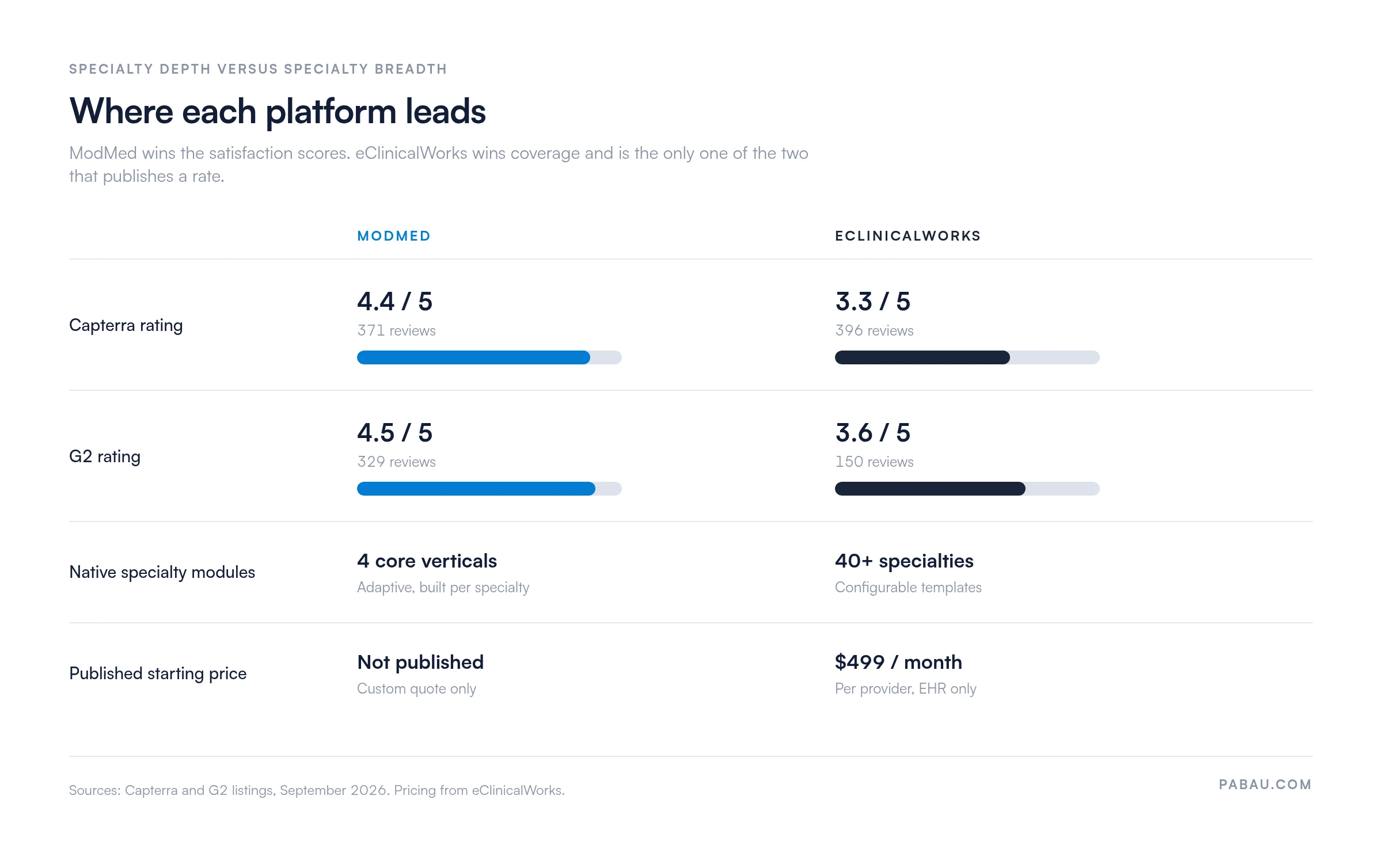
Neither platform is a universal winner. Depth and breadth pull against each other here, and the right answer moves with the number of specialties on your schedule.
If DrChrono is also on your shortlist, ModMed vs DrChrono covers that pairing in the same detail. For larger groups that also have Epic in view, eClinicalWorks vs Epic compares the two on cost, rollout time, and interoperability.
And if aesthetic or wellness services are part of the decision, our software comparison hub puts Pabau side by side with the specialty EHRs.
A third category of practice fits neither platform well. Aesthetic practices, medical spas, wellness centers, and multi-location groups run cosmetic and medical services out of the same book.
Those practices need digital consent forms and treatment plans, before and after photo management, package and membership handling, and automated recalls. ModMed and eClinicalWorks are both built insurance-billing-first, so that work sits outside their core design.
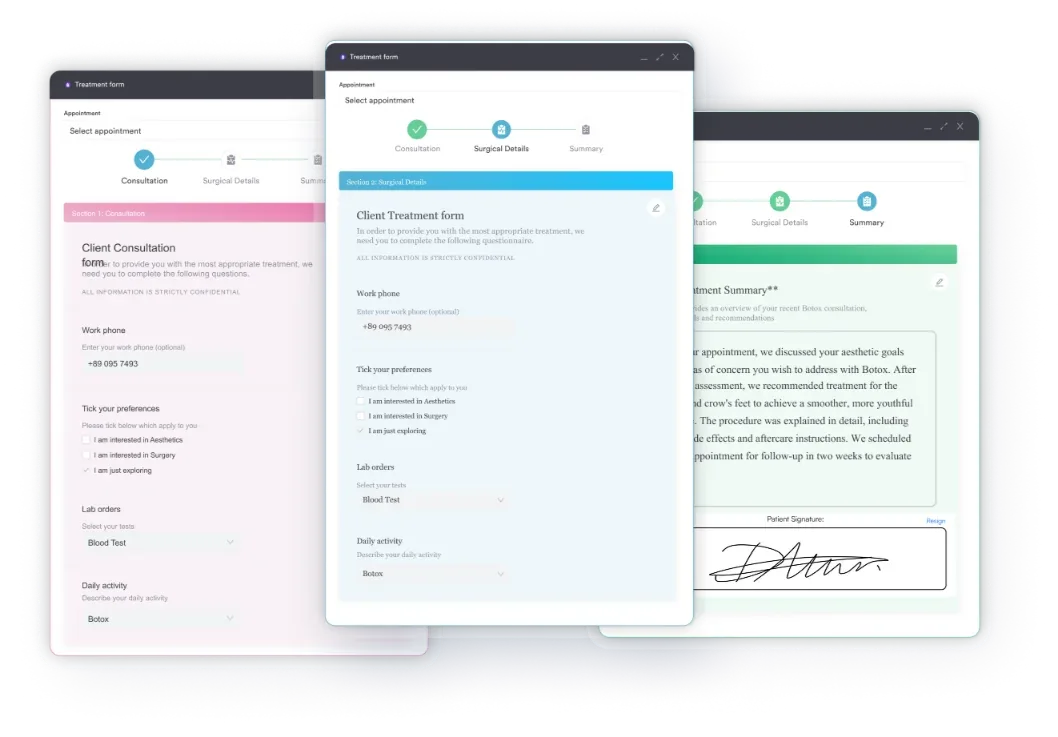
Practice management software like Pabau is built for that model instead. It pairs scheduling and clinical records with consultation tools, digital forms, photo documentation, and integrated payments for cash-pay and hybrid practices.
The outcome is fewer workarounds. Your team stops bolting a photo app and a separate forms tool onto an insurance-first EHR. Consent, notes, images, and payment sit against the same client record.
On Capterra, Pabau holds 4.7/5 from 651 verified reviews. Reviewers point to onboarding, patient communication tools, and before and after photo management.

Pabau is purpose-built for practices combining medical, aesthetic, and wellness services. See how it handles consent, treatment notes, before and after photos, and automated recalls in one system.

Run the shortlist against your specialty mix before you run it against feature lists. A practice sitting squarely in dermatology, ophthalmology, orthopedics, or plastic surgery will get its money back from ModMed’s adaptive documentation. A group spanning more departments than that will save more hours through eClinicalWorks’ breadth.
The trade-off worth remembering is that neither vendor has solved both sides. The satisfaction scores show which reader each one lets down. Only one of the two will tell you the number before a sales call.
If your practice is aesthetic, wellness, or a hybrid of medical and cosmetic work, neither one is the natural fit. Book a demo to see how Pabau handles consent, treatment documentation, and patient recalls in a single system.

Weighing ModMed against the wider market? ModMed competitors lines up the specialty EHRs that appear most often on the same shortlist.
Comparing two more EHRs head to head? DrChrono vs Practice Fusion applies the same documentation, billing, and pricing checks to a different pairing.
Running a surgical aesthetic practice? Plastic surgery EHR covers the photo, consent, and quoting workflows a cosmetic caseload adds.
Shortlisting alternatives to your current system? Pabau competitors and alternatives sets out how the main practice platforms differ on price and scope.
ModMed is a specialty-focused EHR built around adaptive clinical documentation for dermatology, ophthalmology, orthopedics, and plastic surgery. eClinicalWorks is a multi-specialty EHR designed for breadth, supporting 40+ specialties and large medical groups. The core trade-off is specialty depth versus specialty coverage.
eClinicalWorks publishes its rates: $499 per provider per month for the EHR, and $599 per provider per month with practice management added. ModMed does not publish pricing and requires a custom quote, positioned at a premium relative to general-purpose EHRs.
Yes, for most dermatology practices. ModMed EMA includes native dermatology-specific body diagrams, cosmetic and medical workflow separation, and procedure-linked coding built into the system. eClinicalWorks supports dermatology through configurable templates but lacks the same native specialty depth.
Yes. eClinicalWorks includes telehealth through its Healow platform. Patients can join video visits, book appointments, and message their care team through the Healow mobile app, which is integrated with the eClinicalWorks EHR. ModMed also offers a dedicated telehealth module integrated with its EMA system.
Yes, multi-specialty coverage is one of eClinicalWorks’ primary strengths. It supports 40+ specialties within a single platform. Large medical groups and health systems use it to run primary care alongside multiple specialist departments. ModMed, by contrast, is better suited to single or dual-specialty practices within its core supported verticals.
The right alternative depends on your specialty and practice model. Practices needing deeper specialty workflows in dermatology or ophthalmology often evaluate ModMed. Aesthetic, wellness, and multi-location practices need consent, photo documentation, and package management. Those practices often find purpose-built platforms like Pabau a better fit than an insurance-first EHR.