Head to toe assessment cheat sheet: Printable nursing guide
A head to toe assessment cheat sheet gives you one fixed order at the bedside, s...

2
Last Updated: Oct 23, 2026

The crank test is an orthopedic special test for labral tears and SLAP lesions in the glenohumeral joint.
A positive result reproduces the patient’s familiar pain, a click, or a catching sensation under axial compression with rotation.
Reported sensitivity runs from 8.7% to 91% across studies. That spread tracks examiner count and cohort selection more than technique.
Several widely quoted accuracy figures are credited to the wrong paper, so check the citation before you rely on a number.
Structured examination templates in practice management software like Pabau keep special test findings readable across a full clinical team.
A missed labral tear costs the patient months. The crank test gives you a rapid, low-cost signal for glenohumeral labral pathology before you order imaging. Performed the same way every time, it narrows the differential. Performed loosely, it adds noise to the record.
This guide covers the procedure, the interpretation criteria, and what the accuracy literature actually says. It also corrects an attribution error that runs through much of the summary literature. Several accuracy figures quoted for the crank test belong to a different study than the one they are credited to.
It is written for physical therapists, orthopedic clinicians, and sports medicine practitioners assessing shoulder pain of suspected labral or SLAP origin. The last two sections cover documentation language and the workflow around it.
The crank test is a clinical special test that detects tears of the glenoid labrum, including SLAP lesions and anterior or posterior labral tears. SLAP stands for superior labrum anterior to posterior.
Liu et al. first described the test in 1996, and it belongs to the axial compression-rotation family used in sports medicine and musculoskeletal orthopedic assessment.
The test loads the glenohumeral joint, the ball-and-socket articulation between the humeral head and the glenoid fossa of the scapula. The glenoid labrum is a fibrocartilaginous rim that deepens that socket and adds stability. It also anchors the long head of the biceps tendon at the superior aspect, which is what a SLAP lesion disrupts.
Compressive loading plus rotation provokes the labral tissue mechanically. That combination reproduces the catching or grinding a damaged labrum produces under load. The crank test is indicated in patients presenting with:
Procedural consistency decides whether the crank test helps or confuses. Two arm positions appear in the literature. The original Liu et al. protocol used 90 degrees of abduction, and several later studies used 160 degrees of elevation in the scapular plane. Both are valid, so note which one you used and findings stay comparable across assessors and follow-up visits.
Position the patient seated or standing, whichever gives you full access to the shoulder and arm. Elevate the arm to roughly 90 degrees of abduction in the scapular plane, about 30 degrees anterior to the coronal plane. For the modified version, elevate to 160 degrees instead. Flex the elbow to approximately 90 degrees.
Stand on the side being tested. One hand supports the elbow, holding the arm position and applying the axial load. The other hand sits proximal to the wrist and controls humeral rotation.
With the arm at the chosen elevation angle, apply firm axial compression along the shaft of the humerus toward the joint. Hold that compressive load throughout the maneuver.
While sustaining compression, rotate the humerus slowly through its internal and external rotation arc. Keep the sweep deliberate rather than rapid. Speed costs you the ability to feel subtle catching.
Watch for the patient’s familiar shoulder pain, an audible or palpable click, a clunk, or a reported catching sensation. Record the arc of rotation where any response appears, and whether it fell in the internal or external rotation phase.
The crank test is positive when it reproduces the patient’s pain, or when you detect a click, clunk, or catching sensation during the compression-rotation sequence. Not every shoulder click counts. The response has to be familiar to the patient as their presenting symptom. Incidental clicking without pain reproduction carries much less weight.
Interpretation by response pattern:
A single positive crank test suggests labral pathology rather than confirming it. Clinical reasoning has to take in the full history, the mechanism of injury, and the patient’s activity demands. Read the other shoulder special tests before you commit to an impression.
Reported accuracy for the crank test swings widely, and that spread matters more than any single figure you can quote.
The original Liu et al. study (PubMed PMID 8947391) used a cohort undergoing arthroscopy. It compared the crank test against the O’Brien active compression test and routine MRI.
The crank test reached 91% sensitivity and 93% specificity for labral tears. Later independent studies reported sensitivity between 8.7% and 46%, with specificity from 56% to 82.6%.
Two factors drive that difference. Liu’s cohort was pre-selected and read by a single experienced examiner, while later cohorts were broader and used multiple examiners. Arm position protocol and the mix of lesion types also differ from study to study.
Attribution is the second problem. The 46% sensitivity and 56% specificity figures that circulate under the name Parentis et al. come from Stetson and Templin’s 2002 cohort. Parentis and colleagues reported 8.7% sensitivity and 82.6% specificity for the crank test in their own 2006 series. Check which paper a number belongs to before you quote it in a report.
Set side by side, the published figures read less like one accuracy estimate and more like three different questions.
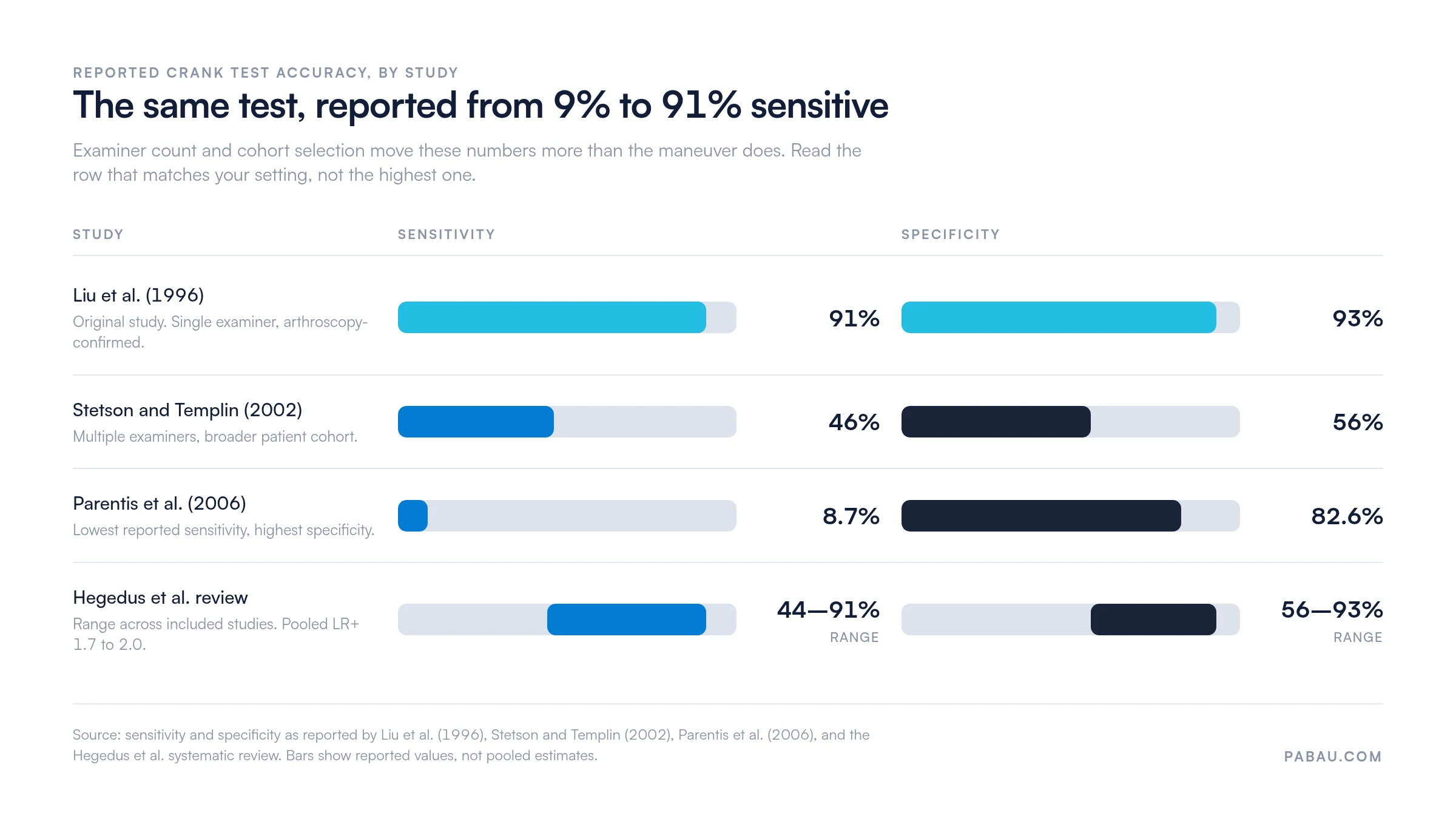
So where does that leave you at the bedside? The crank test performs best with an experienced examiner, a pre-selected population, and other tests read alongside it. A positive likelihood ratio near 1.7 to 2.0 raises the pre-test probability of labral pathology modestly. It does not rule the diagnosis in or out on its own.
The O’Brien test is the alternative clinicians reach for most often when SLAP pathology is on the list. Both tests target superior labral tissue, and each loads it a different way. Which one you choose depends on the clinical question and on how well the patient tolerates the maneuver.
One caution on that accuracy row. The crank figures come from Liu’s 1996 series and the O’Brien figures come from Stetson and Templin’s 2002 series. They are two different cohorts, so the row is not a head-to-head comparison.
Neither test should carry a diagnosis alone. Most assessment batteries for suspected labral pathology pair the crank test with the O’Brien test. Add one confirmatory test, usually the biceps load test for SLAP-specific lesions.
Practices assessing overhead athletes get more out of a structured examination template that records the whole battery in one encounter. Checkbox fields with an outcome per test cut documentation time and keep results consistent between clinicians.

Run the crank test and the O’Brien test in sequence on every suspected labral patient. Document which arc of rotation provokes symptoms. Pain on internal rotation suggests posterior labral involvement, and pain on external rotation suggests anterior pathology. That one detail directs both your MRI arthrogram request and the surgeon’s pre-operative planning.
No shoulder special test confirms or excludes labral pathology on its own, and the crank test is no exception. Leaning on it alone risks both over-investigation and missed diagnoses. The main limitations:
A positive crank test narrows the differential toward labral pathology. It does not replace imaging for definitive diagnosis or surgical planning. The decision pathway in most musculoskeletal and orthopedic settings runs like this:
The post-imaging phase is where records tend to slip. A physical therapy EMR with referral templates that pull the examination findings straight into the imaging request cuts both delays and transcription errors.
Diagnostic work only counts if the record shows it. Crank test findings need to sit in the note in a reproducible, defensible form. The next practitioner who opens the chart has to be able to use them. The SOAP language below works in most physical therapy and sports medicine records.
Objective field example: “Crank test performed at 90 degrees abduction in scapular plane with axial compression and IR/ER rotation sweep. Positive: familiar anterior shoulder pain reproduced during external rotation phase. No audible click. O’Brien test positive in pronation, negative in supination, so AC joint excluded.”
Assessment field example: “Findings consistent with glenohumeral labral pathology, most likely a SLAP lesion or anterior labral tear. Clinical impression supported by positive crank and O’Brien tests. MRI arthrogram requested to confirm and grade the lesion before a surgical referral decision.”
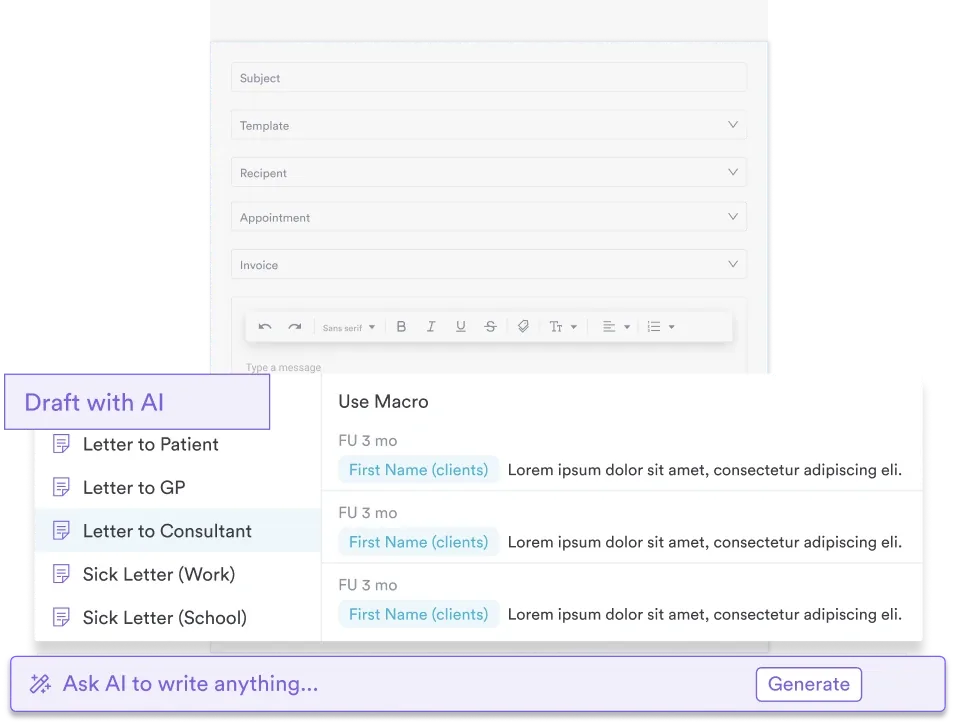
Consistency across the team matters more than the wording of any single note. Software that supports configurable note templates, structured examination fields, and AI-assisted clinical documentation keeps special test findings recorded the same way by every clinician.
The crank test is rarely performed alone. The tests below complement it during a shoulder labral assessment, each adding specificity for a different lesion type or location:
When inferior instability is also suspected, the Feagin test adds a check of the inferior glenohumeral ligament at 90 degrees of abduction. A full shoulder battery takes 10 to 15 minutes to perform and document. Recording it as one structured set, rather than five separate free-text notes, is what makes the findings comparable at the follow-up visit.
In most practices a special test result lands in a free-text box. It reads clearly to the clinician who wrote it and poorly to the next one. Six months on, nobody can tell whether the crank test was performed at 90 or 160 degrees, or which rotation arc hurt.
Practice management software like Pabau replaces that box with a configurable assessment template. Each special test gets its own field. Arm position, response type, and rotation arc are stored as discrete values instead of prose. Pabau Scribe, our AI scribe, drafts the surrounding narrative from the encounter, so the structured record still reads as a note.
The payoff arrives later. You can filter a patient cohort by test outcome and audit how consistently the battery is performed. A new clinician gets a template that already encodes your protocol. Every Pabau subscription includes these templates, so nothing here is an add-on.
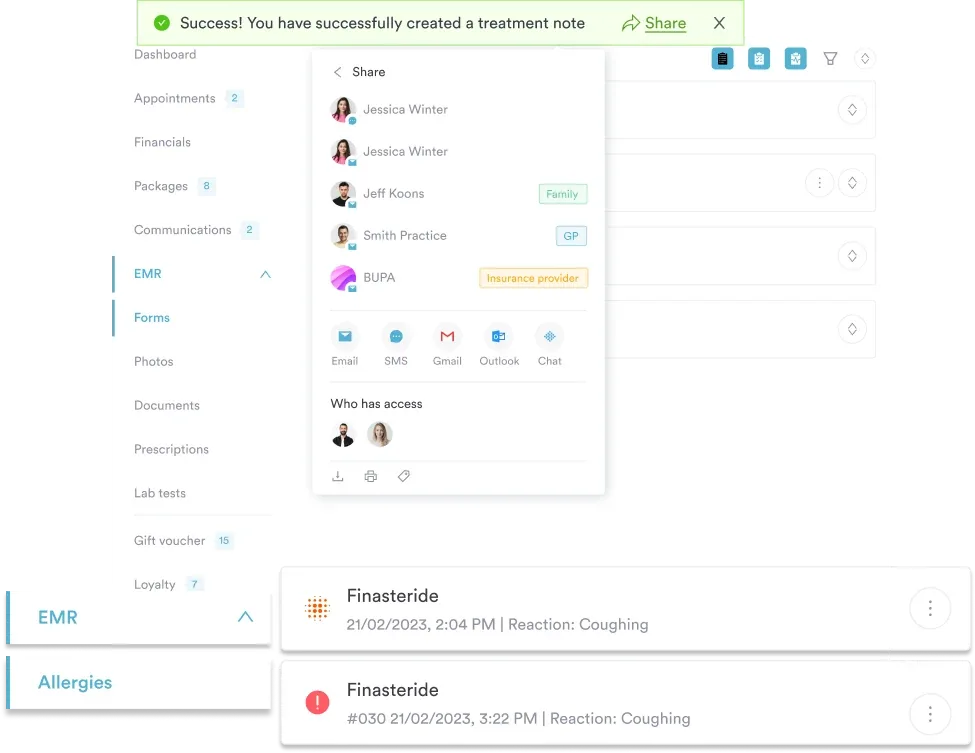

Configurable examination templates, structured special test fields, and AI-drafted referral letters keep your team’s shoulder documentation consistent. See how Pabau fits a physical therapy or sports medicine practice.

The crank test earns its place as a fast way to raise or lower your suspicion of labral pathology. It does not earn a diagnosis. Its accuracy rises with a consistent examiner, a pre-selected population, and other tests read alongside it. A positive result points to an MRI arthrogram, not to a conclusion.
Two habits are worth taking away. Record the arm position and the rotation arc every time, so the next assessor can reproduce what you found. And check the citation before you quote an accuracy figure, because several numbers in circulation belong to the wrong paper.
The documentation habit is what carries your diagnostic work forward to the next clinician. Structured fields, consistent SOAP language, and templates the whole team uses keep examination quality steady as the practice grows.
Book a demo to see how Pabau records shoulder special test findings for physical therapy and sports medicine teams.

Need to rule in a posterior labral tear? Kim test walks through the procedure and gives you a form to record the result.
Separating labral pain from rotator cuff pain? Infraspinatus test covers the external rotation strength test that helps exclude a posterior cuff tear.
Suspect a subscapularis tear as well? Lift-off test explains the procedure and what a positive result means for anterior shoulder pain.
Building governance around your examination records? Mandatory compliance for physiotherapy clinics sets out the documentation and governance requirements practices must meet.
The crank test is an orthopedic special test used to detect labral tears and SLAP lesions in the glenohumeral joint. Clinicians perform it during shoulder examinations in physical therapy, sports medicine, and orthopedic settings to identify labral pathology before ordering imaging.
A positive crank test points to glenohumeral labral pathology, most often a SLAP lesion or an anterior or posterior labral tear. It suggests labral damage rather than confirming it. Clinical correlation and an MRI arthrogram are needed for a definitive diagnosis.
Reported sensitivity runs from roughly 8.7% to 91%, and specificity from 56% to 93%. The highest figures come from Liu et al. in 1996, with a single experienced examiner and an arthroscopy-confirmed cohort. Independent multi-examiner studies report much lower sensitivity, so interpret any single figure in context.
The crank test uses axial compression with rotation in an elevated arm position, and it is more sensitive for anterior and posterior labral tears. The O’Brien active compression test uses resistance in a forward-flexed, adducted, pronated position. It is particularly useful for separating SLAP lesions from acromioclavicular joint pathology. Most clinical batteries use both.
An MRI arthrogram is the preferred next step after a positive crank test with a consistent clinical history. Non-contrast MRI can miss 30% to 40% of labral lesions. If conservative management fails after 6 to 12 weeks, a surgical referral for arthroscopic evaluation is appropriate, subject to clinical judgment and local protocols.
A SLAP lesion is a tear of the superior glenoid labrum running from anterior to posterior, often involving the biceps tendon anchor. Diagnosis combines clinical tests, the history of overhead activity or a fall on an outstretched hand, and an MRI arthrogram. The arthrogram confirms and grades the lesion before surgical planning.