Nursing narrative note template
A nursing narrative note template is a structured PDF that guides you through re...

2
Last Updated: Oct 21, 2026

Five coping skills carry the strongest evidence for depression: behavioral activation, cognitive restructuring, DBT distress tolerance, mindfulness, and exercise.
The severity-match framework picks between them, with behavioral activation for less severe depression, CBT for more severe, and MBCT for recurrent episodes.
DBT distress tolerance skills such as TIPP are what a patient reaches for when depression hits hardest.
Postpartum depression reshapes the plan, because broken sleep and reduced autonomy defeat standard activity scheduling.
Clinicians improve outcomes by embedding a structured coping plan in ongoing care.
Coping skills for depression work best when the skill is matched to the severity of the episode, rather than picked off a list. Behavioral activation suits less severe presentations, CBT-based cognitive restructuring suits more severe ones, and MBCT holds the relapse-prevention slot.
Depression affects approximately 332 million people globally, according to the World Health Organization. Diagnosis rarely arrives with structured skill-building attached. Most patients leave with a medication review, a referral, and a wait.
Healthy coping skills for depression fill that waiting period. These strategies help patients regulate emotion, interrupt rumination, and re-engage with activity between sessions.
The strongest evidence sits with four therapeutic frameworks: CBT, DBT, ACT, and MBCT. Behavioral activation and a small set of lifestyle interventions sit alongside them. We call the matching rule the severity-match framework, and it runs through every section below.
The five coping skills with the strongest evidence are behavioral activation, cognitive restructuring, DBT distress tolerance, mindfulness practice, and regular exercise. Sleep hygiene runs underneath all five, because sleep disturbance both signals depression and sustains it.
Naming the five is the straightforward part. The severity-match framework below is what decides which one a given patient starts with, and in which session.
Evidence for coping skills in depression splits three ways: strategies that reduce symptom severity, strategies that prevent relapse, and strategies that support daily functioning. The phrase “coping skills” covers all three, and it stretches from therapeutic techniques to loosely defined wellness habits.
The line worth drawing for a patient is between everyday low mood and a depressive episode. Two weeks of persistent low mood, lost interest, and disrupted sleep or appetite changes the picture. At that point, coping skills belong inside treatment rather than instead of it. Documenting that threshold consistently often starts with a structured psychiatric evaluation template at intake.
NICE guideline NG222 gives the clearest framework here. NG222 recommends a stepped-care model, in which low-intensity interventions such as guided self-help and behavioral activation come first. High-intensity therapies like full CBT follow when the presentation warrants them.
Which strategy you recommend depends on the patient’s episode severity, history, and treatment stage. The matrix below sets each strategy against its place in NG222, so the severity-match framework sits on one screen.
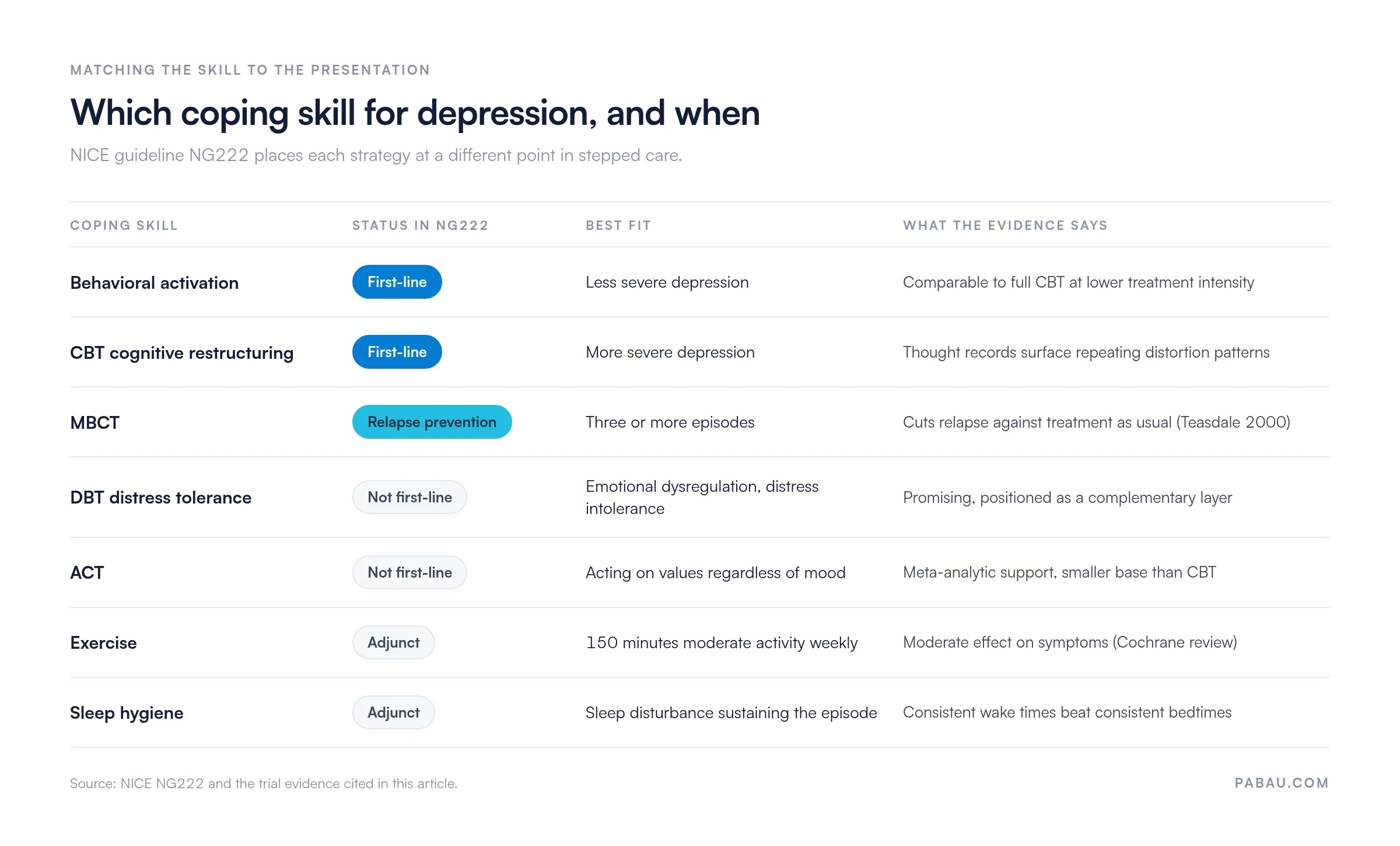
Three principles hold across all of them:
Behavioral activation is a structured way of getting a patient back into doing things, starting with the smallest tasks, before motivation returns. Behavioral activation, usually shortened to BA, targets the withdrawal-avoidance cycle.
Depression reduces motivation and pleasure, so people do less, and doing less reinforces low mood. BA interrupts that cycle by reintroducing activity in a planned order. The sequence starts with tasks that need minimal effort, then builds toward meaningful or rewarding behavior.
NG222 recommends behavioral activation as a first-line psychological intervention for less severe depression. Multiple randomized controlled trials support it, including trials that compared BA with full CBT and found comparable outcomes at lower treatment intensity. UK professional bodies endorse BA as a standalone intervention rather than a component of broader therapy.
Behavioral activation runs in three steps: monitor activity and mood for a week, schedule achievable and valued activities, then build in mastery and pleasure. The monitoring week is where clinicians are most often tempted to skip ahead.
That baseline shows the relationship between activity and mood, which is a psychoeducational tool in itself. The pattern reads more clearly when the patient can name the kinds of moods they are moving through.
Three pitfalls come up repeatedly:
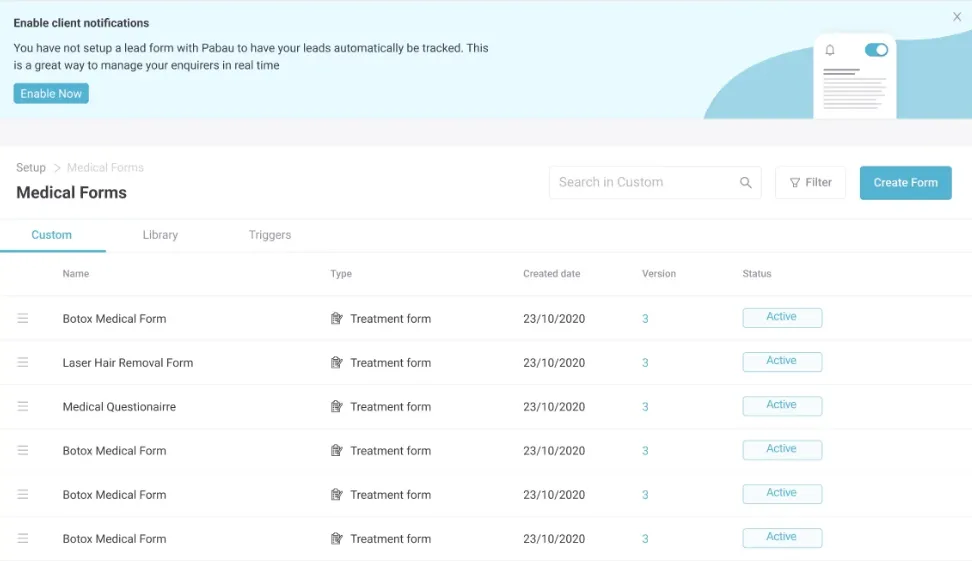
Structured templates keep the process consistent, whether they sit on paper or inside the clinical record.
Build a behavioral activation monitoring sheet into your intake workflow. Patients who track activity and mood between sessions arrive with concrete data to discuss. Digital forms can collect that data and surface it before the appointment starts.
Cognitive coping skills teach a patient to notice a distorted thought, test it against the evidence, and replace it with a balanced one. Cognitive behavioral therapy (CBT) is the flagship psychotherapy for depression, and NG222 recommends it as a first-line psychological treatment for more severe presentations.
The cognitive components of CBT are often used on their own as coping strategies between formal sessions. Depression distorts thinking in predictable directions: catastrophizing, black-and-white reasoning, and personalization. Those patterns are automatic, habitual, and invisible to the patient at first.
Two low-cost additions sit alongside restructuring. Journaling gives the patient somewhere to catch thoughts as they happen, and self-compassion practice softens the self-criticism that restructuring alone rarely reaches.
Here is how the walkthrough usually runs. A patient arrives with “I failed at everything this week.”
The clinician asks for the week item by item. The patient lists two missed deadlines, one report delivered on time, and three mornings of getting up when the alarm went.
Then comes the naming step. The distortion is all-or-nothing thinking, and saying the name out loud is part of the work.
The balanced alternative is not a cheerful reframe. “I missed two deadlines and finished three other tasks” matches the evidence, and matching the evidence is the whole test. The technique feels artificial at first, which is worth normalizing before the patient tries it alone.
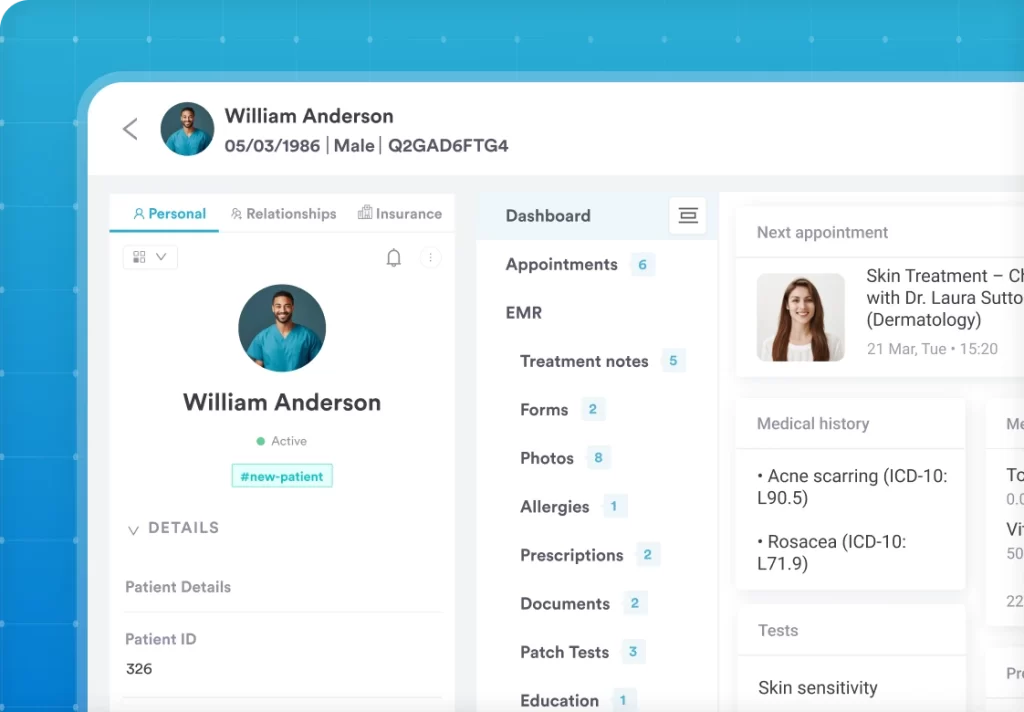
Thought records are the standard tool for this work. They usually run five to seven columns: the situation, the automatic thought, the emotion and its intensity, the evidence both ways, and a balanced alternative. A record section for between-session thought work lets you track progress and spot persistent distortions.
Rumination breaks when the patient’s focus has somewhere else to go: a fixed 15-minute worry window, attention training, or a fully absorbing task.
Rumination is repetitive, passive focus on distress and its causes, and it is one of the strongest maintaining factors in depression. Problem-solving moves toward action, while rumination cycles without resolution.
Clinicians in psychology practices find that patients need explicit psychoeducation on the difference between thinking about a problem and ruminating on it. Without that distinction, patients hear “interrupt rumination” as “suppress important thoughts”, which raises distress instead of lowering it.
CBT and behavioral activation carry the strongest evidence for depression. Two other frameworks still contribute: dialectical behavior therapy (DBT) and acceptance and commitment therapy (ACT). Both have a growing evidence base for depression, and neither is a NICE first-line recommendation in the way CBT is.
For a summary of the trial data, a meta-analysis of ACT across mental and physical health conditions reviews the controlled evidence.
When depression hits hard, the fastest help is a distress tolerance skill: cold water, intense exercise, paced breathing, or muscle relaxation. Those four are TIPP, and DBT distress tolerance skills are built for exactly that moment.
TIPP works on the body first, which is what makes it usable at a point when reasoning has stopped being available. Teach the sequence while the patient is calm, and rehearse it in session, because nobody learns a new skill mid-crisis.
DBT was developed for borderline personality disorder and has since been adapted for depression. DBT fits best where emotional dysregulation and distress intolerance are prominent features of the presentation.
Emotion regulation skills work on the other timescale. PLEASE skills reduce vulnerability to negative emotions through steady sleep, nutrition, and activity, which makes them a slow-burn companion to TIPP rather than a substitute.
The evidence for DBT in depression is promising rather than definitive. Position these skills as a complementary layer, useful for patients who have not fully responded to CBT or whose emotional intensity dominates the presentation. Say that DBT skills may support depression management, not that they treat it the way NICE-endorsed therapies do.
Mindfulness-based cognitive therapy is the one mindfulness approach NICE endorses, recommended for patients who have had three or more depressive episodes. That recommendation rests on relapse-prevention trial data from Teasdale and colleagues, which showed significant relapse reduction against treatment as usual.
MBCT teaches patients to observe thoughts without automatically engaging with them, which targets the ruminative patterns that sustain depression. For patients outside a full MBCT program, components fit into individual therapy: breath awareness, body scans, and mindful observation of emotional states.
ACT uses mindfulness in service of values-based action. ACT works on the behavioral pull of distressing thoughts rather than their frequency, so patients can act on their values whatever their mood.
Clinicians in psychiatry and mental health settings increasingly fold ACT principles into standard care. Psychological flexibility and values clarification travel well, and neither requires specialist ACT training.
Lifestyle interventions are the most consistently underestimated part of depression management. They reach patients as optional adjuncts, along the lines of “it would help to exercise more”, when the evidence supports a firmer position.
Cochrane reviews and NICE guidance agree that regular physical exercise has a moderate effect on depressive symptoms. Some analyses put it close to antidepressant medication for less severe presentations. The Cochrane review on exercise for depression synthesizes the trial evidence behind that position.
Exercise works through several pathways at once. The neurobiological route involves increased BDNF and serotonin activity. The behavioral route adds structure and mastery experience, and group settings add a social element that withdrawal has usually stripped out.
Framing decides adherence. Clinicians who prescribe a specific frequency, duration, and type get better follow-through than those offering general encouragement.
NICE recommends 150 minutes of moderate-intensity aerobic activity a week as part of depression management. For patients with severe depression, a short structured walk is a meaningful start. Treat exercise as an adjunct to other strategies rather than a standalone treatment, because that is what the evidence supports.
Sleep hygiene matters in depression because sleep disturbance is both a diagnostic criterion and one of the strongest factors keeping an episode going. Poor sleep lowers mood, reduces cognitive flexibility, and heightens emotional reactivity.
The components that matter most are consistent wake times, which do more work than consistent bedtimes, and stimulus control, which limits the bed to sleep. Cutting screen exposure in the hour before bed helps, as does a plan for pre-sleep rumination.
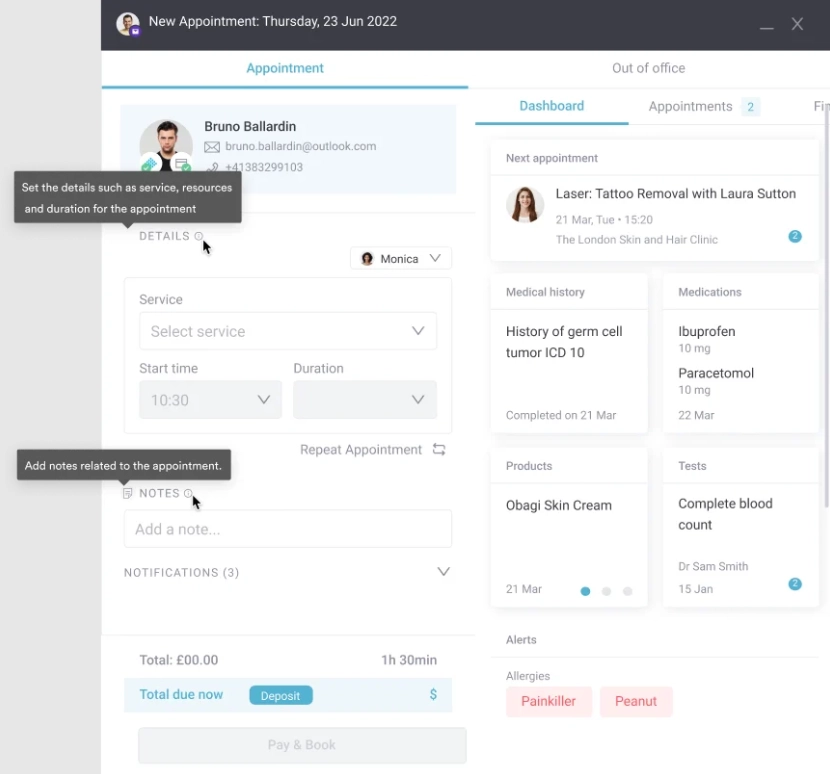
Automated care messages can carry that guidance into the days between appointments. The reinforcement costs no extra clinician time and keeps the advice in front of the patient. Protecting that clinician time matters beyond one plan, since sustained overload is one of the clearest paths to therapist burnout.
Coping skills for postpartum depression follow the same severity-match framework, adapted for a patient whose sleep, autonomy, and identity have all changed at once. Behavioral activation is still where the plan starts, but standard activity scheduling breaks down.
A new parent does not control their own wake time, so “a 30-minute walk on Tuesday at 7am” collides with a feed. Two adaptations do most of the work here.
Cognitive work has its own target here. The distortions in postpartum depression cluster around competence and harm. Restructuring aims at “I am a bad mother”, not at a general failure thought.
Postpartum depression counseling belongs in the plan from the start rather than as an escalation step. NICE guideline CG192 covers antenatal and postnatal mental health as its own pathway, with referral routes that differ from general adult services.
Prenatal depression treatment sits on that same pathway. Depression that starts in pregnancy predicts postpartum depression, so screening before the birth changes what the plan looks like after it.
One boundary matters more here than anywhere else in this article. Thoughts of harm to self or to the baby need same-day escalation, not a coping skill.
The skill a patient needs depends on the moment: acute distress calls for TIPP, inactivity calls for behavioral activation, recurrence calls for MBCT. The severity-match framework decides the shape of a course of treatment. This table decides the next 10 minutes of a session.
| The moment | Skill to reach for | Where NG222 places it | When to introduce it |
|---|---|---|---|
| Acute distress between sessions | DBT distress tolerance (TIPP) | Not first-line, adjunctive | Once the patient names a crisis moment, often session two or three |
| Doing very little, motivation gone | Behavioral activation | First-line for less severe depression | Session one, alongside activity and mood monitoring |
| Thoughts locked into distortion | CBT cognitive restructuring | First-line for more severe depression | After a week of activity data, usually session three |
| Rumination that will not stop | Scheduled worry time and attention training | Component of first-line CBT | Once the patient can tell problem-solving from ruminating |
| Well now, three or more past episodes | MBCT | Recommended for relapse prevention | End of the acute phase, before discharge |
| Every week of the plan | Exercise and sleep hygiene | Adjuncts throughout stepped care | Session one, as the baseline the plan rests on |
Column three follows NICE NG222. Column four is typical rather than prescriptive, because the trigger for introducing a skill is the patient’s own data, not the session number.
A working coping plan names three to five strategies from different domains, gives each one a frequency, and sets a date to review them. At least one strategy should be behavioral, one cognitive, and one lifestyle.
Treatment goals for depression belong in the same document, written as behavior rather than as mood. “Walk Monday, Wednesday, and Friday at 7am” is a goal you can review. “Feel better” is not.
In practices we onboard, the coping plan is the document that goes missing first, because it lives outside the session note. A line in the note, a photocopied worksheet, a mental note to ask next time. The plan ends up in three places and gets reviewed in none of them.
Where coping is already maladaptive, through avoidance, substance use, or withdrawal, a NANDA-based ineffective coping care plan supplies a recognized assessment-and-goals structure to build on.
A plan with no social component tends to stall, because withdrawal is the symptom doing the most damage to a patient’s week. One named person to contact, and one recurring social commitment, is usually enough to start.
Every plan also needs a review mechanism, whether that is a follow-up appointment or a between-session check-in. The therapy practice management software a practice runs on should support that kind of structured, longitudinal documentation.
Psychoeducation is the foundation of the plan. Patients who understand the rationale for a strategy persist with it when it feels difficult, and it frequently will early on. Brief written summaries shared through a client portal improve between-session engagement compared with verbal instruction alone.
Some presentations need the plan adapted further:
Recognizing those differences is what separates clinical guidance from generic coping advice.
One boundary is worth stating to patients directly. Coping skills sit inside a treatment plan rather than replacing one. NICE is unambiguous that more severe depression warrants pharmacological and psychological intervention where indicated.
Positioned that way, the skills read as part of the treatment rather than as self-help. That framing is both more accurate and more motivating for the patient.
Coping plans tend to get documented wherever there is room. The review then starts from memory, instead of from the week the patient had.
Practice management software like Pabau keeps the plan with the record it belongs to. Pabau’s digital forms collect the activity-and-mood log or the thought record before the appointment. The clinician opens the client file and sees the week the patient had.
Pabau’s automated pre- and post-care messages handle the between-session reinforcement, and the client portal gives patients their own copy of the plan. Every Pabau subscription includes those tools, so a solo therapist and a six-clinician group work the same way.
The result is a review that starts from the patient’s own data, and a coping plan that survives the two weeks between sessions.

Pabau brings client records, digital forms, and patient messaging into one place, so coping plans get reviewed at the next appointment instead of forgotten. Clinicians see the week the patient had before the session starts.

Structure is what separates a coping plan that works from a recommendation the patient forgets. Match the strategy to episode severity first, then to the moment the patient is in.
The severity-match framework is the part worth carrying into your next session. NG222 points behavioral activation at less severe presentations and CBT at more severe ones, with MBCT held for recurrent episodes.
Then write the plan down, set the review date, and reinforce it between appointments. Patients with specific, reviewed plans engage far more consistently than patients handed verbal advice.
Book a demo to see how Pabau keeps coping plans, patient forms, and between-session messages in one client record.

Need a ready-made activity and mood log? Behavioral activation worksheet gives patients a structured sheet for scheduling activities and rating mood between sessions.
Want the full cognitive restructuring tool? 7-column thought record walks a patient through situation, thought, emotion, evidence, and balanced alternative.
Planning for recurrent depression? Relapse prevention plan worksheet helps patients map early warning signs and the responses that work for them.
Reinforcing sleep advice between appointments? Sleep hygiene handout collects the guidance patients can act on at home.
Need a framework for mental health documentation? Mental health EMR covers how Pabau supports therapy and psychiatry practices with records, forms, and workflow tools.
Five coping skills carry the strongest evidence: behavioral activation, cognitive restructuring, DBT distress tolerance, mindfulness practice, and regular exercise. NICE guideline NG222 sets the order, with behavioral activation first-line for less severe depression and CBT for more severe presentations. The severity-match framework in this article matches each skill to a severity and an episode history.
Reach for a DBT distress tolerance skill, which is built for acute moments rather than for the course of treatment. TIPP covers temperature, intense exercise, paced breathing, and progressive muscle relaxation. Each one works on the body first, which is what makes it usable when reasoning has stopped being available. Persistent thoughts of self-harm need urgent professional help, not a coping skill.
Behavioral activation is a structured technique that interrupts the withdrawal-avoidance cycle in depression. Reintroducing activities that provide mastery or pleasure breaks the link between low mood and reduced activity. NICE recommends behavioral activation as a first-line intervention, supported by randomized controlled trials that compared it favorably with full CBT.
Mindfulness for depression works mainly by reducing rumination, the repetitive focus on distress that maintains an episode. MBCT trains patients to observe thoughts without automatically engaging with them. NICE endorses MBCT for preventing relapse in recurrent depression, based on trial evidence showing lower recurrence rates.
Coping skills are components within a treatment framework rather than a substitute for one. NICE is clear that more severe depression warrants pharmacological and psychological intervention where indicated. Coping strategies support daily functioning, reduce symptom severity, and prevent relapse alongside those clinical decisions.
Clinicians help most through written coping plans that specify the strategies, the frequency, and the review date. Psychoeducation about why each strategy works improves adherence. Client portals, structured clinical records, and automated care messages support between-session engagement without extra clinician time.
Professional help is warranted when symptoms persist for two or more weeks, interfere with daily functioning, or include thoughts of self-harm. NHS and NICE guidance recommend discussing symptoms with a doctor or mental health professional. That includes persistent low mood, loss of interest, or changes in sleep, appetite, or energy.