









Medical director for a cosmetic clinic in Australia: What the rules require
No law requires a medical director for a cosmetic clinic in Australia. See who m...

Last Updated: September 1, 2026


Single-location med spas typically sell for 3.0x to 7.0x their annual earnings before interest, taxes, depreciation and amortization (EBITDA).
The Corporate Practice of Medicine doctrine decides who may legally own the clinical entity, and the rules vary sharply by state.
The Medical Aesthetics Deal Checklist covers the five hurdles a generic small-business sale never has.
Buyers scrutinize owner-dependence, financial clarity, patient retention, brand position and documented operating procedures.
This guide serves both sides of the table, buyers evaluating listings and owners preparing to exit.
An aesthetics business for sale usually trades at 3.0x to 7.0x EBITDA. The number swings on how little the practice depends on its owner. That range comes from FOCUS Bankers, which tracks med spa valuation multiples.
This page is a guide, not a listings feed. We do not broker practices and there is no live inventory here. The marketplaces that do carry listings are named further down.
Below you get what these practices sell for, who is legally allowed to own one, and The Medical Aesthetics Deal Checklist. That checklist is the five hurdles a normal small-business sale never has. Both sides of the table get answers here, buyers evaluating listings and owners preparing to exit.
An aesthetics business for sale is an operating practice selling non-surgical cosmetic treatments, from a solo injector’s single room to a multi-site med spa group.
Listings cluster into a few recognizable types. A skin care business for sale is usually a facial and laser practice with no prescriber on staff. A Botox business for sale is an injectable-led practice whose revenue concentrates in one or two providers. Larger listings bundle several sites, a shared brand and a management team.
The label on the listing matters less than what sits inside the entity. A beauty business for sale offering only facials, waxing and massage carries no medical layer at all. Add botulinum toxin, prescription skincare or a laser used for a medical indication and the transaction changes category.
Most of these deals are structured as asset sales rather than stock sales. The buyer takes named assets and leaves the old entity behind. That avoids inheriting unknown liabilities and allows a depreciation step-up.
Sellers often prefer a stock sale for tax reasons and to transfer liability with the shares. That pattern is documented for medical-practice sales generally rather than for med spas specifically.
Single-location aesthetics practices typically sell for 3.0x to 7.0x EBITDA, with 4.0x to 5.5x as the midpoint for clean, well-structured practices.
EBITDA is earnings before interest, taxes, depreciation and amortization. FOCUS Bankers publishes those single-location ranges, and puts multi-location operators at 7.0x to 9.0x and branded platforms as high as 12.0x.
Two labels do most of the work inside that range. A lifestyle practice is owner-dependent with modest growth and values at 4.0x to 6.0x. A platform practice clears $1 million in EBITDA, runs on associate providers and scales, which earns 6.0x to 8.0x and up. Those figures come from a healthcare valuation guide published by healthfmv.com.
Three specifics move a practice up its own range.
Those ranges sit further apart than the listings suggest.
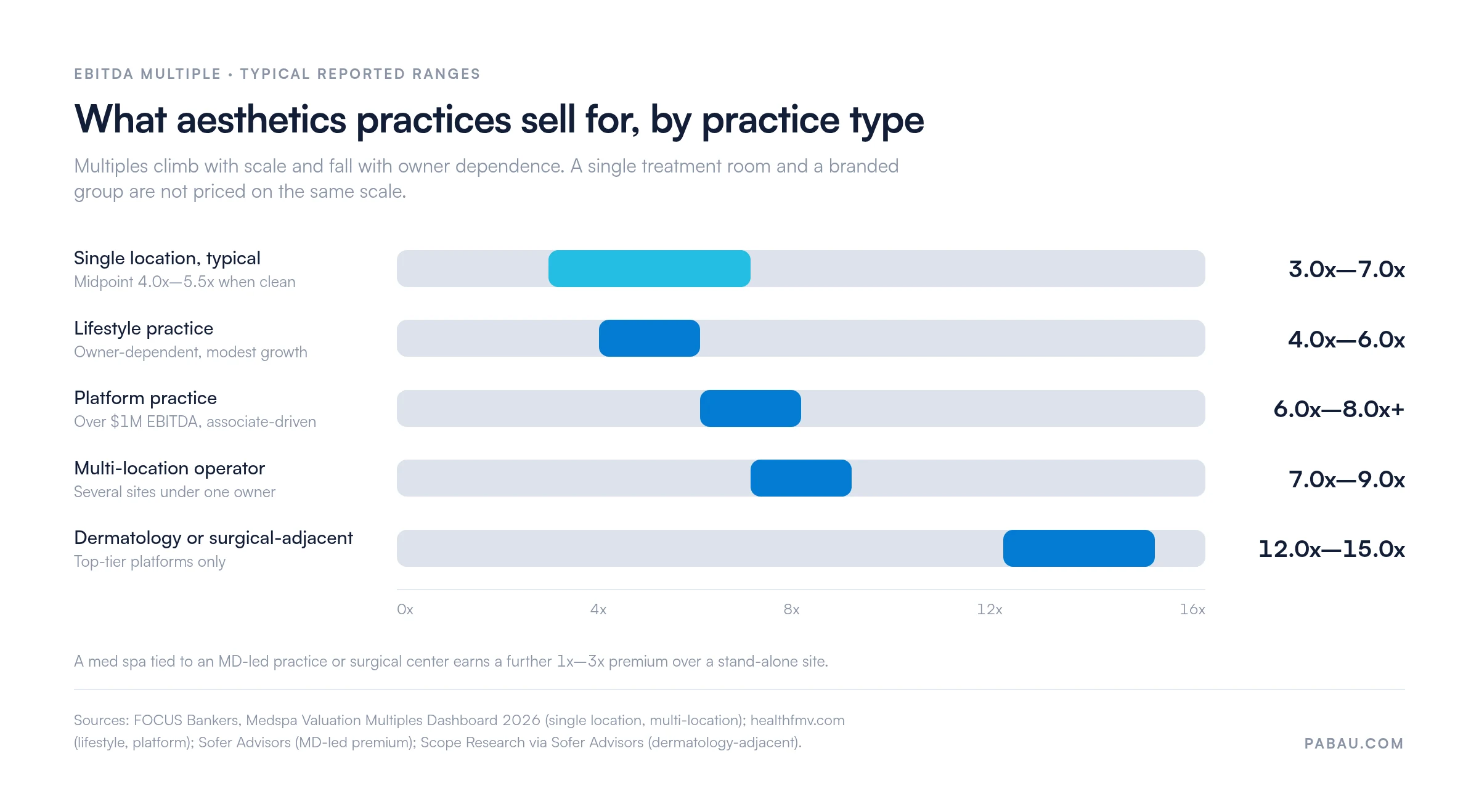
The highest multiples in this market do not attach to standalone treatment rooms. The top of the range goes to dermatology and surgical-adjacent platforms, and to branded groups running several sites.
Buyers then apply one blunt test to whatever multiple gets quoted. They ask whether the practice repays the investment in roughly five years. To answer it they request three years of historical tax returns plus income statement and balance sheet detail, per the American Med Spa Association.
Watch which earnings figure a multiple is quoted against. Smaller owner-operated listings are often priced on seller’s discretionary earnings, or SDE, which adds the owner’s salary and personal expenses back to profit. An SDE multiple and an EBITDA multiple are not comparable, so a multiple quoted on SDE looks cheaper than it is.
Buying an operating practice is also priced against the alternative. Building one from zero typically costs $250,000 to $1 million, according to the American Med Spa Association. Our breakdown of aesthetics business startup costs shows where that money goes.
The Corporate Practice of Medicine doctrine, known as CPOM, decides who may own the clinical entity, and the rules vary sharply by state.
CPOM is in force in most US states. The doctrine generally bars a non-physician from owning an entity that renders clinical care. California sits at the strict end and requires physician-majority ownership. Florida, Alabama and Utah impose no meaningful CPOM restriction, so a non-physician can own the practice outright.
For a non-physician buyer in a strict state, the practical answer is a split structure. A physician-owned professional corporation, or PC, holds the clinical side and employs the treating providers. A management services organization, or MSO, is controlled by the non-clinical owner and runs the business.
Our state-by-state guide to who can open a medical spa sets out where each rule applies. So an esthetician, an investor or a practice manager in California does not buy the practice. They buy the MSO, and a physician holds the PC.
Both entities carry their own agreements, and a sale usually means assigning or re-papering both. A normal small-business purchase agreement has no equivalent step. Ask for the management services agreement early, because its terms decide how much of the business the buyer controls after closing.
The Medical Aesthetics Deal Checklist is the five items that make this transaction different from any other small-business sale. Each one can delay a closing or reprice a deal, and none of them appears in generic acquisition guidance.
| Deal issue | Why it’s different from a normal business sale | What to do about it |
|---|---|---|
| CPOM ownership eligibility | Most states restrict ownership of the clinical entity to physicians, so the buyer’s license decides what they can hold. | Check your state’s CPOM rule before signing a letter of intent, and plan a PC/MSO split if needed. |
| Medical director agreement transfer | The supervising physician relationship is personal and does not transfer with the assets. | Get the current medical director’s written consent, or line up a replacement before closing. |
| HIPAA-compliant patient-record (PHI) transfer | Patient records are protected health information, not a customer list you can simply hand over. | Move records under a business associate agreement and notify patients of the ownership change. |
| License and permit reissuance | Licenses usually cannot travel with the assets in an asset sale. | Treat reissuance to the buyer’s entity as a closing condition, not post-completion paperwork. |
| Injector and patient-retention risk | Patients often follow the provider who treated them rather than the brand. | Tie key injectors in with non-competes and retention terms before the price is fixed. |
The medical director row is the one buyers underestimate. A medical director agreement is a personal professional relationship between the physician and the practice. It does not travel with the assets, and standing orders signed by that physician stop being valid the day they leave.
Lining up a replacement takes time, and our guide on how to hire a medical director covers the search.
Patient records are protected health information, known as PHI, not a customer list. PHI can generally move to a buyer without individual patient authorization. The disclosure has to qualify as treatment, payment or healthcare operations to a successor covered entity.
That transfer usually runs under a HIPAA-compliant business associate agreement, or BAA. Patients still have to be told about the ownership change and how to access or restrict their records.
Retention rules add a second obligation. Many states require patient health records to be kept for seven or more years after the last treatment, and the period varies by state. The state retention period sits separately from the federal six-year HIPAA rule covering policies, BAAs and risk analyses. Whoever holds the records after closing inherits both clocks.
Licenses and permits rarely travel with the assets either. A medical license, a business license and a state aesthetics or spa license typically have to be reissued to the buyer’s entity.
Reissuance is a closing condition on a regulated practice, and it is the step that most often slips a completion date. If the practice runs in-house lab testing, for example some PRP or bloodwork, CLIA licensure may apply as well.
Most of the valuation risk sits with the injector rather than the brand. Patients in this market often follow the person who treated them. In the practices we onboard, a single provider’s personal following often drives much of the repeat booking volume. So a buyer paying for goodwill needs the key injectors tied into the deal before the price is fixed.
SBA 7(a) loans of up to $5 million are the primary federally backed route to financing a practice acquisition in the US.
The Small Business Administration guarantees part of the loan and shares the risk with the lender. That supports a lower down payment than a conventional commercial loan. SBA.gov publishes the program terms and the eligibility rules.
One structure comes up repeatedly in practice deals. Deferred consideration, usually called an earnout, ties part of the price to performance after closing. An earnout protects a buyer against the retention risk above, and gives a seller a route to a fuller price.
Bring the lender the same file the buyer wants. Three years of tax returns, an income statement and a balance sheet are the baseline. Ask the lender early how they treat a PC/MSO structure, because the entity that borrows may not be the entity holding the clinical license.
Aesthetics businesses for sale appear in three distinct places, and the type of listing tells you the size of the deal.
General business-for-sale marketplaces carry most single-site listings. BizBuySell, LoopNet, BizQuest, BusinessBroker.net and DealStream all publish med spa and cosmetic-medical listings. Those marketplaces are self-serve classifieds, so the depth of financial detail varies listing by listing.
Marketplace listings quote revenue far more often than earnings. One Upper Manhattan med spa was listed on BizBuySell at $1,499,000 against roughly $911,096 in gross revenue. Read that as an example of how listings are written, not as a valuation rule, because the multiples above run off earnings.
Business brokers sit above the classifieds and run a confidential process for a single seller. Mergers and acquisitions advisers who specialize in med spas handle the larger and platform-level deals. FOCUS Bankers, Sofer Advisors and Vallexa Advisors all work that end of the market.
Geography works as a filter on one national inventory. Every one of these marketplaces lets you narrow listings to California, Texas, New York or a single city. What changes across a state line is the CPOM rule above. Screen for that before you screen for location.
Buyers examine five areas: owner-dependence, financial clarity, patient retention, brand and market position, and documented operating procedures.
The American Med Spa Association sets out those five areas for owners preparing an exit. Each one is checkable from records, which is why a seller who cannot produce the records loses the argument on price.
Timing changes the number too. A well-prepared, confidential sale process typically runs six to nine months from valuation to close. FOCUS Bankers advises owners to start preparing six to 12 months before that, because the preparation is what moves the multiple.
Four of the five areas are answered out of the practice’s own medical spa software. Retention, revenue mix, membership counts and provider-level performance either sit in one report or get reconstructed by hand under deadline.
Most practices reach a sale with their evidence scattered. Appointments live in one tool, invoices in another, membership counts in a spreadsheet and retention in the owner’s head. Assembling three years of clean, provider-level detail out of that takes weeks.
Practice management software like Pabau holds the client record, the appointment, the treatment note and the invoice in one system. Membership and prepaid package revenue sit against the client who bought it. Reporting reads repeat visits, revenue per provider and no-show rate out of the same data. So the numbers a buyer asks about are already in one place.
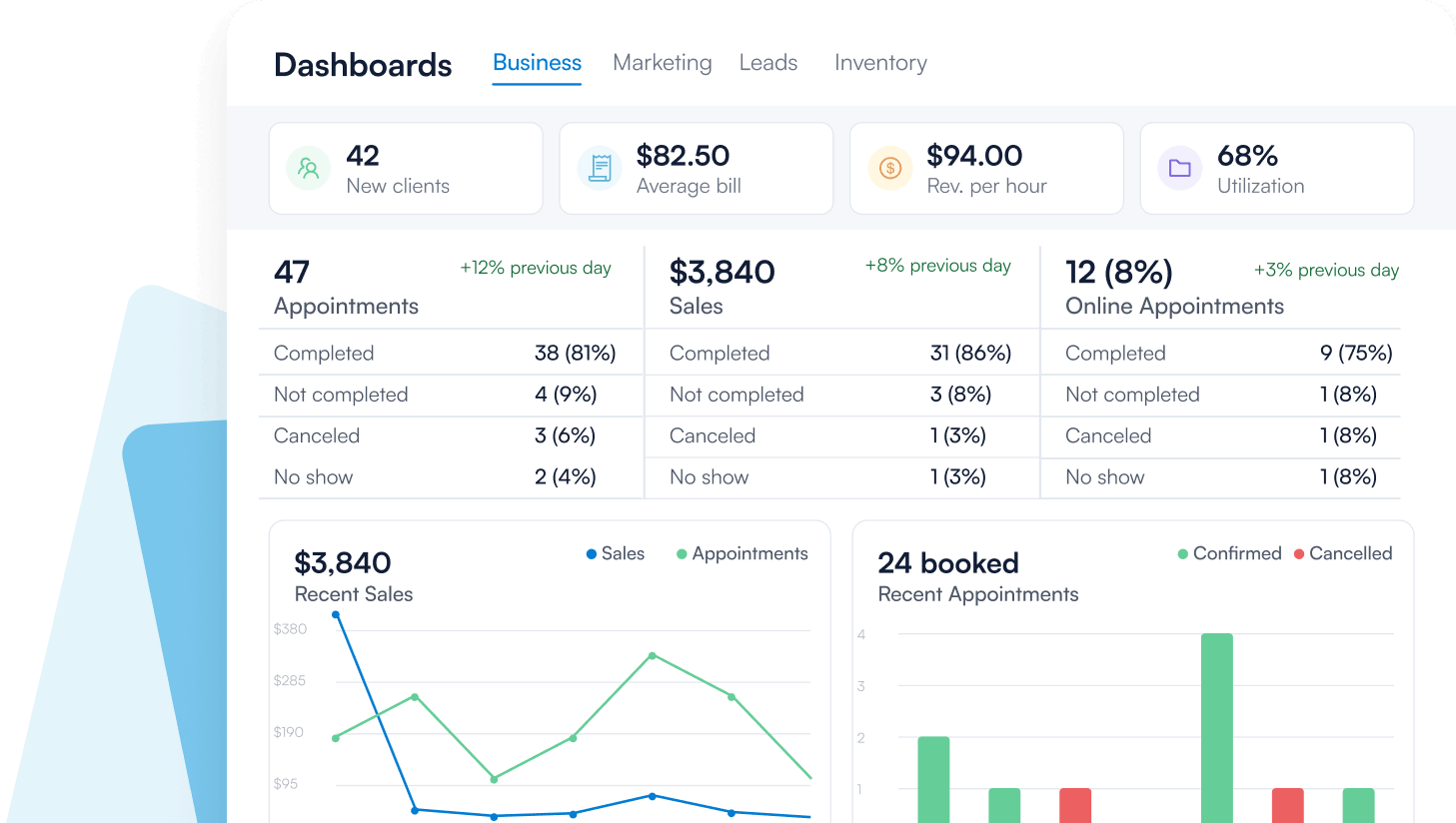
That cuts both ways at the table. A seller shows retention instead of asserting it, and the ranges above pay a premium for clean, well-structured practices. A buyer gets provider-level revenue before closing, so the injector risk above gets priced rather than discovered.

Pabau keeps client records, appointments, memberships and invoices in one system, so retention and revenue reporting is a single export. Sellers can back up the multiple they are asking for, and buyers see provider-level performance before closing.

The valuation range is the easy part of this transaction. Three to seven times EBITDA is a starting position, and where a practice lands inside it comes down to owner-dependence and retention.
The Medical Aesthetics Deal Checklist is what decides whether the deal closes on the date everyone agreed. CPOM eligibility, the medical director, the PHI transfer, the license reissuance and the injector risk each need an owner and a deadline in the timetable. Handle them in that order and a completion date holds.
Whichever side of the table you are on, the practice with clean, exportable records wins the argument about price. Book a demo to see how Pabau keeps retention and revenue reporting ready for a buyer’s diligence list.

Building instead of buying? How to start an aesthetics business walks the route from qualification to first booking.
Want the price of building from zero? Costs of starting an aesthetics business itemizes the setup spend line by line.
Need a supervising physician on file? How to hire a medical director for a med spa covers scope, pay and the agreement itself.
Raising the multiple before you exit? How to grow your aesthetic business targets the retention and repeat-visit numbers buyers read first.
Worth is set by earnings, not revenue. A single site with clean books and low owner dependence lands near 4.0x to 5.5x EBITDA. Multi-location operators reach 7.0x to 9.0x, and dermatology or surgical-adjacent platforms reach 12x to 15x at the top tier.
Profitability varies too widely for one figure, and no reliable industry number covers every salon. Valuation multiples are the better signal. Buyers pay more for practices with membership revenue, prepaid packages and low owner dependence, and less for owner-dependent single-visit businesses.
If the practice delivers medical treatments, then in most states yes. A non-physician buyer needs a physician medical director on file, and in strict CPOM states a physician-owned entity as well. The existing medical director does not transfer automatically, so get written consent or line up a replacement.
A well-prepared, confidential sale process typically runs six to nine months from valuation to close, according to FOCUS Bankers. Owners who start preparing six to 12 months before that tend to reach a better multiple, because the preparation is what buyers pay for.