Free model waiver form + what it is and when your practice needs one
A model waiver form is a signed document that lets a healthcare practice use a p...

4
Last Updated: Sep 29, 2026

An independent prescriber holds a prescribing qualification on top of a clinical registration, which a Level 7 aesthetics diploma does not provide.
Botulinum toxin and hyaluronidase are prescription-only medicines, so an aesthetic clinic needs a prescriber before it can offer anti-wrinkle injections.
Since June 1, 2025 the NMC has required nurse and midwife prescribers to consult face to face before prescribing for cosmetic procedures.
Training a nurse through the V300 costs about £2,000 in university fees, and University College Birmingham runs the programme over 26 weeks.
Run the three-layer prescriber compliance check before you advertise: professional registration, then CQC scope, then JCCP or Save Face accreditation.
Independent prescriber aesthetics describes the prescribing layer that sits on top of injecting. Our guide to software for med spas compares platforms on injection charting, the record kept for every treatment. Botulinum toxin is a prescription-only medicine, known as a POM. As a result, only a registered clinician with prescribing rights can assess a patient and authorise it.
That authority is separate from treatment training. A Level 7 Diploma in Cosmetic Injectables teaches you to inject safely. But it gives you no right to prescribe the medicine you are injecting.
That leaves a UK aesthetic clinic two routes. Contract or employ a prescriber, or put a member of staff through the V300 qualification. This guide prices both routes, then sets out the three-layer prescriber compliance check.
An independent prescriber is a registered healthcare professional who is qualified to assess a patient, decide the treatment and prescribe medicines without another clinician’s authorisation.
In UK aesthetics that description covers four separate routes to prescribing rights, and they are not the same qualification. Checking which one a prescriber holds takes a minute on a public register.
You will hear the same role called a non-medical prescriber, a nurse prescriber or simply an IP. Still, the register entry decides what someone may do, not the label on their website.
Nurses dominate the group. In fact, Hamilton Fraser’s annual practitioner survey found nurses made up 43.5% of respondents, ahead of doctors at 22.5% and dentists at 13.1%.
An aesthetics practitioner delivers treatments, while an independent prescriber holds a separate qualification that allows them to prescribe the prescription-only medicines those treatments use.
The confusion usually starts with the Level 7 Diploma in Cosmetic Injectables. The diploma is a demanding clinical qualification that teaches injecting to a high standard. Yet the diploma confers no prescribing rights at all.
The two qualifications also sit on separate tracks. Harley Academy notes that finishing the Level 7 diploma does not guarantee a place on a prescribing course, because the entry criteria do not match. Some universities now ask for the Level 7 plus membership of a professional standards register.
An aesthetics practitioner without prescribing rights still treats patients. They work from a prescription written for a named patient by a prescriber who assessed that patient personally. The separate question of nurses injecting Botox turns on training and delegation, not on prescribing rights.
Practitioners still mapping the route into the field should start with the training ladder. Our guide on how to become an aesthetic practitioner covers the qualifications that come before any prescribing decision.
An aesthetic clinic needs a Botox prescriber for any prescription-only medicine, though that prescriber can be contracted rather than employed on staff.
The dividing line is the legal class of the product, not how invasive the treatment feels. Here is how the common treatment room stock splits.
The filler entries in that list carry a catch. A filler-only clinic still needs a prescriber relationship, because the reversal agent and the emergency drugs are prescription-only. Offering filler without access to hyaluronidase leaves you unable to treat the complication you are most likely to meet.
One rule applies whoever prescribes. The Botulinum Toxin and Cosmetic Fillers (Children) Act 2021 applies in England. Administering either product to someone under 18 for a cosmetic purpose is an offence, and so is booking the appointment.
Documentation follows the prescription. Our Botox consent form template gives you a structure that records the assessment alongside the consent.
A registered nurse becomes an independent prescriber by completing a V300 programme at an NMC-approved university, supported by a designated prescribing practitioner in clinical practice.
The NMC dropped its fixed three-year rule. Readiness now rests on evidence of the skills, knowledge and experience the programme needs, and the university makes that judgment. Most universities still set their own minimum on top of it.
University College Birmingham asks for at least one year on the NMC register before applying, and so does the University of Cumbria. University College Birmingham runs the programme over 26 weeks, with 90 hours of supervised prescribing practice that the employer has to protect.
The supervision requirement has changed too. It was once the designated medical practitioner’s job, held only by a GMC-registered doctor. Instead, the role is now the designated prescribing practitioner, open to any experienced prescriber on a healthcare register.
| Route | Entry requirement | Course level | Supervision needed | Typical fee (GBP) |
|---|---|---|---|---|
| Nurse or midwife (NMC) | On the NMC register, with evidence of relevant experience. Most universities ask for one year. | Level 6 or Level 7 | Designated prescribing practitioner, plus a practice supervisor | £1,950 to £2,050 at the University of Cumbria, 2025/26 and 2026/27 |
| Pharmacist (GPhC) | On the GPhC register with relevant pharmacy experience. Newly registered pharmacists qualify from September 2026. | Level 7 | Designated prescribing practitioner | Varies by provider. Check the university directly. |
| Physiotherapist, podiatrist, paramedic or therapeutic radiographer (HCPC) | On the HCPC register, prescribing only within scope of practice. | Level 6 or Level 7 | Designated prescribing practitioner | Varies by provider. Check the university directly. |
| Doctor or dentist | Prescribing rights come with GMC or GDC registration. | Not applicable | Not applicable | No separate course fee |
Practitioners often ask how to become a prescriber for Botox specifically. The short answer is that no prescriber course for Botox exists on its own. The V300 is a general prescribing qualification. You then prescribe within your own competence, which is where aesthetics training earns its place.
Some training providers sell a supervision package rather than the course. Array Academy charges £3,600 including VAT for its designated prescribing practitioner service, excluding university fees. Array Academy also asks for a foundation course completed at least a year earlier.
Training a nurse costs about £1,950 to £2,050 in V300 university fees, while contracting an external prescriber is usually charged per patient, per visit.
Training figures are published and easy to check. Contracting rates are not, so budget from a written quote rather than an average. Most UK prescriber services quote privately rather than publishing a rate card.
| Route | Upfront cost | Ongoing cost | Time to have someone in place |
|---|---|---|---|
| Train a staff nurse through the V300 | £1,950 to £2,050 in university fees (University of Cumbria, 2025/26 and 2026/27) | Cover for study days, then revalidation and prescribing CPD | 26 weeks of teaching at University College Birmingham, plus the application cycle |
| Buy a supervision package alongside the course | £3,600 including VAT (Array Academy), on top of university fees | None once the qualification is awarded | Runs alongside the programme, so it adds no extra time |
| Contract an external prescriber per session | None | From £40 per patient prescription, with a £120 minimum call-out, at one East Midlands service | Days to weeks, set by the prescriber’s diary |
| Recruit a qualified prescriber into the team | Recruitment and advertising costs, which vary by region | Salary at prescriber level. No UK aesthetics pay survey publishes a figure. | Weeks to months |
Treat the contracting row as one advertised example rather than a market rate. For instance, those figures come from a single East Midlands nurse prescriber’s own published pricing. A Sheffield service quotes on request and asks for at least three patients before travelling to a clinic.
The hire-versus-train arithmetic is straightforward once you know your volume. An aesthetic prescriber charged per patient costs less than the V300 until you run regular clinic days. Above that, training your own nurse pays for itself and removes the diary dependency.
There is a second reason to train rather than contract. A prescriber for Botox has to attend in person now, so a remote arrangement no longer works. Prescriber cover is one line in the wider budget for starting an aesthetics business.
The three-layer prescriber compliance check verifies professional registration and the prescribing annotation, then CQC registration scope, then voluntary JCCP or Save Face accreditation.
Each layer answers a different question, and clearing one says nothing about the other two. The diagram below shows the order to run them in.
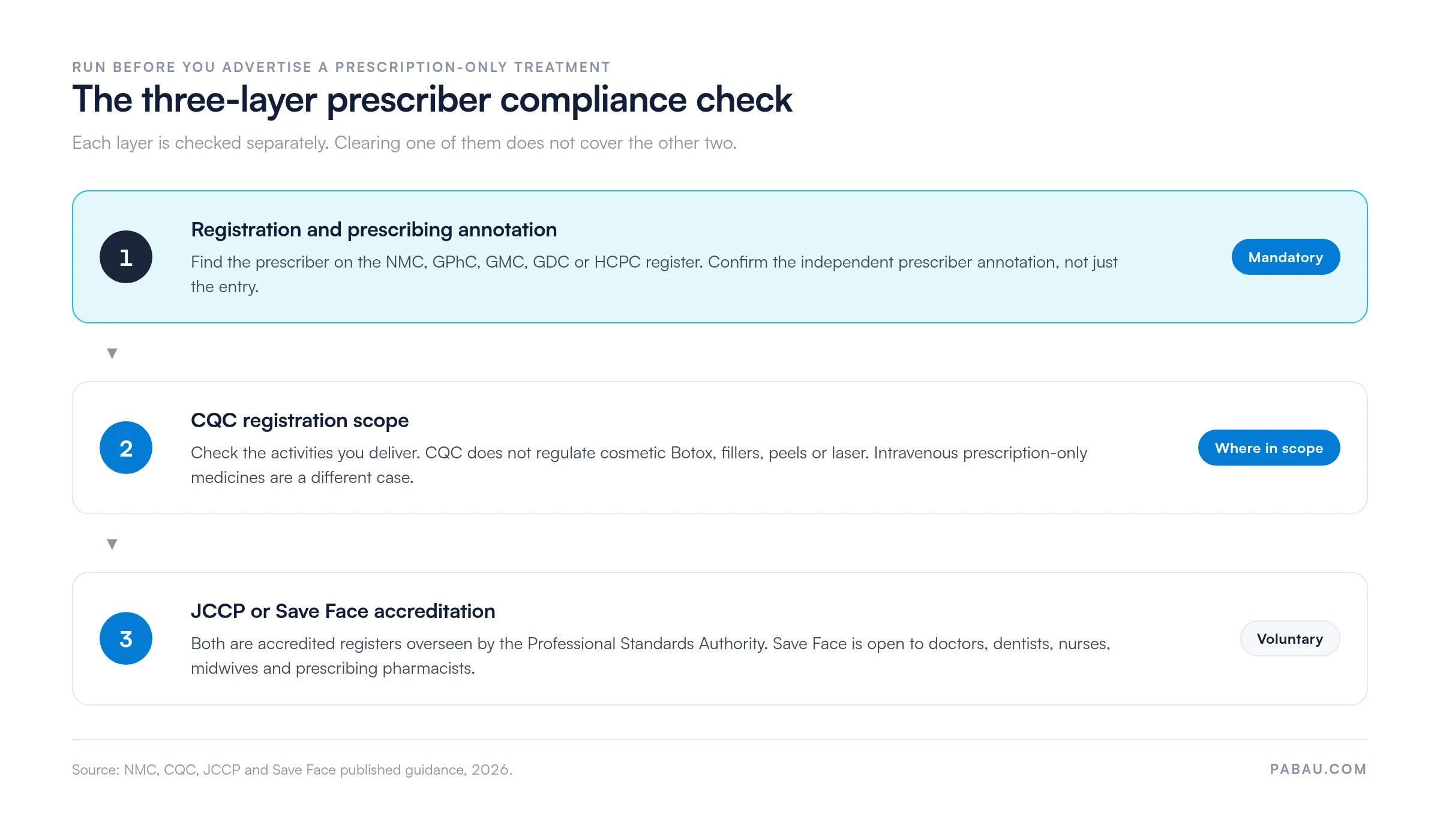
Look the prescriber up on the register their profession sits on. The NMC, GMC, GDC, GPhC and HCPC registers are all public and free to search. Then confirm the independent prescriber annotation, not only that the person appears.
In practices we onboard, the prescriber’s registration details usually live in an email thread rather than in the patient record. Those details belong in the patient file first, because an inspector or an insurer will ask for them.
CQC does not regulate cosmetic injectables in England. Specifically, CQC guidance says the commission does not regulate subcutaneous injections used to alter appearance. That list names Botox and dermal fillers, plus chemical peels and laser or IPL treatments.
What changes the answer is the activity, not the clinic’s name over the door. Intravenous administration of prescription-only medicines is treated as treatment of disease, disorder or injury, so an IV drip service does need registration.
So the check is specific. List the treatments you deliver, then test each one against CQC’s regulated activities. A blanket claim that every aesthetic clinic must register is wrong, and so is the assumption that none of them do.
The JCCP and Save Face are voluntary registers, both accredited by the Professional Standards Authority. Neither one replaces statutory registration, and neither one is a licence to practise.
The two registers cover different populations, which matters when you are choosing one. Save Face accredits doctors, dentists, nurses, midwives and prescribing pharmacists, and has held Professional Standards Authority accreditation since 2016.
The JCCP register is open more widely. It also admits regulated healthcare professionals and non-healthcare practitioners at different levels, mapped to its own competency framework. Accreditation involves an assessment of premises, indemnity, training records and consent processes.
Since June 1, 2025, the NMC has required nurse and midwife independent prescribers to consult face to face first. Prescribers must also document a clinical assessment before treating an elective non-surgical cosmetic procedure.
The NMC states plainly that prescribing for these purposes by remote methods is not appropriate. Its definition of a non-surgical cosmetic procedure is broad. It also follows the Health and Care Act 2022 and covers injections, thread placement, needling and applications of light, electricity, cold or heat.
For a clinic owner the operational effect is simple. So a prescriber cannot sign off your patients from a video call, and a repeat prescription still needs a consultation. Build that visit into your booking flow rather than treating it as an exception.
Stock-holding is the rule that catches owners out, and the position differs by nation. The NMC reports that the MHRA has advised nurse and midwife independent prescribers are not eligible to be supplied with prescription medicines as stock.
| Nation | Can a nurse independent prescriber hold POM stock? | How medicines reach the patient |
|---|---|---|
| Scotland | Yes, where the prescriber owns a clinic registered with Healthcare Improvement Scotland | Stock is held at service level under the clinic’s registration |
| England, Wales and Northern Ireland | No, per the MHRA position reported by the NMC | A pharmacy dispenses against a prescription written for a named patient |
The UK government acknowledged this limitation in its response to the licensing consultation for non-surgical cosmetic procedures, published August 7, 2025. So treat the stock-holding position as live policy. Check your own position with your indemnity provider before changing how you order.
Most clinics run prescriber compliance across four places at once. Typically, the registration certificate sits in a drawer and the consultation note is on paper. The prescription arrives by email, and the consent form lives in a tool that never reaches the patient file.
Practice management software like Pabau puts those four items on one patient timeline. The consultation, the digital consent form, the treatment note and the batch details attach to the same record. An audit request then takes one search rather than four.
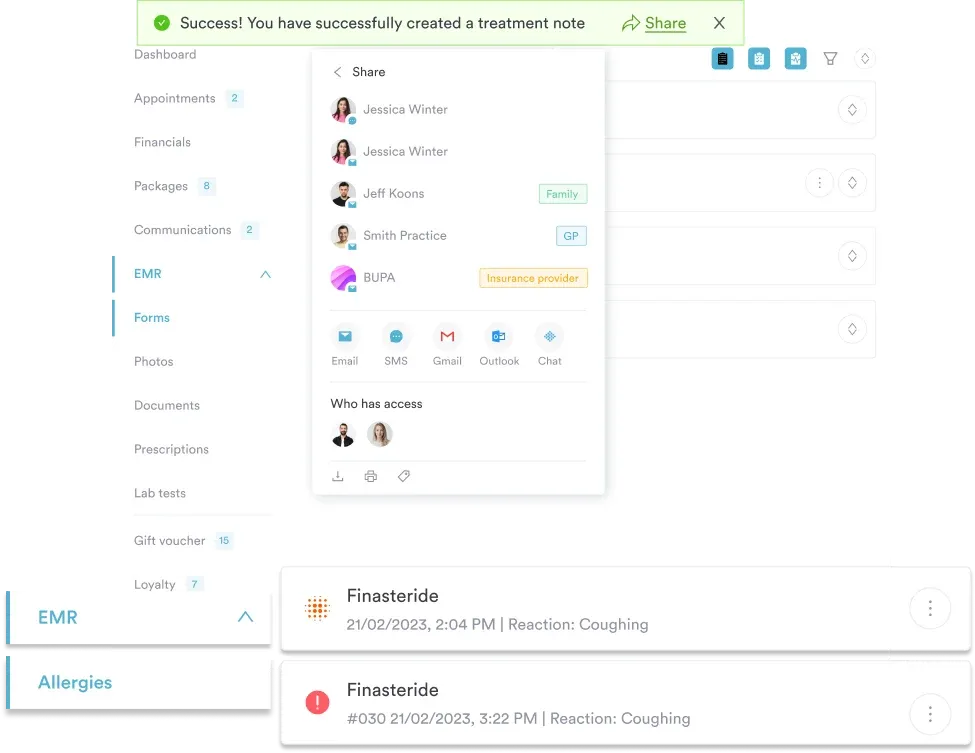
Pabau also connects to UK prescribing partners including CloudRx, SignatureRx and Pharmacierge, and every native integration is included in the subscription. Pabau’s medical spa software serves aesthetic clinics on both sides of the Atlantic, so the same record structure supports UK and US requirements.
There is no feature gating, so a solo injector and a multi-site group get the same consent, records and reporting tools. New customers get structured onboarding rather than a trial, because the value comes from configuring the workflow properly.

Pabau brings the face-to-face assessment, digital consent and treatment notes onto a single patient timeline for aesthetic clinics. Prescriber documentation stays audit ready without a second filing system.

Independent prescriber status is a qualification in its own right, layered on top of aesthetics training. So treat it as a separate hiring or development decision, not as something a Level 7 diploma quietly covers.
Let treatment volume decide the route. Occasional clinic days suit a contracted prescriber. Regular injecting lists justify the V300, and the face-to-face rule has made prescriber availability a scheduling constraint rather than an administrative one.
Whichever route you take, run the three-layer prescriber compliance check before you advertise a single appointment. Verify the register entry, test your treatments against CQC scope, then decide whether JCCP or Save Face accreditation is worth the assessment.
Book a demo to see how Pabau keeps prescriber assessments, consent and treatment notes on one record for your aesthetic clinic.

Need the consultation itself to hold up? How to do a Botox consultation walks through the assessment a prescriber now has to carry out in person.
Building the wider compliance picture? Med spa compliance covers the licensing, records and privacy duties that sit around prescribing.
Not qualified to inject yet? How to become an aesthetic practitioner in the UK sets out the training ladder that comes before any prescribing course.
Wondering who may hold the needle? Can nurses do Botox separates administering a treatment from the authority to prescribe it.
Choosing the system to record it all in? Best aesthetic clinic software compares the platforms that keep consent, notes and prescribing evidence together.
Register with the NMC, GPhC or HCPC first, then complete an approved independent prescribing programme. Nurses take the V300, which University College Birmingham runs over 26 weeks. No prescriber course for Botox exists separately, because the qualification is general and you prescribe within your own competence.
You need statutory registration plus prescribing rights. A nurse needs an NMC entry carrying the independent prescriber annotation, earned through the V300. Pharmacists need the GPhC annotation, and doctors and dentists prescribe under GMC or GDC registration. A Level 7 aesthetics diploma alone does not make someone a Botox prescriber.
Yes, although the V300 is a general prescribing qualification rather than a Botox-specific one. The V300 prescribing course for aesthetics is the same programme nurses take in any specialty. Entry needs evidence of relevant experience and a named designated prescribing practitioner to supervise your practice hours.
Training a nurse costs £1,950 to £2,050 in university fees at the University of Cumbria for 2025/26 and 2026/27. Contracting an aesthetic prescriber is charged per patient or per visit instead. Most UK services quote privately, so ask for written terms before you book a clinic day.
No. Statutory registration with the NMC, GPhC, GMC, GDC or HCPC is the mandatory layer. CQC registration depends on which regulated activity your clinic delivers, and cosmetic injectables sit outside it. JCCP and Save Face are voluntary registers accredited by the Professional Standards Authority.