Free model waiver form + what it is and when your practice needs one
A model waiver form is a signed document that lets a healthcare practice use a p...

5
Last Updated: Sep 29, 2026

A single-room UK Botox clinic taking 12 appointments a week grosses about £14,500 a month and keeps roughly £6,400 of it.
Net margin peaks near 44% for an owner-operator injector, then falls to about 20% once a clinic employs other injectors.
Toxin is the largest variable cost at £1.70 per Allergan unit, and a reconstituted vial expires after 24 hours.
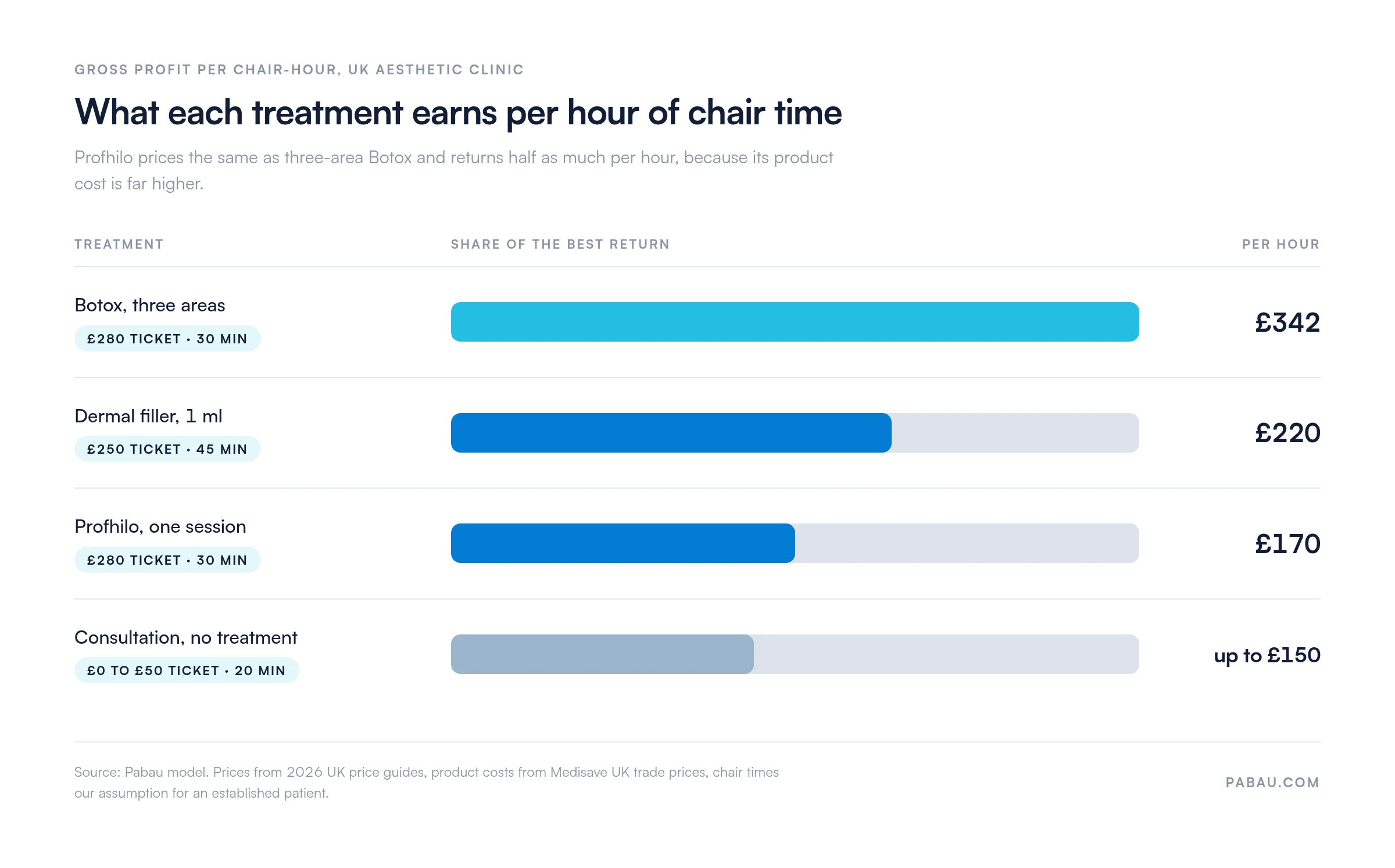
Botox returns about £342 of gross profit per chair-hour, ahead of 1 ml of filler at £220 and Profhilo at £170.
The three biggest margin levers are vial use, an independent prescribing qualification, and rebooking on the three-month treatment interval.
How much do Botox clinics make in the UK? A solo injector taking six appointments a week grosses about £7,300 a month, and a three-site group around £109,100. Net profit moves in the opposite direction to size, so the margin falls as the business grows. To price the software line in that margin, see total cost of ownership for eight platforms in our ranking of software for med spas.
This guide builds a model we call the Botox Clinic Profit Ladder. In practice, the ladder runs across four UK setups, from a mobile solo injector to a three-site group, and prices every cost line those setups carry.
Every figure below traces to a named source. For instance, vial prices come from a UK practitioner supplier, and licensed dosing from the Botox summary of product characteristics. Similarly, room rates come from a 2026 UK therapy-room pricing survey. Where a number is our modeling assumption rather than a published figure, the text says so.
A Botox clinic is profitable at every size we modeled, from a solo mobile injector to a three-site group. Specifically, net margin runs from about 44% for a single-room owner-operator down to 15% for the group. Absolute profit rises with size while the margin falls.
Two features of the treatment itself keep those margins healthy. Botulinum toxin is a prescription-only medicine, so no retailer can sell it over the counter. And the licensed re-treatment interval is roughly three months, which turns one new patient into a recurring booking.
The market is crowded, though. A UCL study published in February 2026 mapped 19,701 practitioners working across 5,589 UK clinics. The study also cites a previously published estimate of roughly 900,000 UK toxin injections a year.
Demand is still growing into that supply. MarketsandMarkets forecasts the UK medical aesthetics market to compound at 11.5% a year through 2031. So the more useful question is which rung of the ladder pays best.
A solo injector taking six Botox appointments a week grosses about £7,300 a month, and a three-site group with nine injectors about £109,100. For comparison, the table below prices all four rungs at £280 per appointment outside London.
| Clinic setup | Injectors | Botox appointments per week | Average price per treatment | Monthly Botox revenue | Same volume at London prices |
|---|---|---|---|---|---|
| Solo or mobile injector | 1 | 6 | £280 | £7,300 | £9,900 |
| Single-room clinic | 1 | 12 | £280 | £14,500 | £19,700 |
| Multi-chair clinic, 3 rooms | 3 | 30 | £280 | £36,400 | £49,400 |
| Multi-site group, 3 sites | 9 | 90 | £280 | £109,100 | £148,100 |
The £280 figure is our modeling assumption for a mixed toxin book, and it sits inside the published three-area range. The London column applies the 20% to 40% premium that 2026 UK price guides report for London and the South East. Even so, the volumes and costs are identical across both columns.
Read the table as Botox revenue only. Most UK aesthetic clinics also sell filler, skin boosters and skincare, so total turnover sits above these figures.
Published 2026 UK price lists put one treatment area at £150 to £250 and three areas at £250 to £450. Alternatively, per-unit pricing is the other common model, at roughly £8 to £15 per unit.
Geography moves UK Botox pricing more than any other factor. For example, London and the South East run £200 to £350 or more per area. By comparison, Manchester and Birmingham sit closer to £150 to £280, and Scotland, Wales and smaller towns start nearer £120.
Two clinics can quote the same Botox cost and earn very different amounts from it. A per-area price is fixed whatever the dose, so an injector using fewer units on a small muscle keeps more of the ticket. Per-unit pricing moves that variability onto the patient instead.
That matters before you copy a competitor’s Botox prices. After all, a neighbor charging £180 per area may be using half your units, or may be running at a thinner margin than you would accept.
The Botox Clinic Profit Ladder shows net margin peaking at 44% for a single-room owner-operator, then falling to 15% across three sites. Revenue climbs 15-fold up the ladder while net profit climbs only 10-fold.
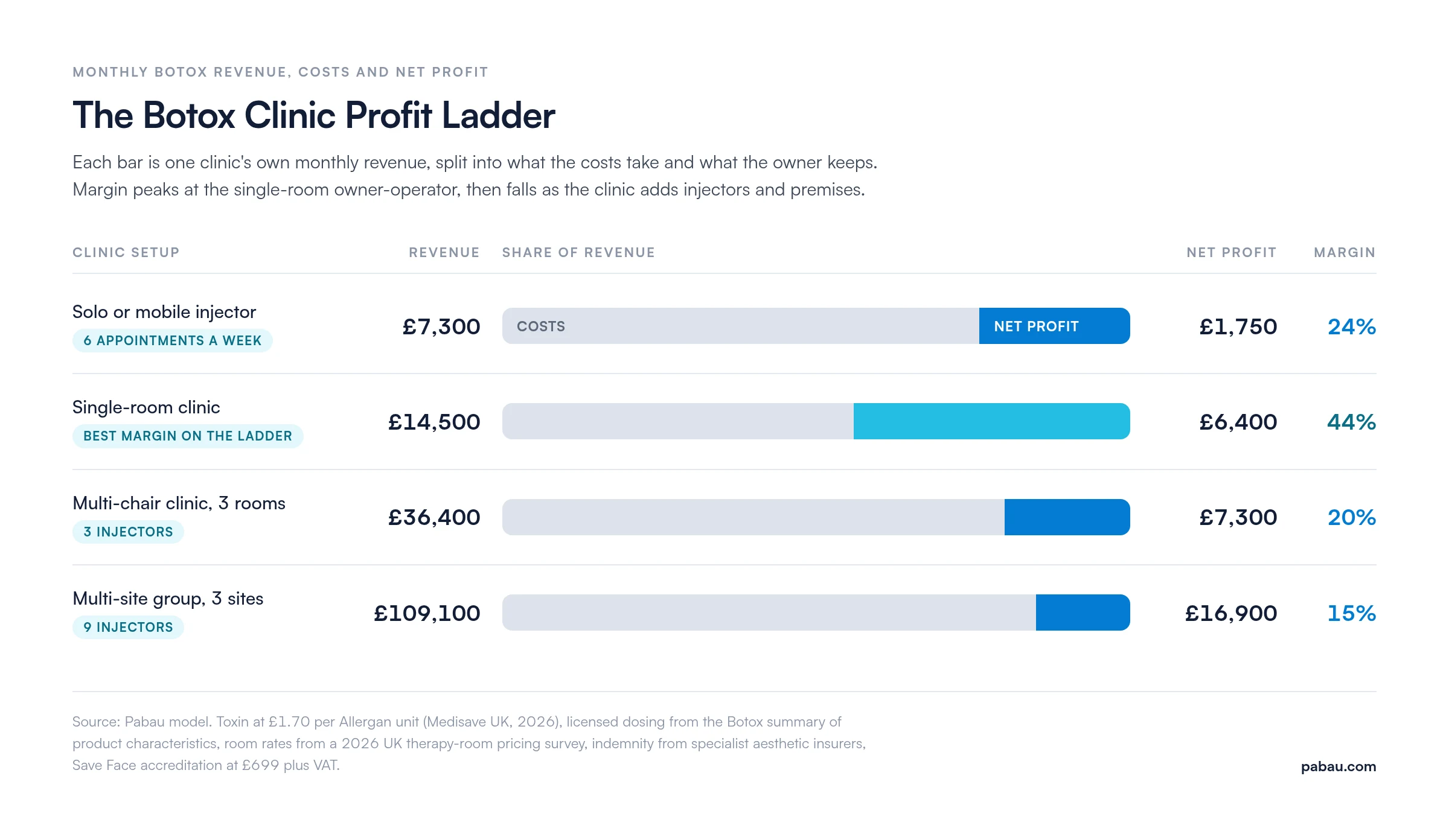
Here is where each cost line comes from, rung by rung.
The Botox summary of product characteristics sets the licensed doses. Glabellar lines take 20 units, crow’s feet 24 units, and forehead lines 20 units alongside the glabella. In total, treating all three in one visit is a 64-unit dose.
UK practitioner supplier Medisave lists a 100-unit Botox vial at £169.89 excluding VAT in 2026. That works out at £1.70 per Allergan unit, so a 64-unit three-area treatment carries £109 of toxin. A practice that logs units per zone on a printable Botox face chart can test that 64-unit figure against what its injectors deliver.
Then comes the part that separates the rungs. A reconstituted vial keeps for only 24 hours at 2°C to 8°C, so whatever you do not inject that day is a write-off.
Treat one three-area patient on a quiet Tuesday and the whole £169.89 vial is your product cost, not £109. By contrast, four toxin patients booked onto the same session share three vials instead of four, which cuts product cost per head by about a quarter.
That single scheduling habit is why our model charges £110 of toxin per treatment at solo scale and £75 at multi-site scale. Brand choice moves the line too. For instance, Medisave lists Bocouture at £155.69 per 100 units, which trims roughly 8% off the same unit dose.
Azzalure looks cheaper still at £165.09 for a 125-unit dual vial, but the comparison is not direct. In other words, Azzalure is dosed in Speywood units, which do not convert one-to-one with Allergan units.
Botulinum toxin is a prescription-only medicine, so somebody with prescribing rights has to authorize every treatment. A GMC-registered doctor can do that, as can an NMC-registered nurse holding an independent prescribing qualification.
In that case, an injector without that qualification pays a prescriber. Specifically, aesthetics industry guides put the fee at £25 to £50 per prescription and £20 to £45 per consultation, and our model uses £35 per patient.
Remote prescribing is not an option here. The NMC position statement from June 2025 rules it out for cosmetic procedures, and the GMC, GDC and GPhC hold the same line. So the prescriber has to be in the room, which costs diary time as well as a fee.
That makes the V300 independent prescribing qualification the highest-return training spend on the ladder. For example, tuition runs from £1,767 at Manchester Metropolitan University to £2,050 at the University of Cumbria for 2026 entry. A 26-appointment month spends £910 on prescriber fees, so the course clears in under three months.
Indemnity is the next fixed line. For example, specialist aesthetic insurers including Cosmetic Insure and Hamilton Fraser quote combined cover from around £450 to £500 a year. For a fuller picture, independent 2026 practitioner guides suggest budgeting £800 to £1,500 once toxins, fillers and laser sit on one policy.
Accreditation is voluntary but commercially useful. For example, Save Face charges £699 plus VAT for one clinic and one practitioner, and our table spreads that one-off fee across the first year. Similarly, the JCCP runs a separate practitioner and premises register, quoting its fees on application.
Neither register is a legal requirement, and neither is CQC registration for routine injectables. In practice, standard botulinum toxin, filler and laser treatments generally sit outside the CQC’s regulated activities in England. In addition, our aesthetics licensing scheme guide covers what the incoming rules would change.
England’s licensing scheme for non-surgical cosmetic procedures is written into the Health and Care Act 2022 but is not in force. Specifically, government confirmed a red, amber and green risk model in August 2025 without setting a start date. A premises license and a practitioner license are both coming, so treat them as a future cost.
Room hire is the other line that scales awkwardly. For example, a 2026 UK therapy-room pricing survey puts central London at £25 to £60 an hour. Meanwhile, day rates run £80 to £250, and monthly licenses £300 to £1,500.
| Monthly cost line | Solo or mobile | Single-room clinic | Multi-chair, 3 rooms | Multi-site, 3 sites |
|---|---|---|---|---|
| Toxin product | £2,900 | £4,700 | £10,400 | £29,300 |
| Independent prescriber fees | £900 | £0 | £0 | £0 |
| Room, rent and premises | £1,000 | £1,200 | £3,500 | £10,500 |
| Injector and support pay | £0 | £600 | £11,950 | £42,400 |
| Insurance and indemnity | £80 | £100 | £200 | £500 |
| Accreditation and registers | £70 | £70 | £150 | £400 |
| Marketing | £600 | £1,430 | £2,900 | £7,600 |
| Software, accounting and compliance | £0 | £0 | £0 | £1,500 |
| Total monthly costs | £5,550 | £8,100 | £29,100 | £92,200 |
| Monthly Botox revenue | £7,300 | £14,500 | £36,400 | £109,100 |
| Net profit | £1,750 | £6,400 | £7,300 | £16,900 |
| Net margin | 24% | 44% | 20% | 15% |
Three lines in that table are our assumptions rather than published figures. For instance, marketing runs at 8% of revenue, rising to 10% for the growing single-room clinic and easing to 7% at group scale. Similarly, injector pay sits at 40% commission in the multi-chair clinic and 35% across the group.
One line deserves a warning. At the solo and single-room rungs the net profit is the owner’s pre-tax income, because no salary line exists. From the multi-chair rung upward, injector pay is a cost, so the profit belongs to the business rather than to a person.
Two cost lines in that table are fixed whatever the diary looks like. In practice, the room rate and the prescriber fee get paid whether the chair was full or empty. So a quiet week hits the margin harder than the toxin price does.
Revenue per treatment is the wrong yardstick when rooms are the constraint. Instead, profit per chair-hour is the measure that decides which treatment deserves the slot, and toxin wins it.
| Treatment | Typical UK price | Product cost | Chair time | Gross profit per chair-hour |
|---|---|---|---|---|
| Botox, three areas | £280 | £109 | 30 min | £342 |
| Dermal filler, 1 ml | £250 | £85 | 45 min | £220 |
| Profhilo, one session | £280 | £195 | 30 min | £170 |
| Consultation, no treatment | £0 to £50 | £0 | 20 min | £0 to £150 |
Prices come from 2026 UK price guides. Similarly, product costs come from Medisave’s listed trade prices for Restylane Classic with lidocaine and Profhilo. Meanwhile, chair times are our assumption for an established patient.
Profhilo prices close to three-area Botox but carries a much higher product cost. So the higher-ticket treatment earns less per hour than the toxin appointment beside it.
The practical reading is to stop discounting toxin to fund a filler upsell. After all, toxin is the treatment paying for the room, and a free consultation slot is the least productive use of that room.
Clinic revenue is what patients pay the business, and a practitioner’s salary is one cost line inside it. As a result, mixing the two makes clinic turnover read like an owner’s take-home pay.
An employed UK aesthetic nurse averages £41,588 a year on Glassdoor, with a middle band of £28,492 to £60,703. By contrast, self-employed injectors report £60,000 to £140,000 or more, according to 2026 UK aesthetics training and salary guides.
Now compare that with the ladder. For example, our multi-chair clinic grosses about £437,000 a year from toxin alone and nets £88,000, which is close to a strong self-employed injector’s earnings. Even so, the owner carries the lease, the staff and the compliance on top.
So the question is which role you want. For the individual-pay picture we keep a separate breakdown of aesthetic nurse salary bands by experience and employment model.
Four levers move a Botox clinic’s margin further than a price rise does, and none of them needs a new treatment or a new room.
Treatment mix is the fifth lever, and the chair-hour table above sets the order. Specifically, add skin boosters and peels to fill quiet hours, not to displace toxin appointments.
Retention beats acquisition on this ladder, because marketing takes 8% to 10% of revenue in our model. For that reason, structured plans help, and our guide to med spa membership packages covers how to price a recurring toxin plan without discounting your best treatment.
Turnover is easy to read off a bank statement. Profit per chair-hour is harder, because the diary, the till and the stock spreadsheet each hold one piece of it. In short, joining those three up is the job of medical spa software built for injectable clinics.
In effect, practice management software like Pabau closes that loop by holding all three in one record. Pabau logs the units drawn from each vial against the treatment note, so the product cost lands on the appointment that consumed it.

Online booking and deposits protect the utilization side. Specifically, patients book and reschedule themselves, deposits sit against injectable slots, and reminders go out without anyone phoning round. As a result, fewer empty chairs is the fastest margin gain on the ladder.
Reporting then closes the loop. Pabau’s reports break revenue down by treatment and by practitioner, so you can see whether toxin or filler earned more per hour last month. Every Pabau subscription includes reporting, stock and online booking, so none of it sits behind a higher tier.
Owners comparing systems usually start with our roundup of the best aesthetic clinic software, then shortlist on stock tracking and reporting depth.

Pabau ties toxin units, deposits and payments to each appointment, so product cost and chair utilization land in one report. So you can price and rebook from figures rather than instinct.

The ladder carries an unwelcome message about growth. In practice, adding rooms and injectors raises what a Botox clinic makes and lowers what it keeps. In other words, expansion is a choice about absolute profit rather than margin.
On the first two rungs, the money is in vial use, prescribing rights and rebooking, not in a bigger lease. By contrast, above them, the margin you gave up bought capacity, and only tight scheduling defends it.
Either way, the number to track monthly is profit per chair-hour. Book a demo to see how Pabau reports Botox revenue, product cost and chair utilization for a UK aesthetic clinic.

Want the individual-pay picture instead? Aesthetic nurse salary breaks down employed and self-employed earnings by experience level.
Running laser alongside injectables? How much can a laser hair removal clinic make per month applies the same revenue-and-cost treatment to device work.
Wondering what the new rules will cost you? Aesthetics licensing scheme England explains the red, amber and green tiers and what applies today.
Planning next year’s treatment menu? Trending Botox and filler treatments covers the requests filling UK clinic diaries now.
Comparing systems to track all this? Best aesthetic clinic software ranks the platforms on booking, stock and reporting depth.
Yes. A single-room UK clinic in our model keeps about 44% of Botox revenue as net profit, or roughly £6,400 a month. Margin falls to about 15% at three-site scale, because injector pay and premises costs grow faster than revenue.
An employed aesthetic nurse in the UK averages £41,588 a year on Glassdoor, with a middle band of £28,492 to £60,703. By contrast, self-employed injectors report £60,000 to £140,000 or more. In short, those figures are personal earnings, not clinic revenue.
UK clinics charge £150 to £250 for one treatment area and £250 to £450 for three areas, based on published 2026 price lists. Alternatively, per-unit pricing runs £8 to £15 per unit. In addition, London and the South East sit 20% to 40% above the national average.
There is, provided the chair stays full. Botox returns about £342 of gross profit per chair-hour in our model, ahead of filler and skin boosters. In practice, empty slots and discarded vials turn a strong treatment margin into a weak business margin.
Aim for 40% or better as an owner-operator injector, and 20% once you employ other injectors and hold a lease. For example, our Botox Clinic Profit Ladder shows margin peaking at 44% at single-room scale and settling near 15% across three sites.