Free model waiver form + what it is and when your practice needs one
A model waiver form is a signed document that lets a healthcare practice use a p...

4
Last Updated: Sep 29, 2026

No UK law requires an aesthetics practice to appoint a medical director, and CQC does not define that title.
CQC registration follows the activity you perform, so purely cosmetic botulinum toxin, filler, peels and laser sit outside it.
Where registration does apply, CQC asks for a registered manager and a nominated individual instead.
GMC guidance requires a face-to-face assessment before prescribing injectable cosmetic medicines, and bans remote prescribing.
The Section 180 licensing scheme is not in force as of August 2026, and no commencement date has been set.
Medical director aesthetics clinic UK rules come down to a single distinction: the Care Quality Commission regulates activities, not job titles. So no UK law requires a non-surgical aesthetics practice to appoint a medical director.
Where CQC registration genuinely applies, the regulator asks for two named roles instead. Those roles are the registered manager and the nominated individual. Neither one carries the title of medical director.
This guide sets out the CQC trigger test, the four activities that pull an aesthetics practice into registration. Beyond that, the sections below also cover who may prescribe and what the role costs to fill. Finally, the last section covers where the Section 180 licensing scheme stands as of August 2026.
CQC does not require a medical director, and no UK law does either. Instead, the regulator’s own statutory roles are the registered manager and the nominated individual.
Those two roles only appear once your practice carries out a CQC-regulated activity. In other words, registration is activity-based. Your treatment menu decides it, not the qualifications or the titles of the people delivering the treatments.
Most non-surgical cosmetic work sits outside the regulated activities. For example, botulinum toxin, dermal filler, chemical peels and laser or IPL treatments given for purely cosmetic reasons do not trigger registration, whoever performs them. That position comes from CQC’s own guidance on cosmetic procedures.
Four activities change that answer. So run your price list through them before you assume either way.
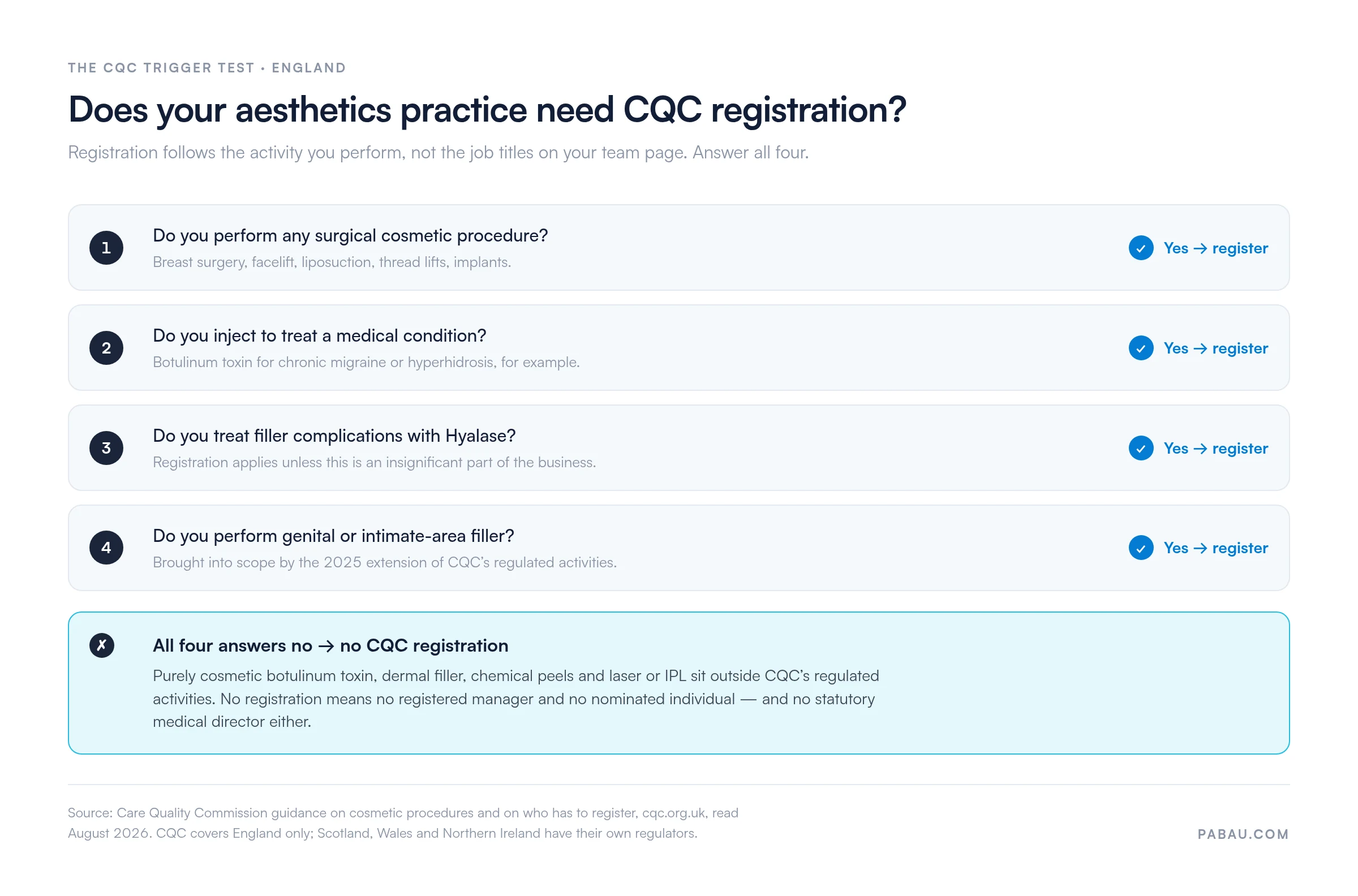
Call it the CQC trigger test. Answer all four questions no and your practice stays outside registration. There is then no registered manager to appoint, and no statutory role for a medical director to fill. Otherwise, answer any one of them yes and registration comes first, before you think about titles.
The table below runs the test across a typical treatment menu, with the point that flips each answer.
One more limit is worth knowing. CQC covers England only. Meanwhile, a practice in Scotland registers with Healthcare Improvement Scotland, and one in Wales with Healthcare Inspectorate Wales.
In Northern Ireland the regulator is the Regulation and Quality Improvement Authority. For more detail, our guide to the CQC’s role covers registration, the fundamental standards and how an inspection runs.
A medical director owns clinical governance, which puts prescribing, supervision, complications, training and regulatory compliance under one accountable clinician.
In practice, the conventional scope of the role covers six areas.
None of that scope comes from a statute. The role is a job description the industry settled on. That is why two practices can both advertise a medical director and mean different things by it.
A medical director’s sign-off is worth what the records behind it can show. In UK aesthetics practices we onboard, prescribing records, consent forms and before-and-after photos usually live in three separate places. As a result, pulling one patient’s history together for a complaint takes an afternoon.
Four kinds of prescriber can cover an aesthetics practice: a doctor, a dentist, a V300 independent nurse prescriber, or a pharmacist independent prescriber. Each one prescribes only within their own competence and scope of practice, which is where the differences start to bite.
Two rules cause most of the trouble. First, GMC guidance on prescribing requires a physical examination before anyone prescribes an injectable cosmetic medicine. The same guidance also bans remote prescribing for this category. So a phone call, a video consultation or a completed form does not meet the standard.
Patient Group Directions do not solve it either. A PGD lets a named professional supply or administer a medicine without an individual prescription. However, GMC guidance does not support that route for purely cosmetic botulinum toxin. A PGD is acceptable only where a practitioner is treating a medical condition such as hyperhidrosis or migraine.
The GMC enforces this. In one fitness-to-practise case, the GMC struck off a doctor after they remotely prescribed botulinum toxin in bulk for nurse trainees through a training company. The arrangement looked efficient on paper, but it cost the doctor their registration.
Delegating the injection itself is fine. A doctor can prescribe and a nurse can administer, provided the doctor carried out the face-to-face assessment before writing the prescription. In short, job title and prescribing rights are separate questions. Our guide on a nurse as medical director walks through that arrangement, using US terminology.
No independent body publishes a salary benchmark for this role, so the arrangement you choose sets the cost, rather than a going rate.
We went looking for one. The GMC, CQC and the recognized UK medical recruiters publish nothing specific to aesthetics medical directors. Meanwhile, the salary bands circulating on industry blogs carry no survey, no sample and no source, so treat them as anecdote rather than a benchmark.
What you are really choosing between is four structures.
Inside each structure, four factors move the number.
So ask every candidate to quote against a written scope. After all, two quotes for a medical director are not comparable unless both name the same duties.
The government plans a licensing scheme for non-surgical cosmetic procedures in England, but it is not yet in force, and the government has not set a commencement date.
Section 180 of the Health and Care Act 2022 has itself been in force since July 1, 2022. The section gives the Secretary of State power to create a licensing regime for injections and for light, electricity, cold or heat treatments. However, Section 180 sets out no detail of its own.
The consultation closed in October 2023. Later, the government’s response, published in August 2025, confirmed a three-tier red, amber and green risk model with separate practitioner and premises licences.
Local authorities would administer green and amber tiers. By contrast, the scheme would restrict red-tier procedures to qualified healthcare professionals at CQC-registered premises.
One line in that response matters here. Specifically, amber-tier procedures performed by non-healthcare practitioners would require relevant oversight by a named regulated healthcare professional holding an accredited aesthetics qualification.
That wording is the closest UK law has come to a medical-director requirement. Read it carefully though. Still, the scheme names an individual overseer with a stated qualification, not a corporate job title on a website.
As of August 2026, the government has laid no regulations. Secondary legislation still has to clear the affirmative parliamentary procedure, and the government expects a transition period after that. So any page telling you the licensing scheme applies to your practice today is wrong.
Appointing a medical director is a hiring decision with a governance job attached. Verify the clinician first, then negotiate the fee against a scope you have written down.
Only the first of those is a hard check. In fact, the GMC register takes a minute to search, tells you whether the licence is current, and shows any conditions attached to it.
BCAM and the Joint Council for Cosmetic Practitioners, known as the JCCP, can point owners toward clinicians already working in the field.
UK industry events such as ACE and CCR are where most of these introductions happen in person. From there, our walkthrough on how to hire a medical director covers the interview and onboarding steps in more depth.
There is no standard contract for this role, so the agreement is where practices resolve the ambiguity. Typically, they cover six points.
A medical director signs off the protocols, and the records are what prove staff followed them. Practice management software like Pabau keeps that evidence attached to the patient instead of scattered across folders, inboxes and phones.
Consent forms, medical questionnaires and treatment notes sit on one client record. Likewise, before-and-after photos attach to the same timeline rather than a personal camera roll. Every entry carries who made it and when, so a complaint review reads as one continuous history.
Staff permissions decide who can perform, record and sign off what. Your medical director can review a practitioner’s treatment notes without the front desk seeing clinical detail. Meanwhile, stock movements log batch numbers and expiry dates against the treatment note, which is exactly what a complication review needs.
Pabau is medical spa software built for aesthetics rather than adapted from a salon booking tool, and every subscription includes every feature. If you are still choosing a platform, our comparison of the best aesthetic clinic software sets out where the options differ on clinical records.

Pabau ties consent forms, treatment notes, prescribing records and before-and-after photos to a single client timeline, with a stamp on every entry. Your medical director can audit a practitioner’s work without chasing paper across three systems.

Most UK practices doing purely cosmetic, non-surgical work need no CQC registration and no statutory role at all. For those practices, appointing a medical director is a commercial and clinical decision rather than a legal one. Even so, the title on its own proves nothing to a regulator.
That still leaves a strong case for the role. A named clinician who owns prescribing, complications and protocols is how a practice avoids learning governance the hard way. So price the role against the scope you wrote, not against a figure you read on a blog.
Section 180 changes that math the day it commences, so keep the licensing scheme on your watch list. Book a demo to see how Pabau keeps consent, prescribing records and treatment notes audit-ready for a UK aesthetics practice.

Auditing your own compliance this quarter? The ultimate medical spa requirements checklist turns the governance work into a list you can work through.
Operating in the US as well? Medical director for med spa Texas shows how different the rules get once state delegation law applies.
No independent source publishes an average medical director salary for UK aesthetics. The GMC, CQC and recognized medical recruiters have no benchmark for this specific role. Pay depends on the arrangement: prescribing sessions, part-time governance, a full-time post, or an equity share. So ask candidates to quote against a written scope rather than a national average.
The new law on aesthetics in the UK is Section 180 of the Health and Care Act 2022. Section 180 enables a licensing scheme for non-surgical cosmetic procedures in England. In August 2025, the government confirmed a red, amber and green risk model. However, the scheme is not in force as of August 2026, and the government has not set a commencement date.
A practice giving botulinum toxin for purely cosmetic reasons does not need CQC registration. However, treating a medical condition, such as chronic migraine or hyperhidrosis, triggers registration. Surgical procedures, intravenous treatment and routine complication work with Hyalase also bring a practice into scope.
Yes. The medical director title is not exclusive to doctors, and a V300 independent nurse prescriber can prescribe within their own competence. However, where CQC registration applies, the regulator assesses the registered manager’s fitness rather than the internal job title.